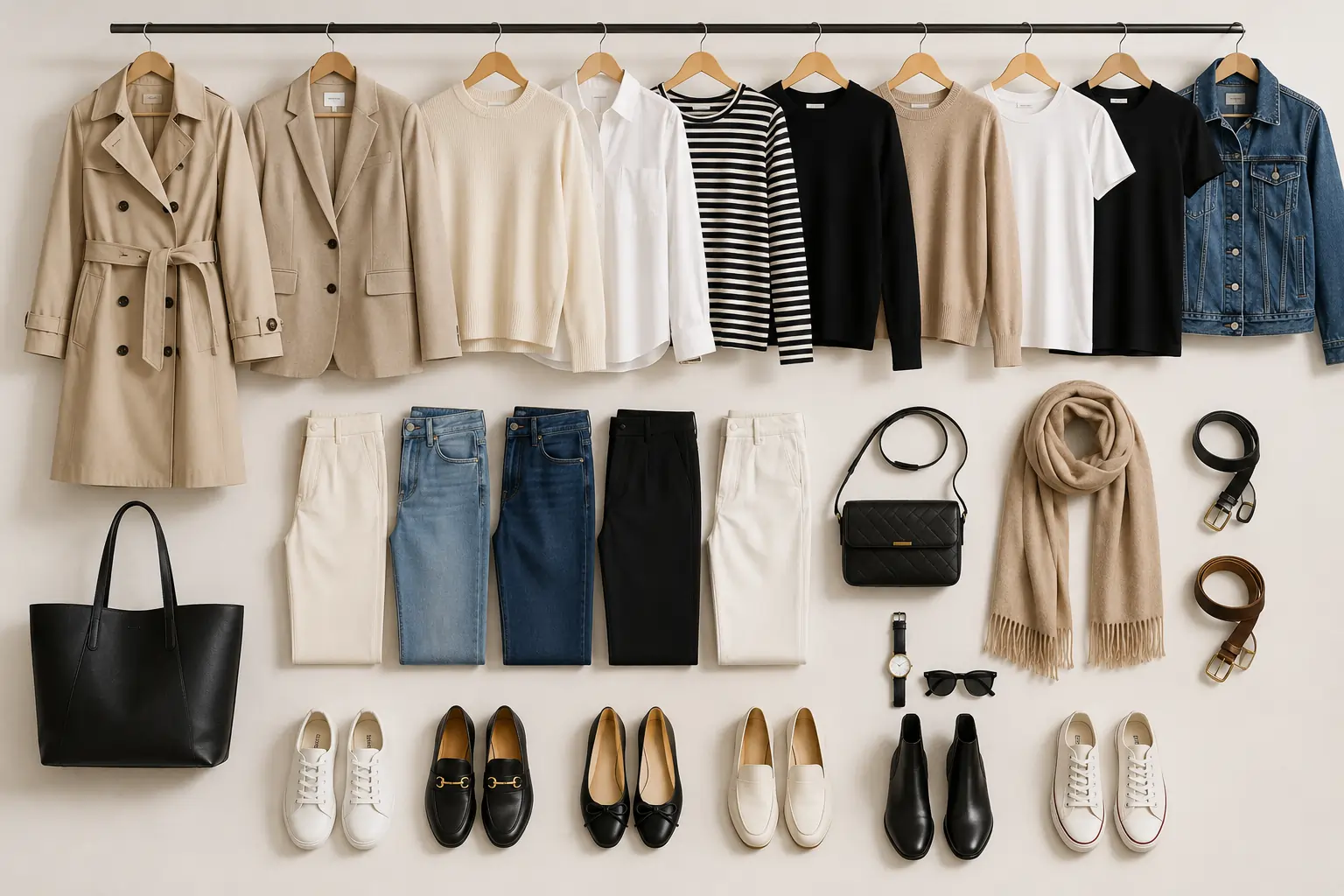
Somewhere between the overstuffed wardrobe and the extreme minimalist who owns seven identical grey t-shirts, there is a wardrobe that actually works. The 33-piece capsule wardrobe sits close to that middle ground. It is specific enough to give you a target, flexible enough to adapt to your life, and small enough to eliminate the daily decision fatigue of choosing from 80 items — most of which you never wear anyway.
This guide breaks down exactly how a 33-piece wardrobe works across all four seasons, what those 33 items should actually be, how to adapt the framework for different climates and lifestyles, and why the number 33 is more of a useful constraint than a rigid rule. If you are starting from scratch or working with a limited budget, the companion guide on building a capsule wardrobe without starting over covers the audit and shopping process in detail. This guide focuses on the specific architecture of the 33-item version.
Where the 33-Piece Rule Comes From
The 33-item capsule wardrobe was formalised by Courtney Carver through her Project 333 challenge, which she launched in 2010. The original premise: dress with 33 items or fewer for 3 months at a time, rotating your wardrobe seasonally. Jewellery, underwear, and workout clothes were excluded from the count.
The challenge attracted hundreds of thousands of participants globally and spawned a book, a movement, and a significant portion of the minimalist lifestyle content that dominated the 2010s.
The number 33 is not scientifically derived. It is psychologically useful. It is small enough to feel like a genuine constraint — forcing curation — and large enough that most people can dress for their actual lives without feeling like they are in a uniform. It is also divisible into logical sub-categories in a way that rounder numbers like 30 or 40 are not.
The Case for a Seasonless Capsule
The original Project 333 framework worked by rotating seasonal capsules — a different 33 items for winter, another set for summer, and so on. That approach works well in climates with dramatic seasonal swings.
But a growing body of capsule wardrobe thinking has moved toward the seasonless capsule: a core collection of 33 items selected specifically because they work across seasons, supplemented by a small number of seasonal additions when genuinely needed.
The seasonless approach has several advantages over seasonal rotation:
- Less storage management — no bins of off-season clothes to rotate twice a year
- More cost-effective — you are buying fewer total items across the year
- Better for transitional weather — the in-between months (late summer, early spring) are where most wardrobes fall apart; a seasonless capsule handles them naturally
- Works better in climates with mild or unpredictable seasons — most of India, for instance, does not have four distinct seasons that warrant four distinct wardrobes
The trade-off is that it requires more careful item selection. A seasonless capsule only works if the items you choose actually span temperature ranges — which means prioritising layering pieces, breathable fabrics, and mid-weight options over extremes.
The 33 Items: A Complete Seasonless Framework
What follows is a seasonless 33-item framework. It is not the only valid version — your occupation, climate, and lifestyle will all require adjustments — but it is a solid starting point that works for a broad range of people. Use the free Capsule Wardrobe Planner below to customise it to your profile and track which slots you have already filled.
Bottoms 6 items
| Item | Why it earns its place |
|---|---|
| Dark slim or straight jeans | Transitions from casual to smart-casual; works across most temperatures with layering |
| Mid-wash or lighter jeans | The contrast wash gives you variety without adding a different silhouette |
| Tailored trousers (neutral — navy, grey, or camel) | Elevates any outfit; works for work, dinners, and most occasions |
| Casual trousers or chinos | A more relaxed alternative to jeans; linen or cotton blends work seasonlessly |
| Shorts (one pair) | For warm weather; keep to a neutral or versatile colour |
| One dress or skirt (if applicable to your style) | An entire outfit in one item — high efficiency in a capsule context |
Tops 9 items
| Item | Why it earns its place |
|---|---|
| White or cream base t-shirt | Pairs with everything; works under layers and alone |
| Black or charcoal t-shirt | The dark counterpart — same versatility, different mood |
| Grey or neutral t-shirt | Third base layer; gives you genuine variety at the simplest level |
| Classic button-down shirt (white or light blue) | Casual open over a t-shirt or tucked and buttoned for smart occasions |
| Second shirt in a pattern or colour | One pattern or colour adds life to the collection without creating chaos |
| Fine-knit top or long-sleeve tee | For cooler days; more polished than a sweatshirt, lighter than a knit |
| Striped or simple graphic tee (one) | Optional personality piece; keep it clean and not too logo-heavy |
| Linen or lightweight blouse (if applicable) | Hot weather solution that still looks intentional |
| Formal or elevated top for occasions | One step up from your daily tops for events, dinners, and work presentations |

Layers and Outerwear 7 items
This is where the seasonless capsule lives or dies. Layering pieces are what make a small wardrobe work across temperature ranges — not replacing items, but stacking them differently.
| Item | Why it earns its place |
|---|---|
| Light cardigan or open knit | The transitional workhorse — worn over a tee in autumn, over a shirt in spring |
| Crew or v-neck jumper (mid-weight) | The cooler-weather staple; works over collared shirts and under outerwear |
| Denim jacket or shirt jacket | Versatile mid-layer; feels casual without being sloppy |
| Blazer (neutral) | The single most powerful formality-adjuster in a capsule wardrobe — elevates any outfit by one register |
| Light rain jacket or trench | Weather protection that does not sacrifice the look; keeps outfits intact in variable weather |
| Warm coat or puffer (climate-dependent) | A heavy outerwear option for genuinely cold days; may be replaced by a second lighter layer in warm climates |
| Sweatshirt or hoodie (one) | Comfort layer for weekends, travel, and low-key days |
Shoes 5 pairs
| Item | Why it earns its place |
|---|---|
| Clean white or neutral sneakers | The everyday casual default; pairs with almost everything |
| Leather or leather-look loafers or flats | Smart-casual bridge; elevates jeans without feeling overdressed |
| Clean boots (ankle or Chelsea) | The autumn and winter workhorse; adds edge and warmth |
| Sport or running shoes (if active) | Separates workout from daily wear; keeps your good shoes in better condition |
| Sandals or one open-toe option | Hot weather necessity; keep to a simple, neutral design |
Accessories 6 items
Accessories are where many capsule wardrobe guides get confused. Project 333 originally excluded jewellery from the count, but here they are included with a practical limit — because accessories are what make 33 items feel like significantly more.
| Item | Why it earns its place |
|---|---|
| One everyday bag (tote, backpack, or crossbody) | Carries everything; works across most outfits and occasions |
| One occasion or going-out bag | Smaller, more polished — for evenings and events |
| One belt (neutral — black or tan) | The functional detail that finishes an outfit |
| A watch or simple bracelet | A single piece that adds intention without clutter |
| Scarf or light wrap | Doubles as warmth and styling — one of the most versatile accessories in a capsule |
| Sunglasses | Functional and finishing; one pair in a classic shape |
How the 33 Items Work Across Seasons
The logic of a seasonless capsule is that layering — not replacing — is how you adapt. The same 33 items behave very differently across the year depending on which pieces are active and how they are combined.
The shorts, sandals, linen or lightweight tops, and light cardigan do the heavy lifting. The blazer works on warm evenings. The sneakers are on daily rotation. Heavier layers sit in your wardrobe but are not in daily use.
This is where the capsule shines. The cardigan, denim jacket, and fine-knit top come into their own. Jeans re-enter rotation. Boots replace sandals. The same tops work with the addition of a layer.
The jumper, coat, and scarf take over. The blazer goes under the coat for extra warmth. Boots are the default. Lighter layers work as mid-layers under the coat rather than outer layers.
The months that break most wardrobes: cold mornings, warm afternoons. A capsule built around layering handles this naturally. You leave the house in the jumper and the denim jacket and take the jacket off by noon.
Adapting the 33 for Your Climate
A 33-piece capsule looks different in a tropical city versus a northern climate versus a city with four distinct seasons. The framework is the same; the specific items vary. The 33 items are a budget — how you spend that budget depends on where you live.
| Climate type | How to adjust |
|---|---|
| Hot year-round (tropical) | Replace 2 outerwear slots with more lightweight tops and breathable bottoms. Fewer layers, more breathable fabrics (linen, cotton). Drop the heavy coat entirely — use that slot for a second pair of sandals or a light kimono-style layer. |
| Cold year-round (northern climates) | Invest more of your item count in quality outerwear, knitwear, and thermal layers. The sandals and shorts slot may go to a second heavy layer or insulated mid-layer. |
| Four distinct seasons | The original rotating capsule model works well here. A core of 25 seasonless items plus 8 targeted seasonal swaps per season gives you variety without doubling the wardrobe. |
| Mild and variable (maritime climates) | Prioritise layering and weather-resistant outerwear. A rain jacket earns permanent resident status. Extreme-weather items (heavy puffer, sandals) are less necessary and can be swapped for more layering flexibility. |

Adapting the 33 for Your Lifestyle
Climate is one variable. The other is what your daily life actually looks like. A 33-piece capsule for someone who works from home looks different from one for someone in a formal office, different again from someone who travels frequently.
Work-from-home
The formality ceiling drops. You need fewer blazers and tailored pieces, and more high-quality comfortable basics. The ratio shifts toward knits, soft trousers, and elevated casualwear. One or two smart pieces for video calls and the occasional in-person day.
Shift: Swap one formal trouser and one smart top for a second casual trouser and a more comfortable jumper or sweatshirt.
Office or formal environment
The proportion of smart pieces increases. You may want two tailored trousers instead of one, two button-down shirts instead of one, and the blazer earns daily rotation. Casual items compress into the weekend slots.
Shift: Swap the denim jacket for a second blazer or a smarter mid-layer. Reduce the shorts to half a slot — one very versatile casual bottom instead of a dedicated weekend bottom.
Frequent traveller
Wrinkle resistance and packing efficiency become key selection criteria. Items that roll without creasing, dry quickly, and look reasonable after a day in a suitcase are worth prioritising over aesthetics alone. The 10-item travel capsule is the compressed version of this thinking — a 33-item wardrobe at home with a 10-item subset that travels.
Shift: Prioritise merino wool basics (travel-friendly, odour-resistant, temperature-regulating), a packable rain jacket over a structured coat, and shoes that walk all day without complaint. A single bag that works as carry-on and daily bag saves a slot.
Active lifestyle
If your daily life includes significant physical activity, the 'workout clothes excluded' convention starts to strain. If you are wearing gym clothes five days a week, they are part of your active wardrobe. Consider allocating 4 to 5 of your 33 slots to quality activewear and treating it as a sub-capsule within the main one.
Building Your 33 Without Buying 33 New Things
The single most important rule of capsule wardrobe building: start with what you own. Most people already have the skeleton of a functional capsule in their wardrobe. The problem is that it is buried under items that do not belong.
- Do the full wardrobe audit first — pull everything out, sort by what you actually wear versus what occupies space
- Identify how many of your 33 slots are already filled by existing items you wear regularly
- Map the gaps — specific items that would make your existing wardrobe work better, not just add to it
- Shop for gaps only, with a written list — the discipline is in the specificity of the brief
- Add one or two items at a time, not all at once — this forces you to test whether each new item actually integrates with what you have
Most people find they need to buy 5 to 10 targeted pieces to complete a capsule from an existing wardrobe — not 33. The marketing narrative that building a capsule wardrobe requires starting over and purchasing a whole new collection is both wrong and expensive. The full process — audit, gap analysis, deliberate addition — is covered in the capsule wardrobe budget guide.
Common Mistakes With the 33-Item Framework
Buying all neutrals and no personality
A common overcorrection. All-neutral capsule wardrobes look great in flat-lay photos and feel flat to wear. One or two pieces with genuine character — a colour you love, a print that is distinctly you, a texture that is more interesting than plain jersey — make the whole capsule feel like yours rather than a uniform. The second shirt slot (patterned or coloured) and the graphic tee slot exist specifically for this purpose.
Treating the number as sacred
The 33 is a constraint, not a law. If your life genuinely requires 35 items to function well, 35 is your number. If you feel comfortable and well-dressed at 28, 28 is your number. The discipline is in counting and being honest about what earns a slot — not in hitting a specific integer.
Rushing to fill all 33 slots
A half-filled capsule of things you love is more useful than a full capsule containing things you settled for. Leave slots empty rather than filling them with items that only partially work. The right piece will present itself; a wrong piece bought to fill a gap will sit unworn and create the same noise you were trying to eliminate.
Not accounting for the actual shape of your week
Build your 33 around the life you live, not the life you imagine. If you work from home four days a week, do not allocate half your capsule to formal office wear. If you rarely attend formal events, one elevated outfit is enough. The capsule works when it reflects reality, not aspiration.
The 33 Items at a Glance
| Category | Items | Count |
|---|---|---|
| Bottoms | Dark jeans, lighter jeans, tailored trousers, casual trousers/chinos, shorts, dress/skirt | 6 |
| Tops | 3 base tees (white, black, grey), button-down shirt ×2, fine-knit top, graphic tee, linen/lightweight top, occasion top | 9 |
| Layers & Outerwear | Light cardigan, mid-weight jumper, denim/shirt jacket, blazer, rain jacket/trench, warm coat, sweatshirt | 7 |
| Shoes | Clean sneakers, loafers/flats, boots, sport shoes, sandals | 5 |
| Accessories | Everyday bag, occasion bag, belt, watch/bracelet, scarf, sunglasses | 6 |
| Total | 33 | |
Wardrobe edits are one of the most common jobs professional organizers take on. If you'd like to learn how they approach closets and client decisions in a structured way, our free CPO® Exam Prep course covers it as part of the Certified Professional Organizer exam outline.
Why 33 Works — and Why It Might Not Be Exactly Your Number
The 33-item capsule wardrobe works because it forces the central decision of any wardrobe edit: what is actually worth owning?
With unlimited space and no count, most people avoid that decision entirely. Things accumulate. The wardrobe grows. Getting dressed becomes a negotiation with a pile of options rather than a simple choice from a collection you trust.
With a 33-item limit, every new item requires a reckoning. Something has to earn its place. Something else has to leave when something new arrives. The discipline is in the counting, and the counting is what makes the system work.
Whether your final number is 28 or 38 matters far less than the practice of treating your wardrobe as a curated collection rather than an accumulation. Start there. The right number will reveal itself.
If the wardrobe audit reveals that the broader home needs the same treatment, the 7-Day Home Declutter Sprint gives you a room-by-room 7-day structure — same edit-first logic, applied to every space in the house.
If you travel regularly, the same capsule logic applies in its most compressed form to packing — the 10-item travel capsule takes the same item-thinking framework and applies it to a single carry-on bag, with specific rules for fabrics, combinations, and packing efficiency. The two guides work as a system: 33 at home, 10 on the road.
Treating your wardrobe as a curated collection rather than an accumulation is really one specific application of a much broader habit — what slow living actually means extends the same "quality over quantity" thinking into food, mornings, and how you spend your attention generally.