
Search "slow living" and you'll mostly find linen dresses, cottages with wildflower gardens, and someone kneading bread in soft window light. It's a beautiful aesthetic. It is also not the thing itself — and treating it as the thing itself is exactly why so many people try slow living for a week, decide it requires a life they don't have, and quietly give up.
Slow living is not an aesthetic, a location, or a income bracket. It's a practical response to a specific, common problem: living at a pace fast enough that you are rarely actually present for any of it. That problem doesn't require a cottage to fix. It requires a handful of deliberate choices you can start making today, in the ordinary, busy life you already have.
Here's what slow living actually means, where the idea came from, and a realistic way to start this week — no relocation required.
What Slow Living Is Not
Before defining what it is, it's worth clearing away what it isn't, because the misconceptions are exactly what make the idea feel unreachable.
- Doing everything at a literally slower pace
- Quitting your job or downsizing your ambitions
- Moving somewhere rural or quiet
- A specific aesthetic — linen, ceramics, a particular kind of kitchen
- Reserved for people with fewer responsibilities than you
- The opposite of productivity
- Choosing your pace deliberately, task by task
- Doing one thing at a time, with attention, instead of several things poorly
- Removing unnecessary urgency from things that don't require it
- A set of practices, applicable in any home, job, or city
- Compatible with a demanding job, small children, or a full calendar
- Often more productive, because single-tasking beats task-switching
If you have a habit-tracking system for anything else in your life, the free Habit Tracker works well for logging your slow living practices too — one or two small daily checkmarks is a realistic, trackable target.
Where Slow Living Actually Came From
The idea has a specific, traceable origin — it wasn't invented by a lifestyle brand. In 1986, Carlo Petrini protested plans to open a McDonald's near the Spanish Steps in Rome, using the phrase "slow food" in deliberate contrast to fast food. That protest grew into the Slow Food movement, an organised response to the standardisation of eating.[1]
Journalist Carl Honoré brought the broader concept into the mainstream with his 2004 book In Praise of Slowness, extending "slow" from food into work, parenting, travel, and daily life generally.[1] Honoré draws a distinction worth keeping: "good slow" is consciously decelerating to do something at the pace that actually produces a better outcome — a considered decision, a proper meal, a real conversation. "Bad slow" is involuntary delay you have no control over, like a queue or a traffic jam. Slow living is entirely about the first kind.
Why It's Having a Moment Right Now
The renewed interest in slow living isn't a coincidence of algorithm-friendly aesthetics — it tracks fairly directly against how burned out people currently report feeling. A late-2025 US workforce survey found that 55% of employees were currently experiencing burnout, and other recent workplace research puts burnout symptom rates even higher, particularly among younger workers.[2] Slow living has become popular in direct proportion to how unsustainable constant acceleration has started to feel.
That context matters because it reframes the whole idea: slow living isn't an indulgence for people with time to spare. It's closer to a corrective — a specific, learnable set of counter-habits for a culture that defaults to speed, multitasking, and constant availability as the baseline.
The Core Principles of Slow Living
Strip away the aesthetic and slow living comes down to four repeatable principles, each of which works independently of the others.
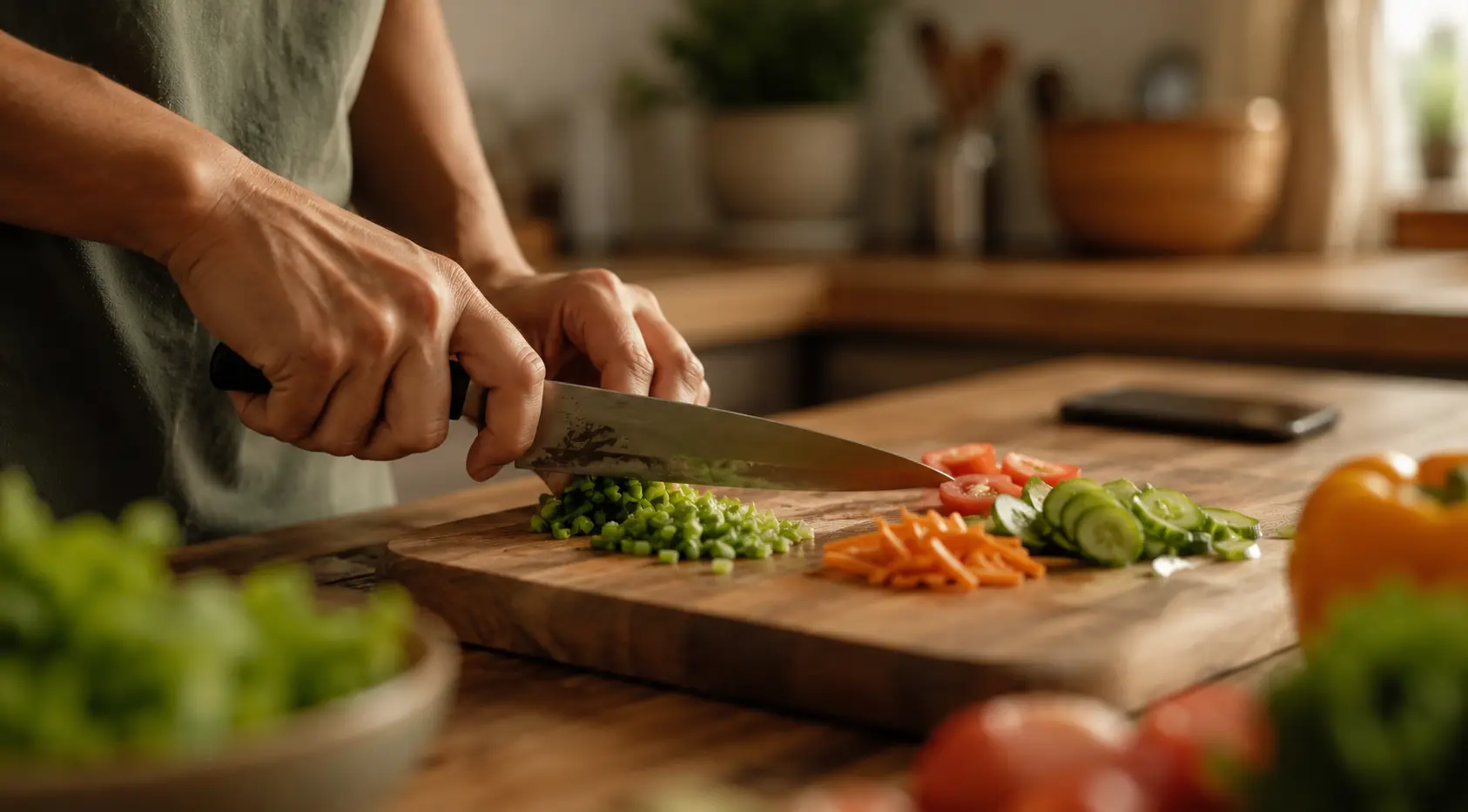
Slow Living vs Laziness: The Real Difference
This is the objection slow living runs into most often, and it deserves a direct answer rather than a dismissal. Laziness is the avoidance of effort — doing less because doing more feels unpleasant, with no particular intention behind the choice. Slow living is a redirection of effort, not a reduction of it. You are still cooking the meal, still doing the work, still showing up for the conversation — you are simply doing one of those things at a time, with attention, instead of three of them badly at once.
In practice, many people who adopt slow-living habits report getting more done, not less. Single-tasking is measurably more efficient than constant task-switching, because every switch between tasks carries a real cognitive cost — the mental residue of the previous task lingers and reduces performance on the next one. A slower, more deliberate pace on individual tasks can produce a faster, cleaner result across the day as a whole.
How to Start This Week: A 7-Day Starter List
The fastest way past the "this feels unreachable" barrier is to try one small, specific practice a day for a week rather than attempting a full lifestyle change at once. Each of these takes under 15 minutes and needs nothing you don't already own.
Pick one meal today — any one — and eat it without your phone anywhere in reach. Notice how much longer it feels, even though it isn't.
No podcast, no calls, no scrolling. Just the walk or the commute, attention on what's actually around you.
Choose one task you'd normally rush — making tea, folding laundry, watering plants — and do it at half your usual speed, on purpose.
Put screens away 10 minutes before you'd normally reach for one at the end of the day. Sit with whatever that gap feels like.
Decline one request, invitation, or obligation today that doesn't genuinely matter to you. Notice the space it opens up.
Add five unhurried minutes before checking your phone — tea, stretching, sitting by a window, nothing productive required.
Look back at the six practices. Pick the two that felt most worth keeping, and build those into next week rather than starting all seven again.
If mornings are where you want to build this further, the free Morning Routine Mastery course and the 30-Day Morning Routine Reset both build directly on Day 6 above — a slower first 30 minutes of the day tends to set the tone for everything after it.
Slow Living Across Different Areas of Life
Once the core principles click, they apply almost anywhere. Here's how they translate across the areas people ask about most.
| Area | What it looks like | Where to go deeper |
|---|---|---|
| Food | Cooking as an unhurried process, not a rushed obligation; eating without screens; fewer, better ingredients over convenience-first choices | Slow Food's original focus; see also the zero-waste kitchen starter guide |
| Home | Fewer possessions, chosen deliberately, with visible space between objects rather than a full room | Room-by-room declutter guide, the seasonal home reset, and the one in, one out rule for keeping it that way |
| Wardrobe | A smaller, considered rotation instead of constant new purchases and a closet full of unworn options | The 33-piece capsule wardrobe |
| Digital life | Deliberate, bounded screen use instead of reflexive checking; single-tasking instead of tab-switching | 7-Day Digital Detox Challenge or the fuller digital minimalism framework |
| Mornings | An unhurried start before the day's demands begin, rather than waking directly into urgency | Morning Routine Mastery course |
| Consumption | Buying less, choosing better, resisting convenience-driven impulse purchases | Sustainable living on a budget and mindful consumption |
Curious where the friction in your own life is actually concentrated? The Minimalism Score Calculator is a free 20-question assessment across home, digital life, wardrobe, and lifestyle that shows exactly where to start — useful both before you begin and a few weeks after, to see what's actually held.
Common Mistakes When Starting
- Trying to change everything at once. Seven new habits on day one is a recipe for quitting by day three. Start with one, as in the list above, and add the next only once the first feels automatic.
- Treating it as a purchase. New ceramics, a new journal, a "slow living" candle — none of these are the practice. The practice is entirely behavioural, and costs nothing.
- Confusing it with total inactivity. Slow living is compatible with an ambitious, busy life. It changes how you move through tasks, not how many you take on.
- Giving up because it doesn't fit a rural, low-obligation life. Most of the aesthetic imagery around slow living implies a life most people don't have. The actual principles were designed to work inside an ordinary one.
- Expecting an instant transformation. The felt difference tends to build over three to four weeks of small, repeated practice — not a single phone-free breakfast.
Final Thoughts
Slow living was never about moving slowly through life. It's about being present for the life you're already moving through — which, for almost everyone, means changing how you do a handful of ordinary things: how you eat, how you commute, how you spend the first ten minutes of your morning and the last ten of your evening.
None of that requires a different life. It requires picking one practice from the list above and trying it today. The cottage, the linen, the wildflowers — those were never the point. Attention was.
Slow living isn't the absence of speed. It's the presence of choice — deciding, deliberately, which parts of your day deserve your full attention, instead of letting urgency decide for you.
If decluttering your physical space feels like a natural next step alongside this, the room-by-room declutter guide and the 7-Day Home Declutter Sprint both build directly on the "quality over quantity" principle covered above.
Sources
[1] Honoré, C. (2004). In Praise of Slowness: How a Worldwide Movement Is Challenging the Cult of Speed. HarperOne. Movement origin: Slow Food, founded by Carlo Petrini in Italy, 1986. See background on Carl Honoré.
[2] Eagle Hill Consulting. (November 2025). Workforce Burnout Survey. Available at: eaglehillconsulting.com