You reach for your phone before you've decided to. You open an app, scroll for a few minutes, and land back on the home screen with no memory of what you were looking for. You feel, in some low-grade but persistent way, overwhelmed — not by any one thing, but by the sheer number of tabs, notifications, apps, and inputs competing for a slice of your attention at every hour of the day.
The instinctive response is to frame this as a willpower problem — you should be more disciplined, check your phone less, delete the apps. That framing rarely sticks, because it treats the symptom without addressing the actual structure underneath it: most people have never deliberately decided which technologies deserve a place in their life. The apps arrived incrementally, one download and one "just try it" at a time, and nobody ever went back and asked whether the collection as a whole was serving them.
Digital minimalism is the framework for asking — and answering — that question properly.
What Digital Minimalism Actually Means
The term was popularised by computer scientist and author Cal Newport, who defines it as "a philosophy of technology use in which you focus your online time on a small number of carefully selected and optimized activities that strongly support things you value, and then happily miss out on everything else."[1]
The operative word is selected. Digital minimalism is not anti-technology, and it is not a purity contest about who uses their phone the least. It's a deliberate, values-first process: you start from what you actually care about — the relationships, work, and activities that matter to you — and only then decide which digital tools genuinely serve those things. Everything else, however entertaining or habitual, is optional weight you're free to set down.
What Digital Minimalism Is NOT
- A framework for intentional decisions
- Built around your actual values
- Compatible with keeping tools that genuinely help you
- An ongoing practice, not a one-time event
- About reclaiming attention, not punishing yourself
- Quitting your phone or social media entirely
- A one-week detox or challenge
- Anti-technology or anti-convenience
- A fixed rulebook everyone must follow identically
- About willpower or self-discipline alone
If you've tried a short digital detox before — a week without social media, a weekend phone-free — and found the old habits crept back within days, that's not a personal failure. A detox is a temporary reset. Digital minimalism is meant to be the permanent operating system that follows it, which is exactly why it needs a decision framework rather than a willpower sprint. If a structured break is what you're looking for first, the week without social media challenge is a good place to start before applying the framework below.
Why Tech Overwhelm Feels So Universal Right Now
This isn't an exaggerated or overly online complaint. A 2025 study found that Americans checked their phones nearly 205 times a day on average — roughly once every six waking minutes — while separate research puts average daily smartphone screen time at just over five hours.[2] More than 40% of people surveyed described themselves as "addicted" to their phone, and over half reported never having gone a full 24 hours without one.[2]
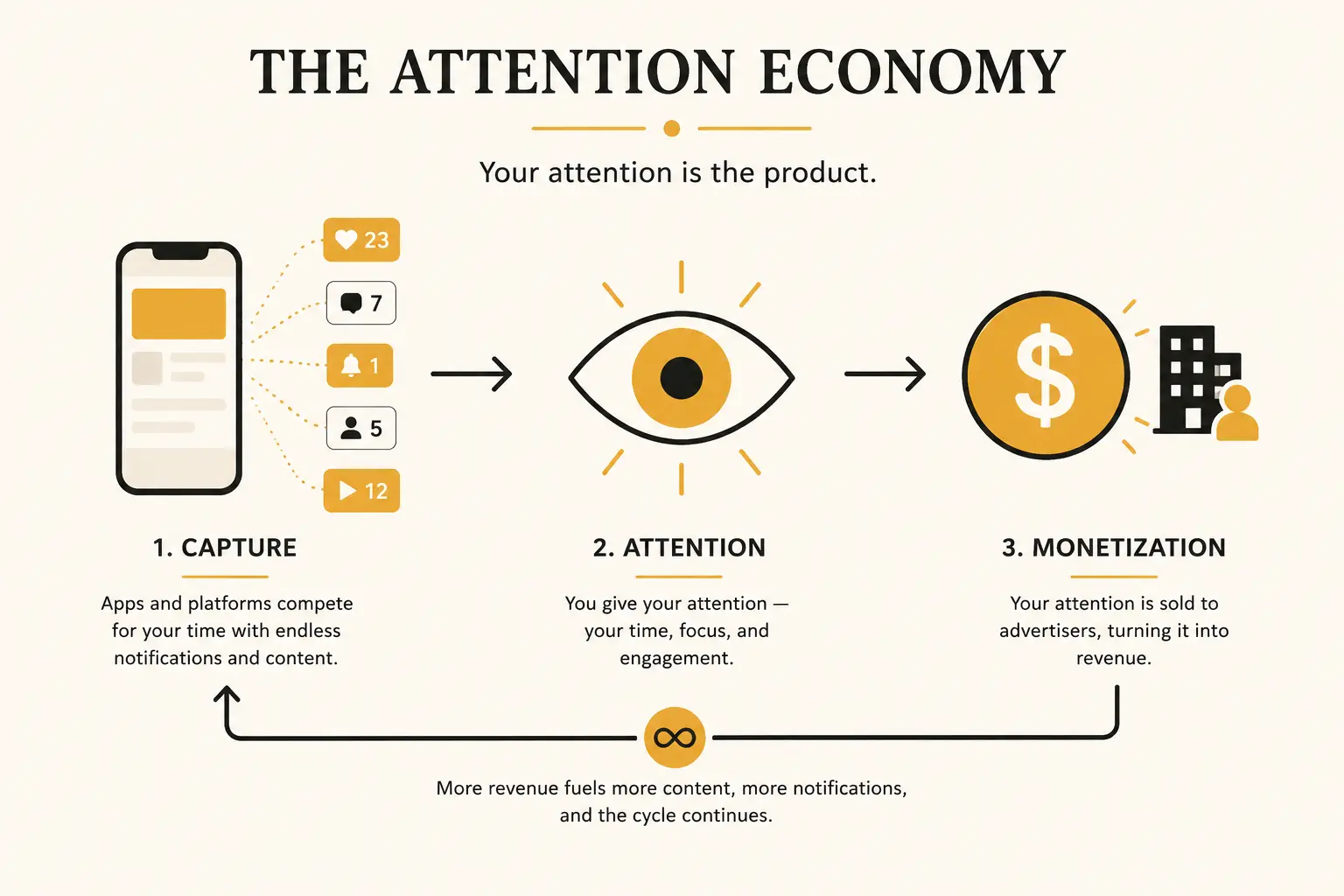
None of that reflects a sudden collective loss of self-control. It reflects a genuinely difficult design problem: every app on your phone was built, tested, and iterated on by teams whose primary success metric is how much of your time and attention they can capture. You are not undisciplined for finding that hard to resist unassisted — you're responding rationally to systems engineered specifically to make resisting difficult. The clearest example of this is doomscrolling, where the same variable-reward design is paired with a well-documented negativity bias.
Digital minimalism doesn't ask you to out-willpower that design. It asks you to change the starting conditions — deciding in advance, away from the pull of the app itself, what deserves your attention and what doesn't.
That same attention-capture design is a central concern in the research on screen time and children — kids and teens are growing up as the first generation to negotiate these systems from childhood, without ever having known a slower alternative. The decision framework below works just as well for setting family media norms as it does for your own phone.
The Three Core Principles
Newport's framework rests on three principles that, taken together, form the actual decision logic behind digital minimalism:
- Clutter is costly. Every app, subscription, and notification you allow onto your phone carries a hidden cost in attention and mental bandwidth, even ones you rarely open. The cumulative cost of many low-value technologies can outweigh the benefit of any single one of them, which is why minimalism evaluates the whole collection, not each app in isolation.
- Optimisation matters. Deciding to keep a technology isn't the end of the process — deciding how to use it well is just as important. Keeping Instagram but disabling notifications and only opening it once a day from a browser, rather than as an always-available app, is optimisation in action.
- Intentionality is satisfying. Newport's more surprising claim is that the process of deliberately choosing your tools — rather than passively accumulating them — is itself a source of satisfaction, independent of whichever specific tools you end up keeping.
The 30-Day Digital Declutter
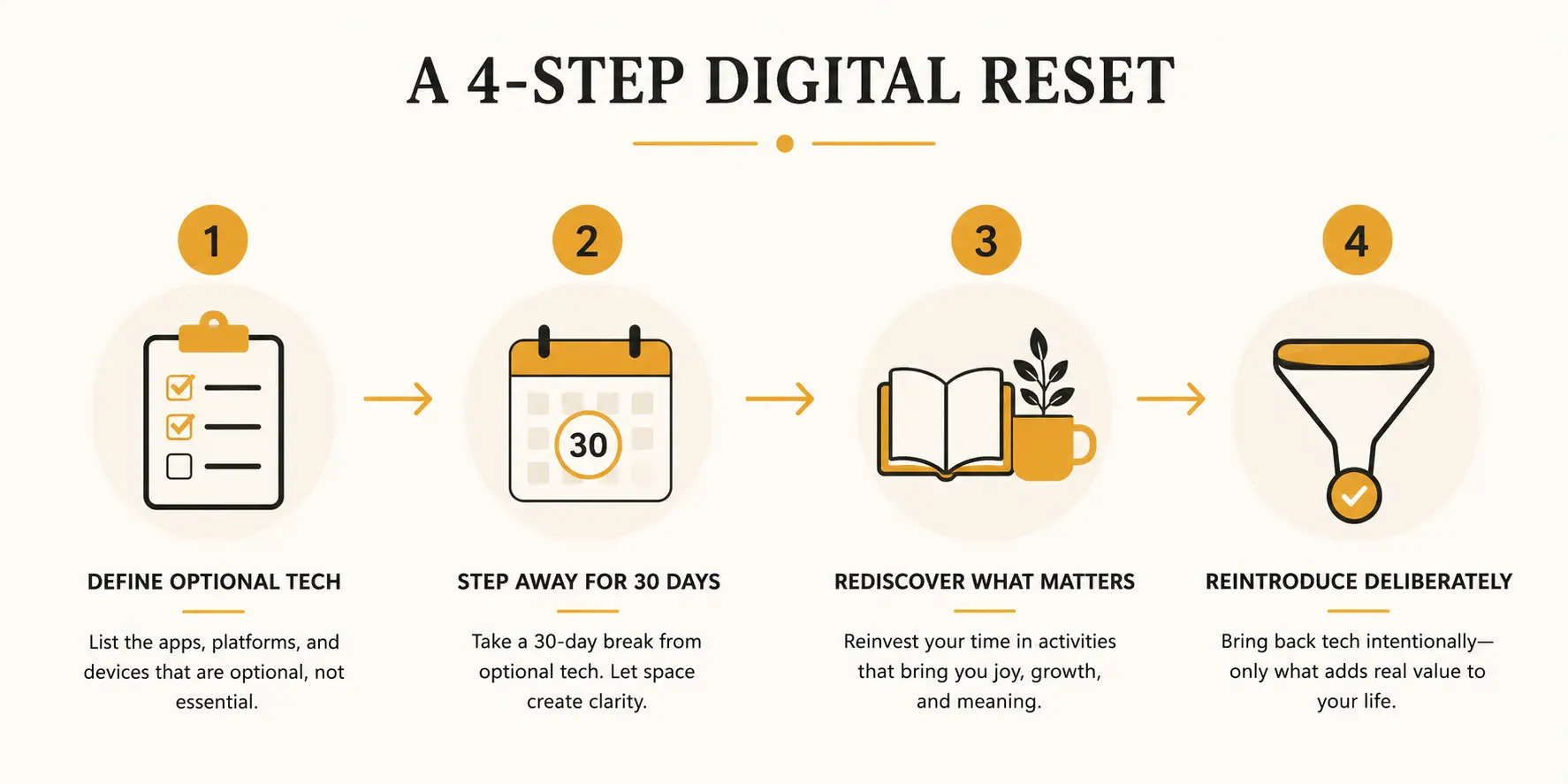
The practical starting point Newport recommends is a 30-day digital declutter: a defined period of stepping away from optional technologies, followed by a deliberate, values-based reintroduction of only what earns its way back.[1] Thirty days is long enough to break the reflexive, habitual pull toward a given app and rediscover what you actually want to fill that time with — a week is usually not.
If a full 30-day declutter feels like too much to start with, the free Digital Declutter Checklist breaks the same process down into smaller, immediately actionable steps — phone, inbox, files, subscriptions, and social media — that you can work through at your own pace and get a digital clutter score as you go. Photos deserve their own pass within this process too — see the digital photo declutter guide for a method that doesn't risk the memories that actually matter. The inbox specifically tends to need an ongoing system rather than a one-time cleanup — a realistic way to handle email overload covers the triage approach that holds up after the initial declutter fades.
The Values-Based Reintroduction Test
The step people most often skip is Step 4 — the deliberate reintroduction. Without it, a digital declutter is just a temporary detox that quietly reverts once the 30 days end. Newport's reintroduction test asks three questions of every technology before it's allowed back:
| Question | What it filters for |
|---|---|
| Does this technology directly support something I deeply value? | Not "is this useful" or "is this fun" — does it connect to a value you'd defend out loud. |
| Is this the best way to support that value? | A messaging app might serve "staying close to family" — but so might a weekly phone call, often better. |
| How will I use this to maximise the value and minimise the harm? | Specific rules: which days, which device, notifications on or off, app or browser-only. |
Applied honestly, most people find that a large share of what's on their phone fails the first question outright — it was never chosen, it just accumulated. The apps that survive tend to be a genuinely small list, which is the point: a phone with eight deliberately chosen apps used on your terms produces less overwhelm than a phone with sixty apps used on the platform's terms, regardless of which specific eight or sixty they are.
Sustaining It: Daily and Weekly Practices
- Keep phones out of the bedroom and off the breakfast table. Physical distance during the times you're least equipped to make deliberate choices — right after waking, right before sleeping — removes the decision entirely rather than relying on willpower in the moment.
- Turn off non-essential notifications by default. Notifications convert a tool you chose to open into a tool that interrupts you uninvited. Very few apps need this permission; most only ask for it because it increases engagement.
- Schedule your check-ins instead of reacting to pings. Checking email or messages at two or three set times a day, rather than continuously, preserves focus without missing anything genuinely time-sensitive.
- Protect solitude. Newport specifically identifies "solitude deprivation" — never being without input from other minds — as a distinct cost of constant connectivity. A walk without a podcast, a commute without a screen, a few minutes of just sitting: these aren't wasted time, they're where undistracted thinking actually happens.
- Revisit the reintroduction test periodically. Apps that passed the test six months ago don't automatically keep passing it forever — a quarterly check-in keeps the whole system honest rather than letting clutter quietly rebuild.
This pairs naturally with a slower approach to life more broadly — if the appeal here is less about the tech itself and more about wanting less noise and more intention generally, what slow living actually means covers the wider philosophy this fits inside.
Common Mistakes
- Treating the 30 days as the finish line. The declutter is the reset, not the destination — skipping the deliberate reintroduction is the single most common reason people slide back to where they started.
- Making decisions during the declutter, not after. Deciding "I'll keep Instagram" halfway through day 12, while still craving it, defeats the purpose. The reintroduction test only works with distance from the habitual pull.
- Confusing fewer apps with better use of the apps you keep. Deleting nine apps and using the tenth exactly as reflexively as before produces limited benefit. Optimisation — how you use what you keep — matters as much as reduction.
- Doing it entirely alone with no environmental support. If everyone around you is fully immersed in the same platforms, sustaining a different relationship with them is harder. Telling a few people what you're doing, or finding one other person to do it with, measurably improves follow-through.
Digital clutter is now part of what professional organizers handle for clients, alongside paper and physical spaces. If that work interests you, our free CPO® Exam Prep course walks through the full Certified Professional Organizer exam outline, including digital and information organizing.
Final Thoughts
The overwhelm most people feel about technology isn't really about any single app — it's the accumulated weight of dozens of small, undecided choices, each one small enough to seem harmless, together large enough to occupy a huge share of daily attention. Digital minimalism doesn't fix that by asking for more discipline in the moment. It fixes it by moving the decision earlier, to a point where you can actually think clearly about what you want your attention to go toward. This is the same principle behind reducing decision fatigue generally — deciding once, in advance, beats re-deciding the same small thing dozens of times a day.
You don't need to use technology less for its own sake. You need to decide, deliberately and in advance, what earns a place in your life — and let everything else go without guilt.
If the broader instinct here is wanting less stuff, less noise, and more room to think — not just digitally — the same logic applies to physical space too. How to declutter your home room by room is the physical-world companion to this framework, and phone-specific first steps live in how to organize your phone in 30 minutes.
This article is for general informational purposes. It draws on the digital minimalism framework popularised by Cal Newport in his book Digital Minimalism: Choosing a Focused Life in a Noisy World, along with independently verified statistics cited below.
Sources
[1] Newport, C. On Digital Minimalism — the philosophy, principles, and 30-day digital declutter process. Available at: calnewport.com
[2] 2025 U.S. phone usage study finding ~205 daily phone checks and over 40% of people self-reporting phone "addiction." Summary available at: reviews.org