
Ask ten parents what they think about screen time and you'll get ten different levels of guilt, each calibrated to a headline they half-remember. "Screens are rewiring kids' brains." "Screen time doesn't actually matter that much." "My pediatrician said an hour a day." Somewhere between the panic and the dismissal is what the actual research says — and it's more useful, and more nuanced, than either extreme.
This isn't a piece telling you screens are fine or screens are ruining childhood. It's a look at what's actually been measured, where scientists genuinely disagree, and what the evidence suggests is worth paying attention to versus what's mostly noise.
How Much Screen Time Kids Actually Get
Before getting into effects, it's worth knowing the actual baseline, because most parents underestimate it. Common Sense Media's ongoing census of media use found that tweens (ages 8-12) average about 5 hours and 33 minutes of screen media per day, and teens (13-18) average about 8 hours and 39 minutes — figures that jumped roughly 17% during the pandemic and have stayed close to that level since.[1] Boys average somewhat more than girls in the tween years (6:11 vs 4:55).[1]
Every official guideline sits well below these averages, which is part of why screen time is such a persistent source of parental guilt: almost every family is "over" the recommended number, because the recommended numbers were never realistic estimates of typical behavior — they're targets based on what the evidence suggests is protective.
What the Official Guidelines Actually Say
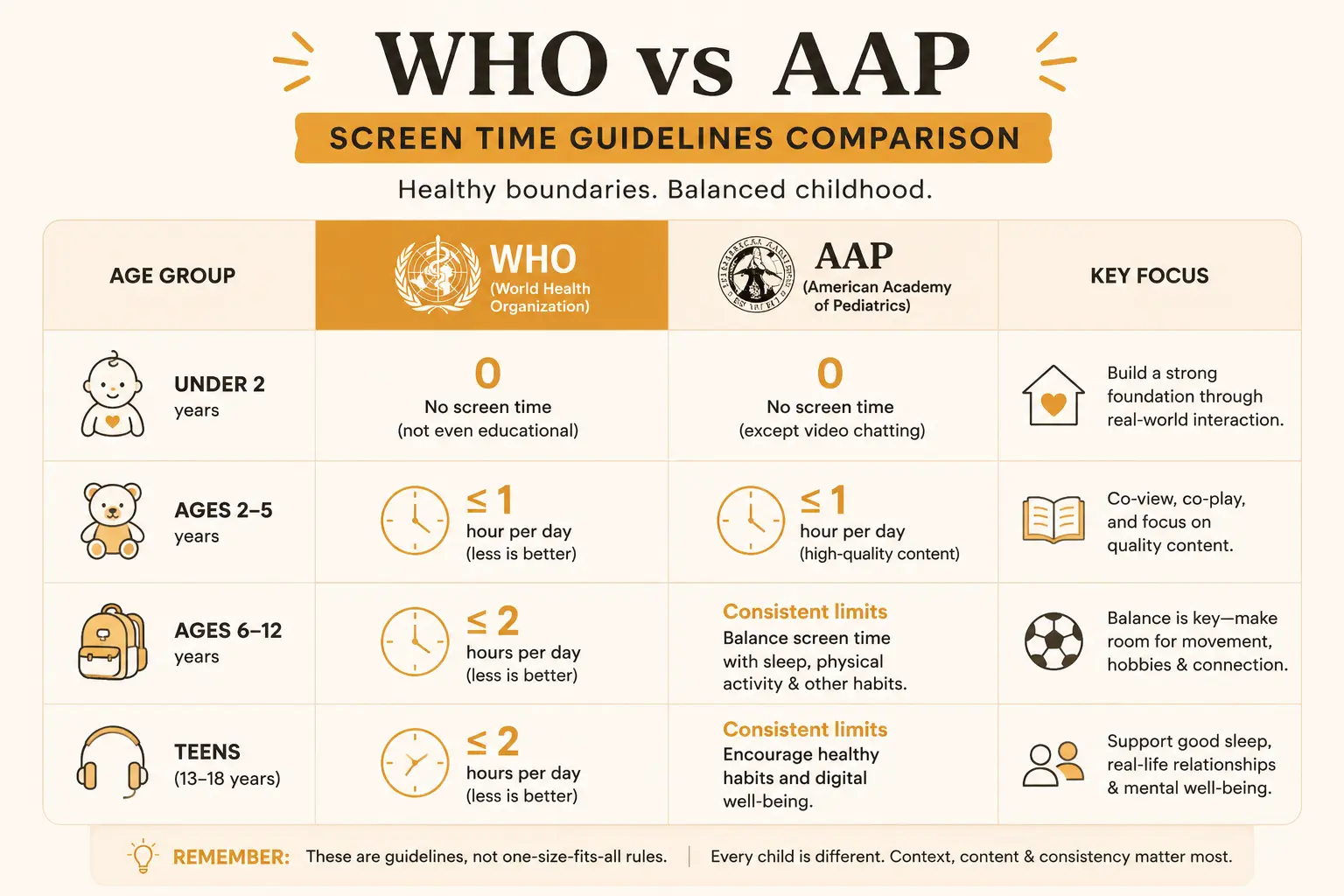
The two most-cited sources — the World Health Organization and the American Academy of Pediatrics — broadly agree on early childhood and diverge somewhat on how to handle older kids and teens.
| Age | WHO guideline (2019) | AAP guidance (updated 2026) |
|---|---|---|
| Under 1 year | No screen time, including background TV | Screens limited to video-chatting with family only |
| 1–2 years | No sedentary screen time | High-quality content only, always co-viewed |
| 2–4 / 2–5 years | Max 1 hour/day, less is better | Around 1 hour/day of high-quality, co-viewed content |
| School-age & teens | No specific WHO figure published | No fixed hourly limit — focus shifted to quality, context, and what screen time displaces |
The most important recent shift is the AAP's 2026 update, which moved away from a single hours-based number for school-age kids and teens and toward a framework built around quality, context, and conversation — co-viewing, talking about content, and making sure screens aren't displacing sleep, physical activity, or family time.[2] This wasn't a loosening of concern; it reflects a genuine shift in the evidence toward "what you watch and how" mattering as much as "how long."
The Honest Disagreement: Two Camps in the Research
Where this topic gets genuinely contested — and where a lot of headlines oversimplify — is the question of whether screen time, and social media specifically, is a meaningful cause of the well-documented rise in teen anxiety and depression since around 2012.
Both camps are looking at real data, and both raise fair points: population-level mental health trends and individual-level statistical associations are genuinely different kinds of evidence, and it's possible for a correlation to be real, contested in size, and still worth taking seriously as a precaution — all at once.
What Actually Matters More Than the Hour Count
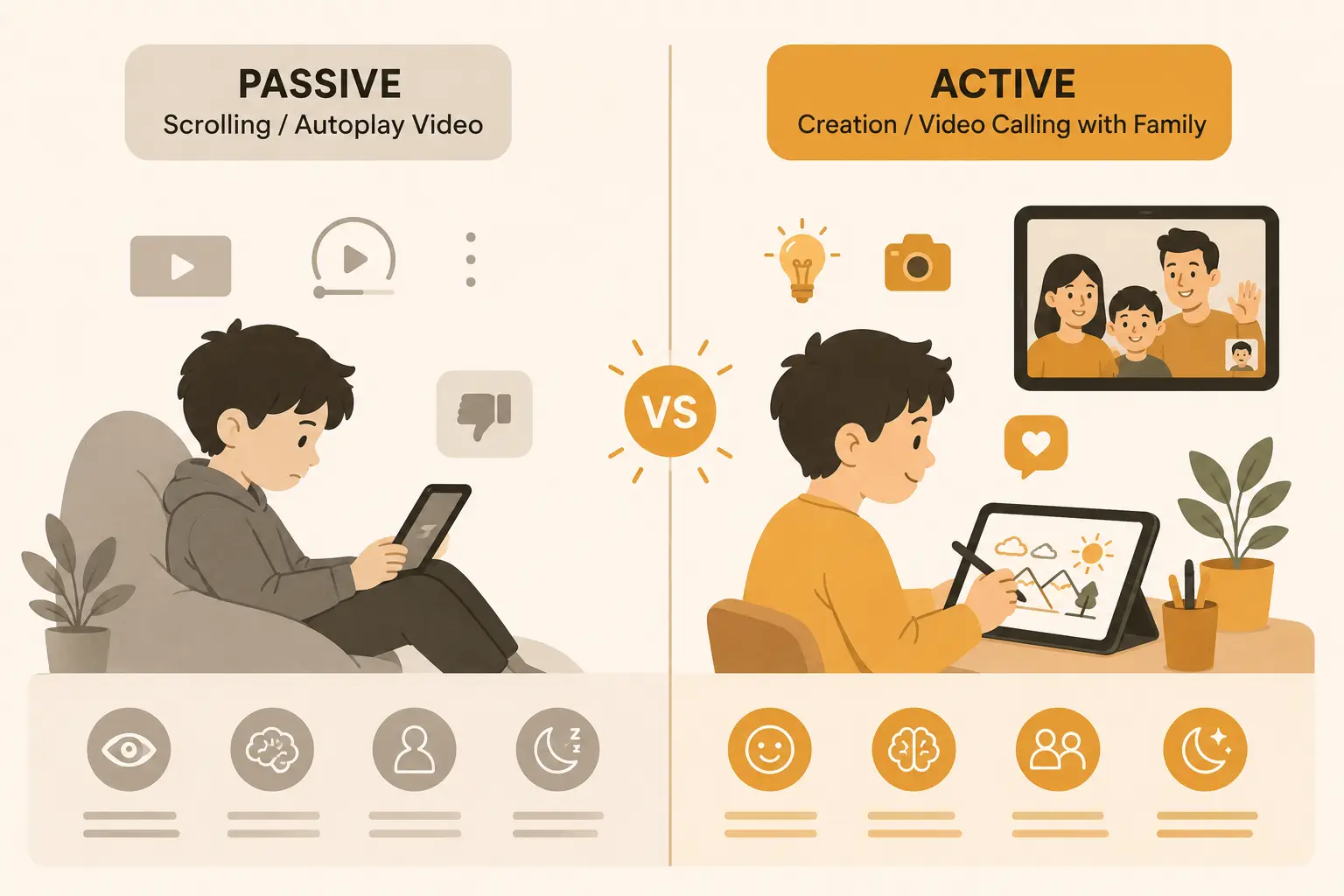
Across both camps of the debate above, there's more agreement than the headlines suggest on one point: the type of screen time matters enormously, and lumping "an hour of co-viewed educational content" together with "an hour of algorithm-driven social media scrolling" as the same variable was always going to produce muddy, hard-to-interpret research.
- Passive vs. interactive. Passively watching a screen (most TV, autoplay video) engages a child differently than interactive use (video calls with family, some educational apps) that involves back-and-forth response.
- Co-viewed vs. solo. A parent watching alongside a young child and talking about what's on screen changes the experience substantially — the AAP's guidance leans heavily on this distinction for the under-5 age range.
- Educational vs. entertainment vs. social media. These are not interchangeable categories. Social media in particular introduces social comparison and algorithmic engagement mechanics that simple video content does not.
- What it displaces. An hour of screen time that replaces an hour of boredom has a different effect than an hour that replaces sleep, outdoor play, or a conversation with a parent.
A Practical Breakdown by Age
Under 2: Video-chat only, minimize passive viewing
The evidence here is the most consistent in the entire field: very young children learn language and social skills primarily through live, responsive interaction with caregivers, which screens — even "educational" ones aimed at babies — do not replicate well. Video-chatting with a relative is a reasonable exception since it's genuinely interactive and often used for legitimate family-connection reasons, not because it's risk-free in some other category.
2–5: Co-viewed, high-quality content, roughly an hour
This is the age range where quality and co-viewing make the clearest measurable difference. A parent or caregiver watching alongside the child, pausing to ask questions or connect the content to real life, meaningfully changes what a child takes away compared to solo viewing of the identical content.
6–12: Shift from hours to habits
This is where a rigid time limit starts to matter less than the overall pattern: is screen time protected from bedtime and mealtime, is at least some of it social/interactive rather than purely passive, and is the child still getting adequate sleep and physical activity? The habit tracker works reasonably well here as a family tool for tracking screen-free windows rather than counting hours.
Teens: Focus on sleep, social media specifically, and modeling
Teen screen time is dominated by social media and messaging rather than passive video, and this is where the sleep-displacement and social-comparison mechanisms carry the most evidence. A device-free bedroom overnight addresses a large share of the most consistently documented harm — sleep disruption — without requiring a broader, harder-to-enforce restriction on daytime use.
The Clearest Mechanism: Sleep Displacement
If there's one effect of screen time on kids that has the strongest, least contested evidence across the research landscape, it's the impact on sleep. This happens through two separate pathways: the stimulating, often emotionally engaging content itself delays the natural wind-down process, and blue light exposure in the evening suppresses melatonin production, delaying the body's natural sleep signal.
Poor sleep in children and teens is independently and robustly linked to worse mood regulation, poorer attention and academic performance, and increased irritability — meaning that even if the "screens directly cause anxiety" question stays contested, the "screens before bed disrupt sleep, and poor sleep affects mood and behavior" chain is well established at each link. For the adult version of this same mechanism, the ideal sleep environment guide covers the same principles that apply to a child's bedroom.
Signs Screen Use Has Become a Genuine Problem
- Distress or anger when screen time ends that's disproportionate and doesn't settle within a reasonable window.
- Screens displacing sleep — later bedtimes, screens in the bedroom overnight, or visible tiredness that coincides with increased evening use.
- Withdrawal from previously enjoyed in-person activities or friendships in favor of screen-based alternatives.
- Sneaking or hiding use, particularly in teens, which is a stronger signal than the raw amount of time.
- Declining school performance or attention that coincides with a clear increase in use, rather than a general pattern unrelated to screens.
None of these in isolation is necessarily alarming — kids get upset when fun things end regardless of what the fun thing is. The pattern and persistence matter more than any single incident.
Building a Family Media Plan
The AAP recommends building a household-specific Family Media Plan rather than adopting a generic rule, since the right approach genuinely differs by family, child, and age.[2] The most evidence-supported components:
- Protect specific times and places. Meals and the hour before bed are the two highest-leverage screen-free windows — they protect the two mechanisms (family connection, sleep) with the clearest evidence behind them.
- Keep bedrooms device-free overnight for kids and teens. This single change addresses most of the sleep-displacement mechanism without needing to police daytime use as closely.
- Co-view when you can, especially with younger kids. Watching together and talking about content changes the experience meaningfully — it's one of the few interventions with strong evidence across multiple studies.
- Apply the rules to yourself too. Parental modeling is consistently one of the strongest predictors of a child's own screen habits — a household with a strict kids' rule and no adult equivalent tends to be less effective than one with a shared standard. If you want a framework for auditing your own relationship with your phone first, digital minimalism and organizing your phone in 30 minutes are useful starting points.
- Revisit the plan as kids age. What's appropriate at 6 is not appropriate at 16 — build in a periodic review rather than treating the plan as fixed.
If you want to model a structured reset as a family — or just experience what less screen time feels like before setting rules for your kids — the 7-Day Digital Detox challenge works well as a parent-led example, and a week without social media covers what to expect if you try a longer version yourself first.
Common Mistakes Parents Make Around Screen Time
- Fixating on a single hourly number. A rigid "2 hours, no exceptions" rule that ignores content type and context is less evidence-aligned than a flexible plan built around quality and displacement.
- Enforcing rules for kids without applying any to themselves. Modeling is one of the more robust findings in this research area — inconsistency here undermines the rest of the plan.
- Treating all screen time as equivalent. An hour of co-viewed educational content and an hour of solo social media scrolling are not the same intervention, and shouldn't be tracked as if they are.
- Reacting only to the amount, not the displacement. The clearest evidence points to what's being crowded out — sleep, activity, in-person time — as the more useful thing to monitor than total hours alone.
- Assuming the science is fully settled in either direction. Presenting the causal case or the small-effect case as the complete, uncontested picture misrepresents an area where genuine expert disagreement exists.
Final Thoughts
The honest picture of screen time and kids doesn't fit neatly into either a scary headline or a reassuring one. The guidelines exist and are worth knowing, the research on outright causation is genuinely contested among serious researchers, and the strongest, least-disputed finding is the simplest one: screens that displace sleep, movement, and in-person connection are the clearest problem — not screens as a category in themselves.
You don't need to resolve the Haidt-versus-Orben debate to make a good decision for your family. Protect sleep, keep bedrooms and mealtimes device-free, watch together when you can, and hold yourself to the same standard you're asking of your kids. That covers most of what the evidence actually supports, regardless of which side of the bigger debate turns out to be more right.
This article is for general educational purposes and does not constitute medical or parenting advice specific to your child. Every child and family circumstance is different. If you have specific concerns about a child's screen use, mood, sleep, or development, consult your pediatrician or a qualified child health professional.
Sources
[1] Common Sense Media, ongoing Census of Media Use by Tweens and Teens — average daily screen media use figures. Available at: commonsensemedia.org
[2] American Academy of Pediatrics, 2026 updated digital media and screen time guidance. Summary available at: aap.org
[3] Haidt, J. The Anxious Generation (2024) — argument and data on the post-2012 rise in adolescent mental health issues coinciding with smartphone adoption. Summary available at: en.wikipedia.org
[4] Orben, A. & Przybylski, A. Screens, Teens, and Psychological Well-Being: Evidence From Three Time-Use-Diary Studies. Psychological Science, 2019. Summary available at: psychologicalscience.org