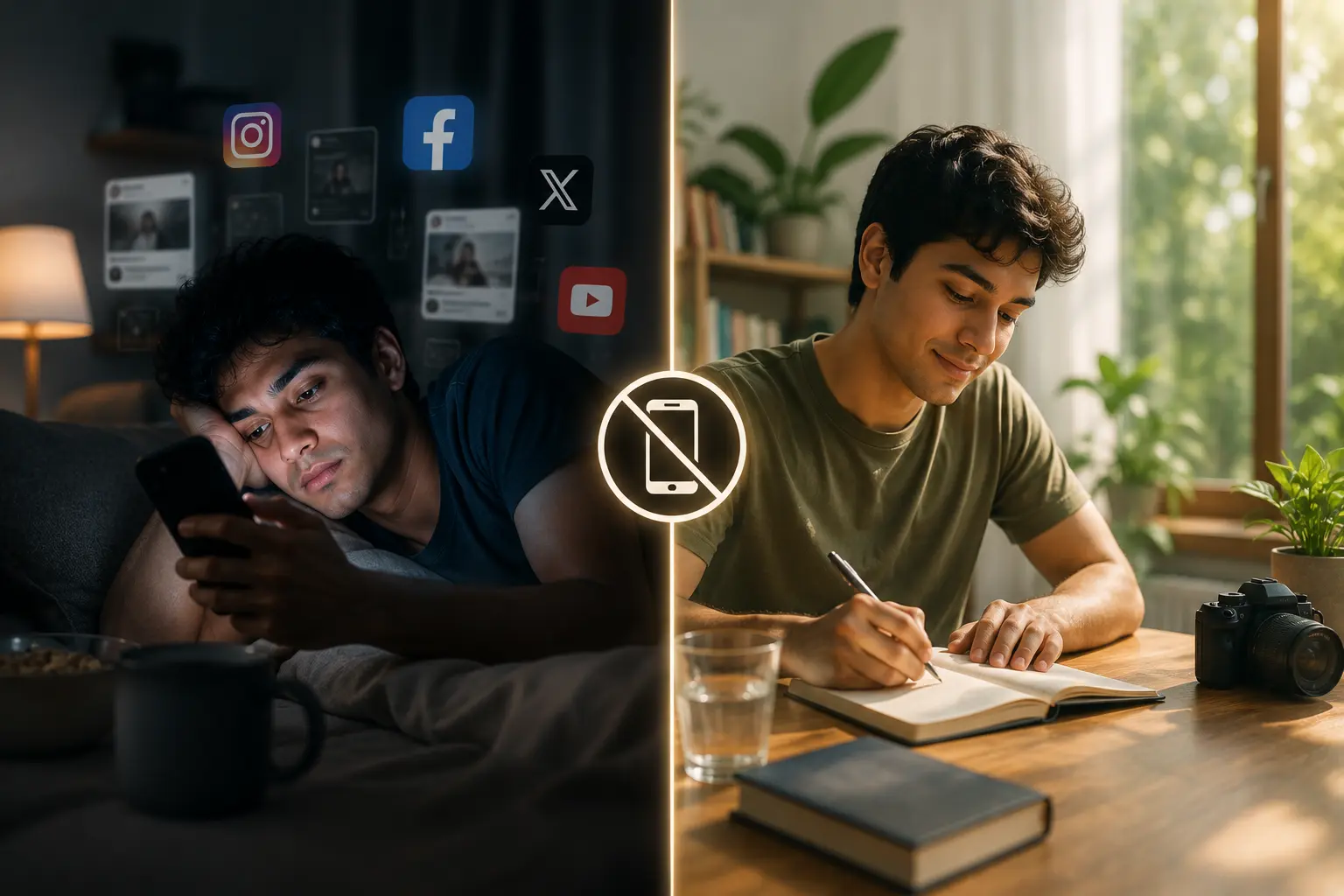
A week without social media does not sound difficult. Seven days is not a long time. Most people who decide to do it are confident going in that it will be straightforward, perhaps even relaxing. By day two, they have usually discovered that it is neither straightforward nor uniformly relaxing, and that their relationship with their phone is more habituated and more reflexive than they had realised.
This article is structured around what a week without social media actually involves — the day-by-day phenomenology, what the research says about why each phase unfolds the way it does, what changes are real and what are overstated, and what the experience reveals about digital habits that is not visible from within the habit itself.
The article is written as a first-person account anchored in research, not as a detox manifesto or a motivational piece about disconnecting. The goal is accuracy: what can you expect if you try this, why does it feel the way it does, and what does the evidence suggest about what it is actually producing in your brain and body.
The social media platforms involved: Instagram, X (formerly Twitter), and YouTube Shorts. WhatsApp, iMessage, and email were not restricted — those serve a different communicative function. The news was also left available via text-based sources with no infinite scroll feed.
Why Do This at All: The Evidence That Made It Worth Trying
The decision came from reading the research rather than from a moment of frustration with the platforms. The condensed version is this: the research most directly relevant to my situation was not the contested adolescent mental health data or the large-scale correlational studies with small effect sizes. It was two specific categories of findings that were harder to dismiss.
The first was the Ward 2019 University of Chicago study showing that the mere presence of a smartphone on a desk — face down, silent, unused — reduced cognitive capacity for the task in front of the user compared to having the phone in another room.[1] The effect was proportional to how strongly the person reported depending on their smartphone. I do most of my best work at a desk with my phone nearby. The implication was uncomfortable.
The second was the Gloria Mark research on context switching: that each digital interruption requires approximately twenty-three minutes to fully restore the previous depth of focus.[2] I had a reasonable suspicion that I was being interrupted more than twice an hour. The arithmetic was not encouraging.
The experiment was not about social media being bad. It was about finding out what, specifically, having it absent would change. The answer was more specific and more interesting than I expected.
The Setup: Rules That Actually Worked
The rules were specific rather than aspirational. Specific rules matter because ambiguous rules create in-the-moment rationalisation opportunities that are hard to resist when the habit is strong.
- Instagram, X, and YouTube Shorts deleted from the phone for the week. Not hidden in a folder, not logged out. Deleted. Reinstalling requires more friction than simply tapping an icon.
- No desktop access to social media platforms. Checking Instagram on a laptop is still Instagram.
- WhatsApp, iMessage, and email unrestricted. These are communication tools rather than scroll feeds — they involve reciprocal interaction with specific people rather than passive consumption of curated content from a crowd.
- Text-based news sources allowed at defined times. This kept the experiment about social media specifically rather than making it a general information blackout.
- No posting about the experiment on social media. The meta-irony of doing a social media break and posting about it is a trap; it also defeats the point.
Expected outcomes going in: easier sleep, slightly more time, mild FOMO early in the week that would resolve. What actually happened was more textured than that.
The Week, Day by Day
The 'nothing' is informative. Those automatic reaches were not triggered by the need for specific information or by genuine boredom. They were conditioned responses to situational cues — transitions between activities, moments of waiting — that had been repeatedly paired with phone use until the phone use had become the automatic response, independent of any conscious decision. BJ Fogg's habit model is useful here: the absence of the app broke the routine, but the cue still triggered the reach. The experience felt like a phantom limb. Sleep that night was unremarkably the same as usual.
The research framing here is the default mode network. When the brain is not engaged in a specific task, it defaults to self-referential processing: reviewing past events, planning future ones, consolidating emotional experiences, generating spontaneous creative thinking. Jonathan Smallwood and others have found that this default mode processing is associated with creative insight and emotional integration — but the contemporary brain has been so thoroughly conditioned to seek external stimulation during these moments that resting in them requires an adjustment period. By evening, the discomfort had reduced slightly. Not yet ease, but less urgency.
Two things were notable. First, the FOMO did not correspond to any specific anticipated event. Second, when I checked in with specific people through messaging — asking directly how they were — the FOMO largely resolved. The social connection need was real; the platform as the only way to meet it was not. The direct conversation was more satisfying than the ambient scroll would have been. This is consistent with the research on passive versus active social media use: passive consumption is associated with worse wellbeing outcomes; active reciprocal interaction is associated with neutral to positive ones. Day three made this experientially concrete.
The first was a quality of attention during work that felt less fragmented — the capacity to stay in a difficult task felt higher than usual. Whether this reflected the absence of notification-driven interruptions, the reduced availability of the phone as a procrastination mechanism, or genuine attentional capacity changes from four days of reduced stimulation load is impossible to determine from a single-person observation — but the subjective experience was consistent with the Ward 2019 finding.
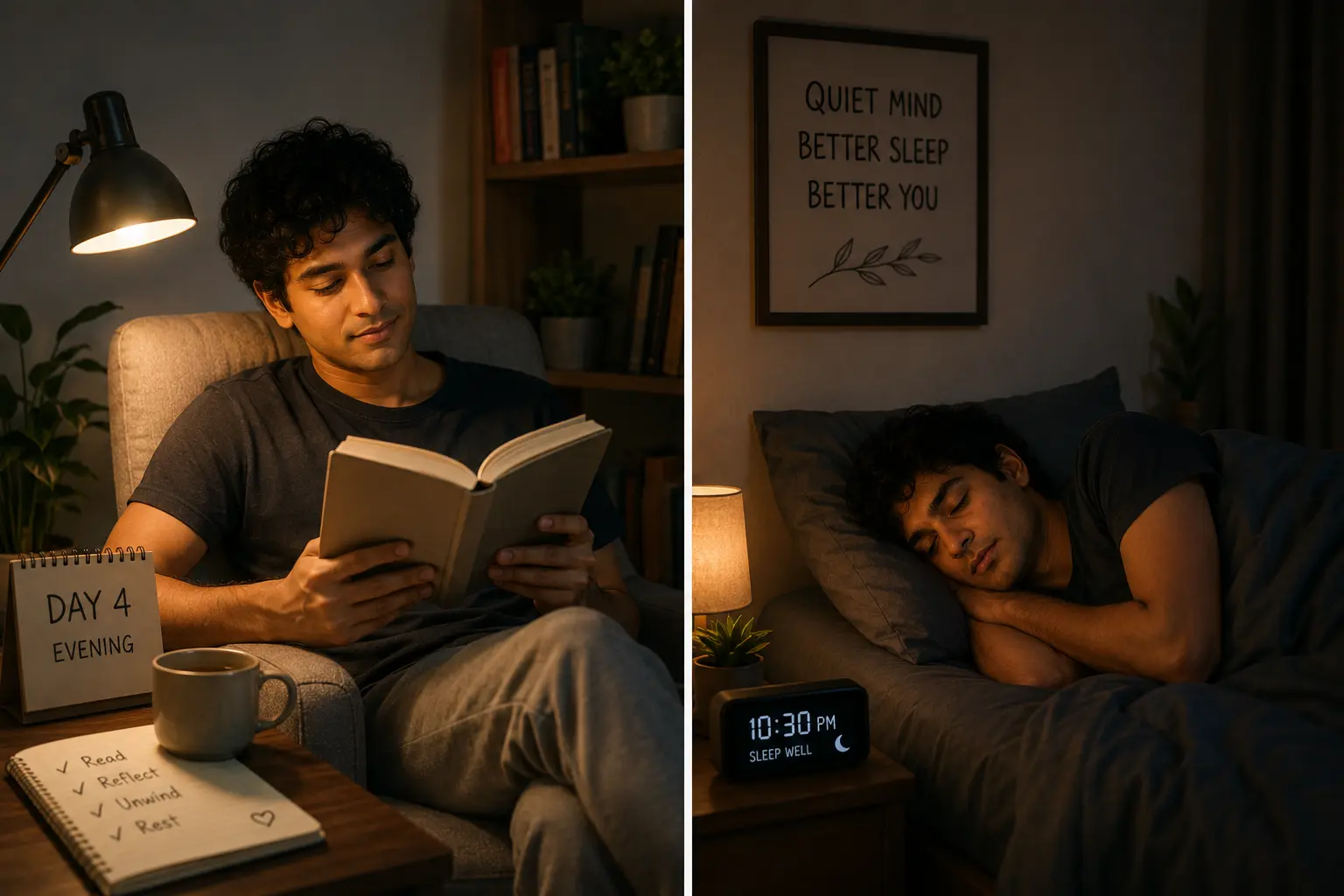
The second was an evening quality change. Without the default of scrolling in the hour before sleep, the evening had been filled differently — more reading, an earlier transition to genuine tiredness, sleep onset that felt faster. The subjective sense was of a less activated pre-sleep state, consistent with the cortisol and arousal research on evening screen use.
This mirrors the news abstinence research: most of what people feel they would miss if they consumed less social media is content that has no measurable impact on their decisions, relationships, or wellbeing. The perception that it is necessary is produced partly by the availability heuristic and partly by the ambient social presence effect.
There was also a noticeably different quality to real-world observation — a finding reported consistently in qualitative research on social media breaks. Without the habit of mediated looking (looking at images and videos of experiences rather than directly experiencing them), being present in environments felt more textured and absorbing. A walk felt more like a walk. A meal had more presence to it. Whether this is a genuine neurological effect of reduced stimulation load or simply the product of removing a competing attentional anchor, the subjective experience is consistent enough across people who report it to be worth noting.
Most people who do a social media break return to exactly the same usage pattern within a week of ending it — the habit infrastructure is still there, the apps return to the home screen, the cues fire, and the context-response pattern re-establishes. The more useful question is not 'should I go back' but 'what specifically do I want to use these platforms for, and what usage structure would give me that without the costs.' That question requires a clearer answer than most people have for why they use social media in the first place — and the week without it is partly valuable because it makes that question answerable for the first time.
What Actually Changed and What Did Not
| Domain | What changed | What did not change | Assessment |
|---|---|---|---|
| Sleep | Pre-sleep window less activated from day 4; subjective sleep onset faster; fewer mid-night phone checks | No dramatic transformation in the first three nights | Real but modest improvement; consistent with arousal-suppression mechanism; cumulative effect likely larger over weeks |
| Cognitive focus | Subjective sense of less fragmentation from day 4; fewer voluntary phone checks disrupting task flow | No objective measurement; impossible to separate from placebo effect | Subjectively meaningful; consistent with Ward 2019 and context-switch research |
| Anxiety and mood | Mild background anxiety slightly reduced by day 3; clearer by day 5–6 | No dramatic mood transformation; some days still stressful for unrelated reasons | Subtle but perceptible; consistent with Graham 2019 RCT findings (6-week effect significant; 1-week is the beginning of the trajectory) |
| Time perception | Days felt slightly longer; the evening felt more usable | No dramatic amount of free time appeared; existing obligations filled most of the day | The time gain is real but modest; more significant is where the gained attention went |
| Social connection | Direct messages and actual conversations increased slightly; social needs met more deliberately | No FOMO about genuinely important social events; relationships unaffected by absence from platforms | Better quality social interaction from more direct contact; consistent with active vs passive use research |
| Information access | No significant gap in important information; major news arrived through other channels | General awareness of platform-specific discourse was lower; viral moments missed entirely | The perceived information need was largely illusory; the actual information need was met by other sources |
| The phantom habit | Automatic reach frequency decreased from day 1 to day 7; still present but less urgent by the end | The habit did not disappear; it required active management throughout the week | Habit weakening is real but seven days is not long enough for full replacement; structural changes needed for maintenance |
What the Research Says About These Specific Experiences
Why day two is always the hardest
The day two difficulty is not specific to social media breaks. It is documented across habit disruption research as the point at which the cue-response habit is still fully active but the routine completion is no longer available. Research on dopamine and reward learning shows that when a well-established reward-associated behaviour is blocked, the dopamine system temporarily increases the drive toward that behaviour before it begins to diminish — a phenomenon called incentive salience escalation. Day two is when this drive is highest, before the neural prediction of reward begins to downgrade. The same variable-reward mechanism, paired with a bias toward negative content, is what makes doomscrolling specifically so resistant to stopping mid-session.
Why the improvement is gradual and not sudden
The research on habit disruption consistently shows a gradual trajectory rather than a sudden transformation. Brain regions involved in habit execution — the basal ganglia and associated circuits — do not immediately downgrade the strength of a well-established habit when the behaviour is blocked. The first few days feel constrained because the habit is intact but unfed. The improvement from day four reflects the beginning of the habit's weakening as the reward prediction error accumulates — the gap between the expected reward and the actual outcome of reaching for the phone.
The FOMO resolution timeline
Research by Przybylski and colleagues on FOMO as a construct distinct from general social anxiety found that FOMO is primarily driven by an unmet need for belonging and social competence rather than by a genuine informational deficit.[3] The resolution of FOMO through direct social contact rather than platform access is consistent with this — the underlying need is for genuine connection, and the platform is a low-quality substitute that activates the need without fully satisfying it.
Why presence quality changes from day four
The shift in environmental presence quality is consistent with attentional restoration theory (Kaplan and Kaplan) and research on the effects of reduced stimulation load on involuntary versus directed attention. Habitually high stimulation environments require continuous directed attention. When stimulation load is reduced, involuntary attention — the gentle, effortless noticing of the environment — becomes more available. The walk feeling more like a walk is the experience of involuntary attention operating without competition from the directed attention demands of a continuous scroll feed.
Designing the Return: What Makes It Different
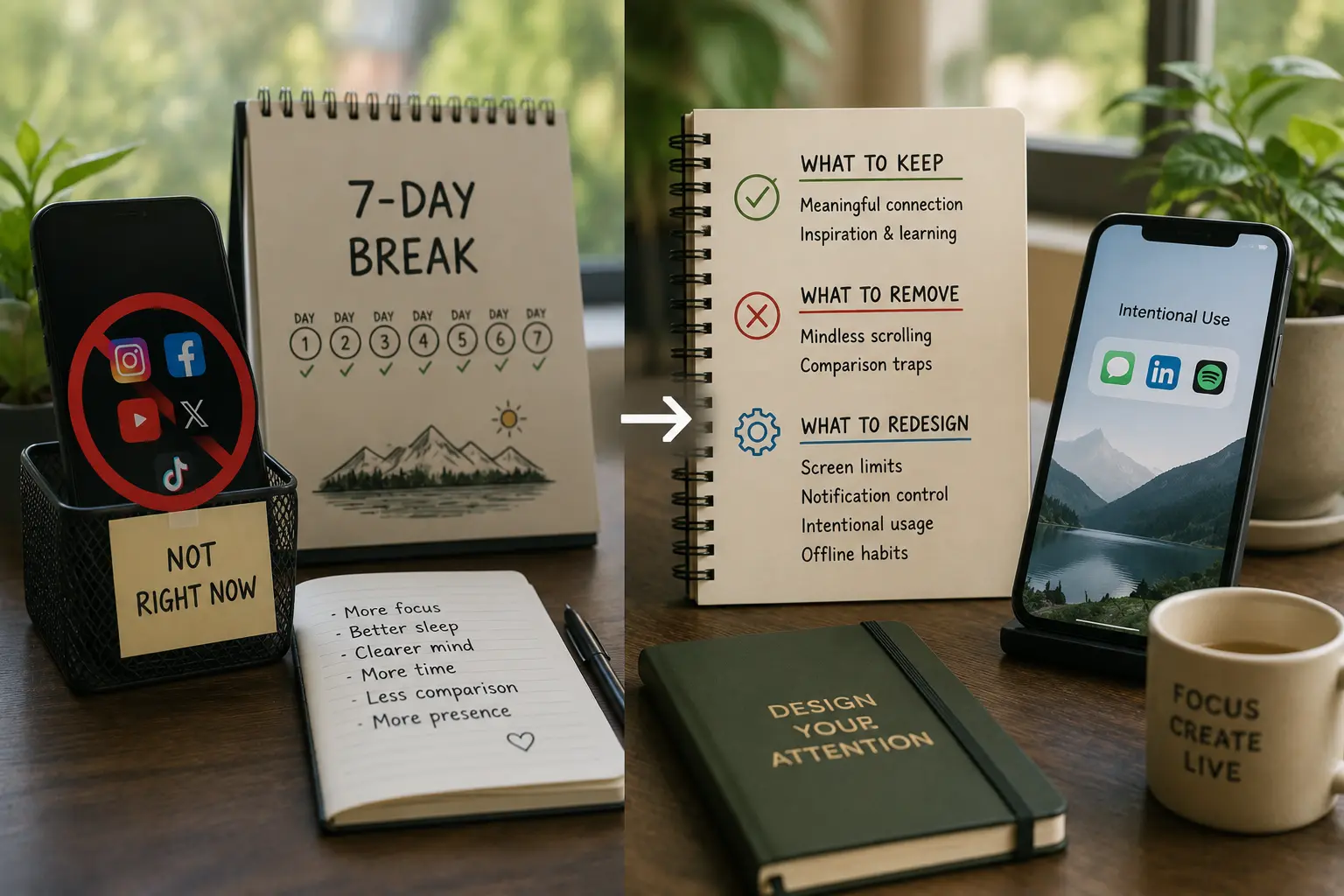
Most accounts of social media breaks end at the seven-day mark without addressing what happens in week two. The data on this is not encouraging for those who hope a week is sufficient to permanently alter their relationship with the platforms. Research on habit disruption shows that a seven-day interruption weakens the habit but does not extinguish it. Reinstalling the apps and returning to the same environment — same home screen, same contextual cues, same evening boredom — will reactivate the habit rapidly.
The break is valuable not because seven days changes the brain but because it creates an observational period during which the habit can be seen from outside itself. The people who sustain meaningful change are those who use those observations to redesign structural conditions rather than simply returning and relying on increased motivation.
The Honest Accounting: What One Week Does and Does Not Do
A week without social media is not a transformation. It is a clarification. The transformation — if one occurs — is the result of what you decide to do with the clarity the week produced, and it requires structural changes rather than relying on the motivational afterglow of the break.
What one week genuinely does:
- Weakens the automatic habit enough to make it observable from outside itself.
- Reveals the specific contextual cues that trigger automatic use — the prerequisite for redesigning the habit.
- Provides an experience of the pre-sleep and morning states without the platforms, making comparison available for the first time.
- Identifies which social needs the platforms were nominally serving, and whether they were serving them adequately (most of the time: not particularly well compared to direct contact).
- Shows which platform is providing something that could be called genuine value and which is providing primarily compulsive engagement.
What one week does not do:
- Permanently alter the habit without structural follow-through. For the structural follow-through itself — a values-based framework for deciding what comes back after the break and on what terms — digital minimalism is the natural next step.
- Produce dramatic wellbeing improvements that a week is too short to establish.
- Resolve the underlying reasons why the platforms were being used compulsively, if those reasons involve loneliness, anxiety, boredom, or avoidance.
- Make social media unnecessary — many of its uses are genuine and worth preserving in a bounded form.
Should You Try It: The Actual Decision Framework
A social media break is worth trying under specific conditions:
- You have noticed that you open social media habitually without a specific purpose and leave feeling worse more often than better.
- You have noticed that your pre-sleep phone use is affecting your sleep quality.
- You have tried to reduce social media use through intention alone and found it did not work.
- You want a comparison period to understand what your baseline wellbeing, attention, and sleep look like without the platforms.
It is probably not the right intervention if your social media use is primarily active and communicative rather than passive and consumptive — or if you are in a period of acute stress, loneliness, or difficulty where the platforms are providing meaningful community support.
Parents often come to this specific week for a different reason: modelling. Kids notice which habits the adults around them treat as optional and which are non-negotiable, and a parent's own phone use is one of the more studied variables in the research on screen time and child development. A week off gives you a firsthand sense of what you are actually modelling before you set rules for anyone else.
What It Was, Actually
A week without social media was not life-changing. It was not a revelation. It did not produce the dramatic sense of liberation that the genre of digital detox writing typically promises. What it was was informative: it made visible a set of habits, dependencies, and uses that were invisible from inside the habit itself.
The phantom reach on day one was informative about how automatic the behaviour had become. The restlessness on day two was informative about what the habit had been masking. The FOMO resolution through direct contact on day three was informative about what social need the platform was nominally serving. One specific area where this clarity is particularly useful: how social media creates the feeling that your wardrobe is inadequate — a phenomenon driven by the same comparison mechanisms that make stepping away feel like relief. The shift in attention quality from day four was informative about what reduced stimulation load actually feels like. The non-existent information gap on day five was informative about how much of the consumption was serving an ambient presence need rather than a genuine informational one — a distinction covered in more depth in why you feel lonely even when you're surrounded by people, including why passive scrolling so rarely resolves the underlying feeling it seems to be filling.
The most durable outcome was not any change produced during the week but the clarity about which platforms to keep, which to remove, and what structural conditions would produce a different default relationship with the ones that returned. That clarity is the point of the exercise. The week is not the change. It is the observational period that makes a different choice possible.
If you want a structured way to turn that observational clarity into a lasting system — for both the digital side and the broader stress and stimulation load — the Sleep Better course covers the full pre-sleep environment redesign, including phone boundaries, in a practical sequence that builds one layer at a time.