Most people who try journaling quit within a week. Not because they found it unhelpful. Because they made it too complicated. They bought a beautiful notebook, committed to writing two pages every morning, and ran headfirst into the reality that most mornings do not have two pages of thoughts ready to go — especially before coffee.
The blank page stares back. They write three sentences. They feel like they did it wrong. They skip the next morning. Within a week, the beautiful notebook is on a shelf.
This is the journaling failure cycle — and it happens because the popular version of journaling is built around volume and inspiration rather than around a specific, repeatable habit that fits inside a real morning.
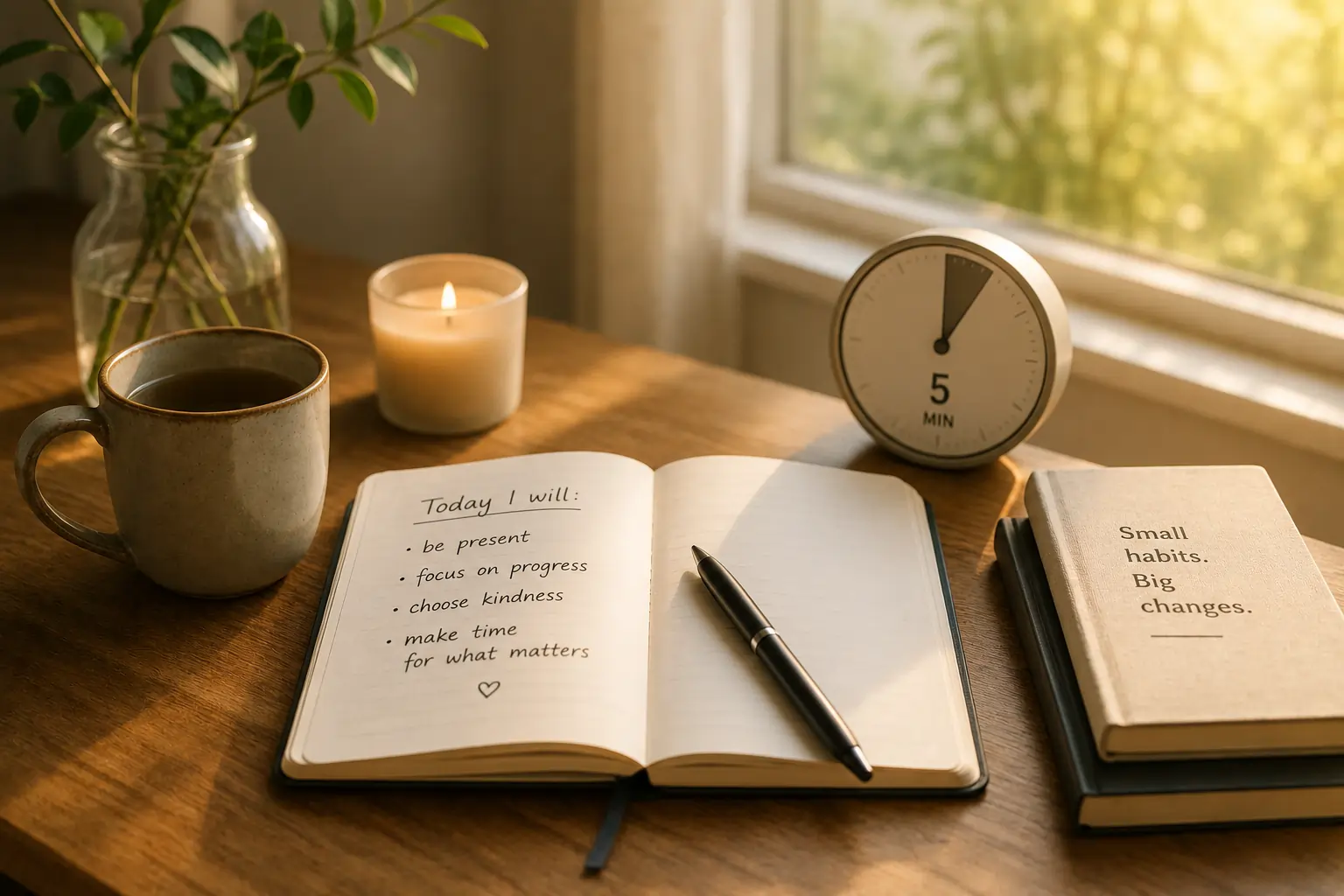
The 5-minute morning journal practice is different. It is three targeted prompts, answered briefly and honestly, that take between three and seven minutes depending on how much you have to say. Same prompts, every morning, in the same order. That structure — the sameness, the brevity, the specificity — is precisely what makes it work.
Why Five Minutes Works Better Than Thirty
Counterintuitively, a shorter journaling practice tends to produce better results than a longer one for most people. Here is why.
Consistency beats depth, every time
A thirty-minute journaling session three times a week produces less cumulative value than a five-minute session seven days a week. The daily repetition is what creates the self-awareness loop. Missing days breaks the loop. A five-minute practice is easy enough to do every single day, including the difficult ones.
Constraints produce clarity
When you have unlimited time to write, the tendency is to meander — to circle around thoughts without landing on them, to rehash rather than clarify. A five-minute limit creates productive pressure. You write what actually matters because you do not have time to write what does not. The constraint is a feature, not a limitation.
Low barriers maintain streaks
The primary enemy of any daily habit is the day when you do not feel like doing it. With a thirty-minute practice, that day becomes a skipped day. With a five-minute practice, the psychological barrier is low enough that almost no morning is too difficult or too rushed to include it. Three minutes on the worst morning still maintains the streak and the identity.
The brain responds to ritual, not duration
What journaling actually does — the mechanism that makes it valuable — is create a brief, structured moment of self-reflection. That mechanism works in five minutes as effectively as in thirty. The neurological and psychological benefits come from the act of regular structured introspection, not from the volume of words produced.
The Science Behind Why Morning Journaling Works
Before getting to the prompts, it is worth understanding what journaling is actually doing in the brain — because the specific prompts in this practice are designed around these mechanisms.
Externalising thoughts reduces cognitive load
Your working memory has a limited capacity. Unresolved thoughts, worries, decisions, and plans compete for space in working memory even when you are not actively thinking about them. Writing them down transfers them to an external medium, freeing up cognitive resources for the actual tasks of the day. This is why people who journal in the morning often report feeling clearer and less mentally cluttered throughout the day — not because they solved their problems, but because they offloaded the holding of them.
Naming emotions reduces their intensity
Research in affective neuroscience — including work by neuroscientist Matthew Lieberman at UCLA — has shown that putting feelings into words (affect labelling) reduces the intensity of emotional responses. The act of writing "I am feeling anxious about the presentation today" literally reduces the anxiety response in the brain compared to simply experiencing the anxiety without naming it.
Setting intention activates selective attention
When you decide what today is for — when you name a priority or an intention — you prime your brain's reticular activating system (RAS) to filter incoming information in favour of what is relevant to that intention. This is the same mechanism that makes you suddenly notice your car model everywhere after you buy one. An intention set in the morning tells your brain what to pay attention to and what to filter out as noise. It is attentional priming — and it is measurably effective.
Gratitude practice shifts baseline mood
Research on gratitude — including studies by Robert Emmons at UC Davis — consistently shows that regular gratitude practice increases subjective wellbeing, reduces negative affect, and improves sleep quality. A daily gratitude prompt is not a feel-good exercise. It is a deliberate intervention in how your brain processes your life — one with measurable, replicable effects.

The Three Prompts: The Core of the Practice
Every morning, in this order, you answer three prompts. You write until you have genuinely answered each one — which for most people takes between one and three minutes per prompt. You stop when the prompt is answered, not when the time is up.
The prompts are fixed. You do not change them. The consistency of the same prompts every day is part of what makes the practice work — you are not spending cognitive energy deciding what to write about. You sit down, you open to a page, and you answer the three questions. The ritual is the point.
What the Practice Looks Like in Real Life
Here is the practice exactly as it plays out on an ordinary morning:
| Time | What happens |
|---|---|
| 0:00 | Sit down with your notebook and a pen. No phone. No music if you can. Preferably the same spot every morning — this becomes the environmental cue that triggers the habit automatically. |
| 0:00 – 0:30 | Write the date at the top of the page. This is not optional — it creates a time-stamped record that becomes valuable when you review past entries. |
| 0:30 – 2:00 | Prompt 1: What am I grateful for this morning? Write specifically. Stop when you have genuinely answered it — usually 3 to 6 sentences. |
| 2:00 – 3:30 | Prompt 2: What is one thing that will make today a good day? Write the one thing. Then write one sentence about why it matters or what doing it will require. |
| 3:30 – 5:00 | Prompt 3: What is present in my mind right now? Write whatever is actually there. No filtering. Stop when the main things are named. |
| 5:00 | Close the notebook. Do not go back and re-read today's entry. Pick up your day. |
Most sessions will be between four and seven minutes. On days when you have a lot mentally present, the third prompt may take longer. On simple mornings, the whole thing takes three minutes. Both are fine. The prompts are complete when they are answered, not when a timer sounds.
What to Write With and In: The Equipment Question
This comes up more than it should. The short answer: use what you will actually use consistently.
Handwriting versus typing
There is reasonable evidence that handwriting produces better outcomes for reflective journaling than typing. The physical act of writing is slower, which forces more deliberate word choice and engages different neural pathways than fast typing. For a practice built around reflection and clarity, handwriting is the better default. That said: a typed journal you do every day beats a handwritten one you do twice a week because setup is inconvenient.
Which notebook
Any notebook works. The expensive, beautiful ones are nice but they are also sometimes too precious to write messily in — and messy is fine. A plain spiral notebook or an A5 ruled notebook is perfectly adequate. The journal is a working document, not an artefact. What matters is that it lives permanently next to wherever you sit to write.
Digital apps
If you prefer digital, Day One and Notion are both popular and functional. The main disadvantage of a phone-based journal is proximity to notifications — opening your journal app and immediately seeing a message defeats much of the purpose of the practice. If you use a digital journal, keep it on a tablet or laptop that stays offline during the morning practice.
The 30-Day Prompt Calendar: One Month of Daily Journaling
Once you are comfortable with the three core prompts and they feel automatic — typically after three to four weeks — you can add a fourth rotating prompt for additional depth. These rotate through themes: clarity, relationships, growth, body, values, and future vision. Use these as an optional fourth prompt only after your three core prompts are complete.
| Day | Optional 4th prompt | Theme |
|---|---|---|
| 1 | What is one thing I am currently avoiding — and why? | Clarity |
| 2 | Who in my life do I want to show up better for this week? | Relationships |
| 3 | What is one thing about my current daily routine that is not serving me? | Growth |
| 4 | How is my body feeling right now — physically and energetically? | Body |
| 5 | What does a genuinely good day look like for me, specifically? | Clarity |
| 6 | What is one belief I hold about myself that might not be true? | Growth |
| 7 | What am I looking forward to in the next seven days? | Mood & Energy |
| 8 | What would I do today if I were not afraid of failing at it? | Values |
| 9 | Who has had the most positive influence on me recently — and have I told them? | Relationships |
| 10 | What is one small thing I could change this week that would have the biggest impact on how I feel? | Growth |
| 11 | What does "a good life" mean to me right now, in this season? | Values |
| 12 | What is draining my energy most right now — and is there anything I can do about it? | Clarity |
| 13 | What have I been proud of myself for recently, even if no one else noticed? | Growth |
| 14 | How present have I been in my relationships this week? | Relationships |
| 15 | What habit am I glad I built — and what habit do I wish I had started earlier? | Growth |
| 16 | Where am I spending time that does not align with what I say matters most to me? | Values |
| 17 | What is one thing I keep putting off that would genuinely make my life better? | Clarity |
| 18 | When did I last feel completely absorbed in something — what was it? | Mood & Energy |
| 19 | What does rest look like for me? Am I getting enough of it? | Body |
| 20 | What is something I want to stop saying yes to? | Values |
| 21 | If I looked back at this period of my life in five years, what would I want to remember about it? | Future Vision |
| 22 | What am I learning right now — and is it something I actually want to learn? | Growth |
| 23 | What conversation have I been avoiding that needs to happen? | Relationships |
| 24 | How has my energy been this week — and what has most affected it? | Body |
| 25 | What small pleasure have I been overlooking in my daily life? | Mood & Energy |
| 26 | What is one way I want to grow in the next 90 days? | Future Vision |
| 27 | What does success actually look like to me right now — not in the abstract, but specifically? | Clarity |
| 28 | Who do I want to become, and what would that person do differently today? | Values |
| 29 | What is something I have changed my mind about recently? | Growth |
| 30 | What has this month taught me that I want to carry forward? | Reflection |
Building the Habit: How to Make It Stick
Anchor it to an existing behaviour
The most reliable way to establish a new habit is to attach it to an existing one. Identify a behaviour you already do every single morning without thinking — making tea or coffee, sitting down after your first glass of water. The journal practice happens immediately after that anchor behaviour, every time. After four to six weeks, the anchor automatically triggers the journaling. If you're still in the earlier, more awkward stage of just getting comfortable putting pen to paper at all, why journaling feels awkward at first is a useful starting point before layering on this specific three-prompt structure.
Same place, every morning
Location is a powerful environmental cue. Sit in the same spot every morning. Keep the notebook and pen there permanently, not in a drawer or a bag. Visible, accessible, in the right place. The environmental cue reduces the friction of starting by making the behaviour contextually obvious.
The two-minute rule for bad mornings
On mornings when time is short, life is chaotic, or you genuinely do not feel like writing, apply the two-minute rule: open the notebook and answer the prompts in one sentence each. One sentence of gratitude. One sentence of intention. One sentence of what is present. That is the session. Two minutes, three sentences, done. The streak is preserved. The habit is maintained. Tomorrow you can write more.
Track it simply
Put an X on a calendar, a tick in your habit tracker, or a mark on the corner of each completed journal page. Tracking creates a visual streak that becomes motivating to maintain. After 14 consecutive days, breaking the streak starts to feel like a loss — which is exactly the psychological hook that carries you through the days when the habit is not yet automatic.
The Weekly Review: How to Use Your Journal Beyond the Morning
Once a week — Sunday evenings work well for most people — spend five to ten minutes reviewing the past week's entries. You are not reading for entertainment. You are looking for patterns.
- What did I put as my one thing across the week — and how consistently did I do it? This reveals the gap between stated priorities and actual behaviour.
- What kept appearing in the "what is present in my mind" prompt? Recurring thoughts or worries that appear across multiple days are worth taking seriously and addressing deliberately.
- What made multiple appearances in the gratitude prompt? The things you are genuinely grateful for when you are quiet and honest are often different from what you think you value — and this gap is worth knowing.
The weekly review transforms the journal from a daily offloading exercise into a genuine record of how you are actually living. Over months, it becomes one of the most accurate maps of your inner life that you have.
What Happens After 30 Days: What to Expect and When
| Timeline | What most people notice |
|---|---|
| Days 1–5 | Slightly awkward. The prompts feel mechanical. Writing feels forced. This is completely normal — you are learning the format, not yet experiencing the benefits. |
| Days 6–14 | The prompts become more natural. The third prompt starts feeling genuinely useful on busy or stressful days — like a pressure valve. |
| Days 15–21 | First notices of carry-over effects. The "one thing" prompt starts influencing how you prioritise during the day, not just what you write. Morning mood is slightly more settled. |
| Days 22–30 | The practice feels established. Skipping it starts to feel slightly wrong, like a small but noticeable absence. The gratitude prompt shifts from effortful to natural. |
| Month 2 | Patterns become visible in your writing. You notice what consistently occupies your mind, what consistently makes you grateful, what your "one thing" tends to be about. |
| Month 3+ | The weekly review starts yielding genuine self-knowledge. You begin to anticipate your own patterns rather than just observe them. The journal becomes a tool for actual self-direction. |
Common Mistakes That Undermine the Practice
| Mistake | Why it matters | What to do instead |
|---|---|---|
| Writing without answering the prompt | Rambling around a prompt without actually answering it is the most common journaling failure. You use up the time without the cognitive work. | Read the prompt. Answer it. If you catch yourself wandering, reread the prompt and return to it. |
| Being vague on the gratitude prompt | "I am grateful for my family" on autopilot produces no benefit. Specificity is what activates the gratitude mechanism. | Name exactly what, exactly why, today specifically. "I am grateful that my sister called last night when I was feeling low" works. "My family" does not. |
| Writing more than one "one thing" | Two priorities is no priority. The discipline of choosing one is the entire point of the second prompt. | Choose one. Write it. If you want to list others, write them in the third prompt as part of what is present. |
| Skipping the third prompt on calm days | The third prompt feels most necessary on stressful days but is quietly most valuable on calm ones — it trains the habit of honest self-observation. | Write it even when nothing feels urgent. Three sentences of "nothing much is present — I feel calm and focused" is a valid and useful entry. |
| Re-reading the same day's entry | Reading your own entry immediately after writing it triggers editing and self-criticism rather than allowing the offloaded thoughts to settle. | Close the notebook after writing. Review previous days only during the weekly review. |
| Journaling with your phone nearby | A phone within reach is a phone that will be checked. The interrupted session produces none of the cognitive benefits of an uninterrupted one. | Phone in another room or face-down on do-not-disturb for the five minutes of the practice. Non-negotiable. |
When You Miss a Day — or Several
Missing a day is not a crisis. It is information. The important questions are: why did you miss it, and what needs to change so it does not happen again?
- Missing one day: simply resume tomorrow. No compensation, no guilt. One missed day changes nothing about a habit that is otherwise consistent.
- Missing three to five days: your streak is broken. Return to the practice with the two-minute version for three days, then return to full sessions.
- Missing more than a week: treat it as starting fresh. Run the practice for two weeks as if you are learning it again. Many people who return after a longer break find it easier the second time — the habit pathways are still there, even if dormant.
Frequently Asked Questions
What if I have nothing to write?
You always have something to write. You may not feel inspired or emotional, but the prompts are specific enough that they can always be answered. "What am I grateful for?" has an answer even on the flattest morning — it might be small (a good cup of tea, a comfortable bed, a clear sky), but it is there. Start with whatever comes first, however modest.
Do I have to write every day? What about weekends?
The daily practice — including weekends — is what builds the habit and compounds the benefits. That said, if weekends genuinely cannot include five minutes of journaling consistently, a five-days-a-week practice is still highly effective. The key is that it happens by design, not by accident. Decide whether it is five or seven days, and stick to that decision.
Can I do this in the evening instead?
The morning placement is intentional — the prompts are forward-looking (what will make today good) and designed to prime the day ahead. An evening version would need different prompts. If morning is genuinely impossible, an evening version using prompts like "what went well today", "what will I prioritise tomorrow", and "what am I leaving in today before I sleep" can work. But the morning version is more effective for its specific purpose.
My handwriting is terrible. Does it matter?
It does not. The journal is not for an audience. It is for your eyes only, and most of the time you are not reading it back immediately anyway. Write as fast and as messily as you need to. The cognitive process of writing is what matters, not the quality of the output.
Should I share my journal with anyone?
In general, no. The honesty that makes journaling work depends on the knowledge that no one else will read it. A journal written for an audience — even a trusted one — is a different document from a journal written for yourself. Keep it private.
Quick Reference: The Complete Practice
| Element | Detail |
|---|---|
| Prompt 1 — Gratitude | What am I grateful for this morning? (Be specific. 3 to 6 sentences.) |
| Prompt 2 — Intention | What is one thing that will make today a good day? (One thing only. One follow-up sentence on why.) |
| Prompt 3 — Offload | What is present in my mind right now? (Write it without censoring. 2 to 5 sentences.) |
| Duration | 3 to 7 minutes. Stop when prompts are answered, not when a timer sounds. |
| Frequency | Daily. Including weekends. Non-negotiable for the first 30 days. |
| Medium | Handwriting preferred. Any notebook. Same pen. Same spot. |
| Phone | Not in the room, or face-down on do-not-disturb. Without exception. |
| When | Immediately after your morning anchor behaviour (tea, water, sitting down). |
| Weekly review | 5 to 10 minutes on Sunday. Look for patterns across the week's entries. |
| Minimum viable session | Three sentences — one per prompt — on the hardest mornings. Two minutes. Still counts. |
The Bigger Picture: What This Practice Is Actually Building
Taken day by day, a five-minute journal practice seems small. Three prompts. A few sentences. A closed notebook.
Taken across a year, it is something different. It is 365 instances of choosing to begin the day with your own thoughts rather than someone else's. It is 365 morning intentions that collectively amount to a clearer understanding of what you actually value and prioritise. It is 52 weekly reviews that reveal patterns about your life that you would not otherwise see.
It is also, quietly, a practice in taking yourself seriously. In treating your inner life as something worth five minutes of deliberate attention each day. In the cumulative message that what you think, feel, and intend matters enough to write down.
That message, repeated daily, changes how you carry yourself through your days. Not because of any single entry. Because of all of them. Five minutes. Three prompts. The same notebook in the same spot. Every morning. Start tomorrow.
If you want a broader structure to build the journalling habit alongside other morning elements, the 30-Day Morning Routine Reset incorporates a daily reflection prompt into a full 30-day morning build — so the journal becomes one piece of a complete routine rather than a standalone practice.