
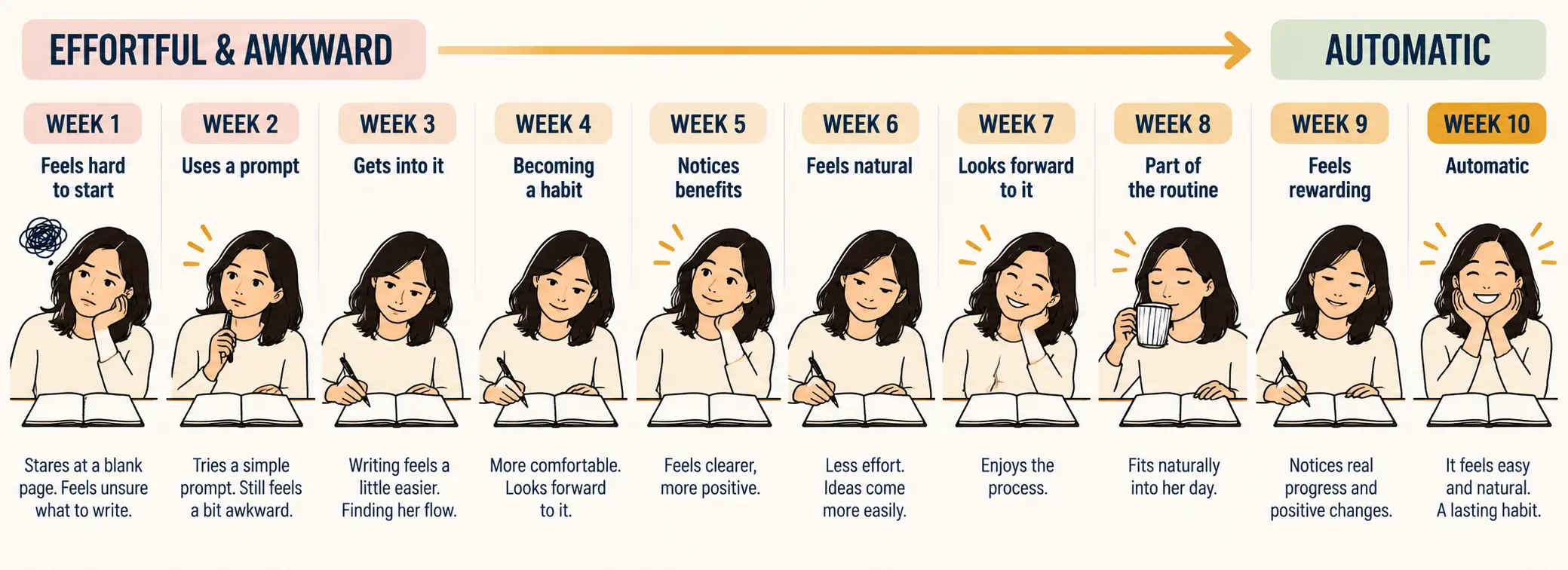
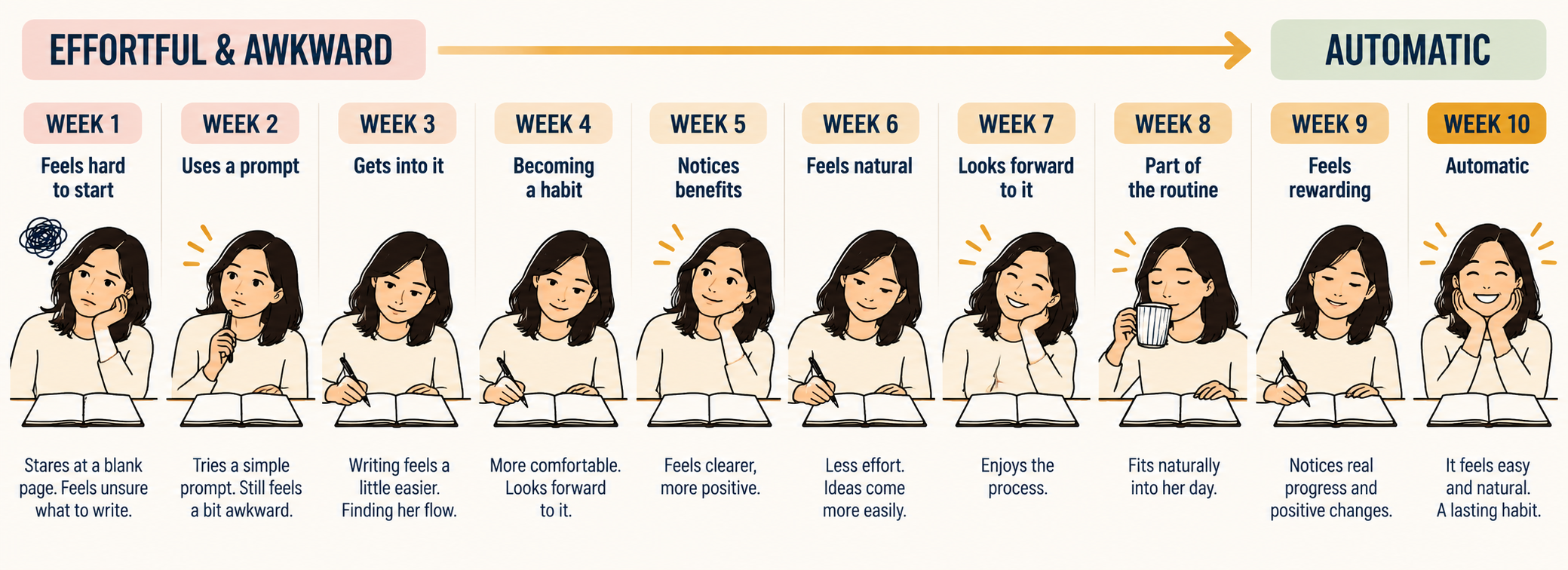
- The awkwardness of early journaling comes mainly from the "blank page problem" and self-consciousness about being watched or judged, even by your future self.
- Concrete, specific prompts consistently produce easier first entries than open-ended, ambitious ones like "reflect on your life."
- Habit research points to roughly three to ten weeks of consistent repetition before a new habit starts feeling automatic rather than effortful.
- Consistency over time (3-4 times a week, sustained for months) builds the habit more reliably than a daily streak that collapses under pressure.
- Short, low-stakes entries in the first weeks matter more than depth — depth tends to come later, once the habit itself is established.
If your first few attempts at journaling felt forced, stilted, or like you were performing for an invisible audience, that's not a sign journaling isn't for you — it's the normal, predictable first stage almost everyone goes through. The awkwardness has specific, identifiable causes, and once you understand what's actually happening in that blank-page moment, it becomes much easier to build a version of journaling that survives past week one.
Why Journaling Feels Awkward at First
Three things combine to make early journaling uncomfortable, and none of them mean you're doing it wrong.
The blank page problem. Writing with no prompt, no structure, and no clear audience is a genuinely unfamiliar task for most people. Almost everything else you write — texts, emails, work documents — has an implicit format and a reader. A journal has neither, and that absence of structure is disorienting rather than freeing for most beginners, at least at first.
Self-consciousness, even in private. It's common to write a sentence, then immediately reread it and judge it — too dramatic, too boring, not insightful enough. This happens even though no one else will read it, because the internal critic that evaluates your speech and writing in daily life doesn't switch off just because the audience is technically just you.
Not knowing what "counts." New journalers often assume an entry needs to be a certain length, contain some insight, or resolve into a tidy conclusion. That expectation makes a three-sentence entry about a mundane day feel like it's "not doing it right," which creates pressure that has nothing to do with what journaling is actually for.
Getting Past the Blank Page
The single most effective fix for the blank-page problem is removing the blank page: start with a specific prompt instead of open-ended free writing. A concrete question — "what's one thing on my mind right now," "what happened today that I want to remember," "what am I avoiding this week" — gives you an immediate, narrow starting point instead of the much harder task of deciding what a journal entry is even supposed to be.

Length is the other lever worth deliberately lowering. Three sentences is a complete entry. The goal in the first two weeks isn't depth or insight — it's simply doing the physical act of writing consistently enough that it stops requiring a decision every time. Depth tends to show up later, once the mechanical awkwardness has faded, not before.
How to Actually Start: A Realistic First-Week Plan
- Pick a fixed, short time slot — 3-5 minutes, not 20. A short, unintimidating time commitment is far more likely to actually happen than an ambitious one that gets skipped when the day is busy.
- Use a single repeated prompt for the first week. Don't shop for the "right" prompt every day — repetition removes a decision point and lets you focus purely on the writing itself.
- Write badly on purpose. Give yourself explicit permission for the first week's entries to be boring, repetitive, or unpolished — the goal is showing up, not producing something worth rereading.
- Attach it to an existing habit. Right after brushing your teeth, with morning coffee, or right before bed — anchoring a new habit to an established one is one of the most reliable ways to make it stick.
- Don't skip a day out of guilt for missing the previous one. A missed day is a data point, not a failure — the habit survives interruptions; what kills it is treating one missed day as a reason to quit entirely.
Journaling Prompts to Get Unstuck
A small rotating set of prompts, organized by what they're good for, removes the "what do I write about" decision on days when nothing obvious comes to mind.
If you want a much more structured, evidence-based framework once the basic habit is in place, the 5-minute morning journal practice covers a specific three-prompt system with a full 30-day prompt calendar — a natural next step once writing itself no longer feels like the hard part.
Digital vs. Paper: Does It Matter?
Not as much as people assume. A notes app, a dedicated journaling app, or a plain paper notebook all work — the format that gets used consistently is the right one, and that's usually a personal, somewhat unpredictable preference rather than something you can reason your way to in advance. Paper removes the temptation to edit obsessively and keeps the activity separate from a phone full of other notifications, which some people find genuinely lowers the self-consciousness described above. A notes app, on the other hand, is always in your pocket, which matters more for people who journal in short bursts throughout the day rather than in one dedicated sitting. If you're not sure, start with whichever is already open in front of you right now — the barrier of buying a notebook or downloading an app is itself a small but real reason first attempts stall before they start.
Making It a Habit That Actually Sticks
Consistency, not perfection, is what turns journaling from a chore into a habit. Three or four times a week, sustained across a couple of months, builds both the routine and its benefits more reliably than a daily streak that collapses the first time life gets busy and then doesn't restart. Treating a missed day as neutral information rather than a failure is what actually protects the habit long-term — an all-or-nothing mindset is one of the most common ways a genuinely good habit gets abandoned after a single interruption.
Common Mistakes
- Starting with an expensive, "special" journal. A blank, pristine notebook can raise the pressure to write something worthy of it — a plain notebook or notes app removes that friction entirely.
- Trying to journal for 20+ minutes from day one. An ambitious time commitment is the easiest thing to skip on a busy day — start smaller than feels necessary.
- Rereading and judging entries immediately after writing. This reinforces the self-consciousness that makes journaling feel awkward in the first place — save rereading for a weekly review, not every single entry.
- Quitting after the first missed day. One missed day derails nothing; treating it as a reason to restart the entire habit from scratch is what actually ends most people's journaling attempts.
Final Thoughts
The awkwardness of early journaling isn't a signal that it's not for you — it's the predictable, temporary cost of doing something unfamiliar without a script. A specific prompt, a short time commitment, and permission to write badly for the first couple of weeks are what get most people past that stage. What's on the other side isn't necessarily profound self-discovery every day — often it's just a habit that quietly makes the rest of your day a little more organized in your own head.
You don't need to feel ready to write, or have something important to say. You just need a prompt, three minutes, and permission for the first few entries to be boring.
Journaling is also a practical tool for working through anxious or spiraling thoughts specifically — how to stop catastrophising covers reframing techniques that pair naturally with a written prompt when a specific worry is what's keeping you from starting.
This article is for general educational purposes. If journaling brings up distressing thoughts or memories you're struggling to process alone, consider talking to a therapist or counselor alongside or instead of journaling independently.
Sources
[1] Research on the time required to form a new habit through repetition. Available at: pubmed.ncbi.nlm.nih.gov