
- Emotion dysregulation is a core feature in an estimated 40-70% of diagnosed mental health conditions.
- A landmark UCLA neuroimaging study found that naming an emotion reduces activity in the amygdala, the brain's threat-detection center, by a substantial margin.
- Cognitive reappraisal consistently outperforms suppression for both immediate emotional experience and long-term wellbeing.
- Emotion regulation is genuinely trainable across the lifespan — it is not a fixed trait set in childhood.
- Employees with poor emotional regulation report the highest rates of depression and insomnia and the lowest positive work outcomes in workplace studies.
Emotional regulation is one of those terms that gets used constantly and defined rarely — and the actual definition matters, because it isn't about controlling emotions or forcing calm. It's the ability to influence which emotions you have, when you have them, and how you experience and express them, without letting the reaction take over. Emotion dysregulation, its absence, shows up as a core feature in an estimated 40-70% of diagnosed mental health conditions, which is part of why this specific skill has such an outsized effect on wellbeing.[1] The genuinely good news: it's trainable, with a body of neuroscience behind exactly how.
What Emotional Regulation Actually Is
Emotional regulation is not suppression, and it's not the absence of strong feelings — it's having enough influence over an emotional response that it serves you rather than runs the show. A useful way to think about it: the emotion still happens, but you get a say in what happens next.
This distinction matters because "emotional regulation" often gets conflated with "not showing emotion" or "staying calm no matter what." Neither is accurate. Someone with strong emotional regulation skills can still feel intense anger, sadness, or anxiety — the skill is in how quickly they notice it, how accurately they name it, and how deliberately they choose a response instead of reacting automatically. It's worth distinguishing this from nervous system dysregulation too — the two overlap but aren't identical: one is a cognitive and emotional skill, the other describes the underlying physiological flexibility that skill is built on top of.
Why This Specific Skill Matters So Much
Beyond the mental health prevalence figures, poor emotional regulation has measurable downstream effects in ordinary daily contexts. Workplace research on employee emotion-regulation profiles found that those in the highest-dysregulation group reported the highest depression and insomnia and the lowest positive work outcomes of any group studied.[2] This isn't a niche clinical concept — it's a skill with visible effects on sleep, relationships, and day-to-day functioning for almost everyone.
Reappraisal vs. Suppression: The Core Science
Two strategies dominate emotion regulation research, and they are not equally effective — cognitive reappraisal consistently outperforms expressive suppression for both immediate experience and long-term wellbeing.[3]
The practical takeaway: catching and reframing a reaction early works better than gritting your teeth through it once it's already at full intensity — timing is a meaningful part of why reappraisal wins.
The Neuroscience of Naming a Feeling
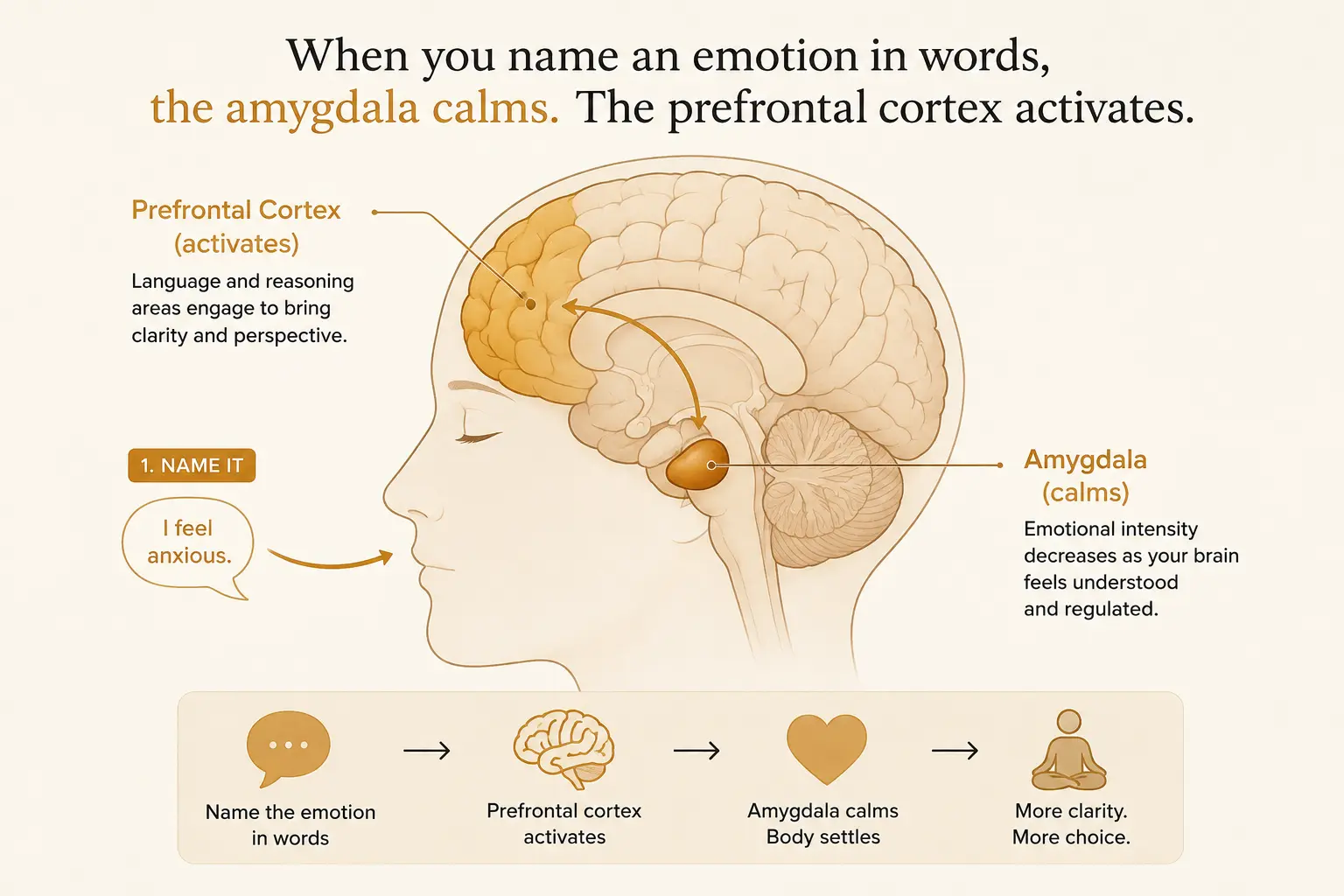
One of the most robust and replicated findings in emotion regulation research is affect labeling — the simple act of putting a feeling into words measurably calms the brain's threat response.[4] A widely cited UCLA neuroimaging study by Matthew Lieberman found that when people labeled an emotion, activity in the amygdala dropped substantially, while the right ventrolateral prefrontal cortex — a region associated with regulation and impulse control — activated. The practice was later popularized as "name it to tame it."
Writing a feeling down, not just naming it silently, is one of the more accessible ways to practice this regularly — which is part of why journaling shows up so often in emotional regulation research. If getting started with the writing itself is the sticking point, why journaling feels awkward at first covers the practical barriers and how to move past them.
How to Build It Like a Skill
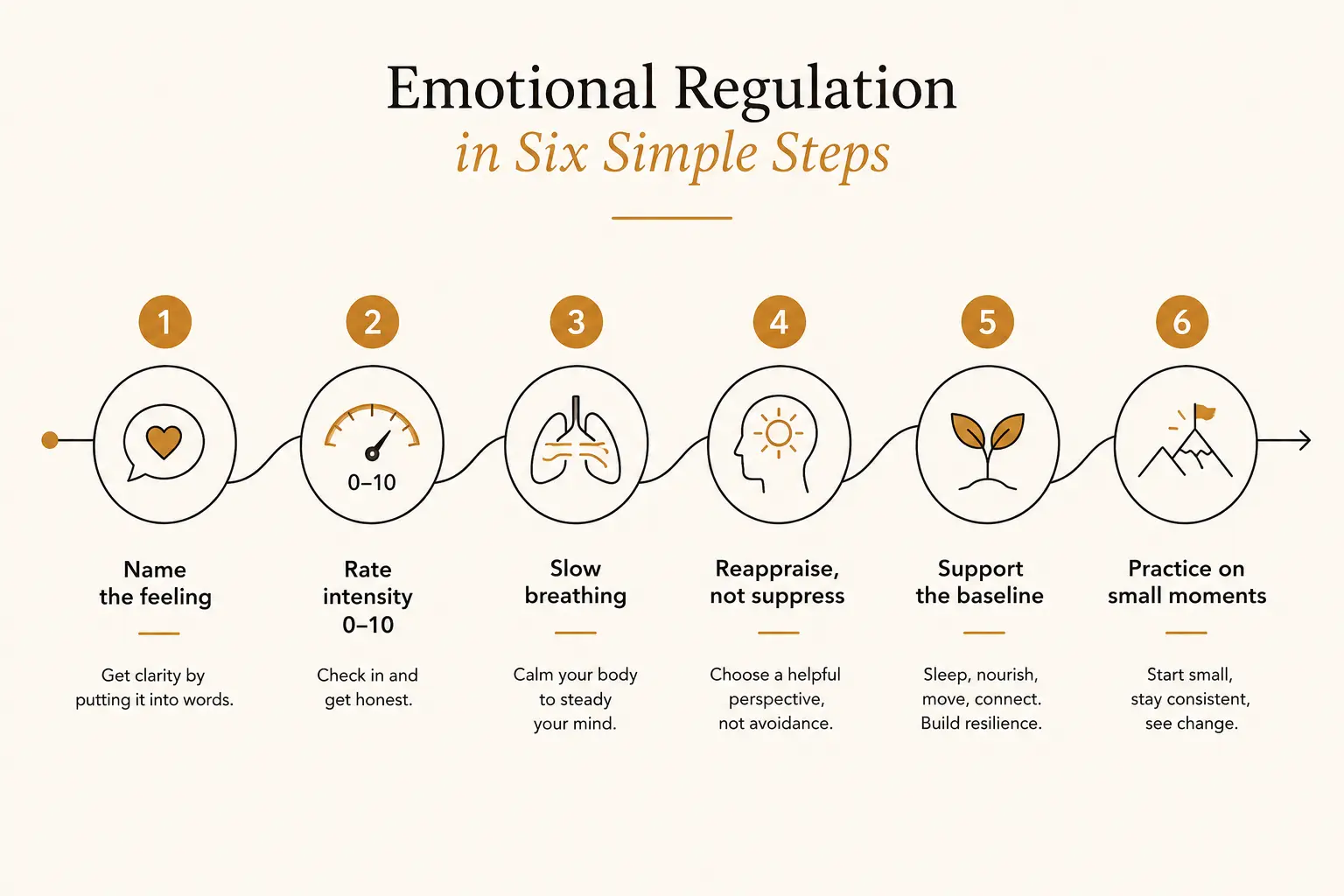
- Name the feeling, specifically. Not "I feel bad" — "I'm noticing frustration" or "this is anxiety." The precision itself does regulatory work, per the affect labeling research above.
- Rate the intensity, 0-10. This small step creates distance between you and the emotion — you're observing it rather than being fully inside it, and it gives you a concrete way to track whether a technique is working.
- Slow your breathing before responding. A few slow, controlled breaths shift the nervous system out of a reactive state and buy the few seconds most regulation actually needs — see breathing techniques that actually work for the specific patterns with evidence behind them.
- Reappraise, don't suppress. Ask "what's another way to see this situation" rather than trying to push the feeling away — reappraisal is the evidence-backed strategy, suppression isn't.
- Treat sleep, movement, and nutrition as part of the toolkit, not separate from it — a poorly rested, under-fed nervous system has less capacity for regulation regardless of technique. How chronic stress affects the body covers why this baseline matters so much.
- Practice during small moments, not just crises. Applying these steps to minor daily frustrations builds the automatic pathway so it's actually available when a bigger reaction hits.
Curious where your own baseline stress level sits before building these habits? The free Stress Level Quiz gives a quick read on where regulation practice is likely to help most.
When Self-Practice Isn't Enough
Common Mistakes
- Confusing regulation with suppression. Pushing feelings down is the less effective, less healthy strategy — the goal is influencing the response, not hiding the emotion.
- Only practicing during a crisis. The skill needs repetition on small, low-stakes moments to become automatic before it's needed for something big.
- Using a vague label instead of a specific one. "I feel bad" does less regulatory work than "I'm noticing disappointment" — specificity is part of the mechanism, not just a nicety.
- Ignoring the physical baseline. Sleep deprivation and poor nutrition genuinely reduce regulation capacity — no technique fully compensates for a depleted nervous system.
- Treating a single hard week as proof it doesn't work. Like any skill, consistency over weeks — not a single attempt — is what builds a reliable, automatic response.
Final Thoughts
Emotional regulation is a specific, trainable skill with real neuroscience behind it — not a personality trait some people simply have and others don't. Naming a feeling precisely, rating its intensity, breathing before reacting, and choosing reappraisal over suppression are small, evidence-backed moves that compound with practice. The goal was never to stop feeling things intensely; it's having enough influence over what happens next that the emotion doesn't make every decision for you.
The honest version of this skill: you're not trying to feel less. You're trying to have more say in what happens after you feel something.
If this connects to a broader pattern of stress in your life, practical stress management techniques and how to stop catastrophising both build directly on the same underlying regulation skills covered here.
This article is for general information and isn't a substitute for professional mental health care. If emotional dysregulation is significantly affecting your life, please speak with a qualified professional.
Sources
[1] Emotion regulation as a core mechanism in mental health conditions. Available at: medicine.yale.edu
[2] Emotion regulation resource profiles among employees — mental health and work outcomes. Available at: frontiersin.org
[3] Cognitive reappraisal vs. expressive suppression, modulatory effects and neural correlates. Available at: ncbi.nlm.nih.gov
[4] Affect labeling and amygdala activity — UCLA neuroimaging research. Available at: uclahealth.org