Breathing techniques have gone from being a niche interest in yoga and meditation circles to a mainstream wellness recommendation, appearing in productivity guides, sleep advice, anxiety management articles, and athletic training programmes simultaneously. The volume of content on the subject has not been matched by an equivalent increase in clarity about which technique does what, for whom, under which circumstances.
The result is that most people know of several breathing techniques but use them interchangeably — reaching for whichever one they remember when they feel stressed without any particular reason to expect it will work for the specific problem they have. Box breathing for everything. Or 4-7-8 for everything. The techniques get blurred together under the generic category of "breathing exercise" and evaluated as though they were essentially the same thing.
They are not. Box breathing, 4-7-8, and the physiological sigh are three distinct tools with different physiological mechanisms, different onset speeds, different durations, and different optimal applications. Understanding how each works at the level of nervous system physiology makes it straightforward to match the right technique to the right situation.
Why Breathing Works at All: The Physiology Underneath
Breathing is unique among physiological processes in being both involuntary — it continues without conscious effort — and directly controllable by conscious intention. This dual nature is the anatomical basis for why breathing techniques work: voluntary control of breathing is one of the most direct and accessible ways to influence the autonomic nervous system, which otherwise operates entirely outside conscious control.
The autonomic nervous system and its two branches
The autonomic nervous system (ANS) governs all the body's involuntary functions: heart rate, blood pressure, digestion, immune response, and the stress-response cascade. It has two primary branches. The sympathetic nervous system — the fight-or-flight system — mobilises the body for action under perceived threat: heart rate increases, breathing becomes faster and shallower, blood flow is redirected to muscles, stress hormones are released. The parasympathetic nervous system — the rest-and-digest system — returns the body to baseline: heart rate decreases, breathing slows and deepens, digestion resumes, cortisol declines.
These two systems do not switch on and off like a toggle. They operate continuously in a dynamic balance, with one or the other dominant depending on internal and external conditions. The goal of breathing techniques is not to permanently activate the parasympathetic system — it is to shift the balance away from excessive sympathetic activation toward the parasympathetic state appropriate to the current moment. This is exactly why slow breathing is one of the core steps in building emotional regulation as a skill: it buys the physiological window a deliberate response needs.
The vagus nerve: the mechanism of respiratory influence
The vagus nerve — the longest cranial nerve in the body, running from the brainstem through the thorax and into the abdomen — is the primary conduit of the parasympathetic nervous system. It carries both efferent signals (from brain to body) and afferent signals (from body to brain), and it is directly stimulated by the mechanical and chemical changes produced by controlled breathing. For the fuller picture of what this nerve does beyond breathing — and which other techniques stimulate it — see what the vagus nerve actually does.
Slow, deep exhalations stimulate the vagus nerve through several mechanisms: the slowing of heart rate during exhalation (the respiratory sinus arrhythmia effect), the stimulation of pulmonary stretch receptors that send calming afferent signals to the brainstem, and the reduction of CO2 that accompanies controlled breathing patterns. Vagal stimulation produces measurable increases in heart rate variability (HRV) — the beat-to-beat variation in heart rate that is one of the most reliable physiological markers of parasympathetic activity and overall autonomic health.
Carbon dioxide: the most misunderstood variable
Most breathing technique explanations focus on oxygen as the primary variable. The physiology is more accurately understood through CO2. Carbon dioxide is not simply a waste gas — it is the primary driver of the urge to breathe and a critical regulator of blood pH, vessel diameter, and oxygen delivery to tissues.
When you breathe faster than necessary (hyperventilation), you exhale more CO2 than the body produces, lowering blood CO2 levels (hypocapnia). Paradoxically, this reduces oxygen delivery to tissues because haemoglobin releases oxygen less readily at low CO2 — the Bohr effect. Hypocapnia also causes cerebral vasoconstriction, which contributes to the light-headedness, tingling, and anxiety amplification that can accompany panicked rapid breathing.
Controlled breathing techniques that reduce breathing rate — particularly those with extended exhalations — allow CO2 to normalise, which reverses these effects: cerebral blood flow improves, oxygen delivery improves, and the physiological substrate of anxiety is addressed directly.
Box Breathing: The Performance and Sustained Calm Tool
What it is
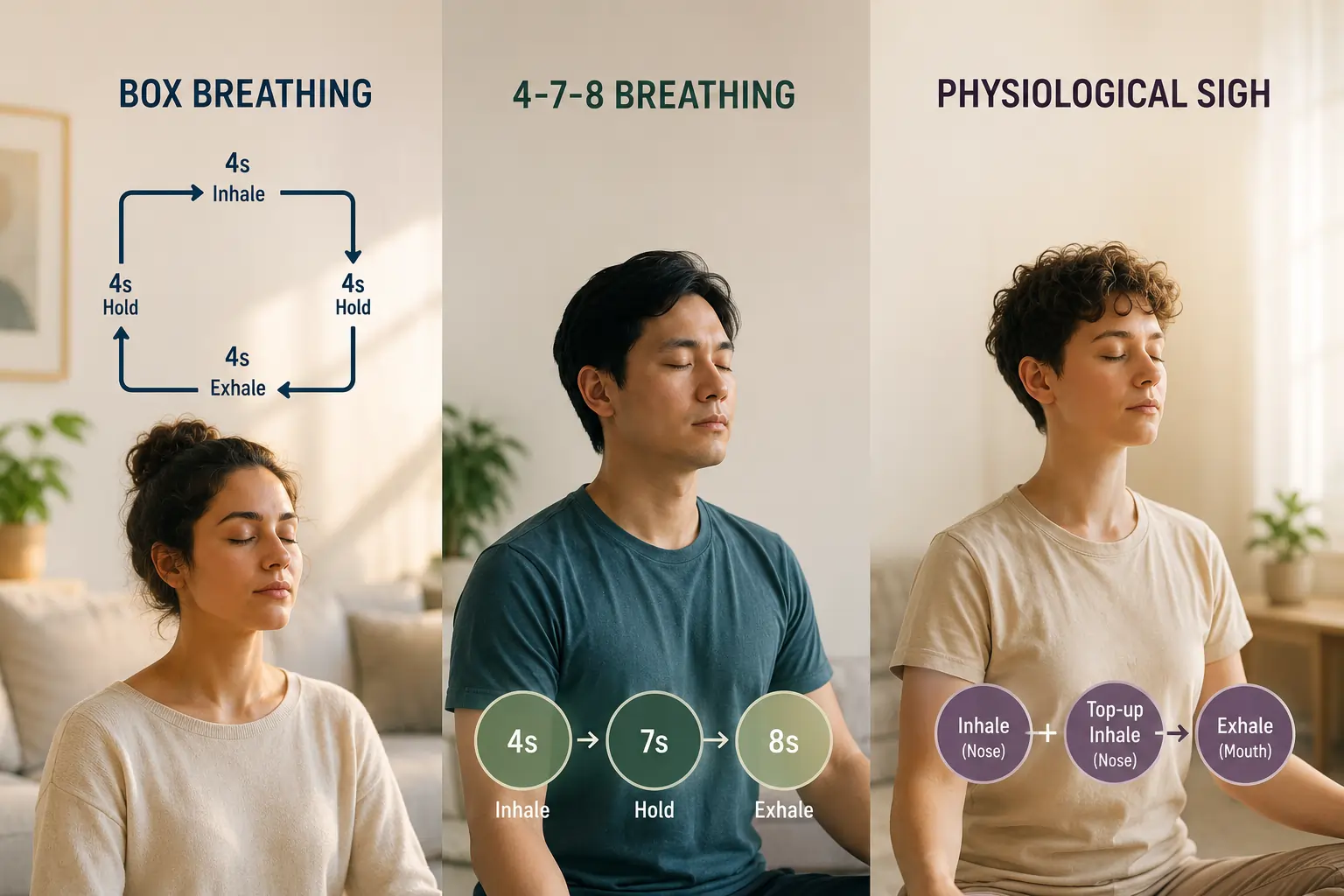
Box breathing — also called square breathing or tactical breathing — follows an equal four-phase cycle: inhale for a count, hold at the top, exhale for the same count, hold at the bottom, then repeat. The most common version uses a count of four for each phase (4-4-4-4), producing a full cycle of sixteen counts. The holds are what distinguish box breathing from most other techniques and give it its characteristic properties.
The technique was developed and adopted by the United States Navy SEALs as a tool for stress management in high-stakes operational settings. Its adoption in military and tactical contexts is a reasonable signal that it performs well under conditions of acute stress when cognitive demand is also high.
The mechanism
Box breathing works through several overlapping mechanisms. The equal-phase structure forces breathing rate to slow significantly — at a four-second count per phase, a complete cycle takes sixteen seconds, producing approximately three to four breath cycles per minute. Normal resting breathing rate is twelve to twenty breaths per minute. Slowing to three to four cycles per minute substantially increases vagal tone.
The breath holds are the distinctive mechanical element. Both the top hold (after the inhale) and bottom hold (after the exhale) require a specific quality of voluntary control over the breath that mere inhalation and exhalation do not. This active regulation of an otherwise automatic function appears to engage prefrontal cortical circuits involved in attentional control — the same circuits involved in managing emotional reactivity. Box breathing is as much a focused attention exercise as a physiological one.
Onset speed and duration
Box breathing takes approximately one to three minutes to produce a meaningful shift in physiological state. It is not an immediate single-breath intervention. It builds its effect over repeated cycles, with the calming state deepening progressively through the session. A complete session of five to ten minutes produces the strongest effect, though three to four minutes is typically sufficient for acute stress management.
With regular daily practice, the baseline autonomic state shifts over weeks: resting heart rate variability improves, baseline cortisol is lower, and the magnitude of the stress response to acute stressors is reduced. Box breathing is not just an acute tool — it is a chronic adaptation if practised consistently. For a full picture of how breathing and daily practices affect cortisol regulation, see what cortisol does to your body and how to bring it down.
When to use it
- Before a high-stakes performance situation. A presentation, an interview, a competition, a difficult conversation. Box breathing is ideal here because its balanced structure and focus requirement actively occupy the attentional resources that would otherwise be directed toward anxious rumination.
- Sustained stress management across a long period. Unlike the physiological sigh, box breathing can be maintained for extended periods without discomfort. Its rhythm can be maintained quietly without being noticeable to others.
- As a daily practice for baseline ANS regulation. Five to ten minutes of box breathing daily produces measurable improvements in resting HRV and basal cortisol over four to six weeks. Pairing it with a consistent morning routine is the most reliable way to build this habit.
- When cognitive clarity under pressure is needed alongside calm. The attentional demand of box breathing makes it active in a way that passive relaxation is not. People who find passive relaxation techniques hard to maintain under stress often find box breathing more accessible because it gives the mind something specific to do.
| Detail | Box Breathing |
|---|---|
| Pattern | Inhale – Hold – Exhale – Hold (equal phases) |
| Common ratio | 4-4-4-4 (4 seconds each phase); can extend to 5-5-5-5 or 6-6-6-6 as tolerance builds |
| Breathing rate | ~3–4 cycles per minute at 4-second count |
| Onset of effect | 1–3 minutes of sustained practice |
| Optimal session length | 5–10 minutes for maximum effect; 3–4 minutes adequate for acute stress |
| Best used for | Pre-performance, sustained stress management, daily practice, high-demand situations requiring calm and focus simultaneously |
| Not ideal for | Immediate single-breath acute anxiety relief; not fast enough for a rapidly escalating panic response |
| Contraindications | Those with respiratory conditions should start with shorter counts; breath holds can cause light-headedness in some people; start with 3-second counts if 4 feels strained |
4-7-8 Breathing: The Sleep and Deep Relaxation Tool
What it is
The 4-7-8 technique involves inhaling for four counts, holding the breath for seven counts, and exhaling for eight counts. It was popularised by integrative medicine physician Dr Andrew Weil, who described it as "a natural tranquilliser for the nervous system." It is asymmetric — unlike box breathing, the phases are unequal — with a dramatically extended hold and an exhale that significantly exceeds the inhale.
The mechanism
The 4-7-8 pattern works primarily through its extended hold and elongated exhale. The seven-count breath hold creates a significant accumulation of CO2 and a marked reduction in oxygen in the arterial blood, producing a strong stimulus for the vagus nerve and a pronounced parasympathetic shift when the breath is finally released. This is more physiologically intense than the moderate holds in box breathing.
The eight-count exhale is the longest exhalation component of any of the three techniques discussed here. Exhalation duration is strongly correlated with parasympathetic activation through the respiratory sinus arrhythmia effect: during exhalation, the vagus nerve slows the heart rate, and the longer the exhalation, the more sustained and pronounced this slowing effect. The ratio of inhale to exhale is 1:2 (4 to 8), which is the pattern most consistently associated with parasympathetic dominance across the breathing research literature.
Onset speed and duration
The 4-7-8 technique produces a noticeably strong relaxation effect within two to four cycles — faster than box breathing and slower than the physiological sigh. Four cycles take approximately one minute at a comfortable pace and are often described as sufficient to produce a significant reduction in subjective anxiety and a clear shift toward relaxation.
The technique can cause light-headedness, particularly in people unaccustomed to extended breath holds. This is the CO2 effect described earlier. Starting with four cycles rather than a longer session, and sitting rather than standing, reduces this effect.
When to use it
- Before sleep. This is the primary application the technique was designed for. The strong parasympathetic activation and significant reduction in arousal make it well-suited to the pre-sleep window. Four to eight cycles performed lying in bed — as part of a broader wind-down routine — produces a state of deep relaxation many people find substantially faster than other techniques.
- Acute anxiety reduction when in a safe, stationary context. The intensity of the 4-7-8 cycle makes it more powerful than box breathing for acute anxiety relief, but also less appropriate in contexts where you need to remain functional and alert.
- Coming down after a high-stimulation period. After a difficult conversation, an intensely stressful event, or a period of high sympathetic activation, 4-7-8 provides a faster and more pronounced downregulation than box breathing. It is the "hard reset" tool where box breathing is the steady-state management tool.
- Managing anticipatory anxiety the night before a stressful event. Four to eight cycles of 4-7-8 before sleep in this context has strong anecdotal and moderate clinical support.
| Detail | 4-7-8 Breathing |
|---|---|
| Pattern | Inhale – Hold – Exhale (asymmetric; hold and exhale dominate) |
| Ratio | 4 seconds inhale – 7 seconds hold – 8 seconds exhale |
| Breathing rate | ~3 cycles per minute (one full cycle ~19 seconds) |
| Onset of effect | 2–4 cycles; strong effect within 4–8 cycles (~1–2 minutes) |
| Optimal session length | 4–8 cycles; longer sessions may cause excessive light-headedness |
| Best used for | Pre-sleep, post-stress downregulation, acute anxiety in a stationary safe context, anticipatory anxiety |
| Not ideal for | Situations requiring continued alertness and function; moving or driving; those with vertigo or cardiovascular contraindications to breath-holding |
| Contraindications | Those with hypertension, heart conditions, or respiratory conditions should consult a doctor before extended breath holds; begin with a 4-second hold if 7 seconds feels distressing |
The Physiological Sigh: The Fastest Real-Time Stress Reset
What it is
The physiological sigh is the simplest and fastest of the three techniques — and the one with the most recent and rigorous scientific research behind it. It involves a double inhale through the nose (a full inhale followed immediately by a second short sniff to maximally inflate the lungs), followed by a long, slow, complete exhale through the mouth. The entire cycle takes approximately five to ten seconds. It does not require a count, a timer, or a specific position. It can be done once and produces an immediate effect.
The physiological sigh is not an invented technique. It is a naturally occurring breathing pattern that the body performs spontaneously approximately every five minutes during normal breathing and much more frequently under stress or during crying. You have done it thousands of times without noticing it — the deep involuntary intake followed by a long exhale that relieves a moment of accumulated tension. The deliberate version simply deploys this natural reset mechanism intentionally.
Controlled exhales like this are also the specific tool used to counter the gasp reflex triggered by sudden cold — see cold showers and cold plunges: what the research actually supports for how breath control factors into cold exposure safety.
The mechanism: reinflating alveoli and offloading CO2
The physiological sigh targets the lungs' alveoli — the tiny air sacs where gas exchange occurs. During periods of stress, shallow breathing, or prolonged sitting, alveoli progressively deflate. Collapsed alveoli reduce the surface area available for gas exchange, decreasing oxygen transfer efficiency and allowing CO2 to accumulate. The body senses this accumulation and generates the spontaneous sigh — the double inhale — specifically to pop the collapsed alveoli back open by maximising lung volume.
The extended exhale that follows serves a different function: it offloads the CO2 that has accumulated, directly addressing the physiological substrate of the acute stress state. Research from Andrew Huberman's lab at Stanford University, published in Cell Reports Medicine in 2023, found that the physiological sigh was more effective at reducing acute physiological stress — as measured by heart rate, respiratory rate, and self-reported anxiety — than either cyclic breathing or mindfulness meditation in a controlled comparison.[1] Crucially, a single physiological sigh produced a measurable acute reduction in stress markers within seconds.
Why the double inhale matters
The double inhale is the mechanically essential component. A single deep inhale, even a very full one, does not reliably reopen collapsed alveoli. The second sniff, added on top of a near-full lung, generates the additional positive pressure needed to pop them open — the same pressure differential that opens a partially deflated balloon when you blow a short sharp puff into it after an initial breath.
This is why the physiological sigh is structurally different from simply "taking a deep breath" — the advice universally given for acute stress that is less physiologically precise than it sounds. A single deep breath is helpful but does not fully replicate the alveolar reinflation and subsequent CO2 offload that the double-inhale-then-long-exhale pattern produces.
Onset speed and duration
The physiological sigh is the fastest-acting breathing intervention available. The calming effect begins during the extended exhale of the first sigh and is largely complete within the first one to three repetitions. For acute stress — a sudden spike in anxiety, a moment of overwhelm, a pre-presentation panic — the physiological sigh provides a real-time reset that no other technique matches in speed.
The effect is also the shortest-lasting of the three techniques. A single sigh or a small cluster of three to five sighs provides immediate relief but does not produce the sustained state shift that a five-minute box breathing session or a pre-sleep 4-7-8 session produces. It is a fast, precise, situational tool — not a substitute for the deeper regulation that longer practices provide.
When to use it
- Immediate acute stress spike. A sharp onset of anxiety, a sudden trigger, the moment before walking into a difficult situation. One to three physiological sighs provide immediate and measurable relief within seconds.
- Mid-conversation or mid-meeting when you cannot pause. A single discreet physiological sigh is unnoticeable in a conversation or meeting context. It takes less than ten seconds, produces an immediate calming effect, and does not require closing your eyes or counting anything.
- Breaking a hyperventilation spiral. Anxious rapid breathing lowers CO2 and amplifies the physiological symptoms of anxiety in a self-reinforcing spiral. The physiological sigh's extended exhale directly addresses the CO2 dysregulation driving the spiral.
- Between intense exercise sets or intervals. One to two deliberate sighs during a rest interval can meaningfully shorten the time to readiness for the next effort.
- Waking up anxious in the night. Three to five physiological sighs in the first minute of waking with anxiety interrupts the rumination-anxiety cycle at its earliest point in a way that box breathing's longer setup does not match.
| Detail | Physiological Sigh |
|---|---|
| Pattern | Double inhale through nose (full inhale + short sniff) → Long slow exhale through mouth |
| Duration per cycle | 5–10 seconds total; no counting required |
| Onset of effect | Immediate; begins during the first exhale; meaningful effect within 1–3 repetitions |
| Optimal repetitions | 1–5 for acute situations; can be repeated as needed without the extended session requirement |
| Best used for | Acute stress spikes, mid-situation covert calming, hyperventilation interruption, exercise recovery, night waking anxiety |
| Not ideal for | Sustained daily practice for long-term ANS regulation; does not produce the cumulative baseline shift that regular box breathing provides; not a substitute for pre-sleep downregulation |
| Contraindications | Very few; the double inhale can occasionally trigger mild light-headedness in people with significant respiratory conditions; otherwise the safest and most universally accessible of the three techniques |

Side-by-Side Comparison: Choosing the Right Tool
| Criterion | Box Breathing | 4-7-8 | Physiological Sigh |
|---|---|---|---|
| Primary mechanism | Equal-phase rhythm; vagal stimulation; attentional regulation via structured count | Extended hold + long exhale; strong parasympathetic activation; CO2 modulation | Alveolar reinflation (double inhale) + CO2 offload (long exhale) |
| Onset speed | Slow; 1–3 minutes to meaningful effect | Moderate; 2–4 cycles (~1–2 minutes) | Immediate; begins within first exhale |
| Effect duration | Sustained during practice; long-term baseline shift with daily use | Pronounced state shift; fades over 15–30 minutes without continued practice | Short-term; relief lasts minutes; reapply as needed |
| Cognitive demand | Moderate; requires counting and attention to four phases | Low–moderate; requires counting three unequal phases | Minimal; no counting; no specific position; no equipment |
| Can be done discreetly? | Difficult; counting phases makes it noticeable if observed closely | Difficult; extended holds and visible mouth exhale are noticeable | Yes; a single physiological sigh is socially invisible |
| Long-term baseline effect with daily practice? | Yes; strongest evidence for sustained HRV improvement and cortisol reduction | Some evidence; less studied for long-term daily practice than box breathing | No evidence for long-term baseline shift; functions as an acute tool |
| Evidence quality | Strong; extensively studied in military, clinical, and sport contexts | Moderate; clinical anecdote and some controlled trials; less formal RCT evidence than box breathing | Strong for acute use; 2023 Stanford Cell Reports Medicine paper; most recently and rigorously studied of the three |
The Situational Guide: Which Technique for Which Moment
| Situation | Recommended technique | Why |
|---|---|---|
| You have a presentation or difficult meeting in 15 minutes | Box breathing (5 minutes) | Builds sustained calm and focus; occupies anxious mental chatter with structured counting; produces a composed state rather than drowsiness |
| You cannot fall asleep and your mind is racing | 4-7-8 (4–8 cycles) | The strongest pre-sleep parasympathetic activation of the three; the extended hold and long exhale produce a pronounced drowsiness effect. Pairs with a sleep-optimised environment |
| You just received very bad news or had a sudden panic response | Physiological sigh (3–5 repetitions) | Immediate CO2 reset addresses the hyperventilation component of acute panic; fastest onset of any technique; can be done right where you are |
| You are in a difficult conversation and need to calm down without stopping it | Physiological sigh (1–2 discreet sighs) | Single cycle is socially invisible; takes under 10 seconds; produces immediate calming without requiring any visible change in behaviour |
| You want a daily 10-minute practice for long-term stress management | Box breathing | Best evidence for sustained baseline HRV improvement and cortisol reduction with consistent daily practice; structured enough to build a habit around |
| You are mid-workout and need to recover faster between sets | Physiological sigh (1–2 repetitions) | Accelerates heart rate and breathing recovery; CO2 offload directly supports faster physiological return to readiness |
| You wake up anxious at 3am | Physiological sigh (3–5) then 4-7-8 (4 cycles) | Sigh first to break the acute panic and address any hyperventilation component; then 4-7-8 to downregulate back toward sleep |
| You have 90 seconds before something stressful | Physiological sigh (3 repetitions) then box breathing (remaining time) | Sigh provides the immediate reset; box breathing maintains the calm and builds composure for the duration |
| You are feeling generally anxious throughout the day with no specific trigger | Box breathing (5 minutes, morning and evening) | Daily practice addresses the sustained elevated sympathetic tone underlying general anxiety; physiological sigh can supplement throughout the day as needed |
| You want to improve sleep quality over the long term | 4-7-8 as pre-sleep ritual + box breathing as daily practice | 4-7-8 addresses the immediate sleep onset problem; box breathing addresses the daytime cortisol regulation that affects evening alertness and sleep quality |
How to Actually Practise Each Technique
Box breathing: step by step
- 1Find a comfortable seated position with a relatively upright spine. Close your eyes if the context allows.
- 2Inhale slowly through the nose for four counts. Fill the lungs from the bottom upward, letting the belly expand first, then the chest.
- 3Hold the breath at the top for four counts. Keep the body still. The muscles are not straining — simply pause the breath with the lungs comfortably full.
- 4Exhale slowly through the nose or mouth for four counts. Breathe out steadily and completely, letting the chest and belly fall.
- 5Hold the breath at the bottom for four counts. Lungs are empty; body is still. This is the most challenging hold for most beginners.
- 6Repeat for five to ten minutes. If four-second counts feel uncomfortable, begin with three. Progress to five or six as comfort with the holds develops.
4-7-8 breathing: step by step
- 1Sit upright or lie down. Place the tip of the tongue against the ridge of tissue behind the upper front teeth and keep it there throughout. This tongue position assists with the extended exhalation shape.
- 2Exhale completely through the mouth, making a whoosh sound. Empty the lungs before beginning.
- 3Close the mouth and inhale quietly through the nose for four counts.
- 4Hold the breath for seven counts. The hold is the defining feature of this technique. Stay still; do not allow air to escape.
- 5Exhale completely through the mouth, making a whoosh sound, for eight counts. This should be an audible, sustained exhale that empties the lungs fully.
- 6This completes one cycle. Begin the next inhale immediately. Complete four cycles to start; build to eight over several sessions of practice.
Physiological sigh: step by step
- 1No specific position required. Can be done seated, standing, or lying down.
- 2Take a full inhale through the nose. Fill the lungs as completely as comfortable.
- 3Without exhaling, immediately take a second short sniff through the nose. This second sniff is the defining feature — it adds air on top of an already-full breath, maximally inflating the lungs and reinflating collapsed alveoli.
- 4Exhale slowly and completely through the mouth. Take longer than feels natural. Let the exhalation be slow, steady, and fully emptying. There is no specific count — simply exhale until the lungs are empty.
- 5Breathe normally for a few breaths, then repeat if needed. One to five repetitions is typical for acute stress management.
Integrating These Into Daily Life Without Overcomplicating It
The risk with learning three distinct techniques is the same risk that applies to most wellness knowledge: accumulating information without building practice. The techniques above are physiologically real and evidence-supported, but they produce no benefit as information. They produce benefit only as embodied habits.
The simplest integration approach builds one technique at a time:
- Start with the physiological sigh. It requires no practice, no timer, no specific context. Use it the next time you feel acute stress — once, deliberately, noticing the effect. This builds the association between the technique and its effect in a single use.
- Add box breathing as a five-minute morning practice. The morning window — after waking, before the day's demands begin — is the highest-leverage time for a breathing practice. Five minutes of box breathing immediately after waking, paired with morning light exposure, sets the autonomic tone for the day.
- Add 4-7-8 as a pre-sleep ritual. Four to eight cycles in bed before sleep, replacing or preceding any other wind-down activity. This pairs naturally with the physiological function it serves — as part of an intentional wind-down routine — you are already in the context where its drowsiness-producing effect is useful.
These three practices together take less than ten minutes of dedicated time per day and cover the three primary contexts where breathing interventions provide the most value: acute stress situations throughout the day (physiological sigh, on demand), daily baseline regulation (box breathing, five minutes morning), and sleep quality (4-7-8, two minutes pre-sleep). Note that breathing techniques address the physiological component of stress and anxiety — the body-level fuel supply for the spiral. When the anxiety is also driven by ruminative thought patterns such as catastrophising, pairing these techniques with CBT cognitive reframing addresses both layers more completely than either approach alone.
The Right Tool for the Right Moment
Box breathing, 4-7-8, and the physiological sigh are not interchangeable variations on the same theme. They work through different mechanisms, at different speeds, for different durations, in different contexts. Treating them as equivalent is the equivalent of using a scalpel, a chisel, and a butter knife interchangeably because they are all bladed.
The physiological sigh is the fastest reset available — immediate, situational, requiring nothing but the breath itself. Box breathing is the daily maintenance practice for people who want to shift their baseline autonomic state over weeks and months. The 4-7-8 is the pre-sleep and hard-reset tool for pronounced acute downregulation when circumstances allow full attention.
Used in the right context, each is genuinely effective. The science is solid. The mechanism is real. The only requirement is the practice — not as a productivity optimisation or a biohacking protocol, but as a straightforward physiological skill that takes a few minutes to learn, costs nothing to use, and is available in any moment you need it.
Sources & Citations
- Balban MY, et al. (2023). "Brief structured respiration practices enhance mood and reduce physiological arousal." Cell Reports Medicine. Huberman Lab, Stanford University. doi.org/10.1016/j.xcrm.2022.100897