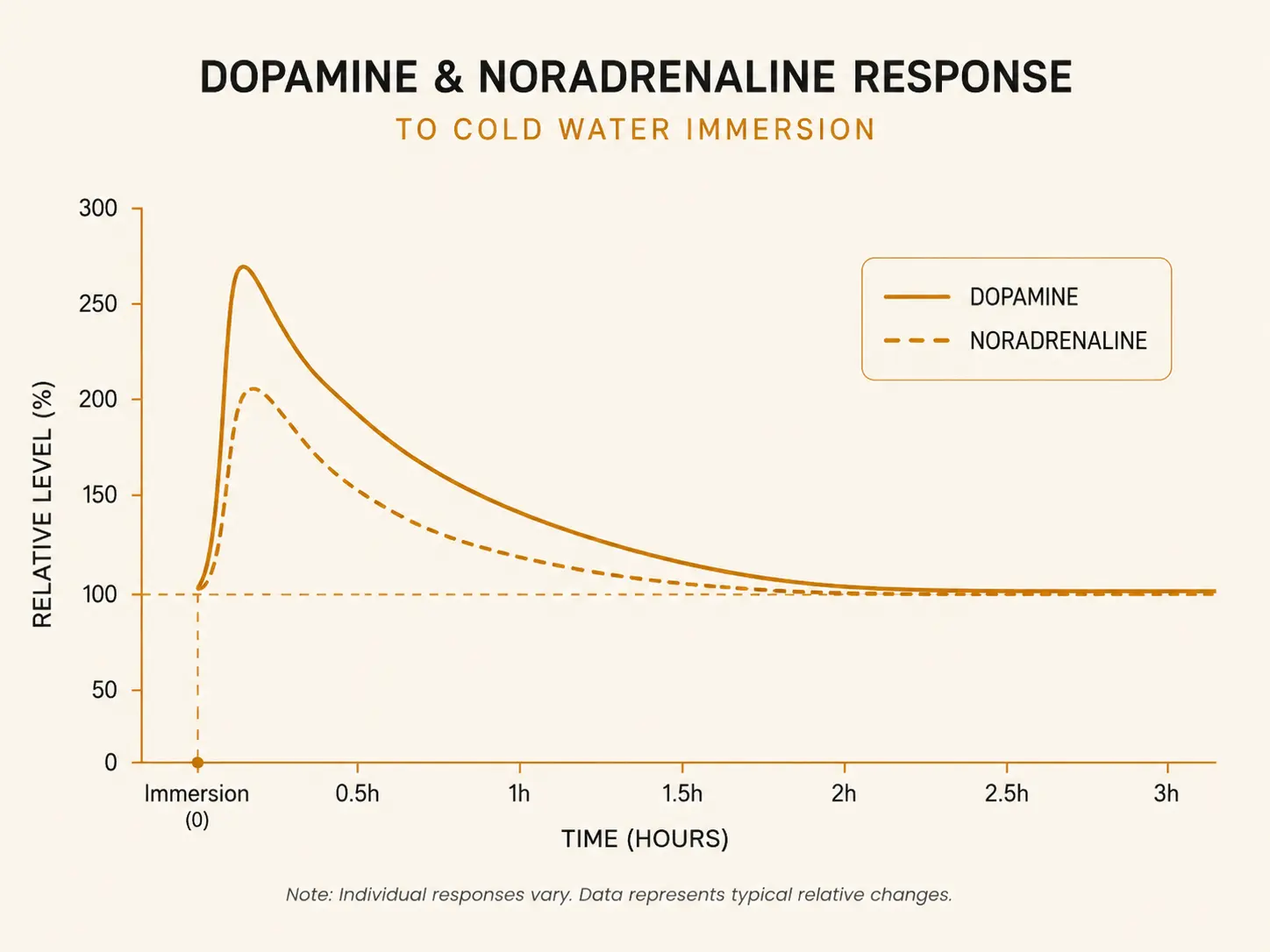
- A classic study found cold water immersion at 14°C raised noradrenaline by 530% and dopamine by 250%, with the dopamine effect lasting 2-3 hours.
- A large Dutch trial found 29% fewer sick-leave days among regular cold-shower takers — but the same research found no measurable change in actual immune markers.
- A 2024 meta-analysis found cold water immersion right after resistance training modestly blunts muscle growth by suppressing anabolic signaling.
- The cold shock response — gasping, spiked heart rate and blood pressure — can be genuinely dangerous for people with heart conditions; the American Heart Association has issued specific warnings.
- Evidence on cortisol is contradictory: cold exposure raises it acutely in the moment, while some long-term studies report lower resting cortisol with regular practice.
Cold showers and cold plunges have real, measurable effects on mood and alertness — the dopamine and noradrenaline response is some of the most consistent evidence in this entire category — but several of the most repeated claims online, including strengthened immunity and lowered stress hormones, are considerably more mixed than the confident claims in a 60-second video suggest.
This piece separates what the research actually supports from what's overstated, including one specific tradeoff — muscle growth — that most cold-plunge content leaves out entirely.
What Cold Exposure Actually Does to Your Body
Cold water immersion triggers an immediate, well-documented surge in noradrenaline and dopamine, driven by activation of the sympathetic nervous system — this is the most reliably replicated finding in cold-exposure research. A frequently cited study measured noradrenaline rising by 530% and dopamine by 250% during immersion in 14°C water, with the dopamine elevation persisting for two to three hours afterward.[1]
| Response | What happens | Evidence strength |
|---|---|---|
| Noradrenaline & dopamine spike | Sharp rise within seconds of immersion, dopamine effect lasts hours | Strong, well-replicated |
| Cold shock response | Gasp reflex, elevated heart rate and blood pressure | Strong, well-documented |
| Cortisol change | Rises acutely; long-term effect on resting levels unclear | Mixed, contradictory |
| Immune marker change | No significant change found immediately or 1 hour post-immersion | Weak for direct immune effect |
Mood and Alertness: The Strongest Evidence in This Category
The mental health and alertness effects of cold exposure have the best research support of any claim in this space, backed by both hormone data and brain imaging. Beyond the dopamine and noradrenaline surge, one study using functional imaging found increased connectivity between brain networks involved in attention control, emotion regulation, and self-processing after cold exposure, alongside self-reported increases in alertness, attentiveness, and pride, and reduced distress and nervousness.[2]
This mechanism is consistent with what many people describe anecdotally — a sharp, immediate mood lift and mental clarity right after a cold shower — and it's the one benefit in this article that doesn't require heavy caveating. For a broader toolkit of evidence-backed ways to manage day-to-day stress, see practical stress management techniques.
The Tradeoff Most Cold-Plunge Content Skips: Muscle Growth
A 2024 systematic review and meta-analysis found that cold water immersion performed right after resistance training modestly blunts hypertrophy gains compared to resistance training alone, likely by suppressing anabolic signaling, reducing blood flow, and dampening the inflammation that helps trigger muscle protein synthesis.[3] The effect doesn't eliminate gains, but it's a real, measurable attenuation — not a myth.
If soreness relief or a training goal that isn't hypertrophy is the priority — for example, endurance athletes managing recovery between sessions — the tradeoff may simply not apply to you. This is a hypertrophy-specific caveat, not a blanket case against cold exposure after any workout.
Immunity and Cortisol: Where the Hype Outruns the Evidence
The immune-boosting and cortisol-lowering claims attached to cold showers are the most overstated parts of the trend — the actual research is mixed, not settled, in both directions.
The immunity claim
A large Dutch randomized controlled trial with over 3,000 participants found that people who took cold showers reported 29% fewer sick-leave days over several months.[4] That's a genuinely interesting result — but the same body of research, including subsequent meta-analyses, found no significant change in actual immune markers immediately or one hour after cold water immersion.[5] The likely explanation isn't that cold water strengthens immune cells directly, but that people who commit to a daily cold-shower habit may also be sleeping, eating, or exercising more consistently — a behavioral effect, not necessarily a physiological one.
The cortisol claim
Cold exposure activates the sympathetic nervous system, which acutely raises cortisol, heart rate, and blood pressure in the moment — the opposite of a calming effect while it's happening. Some studies on regular, long-term cold exposure report lower resting cortisol over time, but the evidence doesn't clearly establish cold showers as a reliable cortisol-lowering tool the way, for instance, chronic stress research on the body is well established in the opposite direction.
Who Should Be Careful — Or Avoid It Entirely
The single most important safety fact about cold exposure is the cold shock response: a sudden gasp reflex plus a spike in heart rate and blood pressure that can be genuinely dangerous for people with cardiovascular conditions. The American Heart Association has specifically warned that this response can trigger chest pain or cardiac events in vulnerable people.[6]
How to Actually Do It, If You Decide To
- Start mild and short. 30 seconds to 2 minutes of cold water — even at the end of a normal shower — is enough to trigger the dopamine and alertness response most people are actually after.
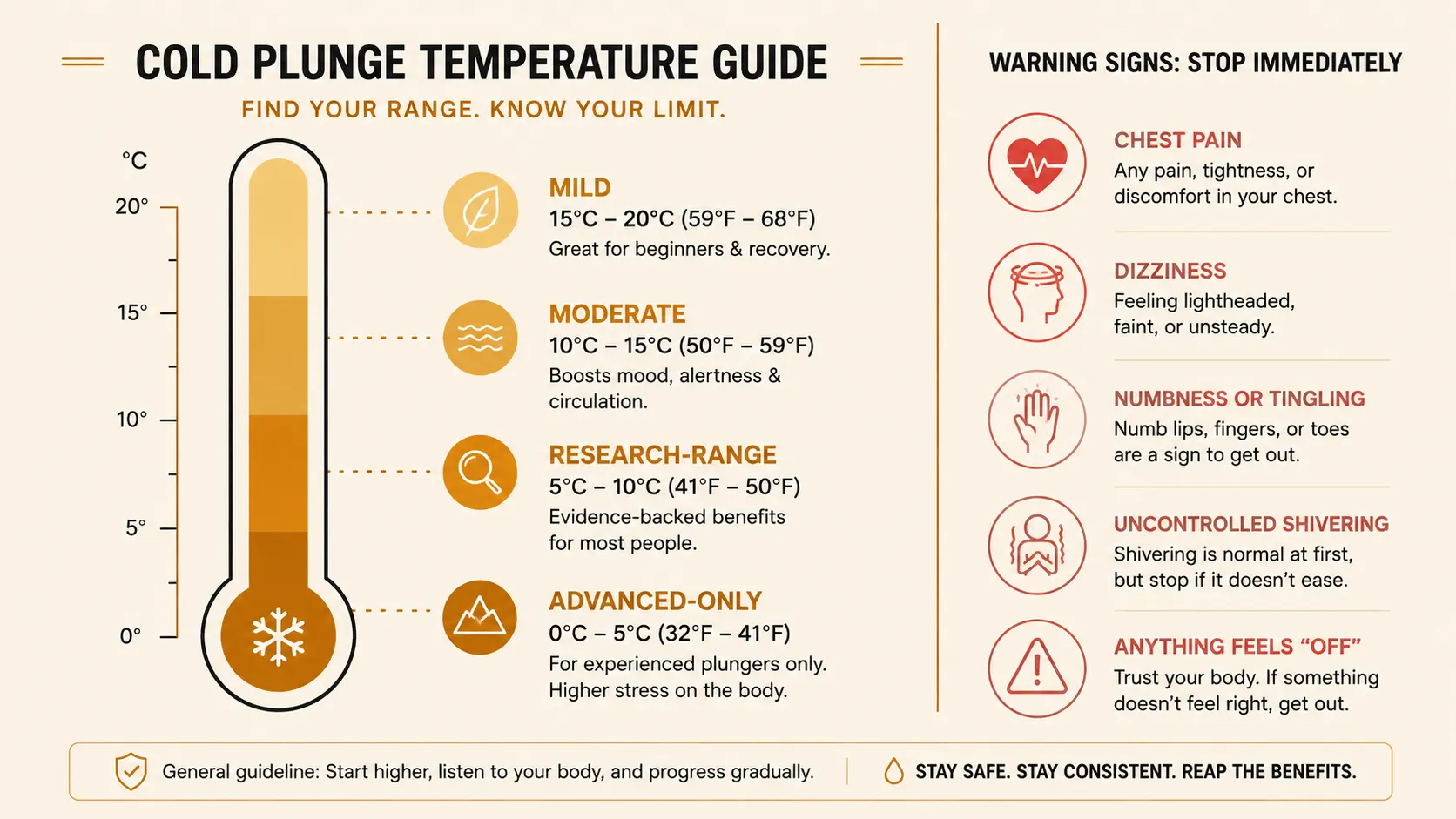
- The research range for recovery-focused cold water immersion is 10-15°C (50-59°F) for 10-15 minutes. This is the protocol most studies use — colder and longer isn't automatically better, and benefits plateau while risk keeps rising.
- Time it around your training goals. Skip cold plunges immediately after hypertrophy-focused resistance training; save them for mornings, rest days, or after cardio instead.
- Control your breathing on entry. Slow, steady exhales counter the gasp reflex — the breathing techniques guide covers the specific patterns that help here.
- Never do it alone as a beginner, and treat any chest pain, dizziness, or numbness as a signal to get out immediately, not push through.
Common Mistakes
- Jumping straight to the coldest, longest protocol seen online. Most measurable benefit shows up in the first few minutes of mild cold — extreme protocols add risk faster than they add benefit.
- Plunging right after a hypertrophy-focused lift. This is the exact window where the research shows cold water interferes most with muscle growth signaling.
- Treating "29% fewer sick days" as proof cold water boosts immunity directly. The same research found no change in immune markers — the effect is more likely behavioral than physiological.
- Ignoring cardiovascular risk factors. The cold shock response is a real, documented danger for people with heart conditions, not a hypothetical caveat.
- Doing it alone as a beginner. Loss of breath control or, in open water, disorientation are real risks that a second person can catch early.
Final Thoughts
Cold exposure earns its place among the more evidence-backed wellness trends — for mood and alertness specifically. The dopamine and noradrenaline response is strong, replicated, and doesn't require a leap of faith to believe. But the version of cold plunging sold on social media — a near-universal fix for immunity, stress hormones, and recovery with no downsides — overstates what the research actually shows. Muscle growth genuinely gets blunted by post-lift cold exposure. Immune and cortisol claims are contested, not settled. And the cardiovascular risk is real enough that the American Heart Association felt it necessary to issue a public warning.
The honest version of this trend: cold water will reliably wake you up and lift your mood for a few hours. Everything past that claim deserves a closer look at the actual study, not just the headline.
If your interest in cold exposure is really about building a better morning, it pairs naturally with the rest of a deliberate morning routine — and if stress management is the underlying goal, practical stress management techniques covers approaches with more consistent long-term evidence behind them. For the other half of the heat-cold recovery trend, sauna use has its own genuine benefits and overstated claims worth knowing before you build either into a routine.
This article is for general information and isn't a substitute for medical advice. Anyone with a cardiovascular condition, high blood pressure, or who is pregnant should consult a doctor before trying cold water immersion.
Sources
[1] Šrámek, P. et al. Human physiological responses to immersion into water of different temperatures. European Journal of Applied Physiology, 2000. Available at: researchgate.net
[2] Brain connectivity and mood response to cold water immersion. Available at: sciencedirect.com
[3] Piñero, A. et al. Throwing cold water on muscle growth: a systematic review with meta-analysis. European Journal of Sport Science, 2024. Available at: onlinelibrary.wiley.com
[4] Buijze, G.A. et al. The effect of cold showering on health and work: a randomized controlled trial. Cited via Medical News Today. Available at: medicalnewstoday.com
[5] Effects of cold-water immersion on health and wellbeing: a systematic review and meta-analysis, PLOS One, 2025. Available at: journals.plos.org
[6] American Heart Association. The plunge into cold water comes with risks, 2022. Available at: heart.org