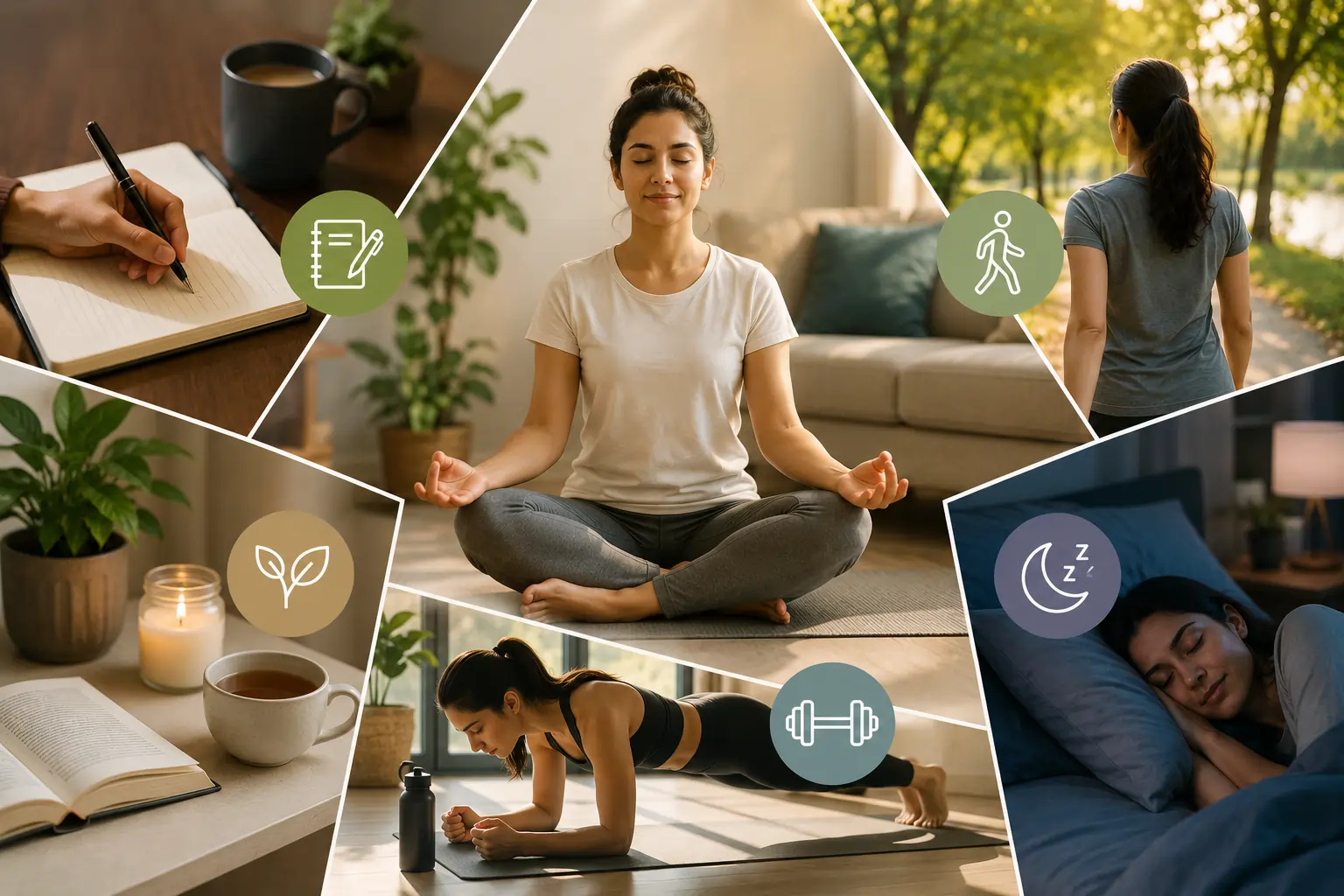
There is a version of stress management advice that exists in an alternate universe. In that universe, you wake up early enough for a forty-five-minute morning routine, have a job with clear boundaries, a social life that is rich but not demanding, enough money that financial anxiety is not a background hum, and the spare time and psychological bandwidth to implement a comprehensive wellbeing practice.
Most people are not in that universe. They are in a universe with an unpredictable schedule, genuine obligations that cannot be delegated away, limited time, and a stress load that is partly the product of circumstances rather than purely of lifestyle choices that can be optimised. For these people — which is most people — stress management advice that begins with restructuring your morning routine and ends with finding more time for yourself is not irrelevant so much as inapplicable in the present form of their life.
This article is about interventions that work within real constraints. Not aspirational restructuring, but specific, evidence-supported actions that can be taken in the form of life most people are actually living. Some take less than five minutes. Some involve reframing how you relate to demands rather than reducing the demands themselves. None require quitting your job, moving somewhere quieter, or waiting until things calm down.
If you want to understand what chronic stress does physiologically — the cortisol mechanisms and the HPA axis are covered in the cortisol article, while the specific body-system effects (cardiovascular, brain structural changes, immune dysregulation, metabolic consequences) are covered in what chronic stress is actually doing to your body. This article is the practical companion: what to actually do, in the order that produces the most benefit for the effort available.
Why Most Stress Advice Does Not Work for Most People
The failure mode of most stress management content is the assumption that stress is primarily a lifestyle design problem. Rearrange your morning, practice more, meditate consistently, set better boundaries, protect your sleep, eat better, exercise more — and the stress will be managed. This is not wrong. All of those things genuinely help. The problem is that they require the very resources — time, energy, bandwidth, psychological space — that stress depletes.
This creates the familiar paradox: the people who most need stress management practices are often the least able to implement them consistently. A demanding job, a young family, financial pressure, or a period of significant life difficulty depletes the cognitive and emotional capacity that building new habits requires. Telling a sleep-deprived parent of small children to establish a morning meditation practice is like telling someone drowning to improve their swimming technique.
The framing that is more useful: stress management is not about transforming your life into one with less stress. It is about increasing the gap between stressors and your capacity to respond to them. Both sides of the equation can be moved. Some interventions reduce the intensity or frequency of stressors. Others increase recovery capacity and physiological resilience. The latter category is often more accessible when circumstances constrain what can be changed about the former. For some people, that capacity gap is also shaped by baseline temperament — highly sensitive people tend to reach overstimulation faster than average, which is worth factoring in rather than fighting.
Many of the interventions below work specifically because they target the physiological side of stress, not just the psychological side — see what nervous system dysregulation actually is for the underlying mechanism these tiers are designed to address.
Tier 1: Zero-Time Interventions — Available in Any Moment
These interventions cost no additional time because they can be deployed within activities already happening. They address the physiological stress response in the moment it is occurring. A related, more intense option some people reach for is deliberate cold exposure — what the research actually supports for cold showers and plunges covers what's proven versus overstated.
1. The physiological sigh
When you notice acute stress — a sharp spike of anxiety, the physical tightening before a difficult call, the moment a problem arrives in your inbox — one to three physiological sighs (double inhale through the nose, long slow exhale through the mouth) produce a measurable reduction in physiological arousal within thirty seconds. The mechanism is specific: the double inhale reinflates collapsed alveoli and the long exhale offloads accumulated CO2 driving the stress response.
This takes fifteen to thirty seconds and is invisible to anyone around you. It requires no setup, no dedicated time, and no prior practice. It is the most accessible acute stress intervention available and works the first time you try it.
2. Name what you are feeling
Labelling an emotional state or stressful experience explicitly — not suppressing it, not dwelling in it, but identifying it in specific words — reduces amygdala activation and shifts processing from reactive to observational. The mechanism is the affect labelling effect documented in research by Matthew Lieberman and colleagues at UCLA: putting an emotional experience into language reduces the intensity of the emotional response.
In practice: when you notice stress or anxiety, take five seconds to name it accurately. Not "I am stressed," but something more specific: "I am anxious about this deadline because I do not yet know if I can meet it," or "I am frustrated by this conversation because I feel unheard." The specificity is part of the mechanism. Vague labelling produces less affect reduction than specific labelling.
3. The two-minute walk
A two-minute walk — even indoors, even in a hallway, even pacing during a phone call — produces immediate neurochemical changes. Physical movement increases BDNF (brain-derived neurotrophic factor), shifts norepinephrine balance, and reduces the rumination that feeds stress responses during sedentary periods. The threshold for benefit is lower than most people assume: brief intermittent movement throughout the day has measurable effects on mood and stress levels that aggregate over the course of a workday.
The specific intervention: when you feel stress building during desk work, stand up and walk for two minutes before returning. Not as exercise. As a neurochemical reset that is available every time you choose it and requires only the decision to stand up.
4. The completion signal
Open loops — unfinished tasks sitting in working memory — are one of the most consistent drivers of background stress and the specific 3am waking anxiety that disrupts sleep architecture. The Zeigarnik effect describes the tendency of incomplete tasks to intrude on attention and maintain a low-level cognitive burden until they are either completed or explicitly captured somewhere external.
A five-minute end-of-workday practice: write down every incomplete task, concern, or open decision on a piece of paper or in a notes app. The physical externalisation signals to the brain that these items are registered and do not need to be held in working memory overnight. This is the completion signal — not completing the tasks but completing the mental holding of them for the day. Research consistently finds that this practice reduces rumination and improves sleep onset, at a cost of five minutes.
Tier 2: Five to Fifteen Minutes — Available on Most Days
These interventions require a small dedicated time slot but can be embedded into existing daily transitions: before sleep, during a commute, in a lunch break, while waiting for something.
5. Pre-sleep body scan or breathing
The highest-leverage five-minute investment for cumulative stress reduction is the pre-sleep period. Five minutes of progressive muscle relaxation (tension-release through six to seven muscle groups), 4-7-8 breathing, or simply lying still with deliberate slow breathing before sleep reduces the cortisol that would otherwise disrupt sleep architecture and elevate the following morning's stress baseline.
The compounding effect makes this the most durable single daily intervention. Poor sleep elevates cortisol, which elevates stress reactivity, which further disrupts sleep. Consistently good sleep from a reliable pre-sleep practice is the physiological foundation that makes every other stress management intervention more effective. Five minutes at the end of the day, done consistently, changes the trajectory of the following day before it starts.
6. Morning light without a screen
Getting outside or near a bright window within thirty minutes of waking, without looking at a phone or screen during that time, amplifies the cortisol awakening response — producing a stronger, cleaner morning cortisol peak that supports better energy regulation through the day and a steeper evening decline toward sleep. This does not require a formal walk. It can be done while drinking coffee by an open window, or during the walk to a transport stop.
The absence of the phone is the operative variable. The cortisol awakening response is amplified by light; it is disrupted by the immediate sympathetic activation of scrolling notifications. Spending the first ten to fifteen minutes of the day responding to others' demands via phone starts the HPA axis at a higher activation point than it would reach if light exposure alone anchored the morning cortisol curve.
7. Deliberate nature exposure
Twenty to thirty minutes in a natural environment — a park, a garden, near trees — produces measurable reductions in salivary cortisol, as documented in the Hunter 2019 study published in Frontiers in Psychology.[1] The mechanism involves reduced sensory load (natural environments have lower informational density than urban or screen environments), involuntary attention that rests directed cognition, and possibly direct physiological responses to natural sounds and green wavelengths.
For people in urban environments with limited access to large natural spaces: even a small neighbourhood park, a tree-lined street, or a community garden provides meaningfully different sensory input from the built environment. The threshold is low. The requirement is primarily to be outdoors, moving slowly, without a phone as the primary focus of attention.
8. One complete social interaction per day
Human contact — specifically face-to-face or voice interaction, not text-based communication — triggers oxytocin release, which directly inhibits HPA axis activity and reduces cortisol. The research by Shelley Taylor and others on the tend-and-befriend stress response identifies social connection as one of the most potent biological buffers against stress, with effects comparable in magnitude to the physiological interventions described above.
The practical barrier is that social interaction feels difficult when stress is high: social withdrawal is a common stress response. The intervention works against this instinct. A ten-minute phone call with a person you feel comfortable with, a genuine in-person conversation rather than a transactional exchange, or even a shared meal with others without phones present — these produce physiological stress reduction that an equivalent time of solitary relaxation does not.

Tier 3: Structural Changes — Things You Set Up Once
These interventions are not daily practices but environmental and structural changes that alter the default conditions of your day. They require one decision or setup action that then runs without ongoing effort.
9. Notification management
The average person picks up their phone approximately 150 times per day. A significant proportion of those interactions are responses to notifications — alerts that interrupt whatever cognitive state was active and trigger an anticipatory stress response. Each interruption requires a context switch and a micro-decision, both of which carry a cognitive and physiological cost that accumulates across a day.
A single thirty-minute notification audit — turning off all notifications except calls and messages from a small defined set of people, disabling email push notifications, removing news app alerts, muting all group chats except the ones you have affirmatively chosen to monitor — reduces this involuntary demand substantially. This is not a digital detox. It is a filter. The morning phone habit is particularly worth addressing: the first fifteen minutes of the day spent on a screen sets the HPA axis at a higher activation point than the rest of the morning can easily recover from.
10. The communication batching practice
Responding to messages, emails, and communication tasks as they arrive throughout the day maintains a continuous partial attention state — never fully in any one task, always partially monitoring for incoming demands — that is chronically activating rather than restful. Batching communication into defined windows — checking and responding to email twice or three times a day at set times, reviewing messages during defined slots rather than continuously — allows focus blocks of uninterrupted attention between the windows.
This does not require explaining your communication schedule to everyone you interact with. It requires only the decision to check at defined times rather than as notifications arrive. The first week feels uncomfortable. The second week feels like a significant improvement in cognitive space.
11. One hard thing per day, done first
Task avoidance is one of the most reliable generators of ongoing background stress. The undone thing sits in awareness, generating low-level dread and repeated micro-decisions about whether to do it now — each of which adds to the cognitive load without resolving the problem. The emotional cost of avoiding an aversive task across a day is typically considerably larger than the actual effort of doing it.
The structural fix: identify the one most avoided, most anxiety-generating task on any given day and do it first, before email, before anything else, without warming up with easier tasks. This is not a productivity technique in the conventional sense. It is a stress management technique: doing the thing that is generating the most anxiety early in the day clears the cognitive and emotional space that the avoidance was occupying. A salary negotiation is a textbook example of exactly this kind of task — scripts for people who hate asking covers how to prepare for it so the dread doesn't outweigh the actual ten-minute conversation.
12. A genuine transition between work and not-work
Remote work and smartphone connectivity have eroded the natural transition that a physical commute once provided: a period of movement and cognitive disengagement between the work state and the home state. Without this transition, the work context bleeds into the evening — partially active email, half-finished mental tasks, unresolved work concerns running in background memory — maintaining a mild work-state activation that prevents genuine recovery.
A deliberate transition ritual does not need to be elaborate. It needs to be consistent and to produce a clear signal of context change: a ten-minute walk without the work phone, a change of clothes, a specific piece of music played only at the end of the workday, the physical closure of the laptop and its removal from the main living space. The content of the ritual matters less than its consistency. Consistency is what builds the associative learning that makes the transition signal effective.

Tier 4: Cognitive Reframes — Changing the Input to the Stress System
The physiological stress response is not triggered by objective events. It is triggered by the brain's appraisal of events as threatening, uncontrollable, or exceeding coping resources. The same event — a critical email from a manager, a deadline, a difficult conversation — produces different physiological stress responses in different people depending on how they appraise it. Cognitive reframes do not deny that stressors exist. They change how the brain evaluates them, which changes the magnitude and duration of the physiological response.
13. The control audit
A significant proportion of stress comes from focusing cognitive and emotional energy on aspects of a situation that are outside personal control. The concern does not change the outcome of uncontrollable events; it only adds stress without productive function. The control audit asks a single question: which parts of this situation are within my influence, and which are not?
The practical application is not a philosophical exercise in acceptance. It is a task-sorting exercise: identify the actions that could meaningfully affect the outcome and take them. Then deliberately redirect cognitive energy away from the aspects that cannot be affected. With practice the habit of quickly sorting controllable from uncontrollable and acting accordingly produces a meaningful reduction in the proportion of stress energy directed at outcomes that attention cannot affect — this reframing instinct is really a form of the same skill covered in what emotional regulation actually is and how to build it, where reappraisal is shown to consistently outperform suppression.
14. The problem versus circumstance distinction
Some stressors are problems: they have solutions, they respond to action, and the appropriate response is to identify and take that action. Some stressors are circumstances: they are real, they are difficult, but they do not have solutions that are currently available, and the appropriate response is to find a way to tolerate and function within them rather than to solve them.
Treating circumstances as problems — directing problem-solving energy at situations that do not currently have solutions — is one of the most consistent sources of sustained stress. The search for a solution that does not exist produces the frustration and helplessness of repeated failure. Recognising that a situation is a circumstance rather than a problem does not make it less difficult. It redirects cognitive and emotional energy toward adaptation and coping rather than futile solution-seeking.
15. The minimum required response
Many stressful situations produce a larger response than the situation actually requires. Part of this is the catastrophising pattern described in detail in the CBT reframes for everyday stress article. Part of it is an undifferentiated stress response that does not scale appropriately to the actual severity of different stressors.
The minimum required response asks: what is the smallest reasonable response to this situation that is also the appropriate response? Not what is the maximum manageable response, but what does this actually need from me. This question is most useful for situations that feel urgent but are not actually high-stakes, and for people whose stress response tends toward over-engagement with moderate difficulties. Calibrating the response to the actual stakes of the situation reduces the total energy expenditure on stress across a day without requiring any change in how genuinely important situations are handled.
Tier 5: Medium-Term Changes That Build Resilience
The interventions above reduce the intensity of the stress response in the present. The following build the physiological and psychological resilience that determines how large and how prolonged the response is in the first place. They operate on a timescale of weeks to months rather than minutes.
16. Consistent sleep timing
Sleep is not one of several equal interventions for stress management. It is the foundation that determines how well every other intervention works. The cortisol system, the cognitive appraisal capacity, the emotional regulation circuits, the physiological recovery from the day's stressors — all of these depend on sleep quality in a way that makes poor sleep a force multiplier for stress and good sleep a force multiplier for resilience.
Consistent sleep timing — specifically a consistent wake time, which is the anchor for the entire circadian system — is more important than any single component of a stress management practice. Fixing sleep first, before adding other practices, produces the largest return per unit of effort. The full picture of how sleep cycles work and how to protect them explains why duration alone is not enough — architecture matters as much as hours.
17. Regular moderate exercise
Exercise is the most reliably evidence-supported lifestyle intervention for reducing chronic stress, anxiety, and depression in the research literature. The mechanism is multi-pathway: physical exercise reduces basal cortisol over time, increases BDNF which supports the neural plasticity underlying emotional regulation, improves sleep quality, provides regular HPA axis activation followed by recovery (which trains the system to activate and deactivate more efficiently), and produces the mood elevation from endorphins, serotonin, and dopamine that most people experience as the post-exercise effect.
The dose for these effects does not require high-intensity training or a gym. The research is consistent that thirty to forty-five minutes of moderate-intensity activity — brisk walking, cycling, swimming, any activity elevating heart rate to a conversational but breathing-elevated level — four or five times per week produces significant reductions in chronic stress markers. For building a sustainable movement habit, a daily morning movement practice is one of the most accessible entry points.
18. A minimum viable social infrastructure
Social support is one of the most consistently identified buffers against chronic stress in epidemiological research. The size and quality of a person's social network predicts stress-related health outcomes, cortisol regulation, immune function, and longevity with an effect size comparable to smoking status. The oxytocin mechanism described in Tier 2 operates chronically, not just acutely: people with consistent social connection have different baseline HPA axis calibration from people who are chronically isolated.
Maintaining social infrastructure requires active, not passive, investment. Social relationships do not maintain themselves through the absence of damage. They require positive acts of reaching out, planning, showing up, and investing attention. For people whose social lives have contracted through life transitions — new city, new job, parenthood, relationship change, post-pandemic isolation — this investment is not optional from a health perspective. It is a primary stress management variable with effects on the stress system that lifestyle interventions cannot fully replicate.
19. Dealing with the actual stressor, not around it
Many chronic stress states have a single identifiable source that is not being addressed: a relationship that is persistently difficult, a job that consistently exceeds capacity or violates values, a financial situation that produces ongoing anxiety, an unresolved family conflict. The instinct in these situations is to manage the symptoms — meditate more, sleep better, exercise to burn off the tension — while leaving the source untouched.
Symptom management has genuine value. But it does not eliminate the source, which means the stress it generates continues indefinitely. The interventions described in this article meaningfully reduce the physiological cost of chronic stressors and increase the capacity to tolerate them. They do not make genuinely bad situations good. For situations that are genuinely unsustainable — where the gap between demands and resources is structural rather than temporary — the appropriate intervention is addressing the situation directly: a difficult conversation, a career decision, a financial restructuring, help from a professional.
Where to Start: The Priority Stack
Nineteen interventions is too many to implement at once, and the instinct to implement all of them simultaneously is itself a stress-generating form of self-improvement that contradicts the premise of this article. The practical question is where to start.
| Priority | Intervention | Time required | Mechanism | Why first |
|---|---|---|---|---|
| 1 | Pre-sleep breathing or PMR | 5 min before sleep | Direct parasympathetic activation; cortisol reduction; sleep quality improvement | Best leverage: fixes sleep, which makes everything else more effective |
| 2 | Notification audit | 30 min once | Reduces involuntary interruptions; removes continuous partial attention state | Set-it-once structural change with ongoing daily benefit; no ongoing effort required |
| 3 | Physiological sigh in acute stress moments | 15–30 sec, as needed | Immediate CO2 reset; fastest physiological stress intervention available | Zero additional time; available in any moment; works from the first use |
| 4 | End-of-day task externalisation | 5 min at workday end | Closes cognitive open loops; reduces rumination and 3am waking | Specifically addresses the most common sleep disruption mechanism; compounds with #1 |
| 5 | Morning light without screen (10–15 min) | Embedded in existing morning | Anchors cortisol awakening response; sets diurnal curve for the day | Zero additional time if combined with commute or window time; highest-leverage morning change |
| 6 | One complete social interaction per day | 10–20 min | Oxytocin; HPA axis inhibition; social support buffer | Highest-impact intervention most people undervalue; addresses isolation as a physiological stress driver |
| 7 | Moderate exercise 4–5 times per week | 30–45 min | Reduces basal cortisol over weeks; improves sleep quality; builds resilience | Medium-term trajectory change; most people already know this and are not doing it consistently |
The priority stack is designed for the person who does not have time for all of it. Start with the pre-sleep practice and the notification audit. These two changes — one five-minute daily practice and one thirty-minute setup — improve sleep and reduce the daily stimulus load that is the primary driver of continuous sympathetic activation for most people. Everything else builds from a better foundation.
When Stress Does Not Reduce: Knowing the Limit of These Tools
These tools are effective for managing stress within a tolerable range. They are not effective for every kind of stress, and it is worth being explicit about their limits.
Clinical anxiety disorders, major depression, PTSD, and other mental health conditions do not respond adequately to lifestyle stress management tools. They require professional clinical support — therapy, medication, or both — as the primary intervention, with lifestyle practices as useful supplements rather than substitutes. If stress and anxiety are significantly impairing daily function, quality of life, or relationships, that is a clinical signal rather than a lifestyle optimisation problem.
Situational stress from genuinely unsustainable circumstances — a job with demands that consistently exceed any human's capacity, a relationship characterised by persistent harm, a financial situation that has no path to resolution — is not amenable to being managed down. It requires structural change. The tools in this article will help someone function within a difficult situation. They will not make an objectively bad situation acceptable indefinitely.
If work stress specifically has progressed into exhaustion, cynicism, and a drop in your sense of effectiveness, that combination has an official name and a more targeted response — see burnout recovery: what actually works when you can't just quit for what changes when everyday stress management tools stop being enough.
Working With the Life You Have
The premise of this article is that most people cannot significantly change their stress sources in the near term, and that waiting for the right conditions to manage stress is itself a form of stress. The interventions above work within the conditions that exist now: a demanding job, limited time, real obligations, and a nervous system that responds to sustained stress in ways that are both predictable and, to a meaningful extent, modifiable.
None of them are heroic. Most of them take under five minutes. Several of them require only a routing decision rather than additional time. The aggregate effect of implementing even four or five of them consistently — not all nineteen, not perfectly, but a small set applied with regularity — is a measurably different stress baseline within two to three weeks, and a meaningfully different physiological and psychological state within two to three months.
The standard for success is not the absence of stress. It is a shorter gap between stressor and recovery, a faster return to baseline after activation, and a stable enough physiological foundation that the stress that cannot be avoided is experienced with something closer to its actual severity — rather than amplified by sleep debt, isolation, and the accumulated cortisol of a system that has been running in activation mode without adequate recovery for too long.
If sleep is the starting point you want to work on first, the Sleep Better course walks through the full system — from circadian calibration to pre-sleep routines — in a structured, practical sequence built around the same evidence base as the sleep interventions above.
The allostatic load concept from this article also has direct implications for exercise recovery. High life stress reduces the body's recovery capacity from training, meaning the same workout requires more rest time during a demanding week than a relaxed one. The guide to rest between workouts covers this and the other five variables that determine recovery timelines — a useful complement to managing stress on the life side.
Note: This article covers lifestyle and behavioural interventions for managing everyday stress within a tolerable range. It is not a substitute for professional mental health support. If stress, anxiety, or low mood are significantly affecting your daily functioning, relationships, or quality of life, please consider speaking with a qualified therapist or your GP. These tools can complement professional care but are not a replacement for it.