
The answer most people want is a number. Twenty-four hours, forty-eight hours, seventy-two hours. A rule they can apply without thinking about it, that tells them whether today is a training day or a rest day with the same certainty as a traffic light.
The answer most people get is a number. Every fitness source has a slightly different one, usually presented with enough confidence to feel authoritative. The problem is that none of them is actually right for everyone, because recovery is not a fixed duration. It is a process whose timeline depends on at least six interacting variables: the type and intensity of the training session, the muscle groups and energy systems involved, sleep quality in the days following training, nutrition, training age, and what is happening in the rest of the person's life.
This article is about understanding those variables well enough to know what your body specifically needs — rather than following a generic rule calibrated for someone else. The practical output is a decision framework for structuring recovery, not a single number to follow blindly.
What Recovery Actually Is: The Biology Underneath the Rest Day
Recovery from training is not a passive process. It is an active biological remodelling programme that the body runs during the hours and days following exercise, and it requires resources — calories, protein, sleep, and time — to run effectively. Understanding what is actually happening gives you a much more intuitive sense of why some workouts require more recovery than others. The same session also has a preparation side worth getting right — see how to actually warm up before a workout for the other bookend of a training session.
Three recovery processes running in parallel
After a training session, the body is simultaneously managing three distinct recovery processes that operate on different timescales and respond differently to the variables that influence them.
Phosphocreatine restores within 3–5 minutes. Muscle glycogen largely restores within 24 hours with adequate carbohydrate intake, and fully within 48 hours.
Training — especially resistance and eccentric loading — creates mechanical disruption that triggers inflammation and muscle protein synthesis. This is the source of DOMS and the driver of strength and hypertrophy adaptation.
Neural fatigue manifests as reduced force output, slower reaction time, and impaired motor coordination. It is the least characterised of the three processes and the slowest to resolve after maximal efforts.
The Six Variables That Determine Your Recovery Timeline
Variable 1: Training type and intensity
Not all workouts create equal recovery demands. The key distinction is between sessions that primarily tax the metabolic system and those that tax the structural and neural systems through high force production and eccentric loading.
| Training type | Primary recovery demand | Typical minimum recovery window | Limiting factor |
|---|---|---|---|
| Low-intensity cardio (Zone 1–2) | Glycogen resynthesis | 12–24 hours | Energy substrate; minimal structural damage |
| Moderate-intensity cardio (Zone 3–4) | Glycogen + moderate muscular fatigue | 24–36 hours | Glycogen resynthesis; some mild muscle damage |
| HIIT | Glycogen + neural + some structural | 36–48 hours | Neural fatigue significant after maximal intervals |
| Low-to-moderate resistance training | Muscle protein repair + glycogen | 24–48 hours per muscle group | Muscle protein synthesis; DOMS peaks 24–48 h post-session |
| High-intensity resistance (heavy compound) | Muscle protein repair + neural + glycogen | 48–72 hours per muscle group | Neural fatigue from high-force production; eccentric damage |
| Maximal strength (1–3 rep max) | Neural fatigue primarily + muscle repair | 72–96+ hours | CNS fatigue is the primary limiting factor |
| High-volume training (20+ sets/session) | Accumulated structural damage + glycogen | 48–72 hours per muscle group | Total structural damage from high set volume |
Variable 2: Eccentric loading volume
Eccentric muscle actions — the lengthening phase of a contraction under load — cause significantly more structural muscle damage than concentric actions. The lowering phase of a bicep curl, the descent of a squat, the negative of a pull-up, running downhill: all involve high eccentric loading. This is why DOMS is most severe after activities with high eccentric components.
The practical implication: two sessions with identical volume but different eccentric loading require different recovery times. A leg press (moderate eccentric load) requires less recovery than a deep barbell squat (high eccentric load) at the same volume. Introducing a new eccentric-heavy exercise, or significantly increasing eccentric loading in a familiar one, extends recovery requirements substantially — often by 24 to 48 hours beyond what a comparable familiar session would require.
Variable 3: Training age and adaptation
Training age — how many years someone has been training consistently — has a profound and initially counterintuitive effect on recovery. Beginners experience more DOMS from the same session than trained individuals and require longer recovery windows. The structural adaptations that reduce exercise-induced muscle damage — denser connective tissue, more efficient calcium handling, better motor unit recruitment patterns — take months to years to develop.
| Training age | DOMS severity | Typical recovery window | Key reason |
|---|---|---|---|
| Beginner (0–6 months) | High; often severe after first exposure | 48–96 hours; 3–5 days between same muscle groups | Unfamiliar stress; poor motor efficiency; low connective tissue resilience |
| Intermediate (6 months–3 years) | Moderate; managed with progressive overload | 36–72 hours; 2× per week per muscle group typical | Structural adaptation progressing; recovery efficiency improving |
| Advanced (3+ years consistent) | Low to moderate; mainly with novel stimulus | 24–48 hours; 3–4× per week per muscle group possible | High structural adaptation; efficient inflammatory response |
| After a deload or training break | Returns to near-beginner severity regardless of history | Near-beginner timelines for 1–2 weeks after restarting | Structural adaptations partially reverse; first sessions cause atypically high damage |
Training age isn't the only factor that resets recovery expectations — hormonal shifts do too. Women going through perimenopause and menopause often need longer recovery windows than the table above would suggest, independent of training age, because declining estrogen slows muscle protein synthesis. See strength training for women over 40 for what changes in the recovery equation specifically.
Variable 4: Sleep quality and duration
Sleep is the primary biological window for the recovery processes described above. Growth hormone — the primary anabolic hormone coordinating muscle repair — is secreted predominantly during slow-wave sleep. Protein synthesis rates are elevated during sleep. The central nervous system performs its own maintenance processes, consolidating motor patterns learned during training and clearing metabolic waste products that accumulate during intense neural activity.

Poor sleep does not just make you feel less recovered. It demonstrably slows the biological recovery processes. A 2011 study by Skein and colleagues found that sleep deprivation significantly reduced muscle glycogen resynthesis rates. Research by Dattilo and colleagues found that sleep restriction was associated with increased cortisol and decreased testosterone and growth hormone — creating a hormonal environment that actively impairs recovery.
The practical implication is that recovery timelines calculated from sleep-optimal conditions extend substantially with poor sleep. An athlete requiring 48 hours of recovery between heavy lower body sessions at 8 hours of quality sleep may require 60 to 72 hours when sleeping five to six disrupted hours — without the training stimulus having changed at all. If you are trying to improve your sleep quality to support recovery, the sleep debt guide and the wind-down routine that actually works cover the practical levers in detail.
Variable 5: Nutrition — protein and carbohydrate availability
Recovery is a substrate-dependent process. The body can initiate repair and remodelling after training, but it cannot complete it without the raw materials to do so. Protein provides the amino acids for muscle protein synthesis. Carbohydrates provide the glucose for glycogen resynthesis. Insufficient intake of either extends recovery timelines in a dose-dependent way.
Protein timing and distribution matter: consuming adequate protein at each meal in the 24 to 48 hours following training sustains elevated muscle protein synthesis rates across the recovery window. A single large protein meal followed by many low-protein meals is less effective than distributed adequate-dose meals, because muscle protein synthesis is triggered acutely by leucine availability at each meal rather than by the total accumulated across the day. For a detailed breakdown of how this works, the protein per meal distribution guide covers the mechanisms and practical targets.
Carbohydrate intake in the hours after a glycogen-depleting session accelerates resynthesis. The body's glycogen synthesis machinery is most active in the first two hours post-exercise, when consuming carbohydrates together with protein produces faster resynthesis than either alone. This is the physiological basis for post-workout nutrition recommendations — not performance of the current session, but speed of recovery for the next one.
Variable 6: Life stress and allostatic load
The body's recovery resources are not training-specific. They are shared across every demand placed on the system: work stress, sleep debt, illness, relationship difficulty, heat, nutritional deficits, alcohol, and psychological anxiety all draw on the same hormonal and physiological resources that recovery from training requires. This is the concept of allostatic load — the cumulative biological cost of adapting to all forms of stress simultaneously.
When allostatic load is high, the body has less capacity available for training recovery. The same session that requires 48 hours of recovery during a low-stress week may require 72 or more during a high-stress week — not because the training was different but because the recovery system is partially occupied with other demands. This is why athletic performance and recovery often deteriorate during exam periods, after bereavements, during heavy work deadlines, or in any period of elevated life stress. The stress management guide covers the practical interventions for managing allostatic load on the life side of this equation.
DOMS Is Not a Recovery Indicator
Delayed-onset muscle soreness — DOMS — is the muscle soreness that peaks 24 to 48 hours after a training session involving significant eccentric loading or novel stimulus. It is consistently misunderstood as a recovery indicator in both directions: people wait for DOMS to disappear before training again, and people judge the quality of a session by whether DOMS appeared. For the full mechanism behind why it happens and what the evidence says actually helps, see DOMS explained.
DOMS is neither a training quality indicator nor a recovery readiness indicator. It is an inflammatory response to structural muscle disruption. Its presence indicates that disruption occurred. Its absence does not indicate that recovery is complete. Its resolution does not indicate that recovery is complete. These are independent events with imperfect correlation.
| DOMS state | What it tells you | What it does NOT tell you |
|---|---|---|
| Severe DOMS (soreness at rest and with movement) | Significant structural muscle disruption occurred | Whether training again is safe; how much longer recovery will take |
| Mild DOMS (soreness only with movement) | Some structural disruption; typical of a well-calibrated session | Whether you are ready to train again; whether neural recovery is complete |
| No DOMS (familiar session, low intensity) | Structural disruption was minimal; adaptation is high enough to prevent significant damage | That recovery is unnecessary; that the session was ineffective; whether neural fatigue is present |
| DOMS resolved (soreness gone) | The acute inflammatory response has concluded | That all three recovery processes are complete; that performance will be at baseline next session |
The practical guide for DOMS: if soreness is severe enough to alter your movement mechanics or substantially reduce range of motion, waiting for it to reduce to mild before retraining the affected muscle group is a reasonable guideline — not because DOMS absence equals recovery, but because severe DOMS indicates a degree of structural disruption that warrants additional time regardless of other indicators.
Active Recovery vs. Complete Rest
Active recovery — low-intensity movement on the day after a training session — supports recovery primarily through increased blood flow to healing tissue, accelerating the delivery of nutrients and oxygen required for the repair processes. A light walk, an easy swim, or a gentle yoga session consistently reduces perceived muscle soreness and may modestly accelerate resolution of the inflammatory response compared to complete rest.
The key word is light. Active recovery is beneficial when it involves intensity low enough that it does not create an additional recovery demand. Activity that elevates heart rate significantly, loads the muscles being recovered, or involves high eccentric demands — even if it does not feel strenuous — competes with recovery rather than supporting it. The threshold for most people is around Zone 1 to low Zone 2: light walking, easy cycling, gentle swimming, stretching, or yoga. Anything that leaves you feeling worked rather than refreshed has exceeded the threshold. A short mobility flow — CARs or controlled loaded stretching rather than long static holds — fits well here too; see mobility vs flexibility for the distinction and why timing matters. Heat exposure is another tool some people build into rest days — sauna use has real cardiovascular evidence behind it, though not the muscle-recovery claims often attached to it.
| Activity type | Recovery classification | Effect on recovery | Best use case |
|---|---|---|---|
| Light walk (20–40 min, easy pace) | Active recovery | Positive; increases blood flow without adding training load | Any rest day; particularly useful after high-volume lower body sessions |
| Easy cycling (Zone 1) | Active recovery | Positive; low joint load | Rest days following heavy leg training |
| Gentle yoga or stretching | Active recovery | Positive; parasympathetic activation from breathing | Any rest day; useful for flexibility maintenance |
| Swimming (easy pace) | Active recovery | Positive; hydrostatic pressure may reduce inflammation | Particularly useful after heavy lower body or full-body sessions |
| Moderate cardio (Zone 3, sustained) | Training stimulus | Neutral to slightly negative; creates its own recovery demand | Treat as a training session and plan recovery accordingly |
| Complete rest | Passive recovery | Positive for neural fatigue; may slightly delay peripheral recovery | After very high-intensity sessions with significant neural fatigue; after illness; during deloads |
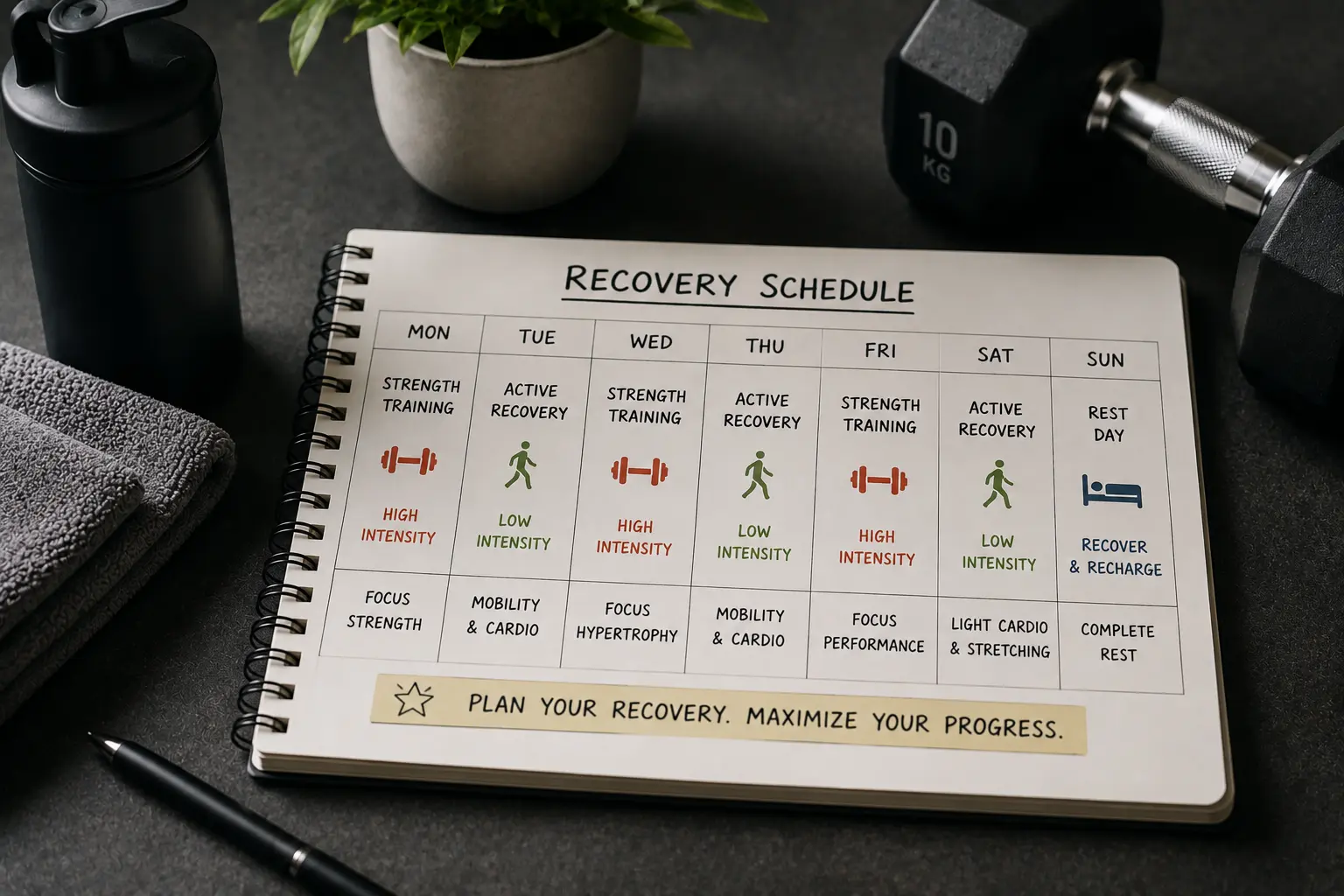
The Deload: Planned Recovery Over a Full Week
A deload is a planned period of reduced training load — typically one week — inserted into a training programme at regular intervals to allow accumulated fatigue from consecutive training weeks to dissipate and the adaptations from that training to express themselves. It is one of the most consistently misused and underused tools in recreational training.
Why deloads are necessary despite adequate between-session rest
Between-session rest allows acute recovery from individual sessions. It does not fully address the cumulative fatigue that accumulates across multiple weeks of hard training. This cumulative fatigue partially masks the underlying fitness adaptations being driven by training. Performance appears to stagnate or slightly decline during a hard training block not because adaptations are not happening, but because fatigue is suppressing their expression.
The deload removes the fatigue layer and allows fitness adaptations to surface. This is why performance typically improves noticeably in the week or two after a deload, not during the deload itself — the adaptations were building throughout the hard block; the deload simply removed what was obscuring them.
What a deload actually involves
A deload does not mean no training. It means reduced training load — achieved by reducing volume (fewer sets), reducing intensity (lighter loads), or both. The goal is to maintain movement patterns and some mechanical stimulus while substantially reducing the training stress that generates fatigue.
A simple deload protocol: reduce weekly sets to approximately 50 to 60% of normal volume, reduce loads to approximately 60 to 70% of normal working weights, maintain similar exercise selection and frequency. The sessions should feel easy. The temptation to train harder because you feel fresh during a deload should be resisted — that freshness is the deload working, not evidence you are under-trained.
| Deload approach | What changes | What stays the same | Best for |
|---|---|---|---|
| Volume deload (most common) | Sets reduced to 50–60% of normal; loads unchanged or slightly reduced | Exercise selection; frequency; movement patterns | Most people most of the time |
| Intensity deload | Loads reduced to 60–70% of normal; sets kept closer to normal | Volume; frequency; exercise selection | Strength athletes who want to maintain movement patterns at high frequency |
| Frequency deload | Training days reduced; volume and intensity maintained on days trained | Load and volume per session | People with high accumulated fatigue who respond better to fewer, higher quality sessions |
| Full week off | No training | Nothing — complete rest | After illness; after competition; after long hard block; for psychological burnout |
When to deload
Deload frequency depends on training intensity and individual recovery capacity. A general guideline is one deload week for every three to six weeks of hard training. More specifically: deload when performance stalls for two or more consecutive sessions despite adequate sleep and nutrition; when motivation to train is consistently low for more than five to seven days; when resting heart rate is elevated by more than five to ten beats above your personal baseline for several consecutive days; or when sleep quality deteriorates without clear external cause.
These are signs of accumulated fatigue exceeding recovery capacity. Treating them as indicators to push harder rather than to reduce load is the most consistent path to overtraining syndrome and eventual forced rest from injury or illness.
How to Know If You Are Actually Recovered: Practical Indicators
The fundamental problem with rest day decisions is that internal signals of recovery readiness are subjective and unreliable in both directions. People who love training underestimate fatigue and train when they should rest. People who fear missing sessions feel unready when they are objectively fine. A set of objective or semi-objective indicators provides a more reliable guide than subjective feel alone.
- Resting heart rate is at or near your personal baseline. A consistently elevated resting heart rate — five to ten beats above your normal morning value for several consecutive days — is one of the most reliable early indicators of accumulated fatigue or incomplete recovery. Measure manually on waking for seven consecutive mornings to establish your baseline, or use a wearable. Any day it is five or more beats above baseline: treat it as a recovery day regardless of what your programme says.
- Perceived morning energy is normal or good. Consistently waking feeling unrefreshed despite adequate sleep duration is a sign of incomplete recovery or excessive accumulated load — distinct from normal morning grogginess that resolves within thirty minutes.
- Motivation to train is present. Persistent low motivation for training — not an occasional off day, but a sustained trend across multiple days — is a psychophysiological signal of accumulated fatigue. The brain's motivational systems are sensitive to overreaching and reduce drive as a protective mechanism.
- Movement quality feels normal during warm-up. The first few warm-up sets serve as an objective readiness test. If movement quality is poor, force output feels significantly suppressed, and the session feels harder than expected for the first few sets without improving, the session is happening on incomplete recovery. Reduce intensity, shorten the session, or leave and return tomorrow. A day spent hunched at a desk can mimic this same stiffness before you've even started warming up — see posture fix exercises for desk workers if tight shoulders and a stiff upper back are a recurring pre-workout issue.
- DOMS is absent or mild. As discussed, DOMS resolution does not equal recovery completion. But training through severe DOMS that alters movement mechanics compromises technique quality and increases injury risk. Mild soreness is training-compatible. Soreness that alters movement is not.
Practical Recovery Structures by Training Goal
The abstract principles become concrete when applied to specific training structures. Below are recovery-calibrated weekly templates for three common goals, designed around the recovery science rather than arbitrary day allocations.
| Day | Session | Recovery logic |
|---|---|---|
| Mon | Full-body resistance (moderate, 45–60 min) | Weekend provides 1–2 days rest before week's first session |
| Tue | Active recovery or rest (light walk, yoga) | 24 h after resistance training; not ready for another resistance session |
| Wed | Cardio or full-body resistance (alternate weekly) | 48 h after Monday; generally adequate for moderate-intensity work |
| Thu | Active recovery or rest | 24 h after Wednesday; same logic as Tuesday |
| Fri | Full-body resistance (moderate-to-higher intensity) | 48–72 h since last resistance session; most people adequately recovered |
| Sat | Active recovery (walk, sport, light activity) | Post-Friday; allow passive recovery of Friday's session |
| Sun | Rest | 48 h before Monday restarts the cycle; full recovery window |
| Day | Session | Recovery logic |
|---|---|---|
| Mon | Lower body (squat-dominant + hip hinge accessory) | Full weekend recovery |
| Tue | Upper body (horizontal push + vertical pull) | Lower body recovering; upper body fresh; 24 h sufficient between different muscle groups |
| Wed | Rest or active recovery | Both upper and lower trained; 48 h needed before lower again |
| Thu | Lower body (hip hinge-dominant + squat accessory) | 48 h since Monday lower; adequate for second lower session |
| Fri | Upper body (vertical push + horizontal pull) | 48 h since Tuesday upper; different movement emphasis |
| Sat/Sun | Active recovery or rest | End of four-session week; full recovery before Monday |
| Day | Session | Recovery logic |
|---|---|---|
| Mon | Push (horizontal + vertical push) | Fresh start of week |
| Tue | Pull (horizontal + vertical pull) | Push recovering; pull fresh; 24 h between antagonist sessions is adequate |
| Wed | Legs (squat + hip hinge) | Upper recovering; legs fresh; manages fatigue by keeping upper/lower separate |
| Thu | Push (varied from Monday) | 48 h since Monday push; adequate for second push session |
| Fri | Pull or full-body (lighter) | End-of-week; slightly reduced intensity appropriate given accumulated weekly fatigue |
| Sat | Active recovery or rest | Weekly accumulated fatigue is highest; active recovery preferred |
| Sun | Rest | Full recovery before Monday; do not train if fatigue indicators are elevated |
These templates cover which days to train, but the reps, sets, and rest-between-sets you use within each session matter just as much for recovery demand — how many reps and sets you actually need breaks down how those numbers shift by goal and why rest periods within a session are part of the same system as rest days between them.
The Most Common Recovery Mistakes
Treating rest days as wasted days
The psychological framing of rest days as lost training time rather than as a productive part of the training process is the most consistent recovery mistake. Adaptation does not happen during training. It happens during recovery from training. The training session is the stimulus; the rest is where the response occurs. A rest day is not an absence of progress. It is progress happening.
Same rest day schedule regardless of session intensity
Taking one rest day after every training day regardless of what that session involved ignores the variable recovery demand described throughout this article. A light cardio session and a maximal deadlift session do not require the same recovery time. The recovery period should be calibrated to the session, not applied uniformly.
Using soreness as the primary rest day decision signal
As covered in the DOMS section: soreness presence or absence is not a reliable recovery readiness indicator. People who train only when they have no DOMS will consistently under-train muscle groups that are fully recovered. People who train through severe DOMS that alters mechanics will consistently compromise technique and accumulate unnecessary risk. Soreness is one signal among several, weighted toward mechanical caution rather than used as a binary go/no-go.
Not adjusting recovery during high-stress life periods
Maintaining the same training frequency and intensity during high-stress life periods — major deadlines, relationship difficulties, illness, travel, poor sleep stretches — without adjusting recovery time is the most consistent path to overreaching and accumulated fatigue. The training is the same. The recovery capacity has dropped. The result is that more rest is needed from the same amount of training. Treating this as a training problem rather than a recovery capacity problem leads to the wrong intervention.
Recovery Is Training
The framing shift that changes how most people approach this question is recognising that recovery is not separate from training — it is the other half of the training process. Programming the training stimulus without programming the recovery is like planning a construction project without budgeting the material costs. The work is specified; the resources to complete it are not.
Rest between workouts is not a concession to limitation. It is the period when the adaptation you trained for actually occurs. Getting it right is not about following a fixed rule. It is about understanding the variables that determine your recovery timeline — session type, intensity, eccentric load, training age, sleep, nutrition, life stress — and adjusting your training structure to match.
Most people err toward either too little rest or too much. Too little because training feels productive and rest feels passive. Too much because DOMS resolves slowly and the association between soreness and incompleteness is easy to make incorrectly. The evidence suggests that for most people doing most kinds of training, 48 to 72 hours per muscle group is broadly appropriate, active recovery beats complete rest on most non-training days, and the first sign the balance is wrong is a performance plateau that does not resolve with more training. If a plateau shows up despite adequate rest, the cause usually sits on the other side of the equation — see what progressive overload actually is for the stimulus side of why workouts stop working.
That plateau is not telling you to train harder. It is telling you to recover better.
If recovery is consistently an issue, the Move More course covers progressive training structure — including how to build and adjust rest periods — as a complete system rather than a set of isolated rules.
This article is for informational purposes only and does not constitute medical or clinical advice. Individual recovery capacity varies significantly. If you are experiencing persistent fatigue, pain, or impaired performance that does not resolve with rest, consult a qualified healthcare or sports medicine professional.