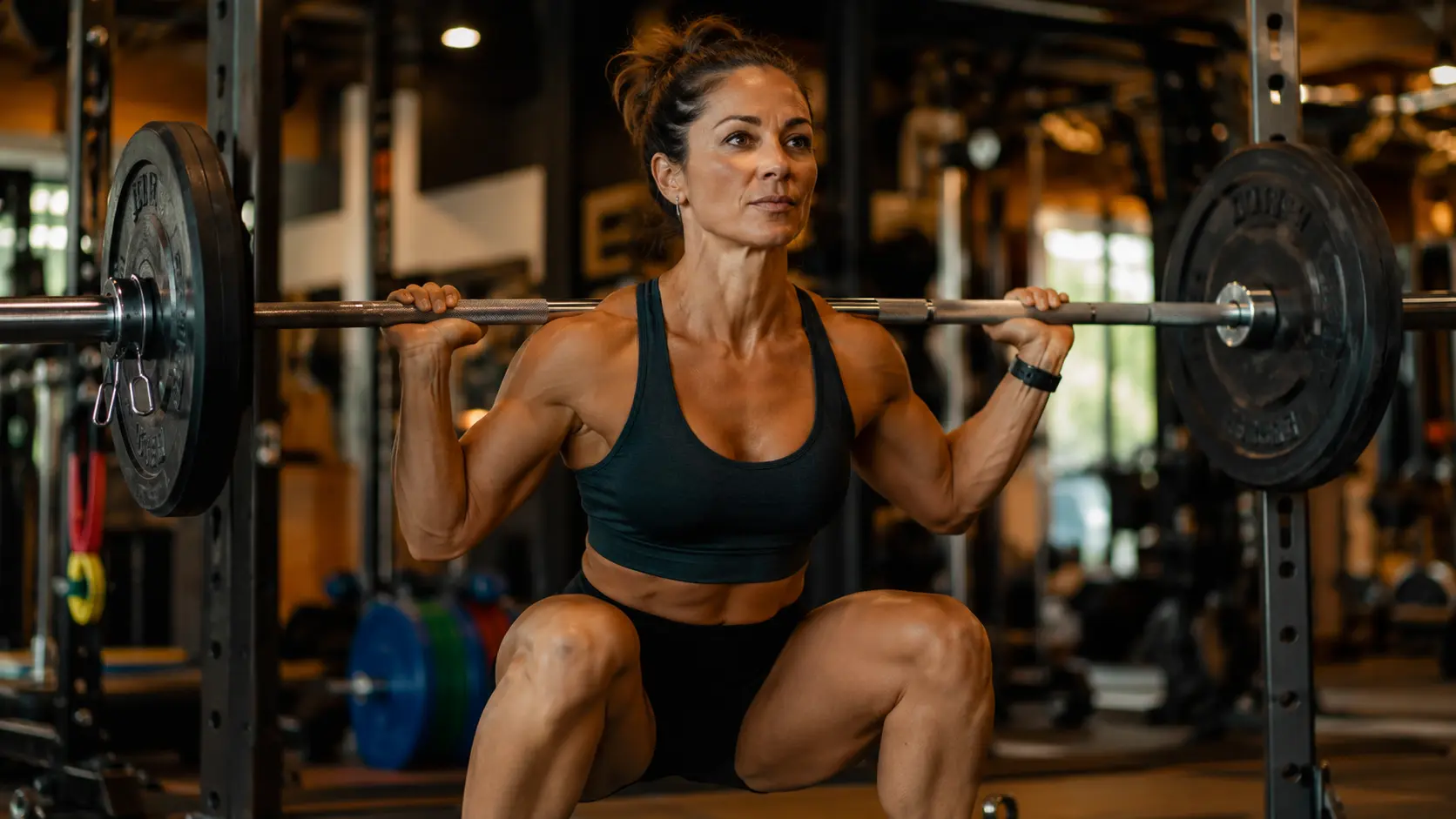
- Resistance training remains effective at building and preserving muscle in women over 40, including after menopause.
- Declining estrogen accelerates muscle loss during perimenopause — one study found roughly 10% less muscle mass in late vs. early perimenopause.
- Postmenopausal women often need higher training intensity (above ~50-70% of 1-rep max) than premenopausal women for comparable muscle gains.
- High-intensity resistance training measurably improves bone density in postmenopausal women (LIFTMOR trial).
- Women typically have 15-20x lower testosterone than men — heavy lifting builds strength and definition, not bulk.
Strength training for women over 40 works through the exact same biological mechanism it always has: place a demand on a muscle it hasn't fully adapted to, and — given adequate recovery and nutrition — it adapts by getting stronger. That mechanism does not switch off at 40, or at menopause, or at any specific age. What changes is the hormonal environment the mechanism is operating in, and that shift is specific and well-documented enough to plan around rather than guess at.
This matters because a lot of advice aimed at women over 40 either overstates the change (implying strength training "doesn't work the same way anymore") or ignores it entirely (recycling generic advice that doesn't account for menopause at all). Neither is accurate. The honest picture: the training principle is unchanged, several specific inputs are not.
What Actually Changes After 40
The two biggest changes are a faster rate of muscle loss without training, and a reduced response to the same training stimulus that worked in earlier decades. Both trace back primarily to declining estrogen during perimenopause and menopause, not to age alone.
How Fast Muscle Loss Actually Happens
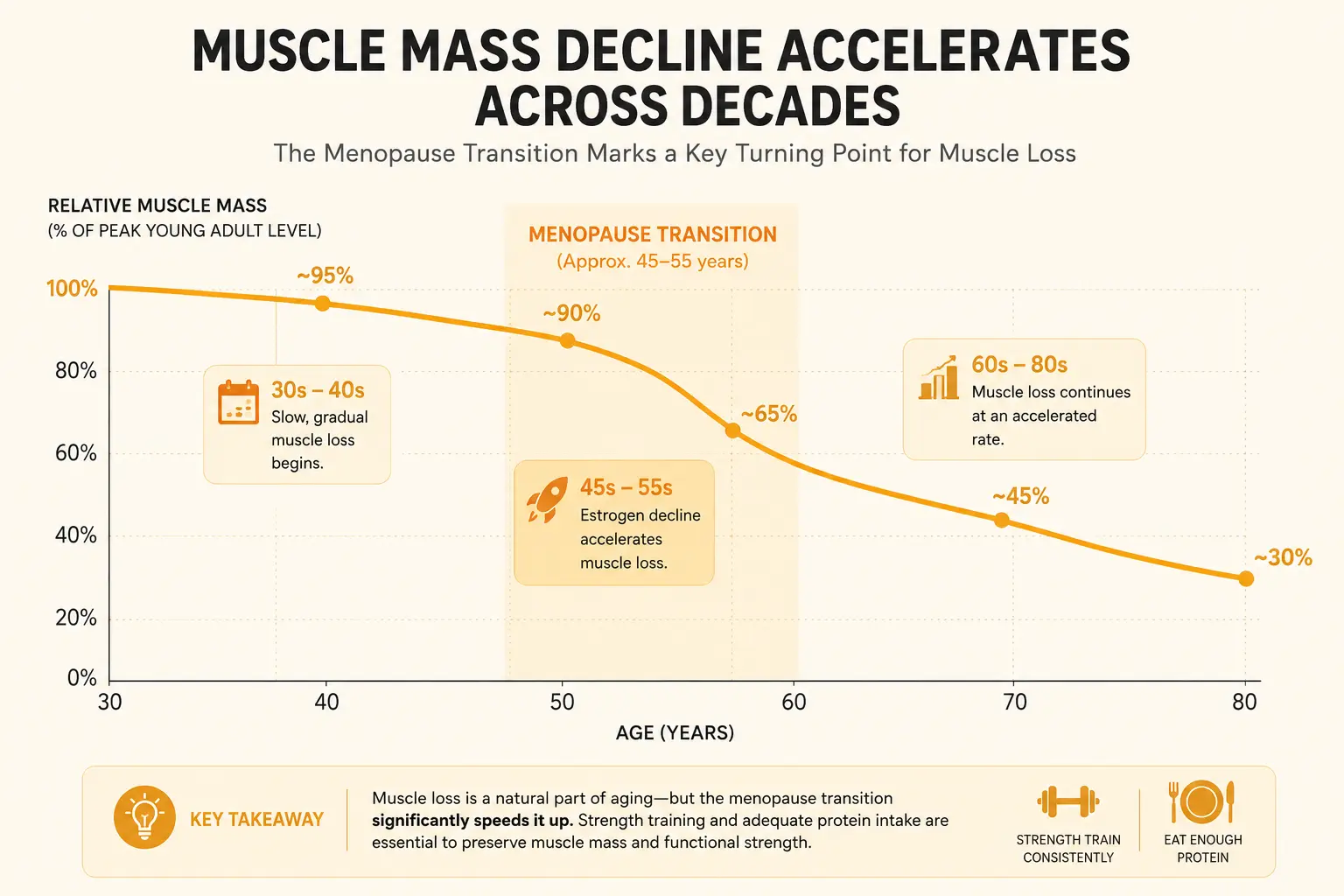
Untrained muscle mass typically declines by 3-5% per decade after age 30, accelerating to as much as 8% per decade between ages 65 and 80. More precise longitudinal research puts the median annual rate at roughly 0.37% per year in women generally, though this accelerates further with age.[1]
| Life stage | Typical annual muscle mass change (untrained) | Notes |
|---|---|---|
| Age 30-50 | ~0.37% per year (median) | Accelerates further during the menopause transition specifically |
| Late perimenopause vs early perimenopause | ~10% lower limb muscle mass[2] | A distinct, hormone-driven acceleration beyond normal aging |
| Age 75+ | 0.64-0.70% per year | Strength is lost even faster than mass — roughly 2.5-3% per year |
The strength-loss figure matters as much as the muscle-mass figure. Strength tends to decline faster than muscle mass itself in later decades, which is one reason strength-specific training — not just general activity — is the more targeted response, not a "nice to have."
Why Menopause Specifically Accelerates This
Estrogen plays a direct role in muscle protein synthesis and recovery, so its decline during perimenopause and menopause removes a hormonal support that was previously helping muscle maintenance happen somewhat passively. This is a distinct, additional mechanism on top of ordinary age-related decline — not just "getting older happening faster."
A 2021 study found women in late perimenopause had approximately 10% less muscle mass in their arms and legs compared to women in early perimenopause — a meaningful difference given the relatively short window most women spend transitioning through this stage.[2] Research also indicates menopausal women tend to lose muscle mass faster than men of the same chronological age during this specific window, a gap that narrows again once both sexes are further into older age.
The Bone Density Case for Resistance Training
High-intensity resistance and impact training measurably improves bone mineral density in postmenopausal women, according to randomized controlled trial evidence — making it one of the few interventions addressing both muscle loss and bone loss simultaneously.
The LIFTMOR trial, a randomized controlled study of postmenopausal women with low bone mass, found that a high-intensity resistance and impact training program significantly improved bone mineral density at the lumbar spine (+2.9% vs -1.2% in controls) and femoral neck (+0.3% vs -1.9% in controls) over the study period, alongside improvements in functional performance.[3] Broader research reviews recommend resistance training at 70-80% of one-rep max, performed two to three times weekly, as an effective, accessible approach for improving bone mass in postmenopausal women.
Bone density loss accelerates during the same menopause window as muscle loss, driven by the same estrogen decline — which is part of why resistance training's dual effect (muscle and bone) makes it disproportionately valuable in this specific life stage compared with lower-impact activities like walking alone, though daily walking remains a valuable complementary habit rather than a substitute.
Will Lifting Heavy Weights Make You Bulky?
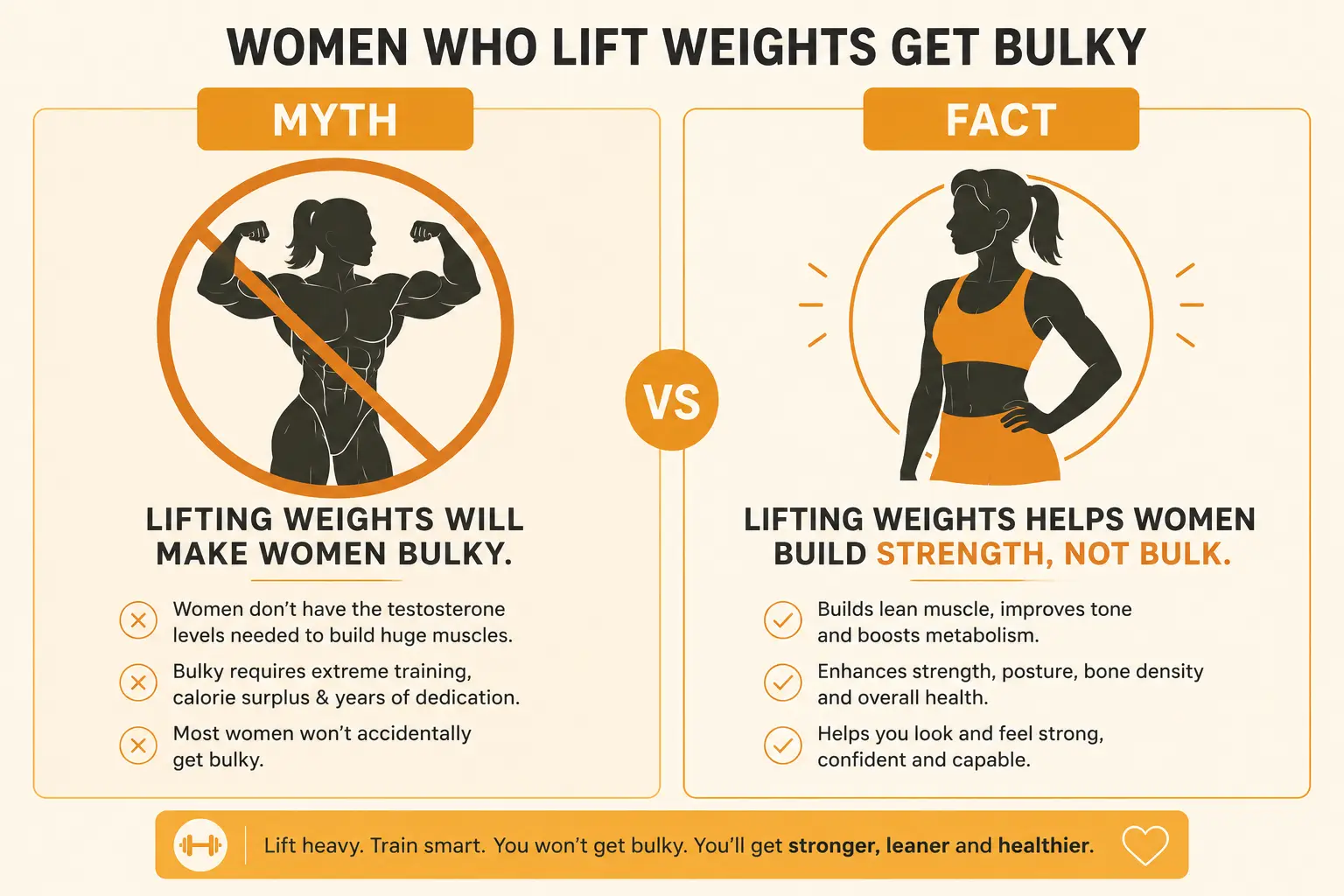
No. Women typically have testosterone levels 15-20 times lower than men, and testosterone is the primary hormonal driver of the significant muscle bulk associated with male bodybuilders — without it, that outcome is not a realistic byproduct of normal strength training.
Building visible bodybuilder-level muscle mass requires a deliberate, sustained caloric surplus, years of specialized high-volume training, and — for the physiques most commonly cited as "bulky" — a hormonal environment most women simply do not have naturally. What heavy strength training actually produces in women is increased strength, improved muscle definition, a modestly increased resting metabolic rate, and the muscle and bone benefits already covered above — not accidental bulk.
Practical Training Adjustments That Matter
- Train at higher relative intensity. Research suggests postmenopausal women often need to train above roughly 50-70% of one-rep max to achieve hypertrophy gains comparable to premenopausal women — moderate-intensity training that worked at 30 may be insufficient stimulus after menopause. How many reps and sets you actually need breaks down exactly what that intensity looks like in practice.
- Prioritise protein intake. With protein synthesis already somewhat impaired by estrogen decline, adequate protein becomes a higher-leverage variable than in earlier decades. See how much protein you actually need per day for the specific target.
- Include impact and high-intensity loading for bone. The LIFTMOR protocol specifically combined heavy resistance training with impact loading (like jumping) for its bone density effect — pure low-impact activity does not replicate this benefit.
- Allow more recovery between sessions if needed. Slower recovery is a documented part of the menopause transition; the rest and recovery guide covers how to judge whether recovery time needs extending.
- Don't mistake normal soreness for a sign something's wrong. Higher training intensity often means more noticeable DOMS at first, especially when returning to or increasing resistance work — see DOMS explained for what's normal and what isn't.
- Apply progressive overload deliberately. The underlying growth mechanism hasn't changed — see what progressive overload actually is for the full framework, which still applies unchanged.
- Start from a proper foundation if new to a gym. The beginner's guide to actually using a gym covers machines, etiquette, and a first-session walkthrough for anyone starting or returning to structured training.
Common Mistakes
- Avoiding heavy weights out of fear of bulking. As covered above, this outcome is not a realistic risk for most women, and avoiding sufficient intensity means missing the stimulus that actually drives the muscle and bone benefits that matter most in this decade.
- Relying only on cardio for "menopause weight gain." Cardio has real benefits, but it does not address the muscle and bone loss specific to this life stage the way resistance training does — the two are complementary, not interchangeable.
- Keeping the same training intensity that worked at 30. Given the reduced response to moderate-intensity stimulus after menopause, sticking with old intensity levels often means training consistently without seeing proportional results.
- Under-eating protein while training harder. Increasing training demand without also increasing protein intake to match undercuts the adaptation the training is trying to produce.
- Skipping medical guidance for pre-existing conditions. Osteoporosis, joint issues, or cardiovascular conditions may require individualised program adjustments — a doctor or physiotherapist should be part of the plan if any of these apply.
Final Thoughts
Strength training for women over 40 is not a different sport than strength training at 25 — it's the same sport with a changed set of inputs. Estrogen decline during perimenopause and menopause accelerates muscle loss, reduces the response to a given training stimulus, and accelerates bone density loss on a similar timeline. None of that means training stops working. It means the intensity, protein intake, and recovery inputs need deliberate recalibration to match what the body needs at this stage — which is a solvable, well-researched adjustment, not a reason to train less.
The biology changed. The principle didn't. Progressive, sufficiently intense resistance training remains one of the highest-return actions available for both muscle and bone health after 40 — the adjustment is in how hard and how deliberately you apply it, not whether it still works.
For building a complete, structured training habit around these principles, the Move More course covers progressive training and recovery planning as a full system, free.
This article is for informational purposes only and does not constitute medical advice. Menopause symptoms, bone health, and pre-existing conditions vary significantly between individuals — consult a doctor before beginning a new high-intensity training program, particularly if you have osteoporosis, joint issues, or a cardiovascular condition.
Sources
[1] Quantitative review of age-related muscle mass and strength decline rates. Available at: ncbi.nlm.nih.gov
[2] Research on muscle mass differences between early and late perimenopause. Summary available at: get-carrot.com
[3] Watson, S.L. et al. High-Intensity Resistance and Impact Training Improves Bone Mineral Density and Physical Function in Postmenopausal Women With Osteopenia and Osteoporosis: The LIFTMOR Randomized Controlled Trial. Available at: pubmed.ncbi.nlm.nih.gov