
Walking has an image problem. It doesn't produce sore muscles the next day, it doesn't require a gym membership or a training split, and it's so ordinary that most people don't count it as "real" exercise at all — something you do between the workouts that actually matter. The research tells a different story. Across cardiovascular health, blood sugar control, mental health, and total daily calorie burn, walking is one of the most consistently evidence-backed activities a person can do, and 30 minutes of it a day produces measurable, specific effects that hold up across a large and growing body of research.
None of this means walking replaces resistance training if your goal is building muscle — it doesn't, and it was never meant to. But as a standalone daily habit, or as the low-impact foundation underneath a structured training programme, the evidence for what walking actually does is stronger than its reputation suggests.
What Walking Does to Your Cardiovascular System
The cardiovascular case for walking is the most extensively researched part of the picture, and the effects are not subtle. Regular brisk walking is consistently linked to lower resting heart rate, lower blood pressure, improved LDL ("bad") cholesterol, and better vascular function, all of which reduce the underlying risk factors for heart attack and stroke. Aerobic activity from walking raises cardiac output and improves how efficiently blood vessels dilate and constrict, a mechanism that compounds over months and years of consistent activity rather than showing up after a single session.
The intensity threshold for these benefits is lower than most people assume. One large international study found that even fast walking for as little as 15 minutes a day was associated with a nearly 20% reduction in all-cause mortality, and that for the least active participants specifically, longer daily walking bouts cut cardiovascular disease risk roughly in half. The floor for meaningful benefit is lower than "30 minutes of structured cardio" — it starts well before that.
Steps and Mortality: What the Research Actually Shows
The "10,000 steps a day" target that shows up on every fitness tracker did not come from a study — it originated from a 1960s Japanese pedometer marketing campaign, and stuck around by cultural momentum rather than evidence. The actual research paints a more specific and, in some ways, more encouraging picture.
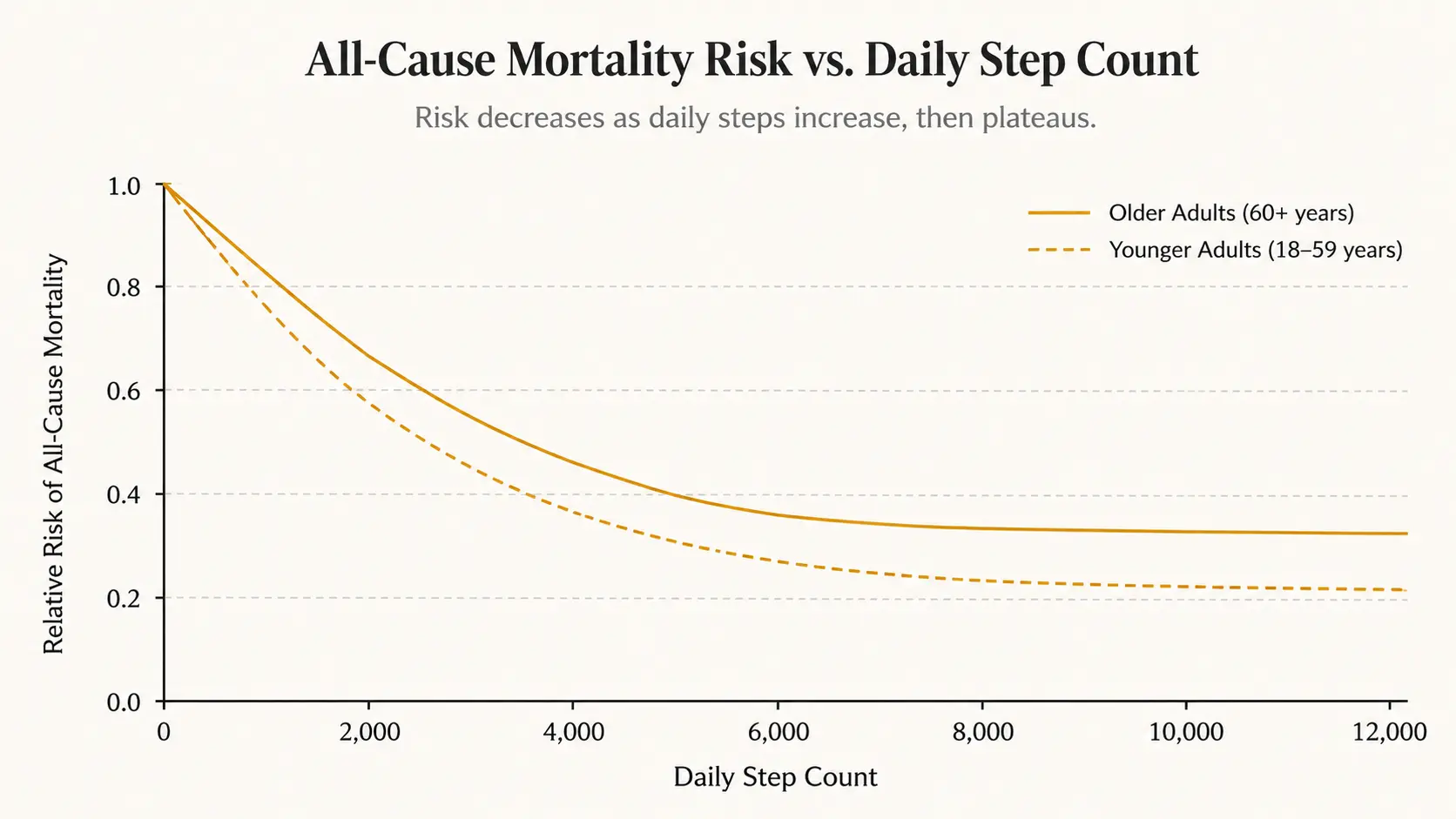
A 2022 meta-analysis pooling participant-level data from 15 international cohort studies found that all-cause mortality risk dropped progressively as daily step count increased, but the relationship was not linear all the way up — it levelled off at a specific point that varied by age.[1] For adults 60 and older, risk reduction plateaued at roughly 6,000-8,000 steps per day. For adults under 60, the plateau landed higher, around 8,000-10,000 steps per day.[1] Past those points, additional steps did not meaningfully continue to reduce risk further — which means the popular 10,000-step target happens to land close to where the real benefit curve flattens for younger adults, even though that wasn't how the number was originally chosen.
NEAT: The Calorie Burn Most People Completely Underestimate
A single 30-minute walk burns a relatively modest 120-200 calories, depending on pace and body weight — not nothing, but not the headline number that makes walking's real metabolic impact obvious. The bigger lever is NEAT: non-exercise activity thermogenesis, the energy your body burns through everything that isn't sleeping, eating, or structured exercise — walking to the store, taking the stairs, standing at a desk, pacing during a phone call, fidgeting.
A landmark study from researcher James Levine overfed 16 lean participants by 1,000 calories a day for eight weeks and tracked their movement with activity monitors. The people who gained the least weight weren't the ones who exercised more — they were the ones whose NEAT increased the most, largely through more standing and incidental movement rather than deliberate workouts.[2] Follow-up research has found that NEAT can differ by as much as 2,000 calories a day between otherwise similar people, driven mostly by occupation and lifestyle rather than genetics.[2] Daily walking is one of the most controllable, sustainable ways to move that number — and the effect compounds: an extra 100 calories burned daily translates to roughly 10 pounds over a year, without a single formal workout.[2]
This is also why a sedentary job quietly undoes more than people realise, and why structured cardio like running or cycling and daily walking aren't competing strategies — they operate through different mechanisms and stack on top of each other rather than substituting for one another. Understanding your total energy expenditure, including NEAT, is also the missing piece in most calorie-tracking approaches — the TDEE calculator factors in activity level for exactly this reason.
Walking After Meals: The Blood Sugar Effect
One of the more immediately useful, if underappreciated, findings in this area concerns timing. A short walk taken soon after eating measurably blunts the blood sugar spike that follows a meal, because contracting skeletal muscle takes up glucose from the bloodstream independent of insulin — a completely separate pathway from the hormonal response covered in what happens to your blood sugar after you eat.
Multiple controlled studies have found that just 10-15 minutes of walking taken immediately after a meal produces a meaningfully smaller glucose peak than remaining seated for the same period, and that the effect is strongest when the walk happens right after eating rather than an hour later.[3] Given that large post-meal glucose swings are themselves a driver of the crash-and-craving cycle covered in sugar cravings explained, a short post-meal walk is a genuinely low-effort way to flatten that swing at the source, not just manage the craving after it starts.
Walking and Mental Health
The mental health case for walking has moved well past anecdote. Systematic reviews and meta-analyses of randomised controlled trials have found that walking measurably reduces both depressive and anxiety symptoms, with the effect showing up at surprisingly low doses — one study found a meaningful reduction in depression scores at just 1,000 steps a day, a fraction of any commonly cited target.[4]
Walking is not a substitute for treatment of clinically diagnosed depression or anxiety, and shouldn't be framed as one. But as a low-barrier, genuinely evidence-backed daily habit that supports mental health alongside other interventions, it holds up unusually well in the research — and it's one of the few activities on this list that costs nothing and requires no equipment to start today.
How to Actually Get 30 Minutes In
The barrier to daily walking is rarely knowledge — almost everyone already knows walking is good for them. The barrier is that it competes for a slot in an already full day, and "go for a walk" as a standalone task is easy to deprioritise. The habits that actually stick tend to attach walking to something that's already happening, rather than treating it as a separate commitment.
- Walk immediately after your largest meal. This stacks the blood sugar benefit from the section above with the habit-formation advantage of a fixed, predictable trigger — same meal, same walk, every day.
- Take calls while walking. Any phone call that doesn't require a screen or notes is a built-in 10-20 minute walking opportunity that costs no additional time.
- Set a standing reminder for a mid-afternoon walk. The early-afternoon slump is a natural, recurring window where a short walk both breaks sedentary time and measurably helps alertness.
- Park farther away or get off transit one stop early. Small, repeatable additions to incidental walking add up through NEAT far more than people expect, without requiring a dedicated time block at all.
- Track it, don't just intend it. A habit that isn't logged is easy to quietly skip for a week without noticing. The free Habit Tracker works well for a simple daily walk streak, and the downloadable log below is built specifically for logging steps or minutes alongside pace.
- Hydrate properly, especially in heat. For a 30-minute walk in normal conditions, plain water is sufficient — see when electrolytes actually matter for longer or hotter sessions.
Common Mistakes When Relying on Walking as Exercise
- Ignoring pace entirely. A slow, strolling pace produces smaller cardiovascular benefits than a brisk one. A useful rule of thumb: if you can hold a full conversation without any increase in breathing effort, the pace is likely too easy to count as the "brisk walking" studied in most of the cardiovascular research above.
- Treating walking as a full substitute for resistance training. Walking does not provide a meaningful stimulus for building or preserving muscle mass. If strength or body composition is a goal, walking should sit alongside structured resistance training, not replace it — see the beginner's guide to actually using a gym for the resistance-training side of a complete routine.
- Not accounting for a sedentary job. A single 30-minute walk can be substantially offset by 9+ hours of sitting the rest of the day. Spreading movement throughout the day — via the NEAT strategies above — matters as much as the single dedicated walking block.
- Chasing a step count without a purpose behind it. 10,000 steps is a reasonable general target, but the actual research shows a plateau, not a cliff — obsessively chasing a round number past where the benefit curve flattens adds pressure without adding much additional health return.
Final Thoughts
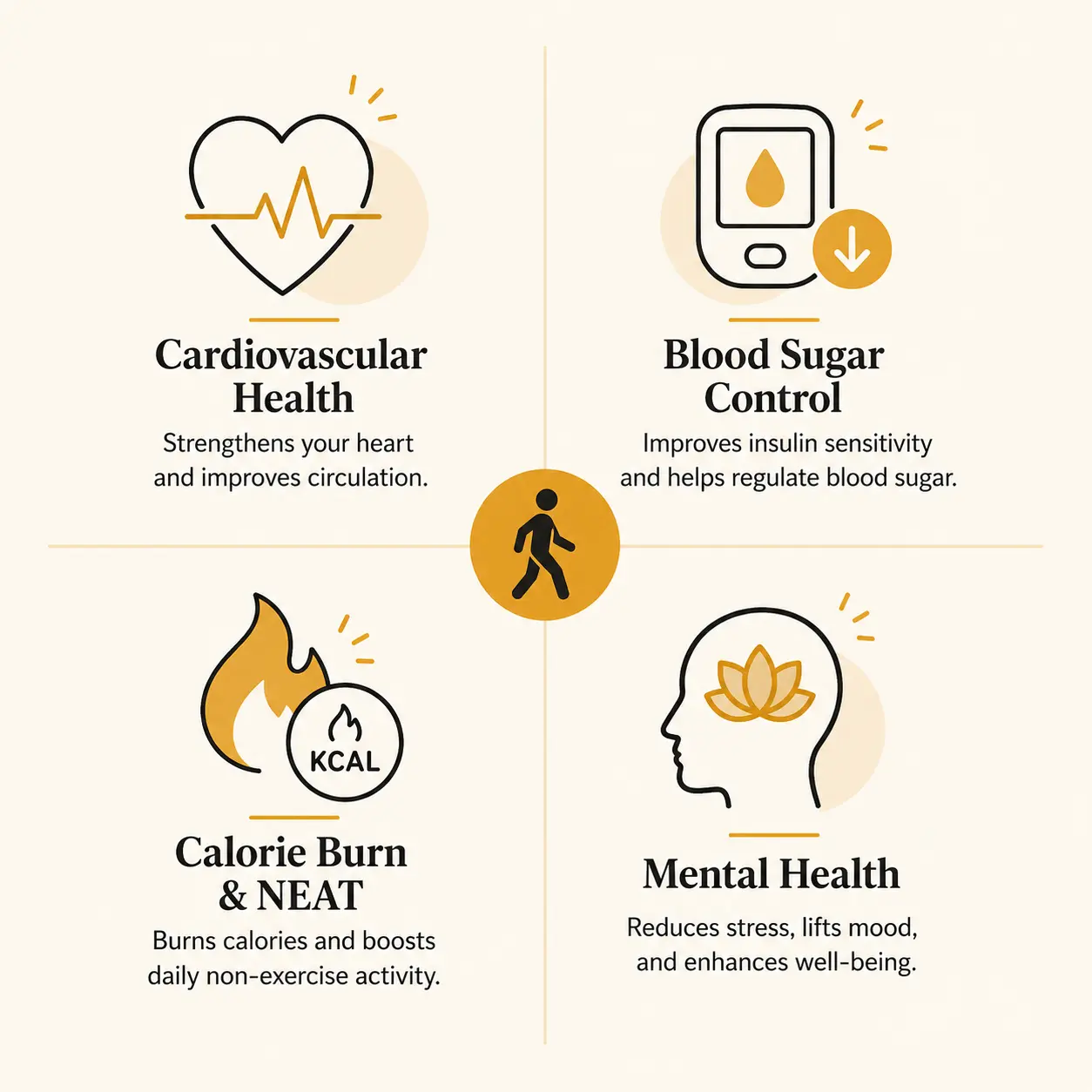
Walking's reputation as "not real exercise" doesn't survive contact with the research. Thirty minutes a day is associated with measurably lower cardiovascular risk, better post-meal blood sugar control, reduced depressive and anxiety symptoms, and — through NEAT — a genuinely significant contribution to total daily calorie expenditure that most people never account for. It is not a replacement for structured resistance training, but it doesn't need to be, to be worth doing.
The best exercise is the one you'll actually do consistently — and walking has the lowest barrier to consistency of almost anything on this list. That's not a consolation prize. Given what a daily 30-minute walk actually does across four separate, well-researched health domains, it's arguably the single highest-return habit in fitness.
If you're building walking into a broader fitness habit — alongside actual resistance training, not instead of it — the Move More course covers how to structure both together into a complete, sustainable weekly routine.
This article is for informational purposes only and does not constitute medical advice. If you have a cardiovascular condition, joint issue, or other health concern, consult a doctor before significantly increasing your activity level.
Sources
[1] Paluch, A.E. et al. Daily steps and all-cause mortality: a meta-analysis of 15 international cohorts. The Lancet Public Health, 2022. Available at: pubmed.ncbi.nlm.nih.gov
[2] Levine, J.A. et al., on non-exercise activity thermogenesis (NEAT) and its role in weight regulation. Summary available at: health.harvard.edu
[3] Research on postprandial walking and glucose response, including studies on 10-15 minute post-meal walks. Available at: ncbi.nlm.nih.gov
[4] The Effect of Walking on Depressive and Anxiety Symptoms: Systematic Review and Meta-Analysis. JMIR Public Health and Surveillance, 2024. Available at: publichealth.jmir.org