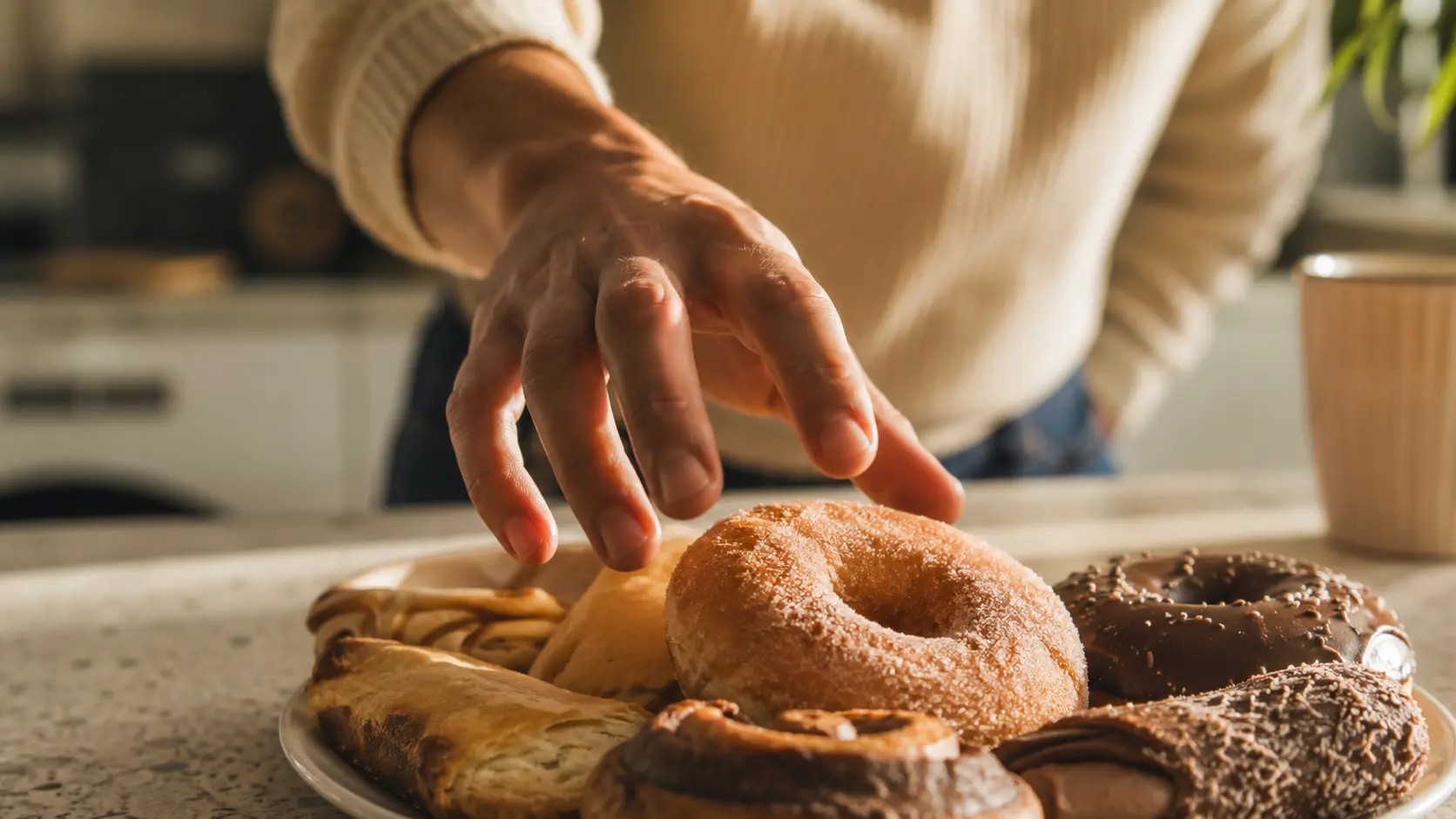
A sugar craving doesn't feel like a decision. It feels like an instruction — sudden, specific, and hard to argue with, usually arriving at 4pm or right after dinner with a clarity that "I could really go for something" never has. The standard explanation is a lack of discipline. The actual explanation is a set of overlapping, well-documented brain and hormone mechanisms that would produce that exact urge in almost anyone, regardless of willpower.
None of this means cravings are unmanageable or that you're powerless against them. It means the effective fixes look different from "try harder" — they target the specific mechanism firing at that moment, which is usually one of a small, identifiable set of causes.
The Dopamine Mechanism: Why Sugar Feels Rewarding Before You Even Swallow It
Eating something sugary triggers a release of dopamine in the brain's reward circuitry, the same system involved in motivation and reinforcement learning generally. What's less intuitive is the timing: dopamine release begins almost immediately after sugar touches the tongue, well before the food has reached the stomach or entered the bloodstream — a "cephalic phase" response your nervous system has learned through repeated exposure.[1]
This matters because it means part of the reward isn't nutritional at all — it's anticipatory and learned, which is exactly what makes cravings so responsive to cues (the sight of a snack, a specific time of day, a stressful moment) rather than actual physical hunger. Research also finds that people with stronger sugar cravings tend to show a larger dopamine spike immediately after eating sugar but a smaller response once the food actually reaches the stomach — the brain's anticipation is doing more of the work than the digestion.[1]
Repetition strengthens this loop. Chronic high sugar intake is associated with measurable changes in dopamine and opioid receptor binding in the brain's reward centre, a pattern consistent with tolerance — needing more to get the same rewarding effect over time.[1] This is the mechanistic reason a small sweet treat that used to feel satisfying can stop feeling like enough.
Is Sugar Actually Addictive? The Honest Answer
This is one of the more genuinely contested questions in nutrition science, and the honest answer sits in the middle of two overstated positions.
The more accurate framing: sugar reliably activates the same reward circuitry involved in other reinforcing behaviours, and repeated intake can shift that circuitry in ways that increase craving over time — without that meaning everyone who wants a cookie is in the grip of a clinical addiction. Treating cravings as "my brain has a learned reward response, not a moral failure" tends to be both more accurate and more useful than either extreme.
The Blood Sugar Crash-Craving Cycle
If dopamine explains why sugar feels good, the blood sugar crash explains why cravings so often arrive a few hours after a meal rather than out of nowhere. The mechanism is mechanical and well understood: a high-sugar or refined-carbohydrate meal spikes blood glucose quickly, which triggers a proportionally large insulin release to bring it back down. In many people, that insulin response overshoots, pulling blood sugar below where it started — a state called reactive hypoglycemia, which typically peaks within about four hours of eating.[2]
The crash itself isn't just uncomfortable — it's a direct trigger for craving, and specifically for the kind of fast-acting carbohydrate that caused the spike in the first place. Research has found that glucose and insulin fluctuations activate the same limbic and striatal reward regions implicated in addictive behaviour, meaning a blood sugar crash doesn't just make you generically hungry, it makes you crave the exact thing that will spike your blood sugar again.[2] That's what makes it a cycle rather than an isolated event: spike, crash, craving, another spike. Fruit juice is a common, easy-to-miss trigger for exactly this spike — fruit juice vs. whole fruit explains why removing fiber changes how fast that sugar hits.
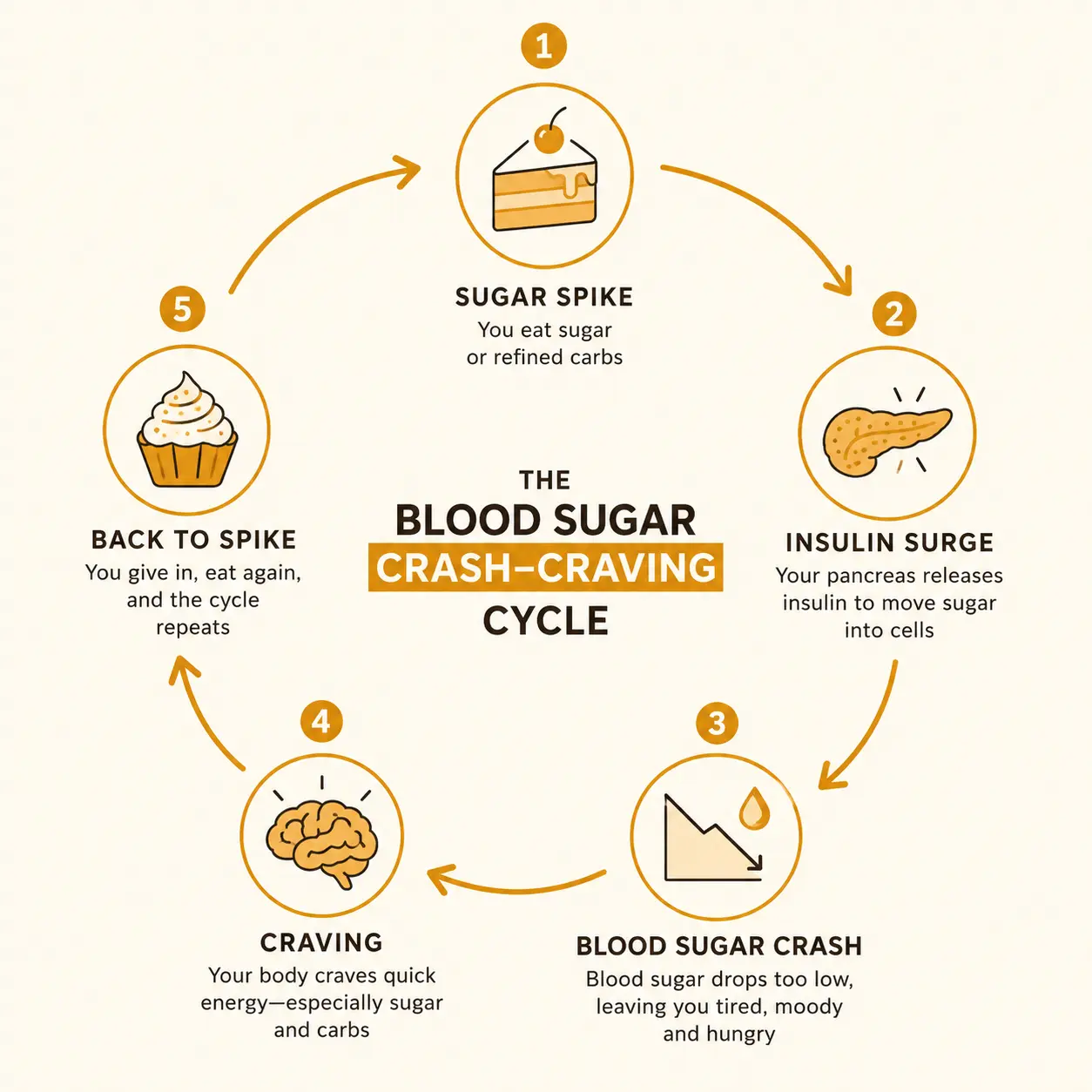
This is also why meal composition matters more than sheer willpower for preventing cravings before they start. A meal that's mostly refined carbohydrate produces a sharper spike and a sharper crash than one built around adequate protein and fiber, which slow gastric emptying and blunt the glucose spike in the first place — the same mechanism covered in detail in what happens to your blood sugar after you eat. Checking the added sugar figure on a package — not just total sugar — is one of the fastest ways to catch a spike-prone product before it's in your cart; how to read a nutrition label in under 30 seconds covers exactly where to look.
Beyond Blood Sugar: The Other Triggers
Blood sugar and dopamine explain a lot, but not everything. Three other well-supported triggers are worth knowing, because each one calls for a different fix. Formulation itself plays a role too — what ultra-processed food actually means explains why these products are specifically engineered to be easy to overeat, sugar cravings included.
What Actually Reduces Sugar Cravings
The interventions with the most consistent evidence behind them target the mechanisms above directly, rather than relying on resisting the craving once it's already at full strength.
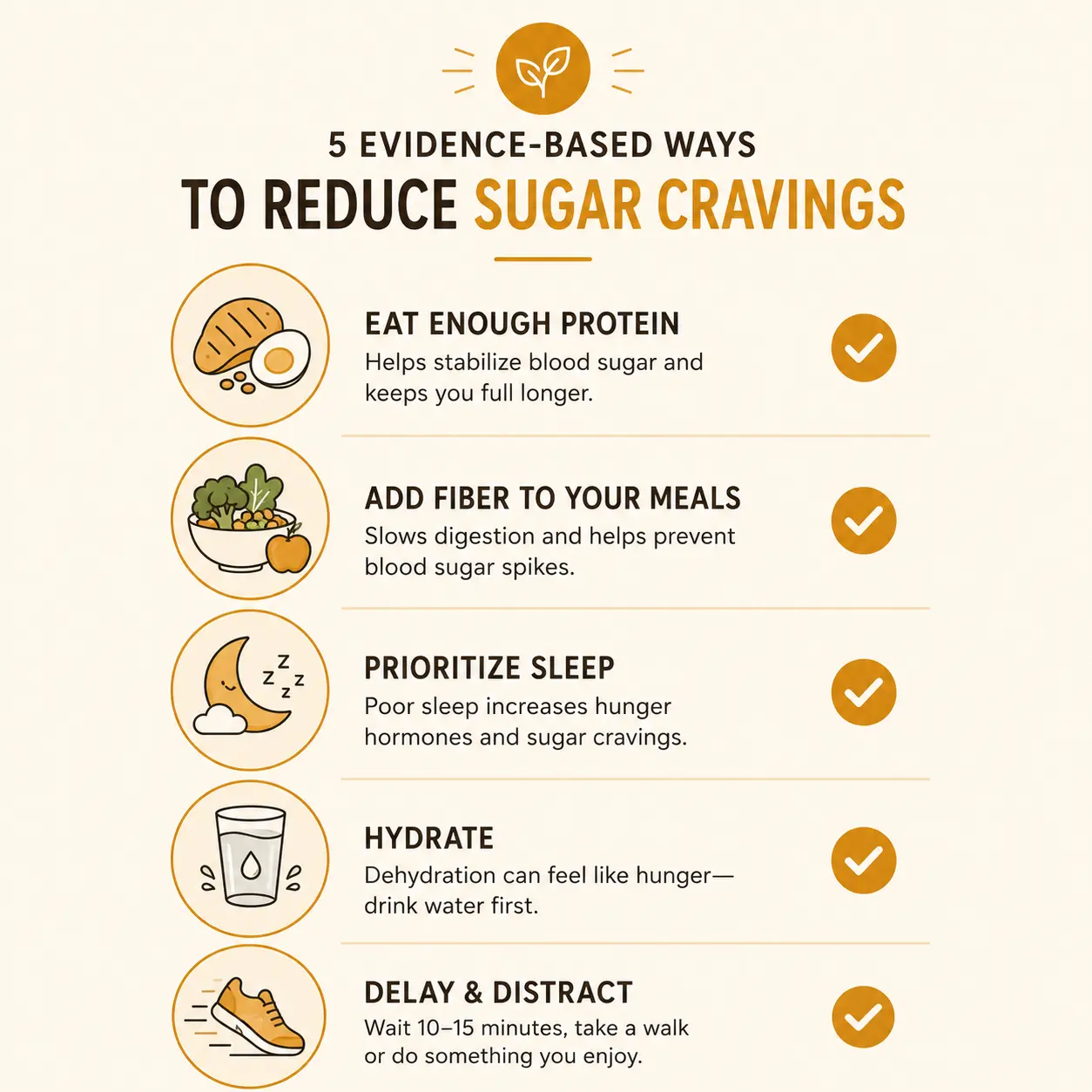
- Front-load protein, especially at breakfast. High-protein meals increase satiety hormones, slow gastric emptying, and produce a flatter blood glucose curve than high-refined-carb meals. Research on protein-rich breakfasts specifically has found reduced brain reactivity to food cues and lower self-reported cravings later in the day.[4]
- Pair carbohydrates with fiber, protein, or fat rather than eating them alone. This is the single biggest lever for blunting the spike-crash cycle at its source — see the food-order strategies in what happens to your blood sugar after you eat.
- Protect your sleep. Given the ~22% ghrelin increase from a single poor night, fixing sleep is frequently a higher-leverage fix than any dietary tactic for cravings that show up mid-afternoon or late at night.
- Delay the decision by 15-20 minutes. A craving is a time-limited spike, not a permanent state — most measurably subside within that window if not acted on immediately. Drinking water or taking a short walk gives the spike time to pass rather than requiring willpower to override it — and a walk does double duty here, since walking after a meal also blunts the blood sugar spike that may have triggered the craving in the first place.
- Eat main meals slowly enough to actually register fullness. The same 15-20 minute lag that governs craving spikes also governs the gut-to-brain fullness signal — see mindful eating without a 40-minute meal for tactics that fit inside a normal lunch.
- Rule out dehydration and electrolyte imbalance first. Thirst and mild sodium or potassium deficits can present as a craving for something sweet or salty — see why water alone isn't always enough before assuming every craving is purely appetite-driven.
- Don't eliminate sugar entirely if total restriction has failed before. Given the restriction-rebound effect, a planned, moderate amount is often more sustainable than an all-or-nothing rule that collapses into a binge the first time it's broken.
- Address stress directly, not just the craving it produces. If cravings cluster around stressful periods, the more durable fix is a stress-management practice rather than fighting the resulting craving each time — see practical stress management.
If you're building this into a broader, sustainable eating approach rather than a one-off fix, the Eat with Intent course covers how to build stable, satisfying meals that prevent crash-driven cravings in the first place — six free lessons, no sign-up.
Common Mistakes When Trying to Stop Sugar Cravings
- Going cold turkey after years of daily sugar intake. Given the restriction-rebound effect and dopamine tolerance built up over time, an abrupt total cutoff is one of the more common ways a craving turns into a binge. A gradual reduction, alongside the mechanism-level fixes above, tends to hold up better.
- Treating every craving as a willpower test. A craving triggered by a genuine blood sugar crash or a poor night of sleep isn't a discipline problem — it's a hormonal one, and no amount of willpower changes the underlying chemistry as effectively as addressing the trigger does.
- Skipping meals to "save calories," then crashing later. Skipped meals frequently set up a sharper blood sugar crash at the next eating opportunity, which is one of the most reliable ways to trigger an intense, hard-to-resist craving.
- Assuming artificial sweeteners are a clean fix. Evidence on whether non-nutritive sweeteners reduce or simply relocate sugar cravings is mixed — some research suggests the hedonic, cue-driven reward response can still be triggered by sweet taste alone, independent of actual sugar or calories.
Final Thoughts
A sugar craving is not evidence of a character flaw. It's a predictable output of a small number of well-studied mechanisms — dopamine reinforcement, blood sugar volatility, sleep debt, stress, and restriction rebound — each of which responds to a specific, targeted fix rather than generic self-control. Knowing which mechanism is firing on a given day is usually more useful than trying harder to resist whichever one it happens to be.
The goal isn't to never want sugar again. It's to stop the specific, avoidable triggers — the crash, the sleepless night, the skipped meal — from manufacturing cravings that wouldn't otherwise exist, so the cravings that remain are ones you can actually make a clear-headed choice about.
For the bigger picture of how stable blood sugar fits into an otherwise balanced way of eating, how to build a balanced plate without a food scale is the natural next read.
Sources
[1] Qin, C. et al. Sugar Addiction: Neural Mechanisms and Health Implications. Brain and Behavior, 2025. Available at: onlinelibrary.wiley.com
[2] Reactive hypoglycemia in binge eating disorder, food addiction, and the comorbid phenotype: unravelling the metabolic drive to disordered eating behaviours. Journal of Eating Disorders, 2023. Available at: link.springer.com
[3] Spiegel, K. et al. A single night of sleep deprivation increases ghrelin levels and feelings of hunger in normal-weight healthy men. Referenced via PubMed. Available at: pubmed.ncbi.nlm.nih.gov
[4] Increased Dietary Protein as a Dietary Strategy to Prevent and/or Treat Obesity. PMC. Available at: pmc.ncbi.nlm.nih.gov