
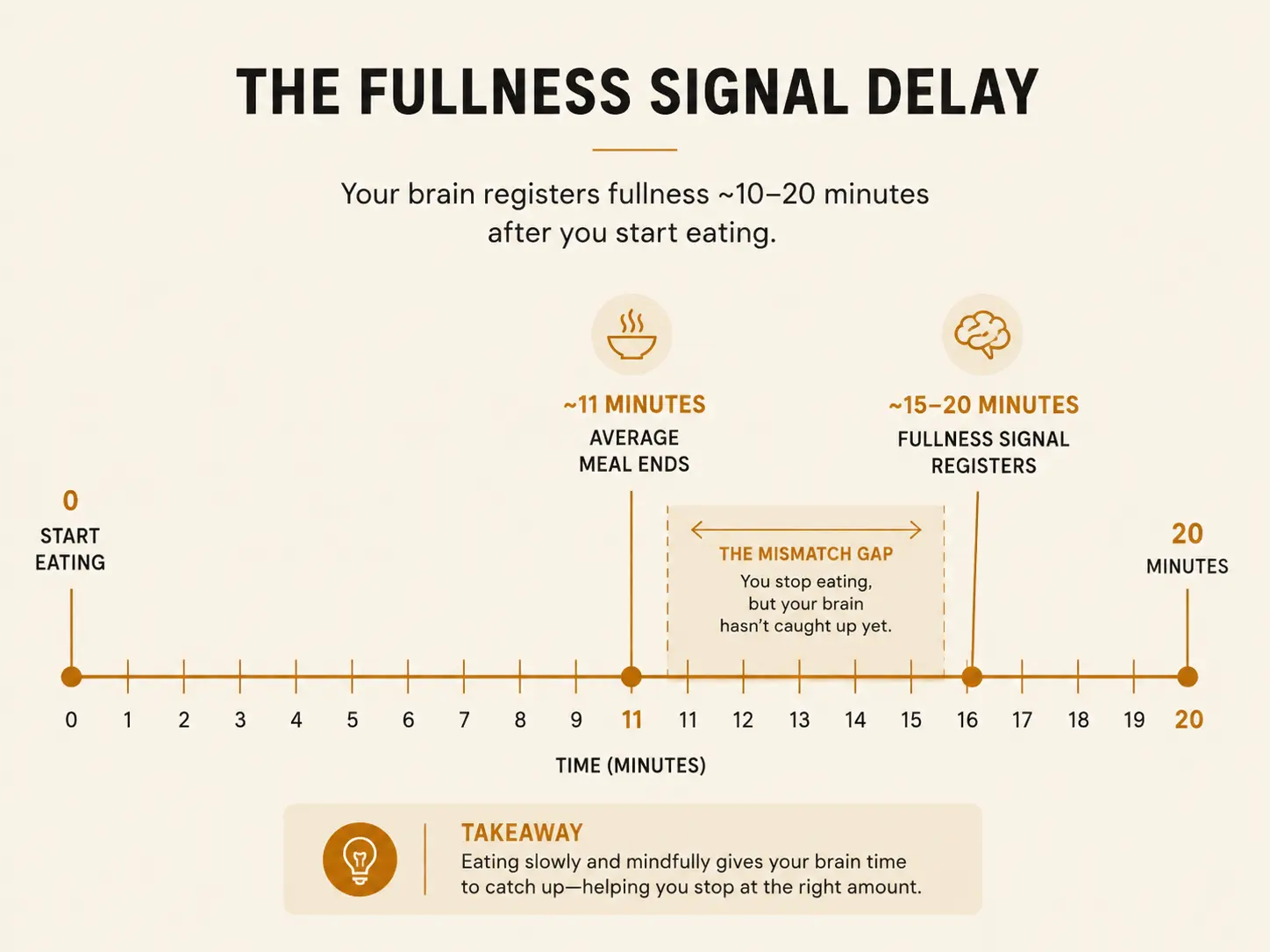
- The gut-to-brain fullness signal takes roughly 15-20 minutes to register, regardless of how fast you eat.
- The average meal in the US takes about 11 minutes — meaning most people finish eating before their brain has caught up.
- This timing mismatch is linked to consuming 15-25% more calories than eating more slowly would produce.
- A large Japanese study found 45% of fast eaters were obese, versus roughly 22% of slow eaters, using local BMI classifications.
- A meta-analysis of 15 studies found fast eaters had an average BMI 1.78 kg/m² higher than slow eaters.
Mindful eating works because it closes a specific, well-documented timing gap: your gut needs about 20 minutes to tell your brain you're full, but most meals are over in about 11 — so by the time the fullness signal arrives, many people have already eaten well past it. Closing that gap doesn't require a 40-minute ritual meal, eating in silence, or removing yourself from a normal workday. It requires a handful of small, specific actions that add real minutes and real attention without adding real time you don't have.
This piece breaks down the actual mechanism behind mindful eating, what the research says about eating speed and weight, and a set of tactics that fit inside a normal 15-20 minute lunch — not a wellness retreat.
The 20-Minute Lag Nobody Told You About
Your stomach and small intestine release hormonal fullness signals almost as soon as you start eating, but it takes roughly 15-20 minutes for those signals to reach the brain and register as "I've had enough." If a meal is finished well before that window closes — which describes the average 11-minute American meal — the brain simply hasn't caught up yet, and the natural stopping cue never arrives before the plate is empty.[1]
| Meal pace | Typical duration | Fullness signal status at the end |
|---|---|---|
| Fast / distracted eating | ~10-11 minutes | Signal hasn't arrived yet — easy to overshoot |
| Moderate, unhurried eating | ~15-18 minutes | Signal arriving — easier to notice and stop |
| Deliberately slow eating | 20+ minutes | Signal fully registered before the meal ends |
This single mismatch — not willpower, not discipline — explains a meaningful share of ordinary, everyday overeating. Research estimates people who eat quickly consume 15-25% more calories per meal than they would eating at a moderate pace, simply because they keep eating past the point their body would otherwise have signaled to stop.[2]
What the Research Actually Shows About Eating Speed
Multiple large population studies, mostly out of Japan, have found a consistent and fairly large association between fast eating and both obesity and metabolic syndrome — this isn't a fringe finding, it's one of the more replicated results in behavioral nutrition. One study found 45% of self-identified fast eaters were classified as obese, compared to roughly 22% of slow eaters, using Japan-specific BMI thresholds.[3]
This doesn't mean eating speed is the only variable that matters for weight or metabolic health — food choice, portion composition, and activity level all matter too, and building a balanced plate addresses a different, complementary part of the picture. But eating pace is a genuinely underrated lever, and unlike food composition, it requires no new grocery list or meal plan to change.
You Don't Need a Ritual — You Need a Few Specific Habits
The version of mindful eating that shows up in wellness content — sitting in silence for 40 minutes, chewing each bite 50 times, meditating before every snack — is real for some practitioners, but it isn't the mechanism that produces the actual benefit, and it isn't realistic for most people's actual days. The mechanism is simpler: add enough pause and attention to a meal that it takes closer to 18-20 minutes instead of 10-11, and give your brain a fair chance to register fullness before the plate is empty.
That reframe matters because it removes the biggest barrier people report to trying mindful eating: the belief that it requires a time commitment they don't have. A genuinely effective version fits inside a normal desk lunch or family dinner.
Tactics That Add Zero Extra Time to Your Day
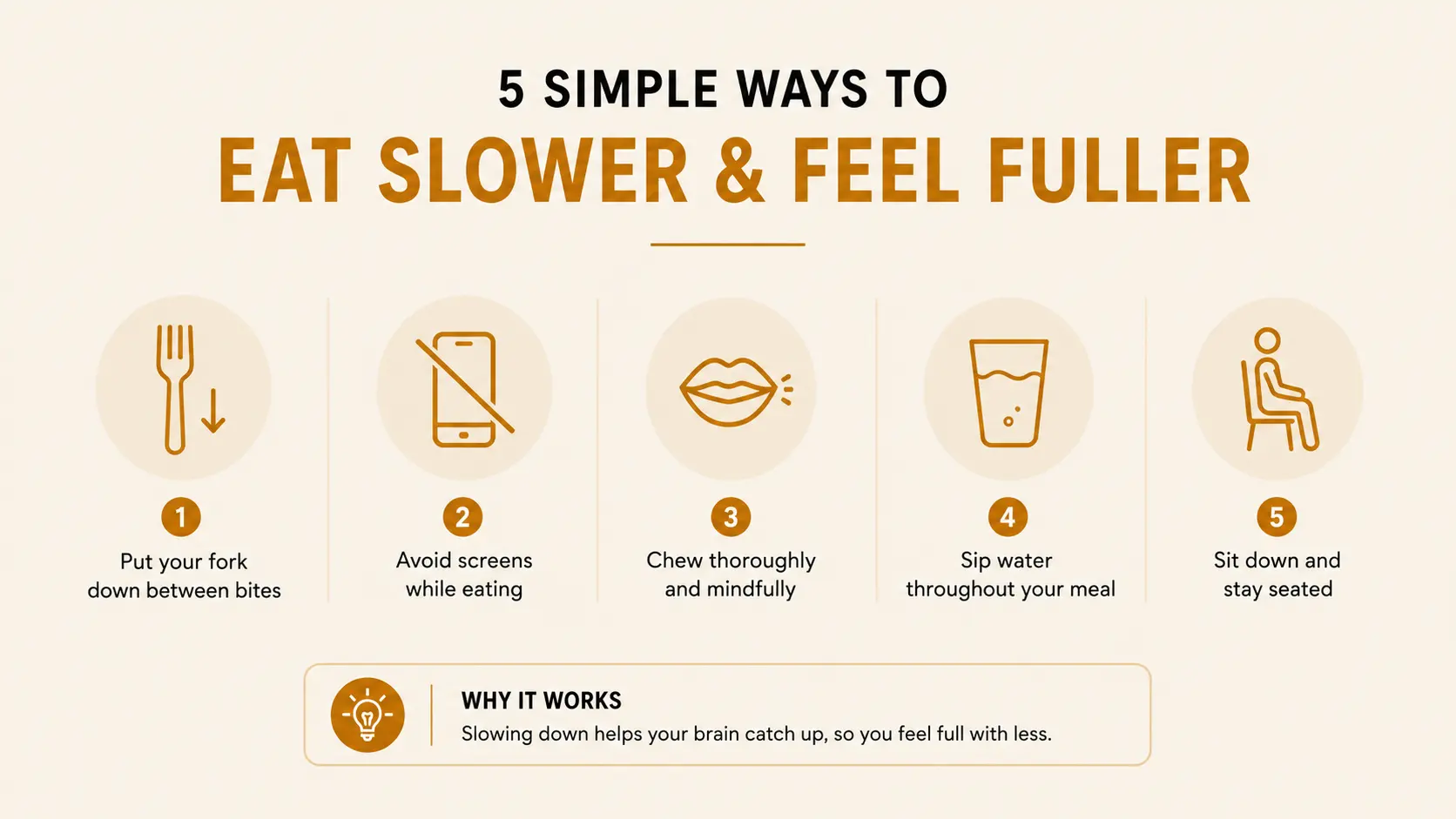
- Put your fork or spoon down between bites. This single physical habit forces a natural pause and breaks the automatic hand-to-mouth cycle — most people find it's the easiest change to sustain and the one with the most noticeable effect.
- Eat the first three bites without your phone. You don't need a distraction-free meal — just a distraction-free start, which is enough to register the first real hunger and flavor cues before autopilot takes over.
- Chew until the food loses its original texture, not for a fixed count. The 20-30 chews guideline is a rough starting point, not a rule — the actual goal is texture, which naturally slows the meal without you counting anything.
- Drink a glass of water before you start eating. Thirst is commonly mistaken for hunger, and starting hydrated removes one source of eating faster or more than needed.
- Sit down somewhere, even for five minutes. Eating standing at a counter or in a car removes the physical cue that a meal is happening at all — sitting down, even briefly, is enough to shift out of autopilot.
The 5-Minute Version: A Sequence, Not a Ritual
If you want a simple structure rather than a loose list of habits, this four-step sequence fits inside any meal without adding meaningful time.
- Before the first bite: take one breath and rate your hunger from 1-10. This takes five seconds and sets a baseline you'll check against later.
- First three bites: no phone, no screen — just the food. This is the only genuinely distraction-free part of the meal, and it's short enough to always be realistic.
- Halfway through: pause for one breath and re-rate your hunger. If it's dropped to a 3-4, you're likely close to the fullness signal even if the plate isn't empty.
- Before taking seconds or finishing everything out of habit: pause 60 seconds. If the meal is genuinely still needed, continue. If it's habit rather than hunger, that pause is usually enough to notice the difference.
What Doesn't Need to Change
This pairs naturally with how you build the plate itself — if portion composition and this pacing habit both feel like too much at once, start with pacing first. It requires no new shopping list, and unlike calorie counting, it doesn't create a new daily obligation to track anything.
Common Mistakes
- Treating mindful eating as an all-or-nothing ritual. Waiting for a distraction-free 40-minute window that rarely arrives means the habit never actually gets practiced.
- Trying to slow down every single meal at once. Start with one meal a day — often lunch, since it's usually the most rushed — and let it become automatic before expanding.
- Confusing "mindful" with "restrictive." This isn't about eating less on principle; it's about eating the amount your body actually needs, which sometimes means eating more slowly to a smaller portion and sometimes doesn't change the amount at all.
- Ignoring the first-three-bites rule because "the whole meal isn't distraction-free anyway." Partial attention at the start still produces most of the benefit — it doesn't need to be perfect to work.
- Stopping after one bad day. Like any habit, the fork-down pause or the hunger check-in feels awkward for the first week and close to automatic after that — the 7-day log exists specifically to get past that adjustment period.
Final Thoughts
The core insight here is almost mechanical: your body is already sending a fullness signal, it just needs about 20 minutes and a little bit of attention to arrive. Mindful eating isn't a personality trait or a discipline you either have or don't — it's a handful of small, specific pauses that give a biological process the time it needs. None of them require a 40-minute meal, a silent room, or a wellness retreat. They require a fork set down, three attentive bites, and one honest pause before the plate is automatically finished.
You're not trying to eat less. You're trying to give your body's own "I'm full" signal a fair chance to arrive before the meal is over.
If distraction is the bigger obstacle in your case — phones, screens, eating at a desk — the digital minimalism guide covers building phone-free windows that naturally extend to mealtimes. And if you're building out a full week of intentional meals rather than just one habit, the 2-hour Sunday meal prep reset pairs well with slower, more attentive eating during the week.
Sources
[1] Gut-to-brain satiety signal timing and eating speed. Available at: health.clevelandclinic.org
[2] Average US meal duration and calorie intake from eating speed. Available at: signoshealth.com
[3] Eating speed and obesity rates, Japanese population study. Available at: sciencemediacentre.org
[4] Eating speed and metabolic syndrome risk, population-based cohort study. Available at: ncbi.nlm.nih.gov
[5] Mindful eating and satiety signal perception research. Available at: health.harvard.edu