
Two hours is a specific claim. Not 'a Sunday afternoon.' Not 'whenever you have time.' Two hours, with a defined start and a defined end, after which the kitchen is clean and the week is set up.
The specificity matters because vague time commitments expand to fill available space. 'I'll do some meal prep this weekend' becomes a three-hour project that bleeds into the rest of the day and leaves you feeling more drained than prepared. A hard two-hour constraint forces the most important question in any prep session: given finite time, what are the highest-leverage things to make?
This article is a framework for answering that question — not a recipe list. Recipes are easy to find. The harder problem is the decision architecture: how you decide what to prep, how you sequence the session to run multiple things in parallel, how you calibrate the output to your actual household and weekly rhythm, and how you build a feedback loop that makes each Sunday slightly more efficient than the last.
If you want to put this framework to work in a structured way, the 14-Day Meal Prep Challenge gives you a day-by-day sequence that builds the Sunday session habit over two weeks — starting with a short first session and expanding as the system becomes familiar.
This is for people who have already understood that cooking from scratch every night is not sustainable, and who want a system with enough structure to be reliable and enough flexibility to handle the real weeks that do not go according to plan. It pairs naturally with the high-protein meal prep system if protein targets are a priority, and with the balanced plate framework for structuring what you assemble from the prepped components each day. The proportions that framework is built on — roughly half vegetables and fruit, a quarter protein, a quarter whole-grain carbohydrate — are the same ones that six different countries' official dietary guidelines independently converge on.
Why a Framework Beats a Recipe List
Most meal prep content is recipe-driven: here are five things to make this Sunday. This is useful the first time. By the third Sunday, the novelty has worn off and you are back to deciding from scratch which five things to make. The recipe list solved the cooking problem but not the decision problem.
A framework is different. A framework gives you a structure that accommodates any ingredients, any cuisine, any dietary requirements, and any week. Once the framework is internalised, you never need a meal prep recipe list again — because you have a decision-making process, not a set of fixed outputs.
The framework has four components: a slot system that defines what categories of food to prepare; a prioritisation logic that tells you which slots to fill first given your specific week; a sequencing method that maximises parallel processing within the two-hour window; and a calibration mechanism that adjusts output to household size and the coming week's schedule. Each of these is explained in full below.
The Slot System: Five Categories, Not Five Recipes
The slot system replaces the question 'what should I make?' with 'which slots do I need to fill?' A slot is a functional food category. Filling a slot means producing a component in that category — the specific ingredient within the slot is your choice, based on what you have, what you want, and what your week looks like.
There are five slots in the Sunday Reset framework. You do not have to fill all five every week. You need to fill the ones most likely to create friction later in the week if they are empty.
| Slot | Function | If empty, the consequence is… |
|---|---|---|
| Slot 1: Anchor Protein | Primary cooked protein for the week; highest-friction weeknight item | Weeknight dinners default to whatever is easiest — usually carbohydrate-heavy or delivery |
| Slot 2: Grain Base | Eliminates the 20-minute rice-on-the-stove gap at dinner time | Every dinner requires a separate grain-cooking step; adds 20–30 minutes to weeknight cooking |
| Slot 3: Roasted Vegetables | Ready sides and bowl components without any further preparation | Vegetables get skipped at weeknight meals because the path from raw to ready is too long when tired |
| Slot 4: Flavour Base / Sauce | Transforms plain assembly into a meal that tastes finished and satisfying | Assembled meals taste plain; low satisfaction drives abandonment of home cooking |
| Slot 5: Backup Protein | Fast no-assembly fallback when the primary system fails | Hunger without ready protein leads to carbohydrate-dominant snacking or skipping meals entirely |
The logic of the five slots is designed around where meal planning most commonly fails in practice. Slot 4 — the flavour base — is systematically underprioritised by people new to batch cooking because it does not feel like a substantial preparation. It is. A week with a good green chutney and an onion-tomato masala in the fridge produces more satisfying meals from the same components than the same week without them. This connects directly to how distributing protein across each meal keeps the system working: the protein anchor (Slot 1) only works if the meal is satisfying enough to eat. Flavour is what makes the system sustainable.
Prioritisation Logic: Deciding What to Prep This Sunday
With a two-hour constraint, the most important skill is not cooking technique. It is deciding which slots deliver the most value for your specific week given your specific fridge state, schedule, and preferences. Two people using the same framework will make different Sunday prep decisions and both will be correct — because the decisions are calibrated to their individual weeks.
The pre-session five-minute review
Before turning on the stove, spend five minutes on three questions. The answers drive the session's priorities.
| Question | What you are assessing | How it changes the session |
|---|---|---|
| What is in the fridge right now that needs to be used? | Existing perishables that will go off this week; partially used vegetables; proteins close to use-by date | Slot choices should prioritise these items; prep them first; this prevents food waste and often produces the most interesting components |
| How many meals will I actually cook at home this week? | Planned dinners out, work travel, lunches out, social meals — anything that reduces the number of home meals | Fewer home meals = smaller prep volume; do not batch cook for seven dinners if four are already accounted for elsewhere |
| Which day of the week is the highest friction point? | The day most likely to produce a poor food decision — usually the most tired, busiest, or most schedule-disrupted day | That day's meal should be the most fully prepared; the component for that day's dinner should be made first in the session |
The slot priority hierarchy
When time is short — a 90-minute session instead of two hours — fill the slots in this order:
- Slot 1 first (Anchor Protein). If you can only do one thing, make a batch of protein. Dal, eggs, chickpeas — something that takes the highest-friction item off the weeknight list. Everything else can be improvised. The protein anchor cannot. This is the same insight that drives the approach to hitting protein goals without formal meal prep — the anchor must exist before anything else can work.
- Slot 4 second (Flavour Base or Sauce). The onion-tomato masala base or a single sauce takes ten to fifteen minutes and multiplies the usefulness of everything else in the fridge. Plain rice and dal with no finishing element is edible. Rice and dal with a fresh chutney is a meal people actually want to eat.
- Slot 2 third (Grain Base). Pre-cooked rice converts a 25-minute cooking task into a 3-minute reheating task. This is the largest single time barrier removed for weeknight cooking.
- Slot 3 fourth (Vegetables). The most nutritionally important omission when time is short — but also the most hands-off item to make. Once in the oven, they require no attention. Prioritise them if the oven slot is available during Slots 1 or 2 passive time.
- Slot 5 last (Backup Protein). Boiled eggs and Greek yoghurt are so fast to produce or purchase that they almost never require dedicated session time. Include them at the end as a five-minute addition, or buy them as part of the weekly shop.

The Sequencing Method: Running Two Hours in Parallel
A two-hour prep session run sequentially — finish one task completely before starting the next — produces far less output than the same two hours run in parallel. The sequencing method exploits the structure of kitchen tasks: every cooking method has an active phase (chopping, seasoning, setting up) and a passive phase (simmering, roasting, boiling). Passive phases of one task should always overlap with active phases of another.
The two-hour window is not two hours of cooking. It is two hours of wall-clock time during which four to five cooking processes run concurrently.
The sequencing principles
- Start the oven immediately. The oven takes 10–15 minutes to reach temperature and then runs hands-off for 25–40 minutes. It should be the first thing turned on at the start of every session, even before you have finished deciding what goes in it.
- Longest passive time goes on first. Legumes in the pressure cooker, grains on the stove — these take the most calendar time and the least active attention. They go on first so their passive time is available for other active work.
- Chop during simmer time. Vegetable prep for roasting, salad prep, ingredient preparation for the masala base — all of this happens while the pressure cooker runs. No chopping before anything is on the stove.
- Make sauces last. Sauces and dressings take 5–10 minutes and require the stove or oven to be free. They go at the end of the session when other processes are complete or winding down.
- Cool and store while cleaning. The final 15 minutes is simultaneous cleaning and storing. Components go into containers as they cool. The kitchen is clean when the session ends, not after a separate cleanup phase.
A fully sequenced two-hour session: the annotated timeline
| Time | Active task | Parallel passive processes | Slot |
|---|---|---|---|
| 0:00–0:05 | Preheat oven to 200°C. Review fridge. Answer the three pre-session questions. Decide the session's priority order. | — | Pre-session review |
| 0:05–0:15 | Rinse 250g dal or legumes. Add to pressure cooker with water, turmeric, and salt. Seal and start. | — | Slot 1 initiated |
| 0:10–0:20 | Chop two trays of seasonal vegetables (cauliflower, sweet potato, capsicum, carrot). Season with oil, salt, cumin or mixed spices. Load into oven. | Dal in pressure cooker | Slot 3 initiated |
| 0:20–0:30 | Rinse and start rice: 300g to pot, correct water ratio, lid on, medium heat. Set timer for 15 minutes. | Dal cooking; vegetables roasting (20–35 min total) | Slot 2 initiated |
| 0:30–0:45 | Make onion-tomato masala base: slice 3 onions; fry in oil 10 minutes; add ginger-garlic paste; add 3 chopped tomatoes; cook down 8–10 minutes. | Rice simmering (timer running); vegetables roasting; dal done — depressurise and set aside | Slot 4 active |
| 0:45–1:00 | Wash and chop raw salad vegetables (cucumber, tomato, lettuce); store in containers. Turn and check vegetables in oven. | Rice done — turn off, leave covered; masala base cooking down | Slot 5 prep; Slot 3 finishing |
| 1:00–1:15 | Remove vegetables from oven; cool. Hard-boil 6 eggs (10 minutes). Make green chutney or dressing: blitz coriander, mint, chilli, garlic, lemon, salt. | Eggs boiling; vegetables cooling; masala cooling | Slot 4b (finishing sauce); Slot 5 initiated |
| 1:15–1:30 | Portion and store all cooked components into labelled airtight containers. Rice, dal, masala base, roasted vegetables — each in separate containers. Write prep date on lids. | Eggs still boiling (done at ~1:25) | Storage and organisation |
| 1:30–1:45 | Store eggs (in shell) and chutney. Pack raw salad veg. Final check: all five slots covered? Any gaps to note for mid-week? | — | Slot 5 complete; final review |
| 1:45–2:00 | Clean: wash pots, wipe surfaces, empty pressure cooker, load dishwasher. Kitchen done. | — | Session close |
At the end of this session: cooked dal (Slot 1), cooked rice (Slot 2), two trays of roasted seasonal vegetables (Slot 3), onion-tomato masala base and green chutney (Slot 4), boiled eggs (Slot 5). Five slots filled in two hours of wall-clock time, with less than ninety minutes of active work because processes overlapped throughout. The kitchen is clean. The week is set up.
The Calibration Mechanism: Adjusting Volume and Scope to Your Week
The biggest calibration error in meal prep is cooking the same volume every week regardless of what the week actually looks like. A week with four planned dinners out needs half the protein prep of a week where every meal is home-cooked. Calibration is what distinguishes a session that produces the right amount from one that produces too much (food waste, fridge overwhelm) or too little (mid-week gaps).
Volume calibration by household size
| Household | Dal / legumes (dry) | Grain (dry) | Vegetables for roasting | Eggs | Sauce |
|---|---|---|---|---|---|
| 1 person | 100–150g | 150–200g | 1 tray (400–500g mixed) | 4–6 | 1 sauce (half batch) |
| 2 people | 200–250g | 250–300g | 2 trays (700–900g mixed) | 6–8 | 1 sauce (full batch) |
| 3–4 people | 350–450g | 400–500g | 3 trays (1.2–1.5kg mixed) | 10–12 | 2 sauces |
| Family with children | 400–500g | 500–600g | 3–4 trays; choose kid-compatible vegetables | 12+ | 1 mild sauce + 1 adult sauce |
Scope calibration by week type
Not all weeks are equal. A quiet week at home requires a full session. A week with three dinner engagements, a work trip, and a weekend event requires a fraction of the normal prep. Calibrating scope to the actual week prevents over-cooking and the specific demoralisation that comes from throwing away food you spent Sunday preparing.
| Week type | Description | Recommended scope | Key slots to prioritise |
|---|---|---|---|
| Full home week | Most dinners and lunches at home; standard schedule | Full two-hour session; all five slots | All five; Slot 3 especially important for variety |
| Semi-social week | Two to three dinners out; some lunches out; normal workdays | 90-minute session; reduce volume by 30–40% | Slots 1, 2, and 4; vegetables and backup protein can be minimal |
| Heavy travel or event week | More than three dinners out; travel mid-week; disrupted schedule | 45-minute minimum session; weekday lunches and two highest-friction dinners only | Slot 1 (dal or eggs); Slot 4 (one sauce); skip grains if eating out covers dinner |
| Post-holiday / depleted fridge | Returning from travel; fridge nearly empty; no existing components | Full session; prioritise restocking pantry staples first | All five slots; also restock pantry before cooking session |
| High training week | Intense exercise schedule; elevated protein requirements; higher food volume | Full session with increased Slot 1 volume; may need mid-week Slot 1 refresh | Double Slot 1 protein volume; ensure two distinct protein sources. See the high-protein prep guide |
The Mid-Week Refresh: A 20-Minute Wednesday Intervention
The Sunday session covers Monday through Wednesday reliably for most household sizes. By Wednesday evening, Slot 1 and Slot 2 components are running low. Thursday and Friday are the days most likely to produce friction and default to delivery if no mid-week restocking happens.
The mid-week refresh is not a second batch cooking session. It is a twenty-minute targeted restock of the specific components most depleted, timed to carry the fridge through Friday. No planning, no oven preheating, no elaborate setup — maintenance mode for the system.
The mid-week refresh decision tree
On Wednesday evening, a quick fridge check answers four questions:
- Is there a protein component for Thursday and Friday? If yes: nothing to do for Slot 1. If no: make a fast protein. A batch of boiled eggs takes twelve minutes. A tin of chickpeas drained and seasoned takes five. A quick masoor dal (no soak required) takes twenty-five minutes including passive time.
- Is there cooked grain? If no: put rice on now. It takes twenty minutes mostly unattended. Start it as the first action of the refresh and everything else fits around it.
- Is there a sauce or finishing element? Sauces and chutneys deplete quickly because they are used at most meals. A five-minute green chutney at mid-week makes Thursday and Friday meals feel fresh rather than like the tired end of a week's worth of the same food.
- What raw vegetables are left? Spend five minutes washing and cutting whatever fresh vegetables are available. Even a basic cucumber-tomato-onion salad stored in a container reintroduces freshness to the second half of the week.
Building the Feedback Loop: Getting Better Each Week
A framework without a feedback mechanism stays static. The Sunday Reset improves over time when each session includes a brief retrospective on the previous week: what ran out too fast, what went uneaten, what you wished was available and was not.
This does not require journalling or formal tracking. It requires a thirty-second mental note at the end of each week: what did the fridge fail you on? The answer is almost always in one of five categories.
| Observation | What it means | Adjustment for next week |
|---|---|---|
| Slot 1 ran out by Tuesday | Underestimated protein consumption; possibly higher-than-usual training volume | Increase Slot 1 volume by 30–50%; consider adding a second protein with different flavour profile |
| Slot 3 vegetables went uneaten | Wrong vegetable choices; family preference mismatch; flavour combination not working | Change the vegetables; pair with a better finishing sauce; or reduce Slot 3 volume and increase Slot 1 |
| Ordered delivery on Wednesday and Thursday | Mid-week gap; Sunday session did not carry through the week | Add Wednesday mid-week refresh; increase grain and protein volumes; or do a partial Slot 1 restock on Tuesday |
| Slot 2 grain was boring by day four | Monoculture grain; same rice every day of the week | Cook two different grains on Sunday (e.g. rice and quinoa); or vary the grain at mid-week refresh |
| Slot 4 sauce ran out first | Sauce is the component most correlated with meal satisfaction; high consumption means it is working | Make a larger batch of the preferred sauce; or make two different sauces for variety across the week |
| Too much food; components going off unused | Over-prep for the actual week; too many planned meals did not happen | Use scope calibration more aggressively; deduct social meals from prep volume before you start cooking |
After three to four weekly cycles of observation and adjustment, the session naturally calibrates to the actual rhythms of a specific household. The volumes, the slot choices, the sequencing — all of it settles into a pattern that fits the week without requiring active thought. At that point, the framework has become infrastructure.
Three Versions of the Sunday Reset
Two hours is the standard version. It is not the only version. The framework scales down and up depending on life circumstances, household complexity, cooking confidence, and available time.
The Minimum Session
For weeks when two hours is genuinely not available. Covers the two highest-leverage slots only and ensures the week is not completely unprepared even when time is short.
| Step | Task | Time | Output |
|---|---|---|---|
| 1 | Start pressure cooker with masoor dal (no soak required) or drain a tin of chickpeas | 5 min active; 20 min passive | Slot 1: Anchor Protein |
| 2 | While dal cooks: put rice on stove; make green chutney or raita while rice cooks | 5 min active; 20 min passive (rice); 5 min active (sauce) | Slot 2: Grain Base; Slot 4: Finishing Sauce |
| 3 | Store components; boil 4 eggs if time allows | 10 min | Slot 5: Backup Protein (partial) |
Output: Two to three days covered for one to two people. Not a full week, but Monday through Wednesday is managed. The mid-week refresh carries Thursday and Friday.
The Standard Session
The full framework session described in the sequencing section. All five slots filled. Covers a full week for one to two people, or four to five days for three to four people with a mid-week refresh.
| Slot | Item | Method | Output (2 people) |
|---|---|---|---|
| Slot 1 | Cooked dal or legumes | Pressure cooker | 250g dry weight; 4–5 days of servings |
| Slot 2 | Cooked rice | Stovetop or rice cooker | 300g dry weight; 4–5 days of servings |
| Slot 3 | Two trays roasted vegetables | Oven 200°C, 25–35 min | 800–900g mixed; 4–5 days of sides |
| Slot 4a | Onion-tomato masala base | Stovetop, 20–25 min total | Covers 6–8 dishes as base |
| Slot 4b | Green chutney or dressing | Blender or jar, 5 min | 200ml; 5–6 days of finishing |
| Slot 5 | Boiled eggs + raw vegetable prep | Stovetop + knife | 6–8 eggs; 3 days of raw salad components |
The Extended Session
For households of four or more, high-training weeks with elevated protein demands, or anyone who prefers to cook less during the week and invest more on Sunday.
| Additional task vs standard session | What it adds | Why it is worth the extra time |
|---|---|---|
| Second Slot 1 protein (e.g. chicken thighs or paneer alongside dal) | An animal or additional plant protein alongside the base dal batch | Variety in protein flavour across the week; ensures protein threshold crossing at each meal for larger households — the same principle behind per-meal protein distribution |
| Third tray of vegetables with different seasoning | More variety in the vegetable component; extends coverage to full week for larger households | Prevents vegetable monotony; different seasoning on tray three creates different meal character each day |
| Two sauces instead of one | Separate flavour directions available across the week | Most impactful variety investment; same components, completely different meal character depending on sauce chosen |
| Batch roti dough | Three days of roti production reduced to a two-minute roll-and-cook task | Highest time-saver for Indian households; fresh roti in under five minutes instead of twenty |
| Marinated raw protein for one fresh mid-week cook | Chicken, fish, or paneer marinated and stored raw; requires only a fresh cook mid-week | Allows one 'proper' cooked dinner mid-week without any planning; marinating is the only active work required on Sunday |
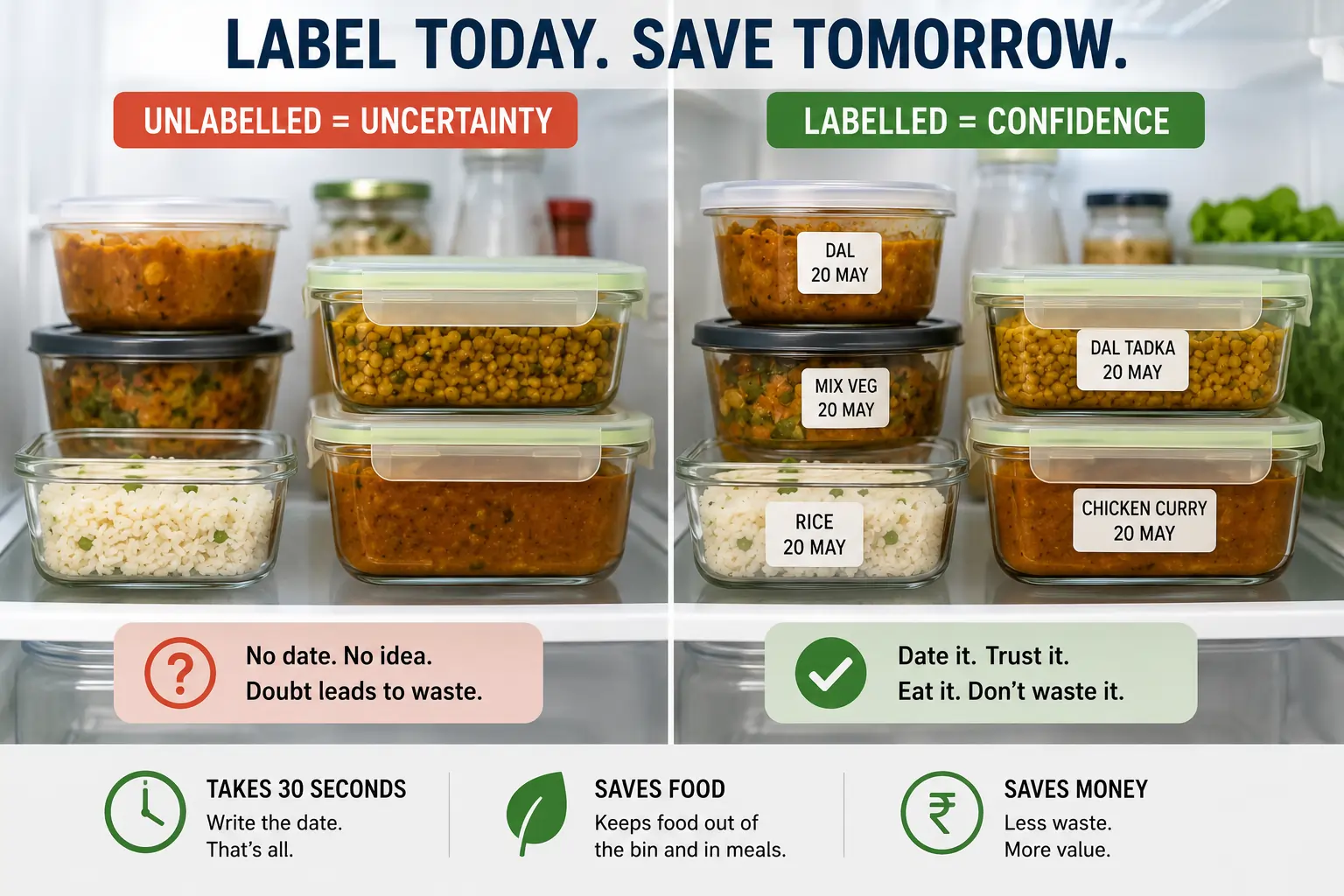
Fridge Life and What Degrades: A Practical Storage Reference
The most common operational failure in batch cooking is not prep technique or sequencing — it is food storage. Components prepared on Sunday that are not safely usable by Wednesday because of incorrect storage, wrong containers, or over-optimistic fridge-life estimates. Understanding the actual storage limits of each component category is operational knowledge, not nutrition knowledge.
| Component | Correct storage | Fridge life | Freezer life | Signs of degradation |
|---|---|---|---|---|
| Cooked dal and lentils | Airtight container; cool completely before sealing | 4–5 days | 3 months | Sour smell; surface mould; off colour |
| Cooked chickpeas or rajma | Airtight container with a small amount of cooking liquid to prevent drying | 5–6 days | 3 months | Dryness and cracking (quality only); off smell (safety) |
| Cooked rice and grains | Airtight container; cool completely and refrigerate within 1 hour of cooking | 4 days maximum | 1 month | Hard dry texture (quality); off smell (safety). Rice especially: do not leave at room temperature for extended periods |
| Roasted vegetables | Airtight container; can be stored warm but seal once cool | 4–5 days | 2 months (quality degrades) | Sogginess; off smell; visible mould |
| Raw prepped vegetables | Container with a damp paper towel to maintain moisture; do not seal too tightly | 2–3 days | Not recommended | Wilting; browning at cut edges; sliminess |
| Onion-tomato masala base | Airtight container; surface can be covered with a thin layer of oil to extend life | 6–7 days | 3 months (excellent freezer item) | Mould on surface; sour smell beyond normal acidity |
| Green chutney | Airtight jar; press cling film directly onto surface to prevent oxidation and browning | 5–6 days | 1 month (colour degrades; flavour mostly intact) | Yellowing / browning (quality); off smell (safety) |
| Dairy-based sauces (raita, yoghurt dressings) | Airtight container; do not combine with other components until eating | 3–4 days | Not recommended | Off smell; texture separation (stir and use if smell is fine); curdling |
| Oil-based dressings (vinaigrette, tahini) | Jar with lid; shake before use as separation is normal | 7–10 days | Not necessary | Rancid smell (fat oxidation); cloudiness is normal and not a safety issue |
| Hard-boiled eggs (in shell) | Loose in a container or on fridge shelf; do not peel until ready to use | 7 days | Not recommended | Sulphurous smell when peeled; rubbery white texture |
| Cooked chicken or fish | Airtight container; cool quickly; refrigerate within 1 hour | 3–4 days (chicken); 2–3 days (fish) | 2 months (chicken); 1 month (fish) | Off smell; sliminess; colour change |
| Paneer | Airtight container; submerge plain paneer in water and change daily for longer life | 3–4 days cooked; 5–6 days in water (plain) | 2 months | Slimy texture; sour smell; pinkish tinge |
This storage discipline is also the biggest lever against food waste more broadly, not just meal-prepped components — the zero-waste kitchen starter guide covers the same "prevent it before it happens" logic applied to the rest of the kitchen.
The System as Infrastructure: What It Looks Like After Eight Weeks
The first Sunday Reset takes the full two hours and feels like an effort. The second takes ninety minutes because some decisions are already made. By the fourth or fifth week, the session runs in approximately seventy-five minutes because the slot choices are habitual, the sequencing is automatic, and the five-minute pre-session review is fast because you know your household's patterns.
By week eight, the framework has become kitchen infrastructure: it runs in the background of the week like a clean fridge or a stocked pantry, something you notice primarily when it is absent. The cognitive overhead around food is substantially lower. Weeknight cooking is mostly assembly. The delivery app is still on your phone but gets opened less often by default, not by effort.
This is what good systems produce: not perfect outcomes every time, but better defaults. The Sunday Reset does not guarantee that every meal is excellent. It guarantees that the option of a decent home meal is always available, requires minimal active decision-making, and costs less time across the week than cooking from scratch every night. This is the same principle behind moving away from calorie-counting toward nutritional literacy — the system replaces daily decisions with daily defaults, and defaults are what actually determine outcomes over months.
The prep system is the infrastructure; the plate composition framework is what you use it for. The balanced plate without a food scale gives you the assembly logic that transforms Sunday's prepped components into well-composed meals all week — without weighing a gram or counting anything.
The measure of a working Sunday Reset is not the quality of Sunday's prep. It is whether Thursday night's dinner takes twelve minutes to assemble and is genuinely good. That is the output the system is optimised for. Design backward from Thursday.
Meal planning is also one of the single most effective ways to reduce food waste — and the financial savings are real. The sustainable living on a budget guide shows how reducing food waste, switching kitchen items from single-use to reusable, and a few energy habits can save ₹10,000 or more per year without any significant lifestyle change.