
There is a specific kind of paralysis that food scales and calorie apps create. Before you can eat, you must weigh. Before you can log, you must identify. Before you can sit down to a meal with other people, you must quietly do arithmetic in your head and feel vaguely guilty about the parts you cannot calculate precisely.
This is not how most people want to live. And it is not how they have to.
The research on visual portioning and hand-based estimation is more robust than most people realise. Your hand is calibrated to your body. It scales proportionally with your size. It is always with you at every meal, in every country, at every restaurant, at every dinner party. It does not require batteries, a subscription, or a kitchen counter.
More importantly: the goal of eating well is not mathematical precision. It is consistent, roughly correct composition across most meals. (Every major official dietary guideline — from the US's MyPlate to India's ICMR plate to Brazil's processing-level framework — converges on the same few proportions. How different countries define a healthy plate is worth reading to see which principles are genuinely universal.) A system that achieves 80% accuracy and gets used every day beats a system that achieves 95% accuracy and gets abandoned within a month. Visual portioning is the more durable method — and this guide gives you the full framework to use it confidently. If the idea of abandoning numerical tracking feels daunting, the deeper reasons why precision-first systems tend to fail are covered in detail in the article on why calorie counting doesn't work long-term.
Why Visual Portioning Actually Works: The Evidence
The hand-measure method was popularised in sports nutrition practice and has since been examined in formal research settings. A study published in the Journal of Nutritional Science tested hand-based and household portion estimates across a range of food types, finding that hand measures produced estimates within an acceptable range of actual weight for most whole foods. Across a full day of eating, these individual errors tend to partially offset each other rather than compound in one direction.
Ten to twenty percent accuracy sounds imprecise compared to a scale that measures to the gram. In practice, it is more than sufficient for the goal. The research on nutrition outcomes consistently shows that the variable driving the most improvement in eating habits is not measurement precision — it is awareness and consistency. People who apply a rough but reliable framework to every meal produce better long-term outcomes than people who track precisely but inconsistently.
Visual portioning also produces an important secondary benefit: it builds genuine nutritional intuition. After several months of using hand measures consistently, most people develop an accurate sense of portion sizes that operates automatically, without conscious measurement. The framework becomes internalised. The hand measure is scaffolding that eventually becomes unnecessary because the skill it was building is now embedded. The same kind of fast, repeatable habit applies to packaged foods — reading a nutrition label in under 30 seconds is the label-reading equivalent of this hand-measure system.
The fastest way to build that consistency is to apply the framework to every meal for a defined period. The 14-Day Meal Prep Challenge structures the first two weeks of this habit — each day includes a simple meal task that reinforces the same principles as the hand-measure system.
Your Hand as a Measuring Tool: The Four Reference Points
The hand-measure system uses four reference points, each calibrated to a specific macronutrient or food category. These references are not arbitrary — they are chosen because they correspond to meaningful portion sizes for most adults, and because the hand scales proportionally with body size, meaning a larger person naturally gets a larger portion from the same reference.
1. The Palm — Protein
The palm of your hand — excluding fingers, roughly the area from wrist to base of fingers — represents one serving of protein-dense food. The thickness of the serving matches the thickness of your palm.
For most adults, one palm of a dense protein source corresponds to approximately 20 to 35 grams of protein depending on the source. This is close to or above the leucine threshold required to stimulate muscle protein synthesis at a meal — a mechanism covered in detail in the article on why protein distribution across meals matters more than your daily total. Two palms at a meal — appropriate for larger individuals, men, or post-workout meals — comfortably crosses the threshold for most body sizes.
| Food | 1 palm portion | Approx. protein | Notes |
|---|---|---|---|
| Chicken breast (cooked) | ~85–100g | 25–30g | One palm is typically a small to medium breast half |
| Fish fillet (salmon, tuna, cod) | ~85–100g | 22–28g | Thickness matters as much as surface area |
| Paneer | ~80–100g | 18–22g | Denser than it looks; one palm is roughly one standard block quarter |
| Eggs (whole) | 2–3 eggs | 12–18g | Use 2 eggs as a rough palm equivalent; add a side for higher targets |
| Cooked dal or lentils | ~120–150g (¾ cup) | 9–12g | Lower protein density; needs 2 palms or combination with other sources to reach threshold |
| Cooked chickpeas or rajma | ~120–150g (¾ cup) | 9–11g | Same caveat as dal; use larger portions or combine |
| Greek yoghurt | ~150–170g | 15–20g | Volume is slightly larger than a palm but protein density is relevant |
| Tofu (firm, pressed) | ~100–120g | 10–14g | Needs 2 palms for reliable threshold crossing |
| Tempeh | ~85–100g | 17–22g | Higher protein density than tofu; one palm more effective |
For a broader list of protein-dense whole foods beyond the obvious choices, including plant-based options well suited to Indian cooking, 20 high-protein foods that aren't chicken breast covers the full range with quantities and practical notes.
2. The Cupped Hand — Carbohydrates
Cup one hand as if catching water. The volume of that cup represents one serving of cooked carbohydrates — grains, legumes, root vegetables, cooked rice, cooked pasta.
For most adults, one cupped hand of cooked rice is approximately 100 to 130 grams, which is 130 to 170 kilocalories and 30 to 40 grams of carbohydrate. Most people find that two cupped hands of cooked carbohydrate at a main meal — combined with the rest of the plate — produces comfortable satiety without excess. The cupped hand naturally scales with body size: a larger person has a larger cupped hand and gets a proportionally larger carbohydrate serving.
| Food | 1 cupped hand | Approx. carbohydrate | Notes |
|---|---|---|---|
| Cooked white rice | ~110–130g | 35–42g | Roughly a small restaurant serving; many people habitually eat 2–3 cupped hands |
| Cooked brown rice | ~110–130g | 33–40g | Similar carbohydrate; higher fibre increases satiety per unit |
| Cooked dal or rajma | ~120–150g | 18–22g | Lower carbohydrate density than grains; counts as both protein and carbohydrate |
| Cooked quinoa | ~100–120g | 25–30g | Higher protein than most grains; slightly lower carbohydrate density |
| Roti or chapati | 1–2 medium rotis | 25–50g | One medium roti ≈ one cupped hand equivalent; portion by count |
| Cooked pasta or noodles | ~100–120g | 32–40g | Most restaurant servings are 3–5 cupped hands — this is where awareness matters most |
| Sweet potato (cooked) | ~120–140g | 25–32g | Higher fibre and micronutrient density than white potato; good carbohydrate choice |
| Oats (cooked) | ~150–180g | 25–30g | Water content makes cooked volume larger; roughly 45–55g dry oats |
| Bread (whole grain) | 1–2 slices | 25–40g | Count by slices; 1 slice ≈ one cupped hand equivalent |
3. The Fist — Vegetables
One closed fist represents one serving of non-starchy vegetables. This is the most generous reference point in the system: most people significantly under-eat vegetables, and the instruction here is not to limit but to use the fist as a minimum, not a maximum.
Non-starchy vegetables — leafy greens, cruciferous vegetables, cucumbers, tomatoes, capsicum, brinjal, courgette, most sabzi vegetables — are high in fibre, micronutrients, and water, and low in caloric density. They fill physical volume on the plate and in the stomach, supporting satiety. There is almost no practical scenario where eating more vegetables is the nutritional problem. The target is two to three fists of vegetables at a main meal — and the fist system is a reasonable proxy for hitting a real fibre target, since most people fall well short of the 25-38g/day recommendation without a structured way to make sure vegetables and legumes take up real plate space.
| Vegetable category | Examples | 1 fist portion | Notes |
|---|---|---|---|
| Leafy greens (raw) | Spinach, lettuce, methi, arugula | ~30–40g | Shrinks dramatically when cooked; use 2–3 fists raw or 1 fist cooked |
| Cruciferous (cooked) | Broccoli, cauliflower, cabbage, Brussels sprouts | ~80–90g | High fibre; excellent satiety per unit; aim for 2 fists minimum |
| Soft vegetables (cooked) | Zucchini, brinjal (baingan), bell peppers, tomato | ~85–100g | High water content; 2–3 fists has minimal caloric impact |
| Root vegetables (cooked) | Carrot, beetroot, sweet potato, turnip | ~80–90g | Higher carbohydrate density than soft vegetables; count toward carbohydrate portion |
| Cucumbers and raw salad | Cucumber, radish, spring onion, raw tomato | ~80–100g | Nearly zero caloric impact; eat freely; excellent volume food |
| Onion, garlic, ginger | All | Condiment quantity | Counts as flavour base; no meaningful portioning required |
4. The Thumb — Fats
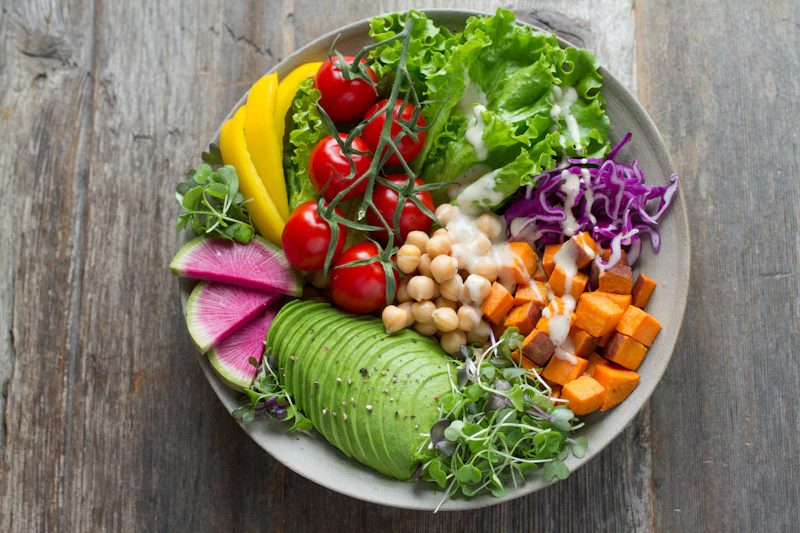
The length and width of your thumb, from tip to first knuckle, represents one serving of calorie-dense fat sources: oils, butter, ghee, nut butters, full-fat condiments, avocado, and cheese.
Fat is the most calorically dense macronutrient at 9 kilocalories per gram compared to 4 for protein and carbohydrate. The difference between one thumb of olive oil and three thumbs — a realistic range depending on how liberally you pour — is approximately 180 to 540 kilocalories. This is the food category where unconscious over-portioning has the most caloric impact, and where portion awareness produces the most meaningful adjustment. One thumb of fat corresponds to roughly 7 to 12 grams, or 65 to 110 kilocalories.
| Fat source | 1 thumb portion | Approx. calories | Notes |
|---|---|---|---|
| Olive oil or any cooking oil | ~7–10ml (generous tsp) | 60–90 kcal | The most common unconscious over-pour; 1 thumb is less than most people use per meal |
| Ghee | ~7–10g | 60–90 kcal | High caloric density; 1 thumb is a small but meaningful amount; 2 thumbs is generous |
| Butter | ~10–12g | 70–90 kcal | Roughly one restaurant pat; 1 thumb is adequate for one slice of toast |
| Nut butter (peanut, almond) | ~12–15g (1 tbsp) | 70–90 kcal | Easy to under-estimate; a heaped tablespoon is 1.5 to 2 thumbs |
| Avocado | ~50–60g (¼ to ⅓ avocado) | 80–100 kcal | One thumb is a modest amount; half an avocado is 2–3 thumbs |
| Full-fat cheese (cheddar, paneer) | ~20–25g | 70–90 kcal | Roughly a 2cm cube; easy to eat 3–4 thumbs without noticing |
| Nuts (mixed) | ~15–20g (small handful) | 90–120 kcal | Straddles thumb and palm; 1 thumb is about 10–12 almonds or cashews |
| Coconut milk (full fat, in curries) | ~30–40ml | 55–75 kcal | Significant contributor in coconut-based South Indian cooking; awareness matters |
The Balanced Plate Formula
The four hand references combine into a meal template that works across cuisines, meal types, and contexts. The formula is not a rigid prescription — it is a composition guide that ensures the key elements are present at each meal in roughly the right proportions.
| Component | Reference | Target per meal | Primary function |
|---|---|---|---|
| Protein | Palm | 1–2 palms (women); 2 palms (men) | Muscle synthesis, satiety, metabolic function |
| Vegetables | Fist | 2–3 fists minimum | Fibre, micronutrients, volume, satiety |
| Carbohydrates | Cupped hand | 1–2 cupped hands | Energy, fibre (whole sources), fuel for activity |
| Fats | Thumb | 1–2 thumbs | Fat-soluble vitamins, hormonal function, palatability |
The order matters. Protein and vegetables are the non-negotiable anchors. Carbohydrates and fats are adjusted based on activity level, hunger, and the specific meal. A post-workout meal benefits from a larger carbohydrate portion. A sedentary rest day requires less. A meal that is already high in fat from the protein source — fatty fish, full-fat dairy — requires less added fat. This is the intent-based application of the hand measure: the formula gives you the structure, and you adjust the quantities within it based on what your body is doing that day. Understanding how much total protein you actually need per day helps calibrate how many palms to target across your meals.
The Plate Visual: A Spatial Shortcut
For meals served on a plate — which is most meals — the hand measures translate directly into a spatial plate composition that is faster to apply and easier to share than describing gram weights.
The balanced plate, viewed from above, looks like this:
| Plate section | What goes here | Approximate proportion |
|---|---|---|
| Half the plate | Non-starchy vegetables — salad, sabzi, cooked greens, raw sides | 50% of total plate area |
| One quarter | Protein source — meat, fish, eggs, paneer, legumes in adequate quantity | 25% of total plate area |
| One quarter | Carbohydrate source — rice, roti, grains, starchy vegetables | 25% of total plate area |
| On top / alongside | Fat — cooking oil, ghee, dressing, avocado, nuts | 1–2 thumbs total across the meal |
The half-plate vegetable target is the most commonly missed and the most valuable to internalise. Most people habitually plate roughly one-third carbohydrate, one-third protein, one-quarter vegetable, with the remaining space going to fats and condiments. The balanced plate shifts the vegetable portion to dominant and adjusts the carbohydrate portion down accordingly — without reducing total volume or satisfaction, because vegetables are high in fibre and water.
Applying the Method to Indian Meals
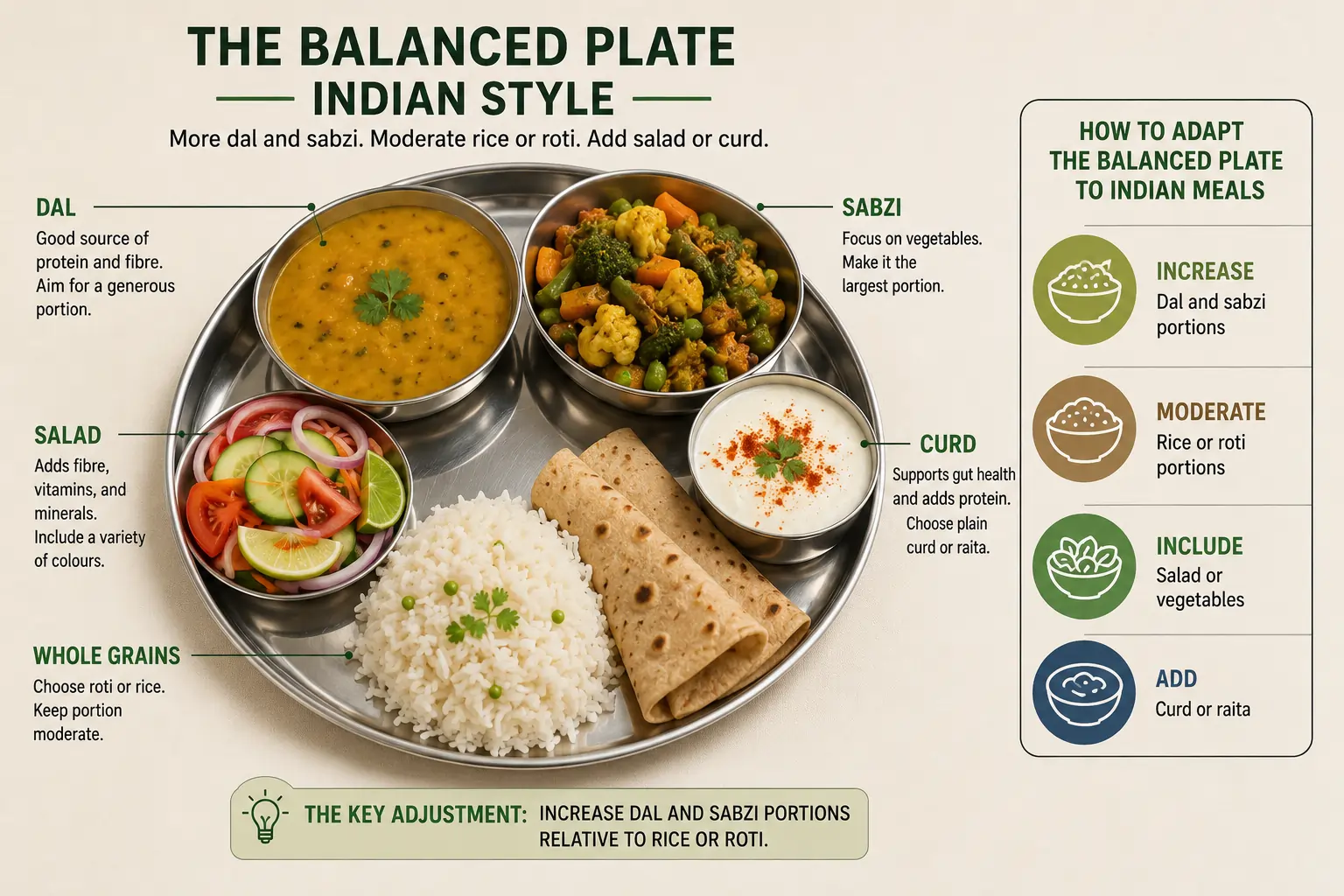
The hand-measure and plate-visual frameworks were largely developed and tested in Western food contexts, which creates a gap for readers whose primary diet is Indian. Indian meals — particularly traditional thali formats, dal-rice combinations, roti-sabzi structures, and South Indian meal patterns — do not always present as discrete components on a single plate. The framework translates straightforwardly with a small amount of contextual adaptation.
Dal-rice or dal-roti (the most common Indian meal structure)
The typical dal-rice meal has a structural imbalance: the carbohydrate portion tends to dominate the plate, the dal provides protein but in a dilute liquid form that is easy to under-serve, and the vegetable component is often a small secondary element. The balanced plate version increases the dal portion, reduces the rice portion, and adds a larger sabzi or salad alongside. For breakfast protein strategies using Indian ingredients, see the guide to hitting 30g protein at an Indian breakfast.
| Typical Indian plate | Protein (g) | Balanced version | Protein (g) |
|---|---|---|---|
| 3 cups cooked rice + 1 small katori dal + token sabzi | 9–12g | 1 cup rice + 1.5 cups thick dal + large sabzi + dahi (100g) | 25–30g |
| 3 rotis + small dal katori + minimal sabzi | 10–14g | 2 rotis + larger dal + generous sabzi + egg/paneer addition | 28–35g |
| Idli (4 pieces) + small sambar + chutney | 8–12g | Idli (3) + larger sambar bowl + egg or paneer side | 22–28g |
| Curd rice (large portion) + pickle | 10–14g | Smaller curd rice + dal + sabzi + additional protein | 22–28g |
Thali meals
A traditional thali presents naturally in portions — katoris of different foods rather than free-form plating. The hand-measure approach maps onto thali eating by asking: how many katoris of protein-dense food (dal, sabzi with paneer or legumes, curd) versus how many of carbohydrate-dense food (rice, roti)?
A reasonable balanced thali: one katori each of dal, a vegetable sabzi, and curd or raita; one small katori of rice; two medium rotis; a small serving of pickle and papad as condiments. This achieves the plate proportion framework — roughly half vegetable and protein sources, one quarter carbohydrate, condiment fat — in a traditional format.
Restaurant meals
Restaurants are where most portioning frameworks break down. Portions are larger, preparation methods involve more oil and butter than home cooking, and the social context makes deliberate portioning feel conspicuous. The hand measure is particularly valuable here because it requires no visible action — you are looking at your plate and estimating, not producing a scale.
The practical approach at restaurants: identify the protein on the plate and assess whether it is roughly two palms. Note the carbohydrate proportion — most restaurants serve three to four cupped hands of rice or a large bread basket, which is significantly more than the two-cupped-hand target. Eat the protein and vegetables first; assess hunger before deciding how much carbohydrate to continue with. You do not need to finish the rice to have eaten well.
Adjusting the Formula for Different Goals
The base formula — two palms protein, two to three fists vegetables, one to two cupped hands carbohydrates, one to two thumbs fat — is calibrated for a moderately active adult maintaining their current body composition. Adjustments for different goals require changing the portions of specific food categories rather than redesigning the framework.
| Goal | Protein | Vegetables | Carbohydrates | Fats | Key logic |
|---|---|---|---|---|---|
| Fat loss | 2 palms (maintain) | 3+ fists (increase) | 1 cupped hand (reduce) | 1 thumb (reduce slightly) | Increase volume through vegetables; reduce carbohydrates; keep protein to preserve muscle |
| Muscle gain | 2–3 palms (increase) | 2–3 fists (maintain) | 2–3 cupped hands (increase) | 1–2 thumbs (maintain) | Increase protein per meal to maximise MPS; increase carbohydrates for energy and recovery |
| Endurance performance | 2 palms (maintain) | 2 fists (maintain) | 2–3 cupped hands (increase, especially pre-activity) | 1–2 thumbs (maintain) | Carbohydrates are the primary fuel; increase on training days, reduce on rest days |
| General health | 2 palms | 2–3 fists | 1–2 cupped hands | 1–2 thumbs | Base formula applies; focus on food quality within each category |
| Older adults (65+) | 2–3 palms (increase) | 2–3 fists | 1–2 cupped hands | 1–2 thumbs | Protein is the priority adjustment; aim for upper end of palm range to counter anabolic resistance |
The adjustments follow a simple logic: change only the relevant category, and change it in the direction that serves the goal. Fat loss reduces carbohydrate and fat portions while maintaining protein and increasing vegetable volume. Muscle gain increases protein and carbohydrate portions. The framework remains constant; the quantities within it flex. For context on why keeping protein high — particularly across multiple meals rather than in one or two large servings — matters more than most people realise, the article on protein distribution and muscle synthesis covers the mechanism in full. Once plate composition is dialed in, whether meal timing itself matters for fat loss is a reasonable next, secondary question worth understanding.
What the Hand Measure Does Not Cover
Mixed dishes and one-pot meals
Curries, stews, biryanis, pasta dishes, and mixed rice preparations combine protein, carbohydrates, and fat in a single dish that cannot easily be separated into hand-measure components. For these, the bowl or plate volume estimate is more useful: a serving of a mixed dish that fills roughly half a standard dinner plate or two cupped hands of volume is a reasonable single-serving estimate for most adults.
The more useful intervention for mixed dishes is assessing their composition before eating: is this dish protein-forward (dal makhani, chicken curry) or carbohydrate-forward (pulao, biryani-heavy serving)? If carbohydrate-forward, add a side of protein or reduce the portion and add a side salad. If protein-forward, the mixed-dish estimate is sufficient. For a structured approach to planning protein-forward meals across the week, the 90-minute high-protein meal prep system sets up components in advance that make balanced plating effortless during the week.
Snacks and between-meal eating
The hand-measure framework applies to snacks using smaller references. A snack-sized protein portion is roughly half a palm — a small handful of nuts, a boiled egg, a small container of Greek yoghurt. A carbohydrate snack is roughly one cupped hand — a piece of fruit, a small portion of crackers. A fat snack is one thumb.
The more useful question for snacks is not portion size but composition: does this snack have a protein anchor? A handful of nuts has both protein and fat and is a structurally complete snack. Biscuits, chips, and most packaged snack foods are pure carbohydrate and fat with minimal protein — they fill the stomach briefly without triggering satiety effectively, and they do not contribute a protein serving to your daily distribution.
Liquid calories
Smoothies, juiced drinks, chai with milk, coffee with whole milk, and protein shakes are not well-served by hand measurements. A protein smoothie — Greek yoghurt, milk, fruit, nuts — is a legitimate meal and can be assessed by imagining its components in solid form. A glass of juice or a sweetened chai is liquid carbohydrate without the fibre of the whole fruit or the structure of a meal.
Building the Habit: How Long Until It Becomes Automatic
The hand-measure framework requires conscious application for the first four to eight weeks. It then becomes increasingly automatic as the portion-size estimates are internalised and the plate composition becomes a default habit rather than a decision.
The learning curve has a predictable shape. In weeks one and two, the references feel imprecise and unfamiliar. In weeks three and four, the estimates become more confident and the plate composition starts to feel natural. By week six to eight, most people find they are applying the framework unconsciously — reaching for a protein source before building the rest of the plate, instinctively filling half the plate with vegetables, pouring oil with awareness rather than habit.
Three things accelerate this learning curve:
- Consistency over precision. Apply the framework to every main meal, even imperfectly. An approximate application every day is more valuable than a perfect application three times a week. This is the same principle that makes hitting protein goals without formal meal prep more sustainable than strict tracking — habitual awareness beats occasional precision.
- Feedback from outcomes. Pay attention to how you feel two to three hours after eating — energy level, hunger, mental clarity. This is the body's feedback on whether the meal composition was roughly right. Meals that leave you hungry within an hour are usually low in protein or fibre. Meals that leave you sluggish are often carbohydrate-heavy or too large overall. Reading that feedback accurately also depends on eating at a pace that lets fullness signals actually register — see mindful eating without a 40-minute meal for the timing mechanism behind this.
- Occasional recalibration. Every few months, spend one or two days weighing your portions alongside the hand estimates to check for drift. It is common for portion estimates to gradually creep upward over time, particularly for calorie-dense foods like grains and fats. The weigh-in is not a return to daily food scales — it is a calibration check to keep the estimates accurate.
The One-Page Reference: Hand Measures at a Glance
This is the summary you can screenshot, write on a card, or simply memorise. Everything above supports and explains these six points. The points themselves are sufficient to start.
| Reference | Food category | Target per main meal | Remember |
|---|---|---|---|
| 🤚 Palm (thickness included) | Protein | 1–2 palms | Dense protein: chicken, fish, eggs, paneer, tofu, legumes in adequate quantity |
| 🫲 Cupped hand | Carbohydrates | 1–2 cupped hands | Cooked grains, rice, roti (count by piece), starchy vegetables |
| ✊ Closed fist | Vegetables | 2–3 fists (minimum) | Non-starchy: greens, sabzi, salad, cooked cruciferous vegetables |
| 👍 Thumb (tip to first knuckle) | Fats | 1–2 thumbs | Oils, ghee, butter, nut butters, cheese, avocado, nuts |
| 🍽️ Half the plate | Vegetables (spatial) | 50% of plate area | The most important single plate habit; vegetables before carbohydrates |
| 🥩 Two palms first | Protein anchor | Build the meal around this | Choose protein first; build carbohydrate and vegetable around it |
The framework does not require perfection or consistency across every meal. It requires broadly correct application across most meals, maintained over weeks and months. A person who applies these references at 80% of their main meals over a year will have built genuine nutritional intuition and a well-calibrated default eating pattern. Not precision. Not perfection. A durable, portable, accurate-enough system that works at every meal, in every kitchen, in every country, without a single gram being weighed.
The hand-measure system is also the foundation of the Eat With Intent course — six lessons that build a complete nutrition system around exactly this approach, covering protein targets, meal planning, food labels, and which supplements are worth it. Free, no sign-up.
One thing the hand-measure system does not help with is decoding what is actually inside the packaged components you buy — protein powders, sauces, spice mixes, and processed ingredients that go onto your plate. For that, understanding how to read ingredient labels is the complementary skill: the deep-dive on what 'natural flavours' actually means on a food label covers the most commonly misunderstood label entry and gives you a practical framework for reading past the marketing language.