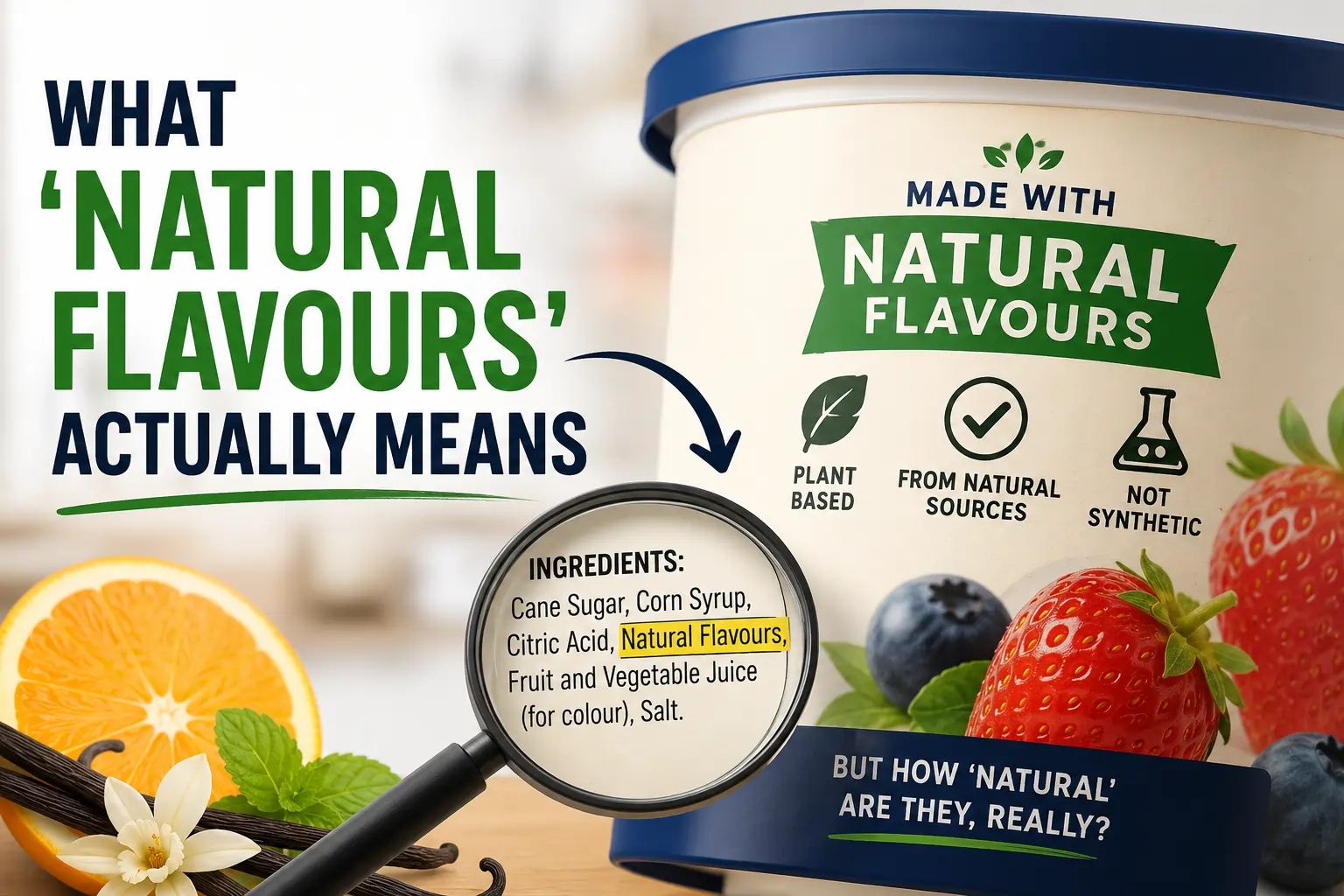
Pick up almost any packaged food and scan the ingredients list. Somewhere in that list, often near the end, you will find the words 'natural flavours' or 'natural flavouring.' On an orange juice carton, a protein bar, a bag of flavoured popcorn, a bottle of sparkling water, a box of instant oats. It is one of the most commonly appearing ingredients in the processed food supply — in the United States alone, it appears on more ingredient lists than any other ingredient except salt and water.
Most people read it and feel broadly reassured. Natural. That must mean it comes from a fruit, a plant, something recognisable. It probably means it is better than artificial flavours, which presumably come from a laboratory and are therefore bad.
Both assumptions are worth examining carefully, because neither is straightforwardly true. The term 'natural flavours' has a specific regulatory definition that most people have never read and that produces some genuinely surprising implications. What it covers, what it does not disclose, why it appears so often, and whether it is something you should actually care about — these are answerable questions, and this article answers them.
The Regulatory Definition: What It Actually Says
The term 'natural flavours' is defined by regulatory bodies, not by common understanding. The definition most widely cited comes from the United States Food and Drug Administration (FDA), which under 21 CFR 101.22 defines a natural flavour as:
This definition is doing considerably more work than the two words on the label suggest. Three things are worth unpacking carefully:
First, the starting material must be biological in origin. It must be derived from one of the categories listed: plant materials, animal products, or fermentation products. This is what distinguishes natural from artificial flavours, which are chemically identical compounds synthesised from non-biological starting materials. The distinction is entirely about origin, not about the final chemical structure or the processing involved in getting there.
Second, the definition explicitly permits a wide range of processing methods: roasting, heating, enzymolysis, distillation, and extraction. A natural flavour can go through multiple industrial processing steps, involve solvents, be isolated, concentrated, and combined with carrier substances, and still qualify as natural under this definition because the original source material was biological.
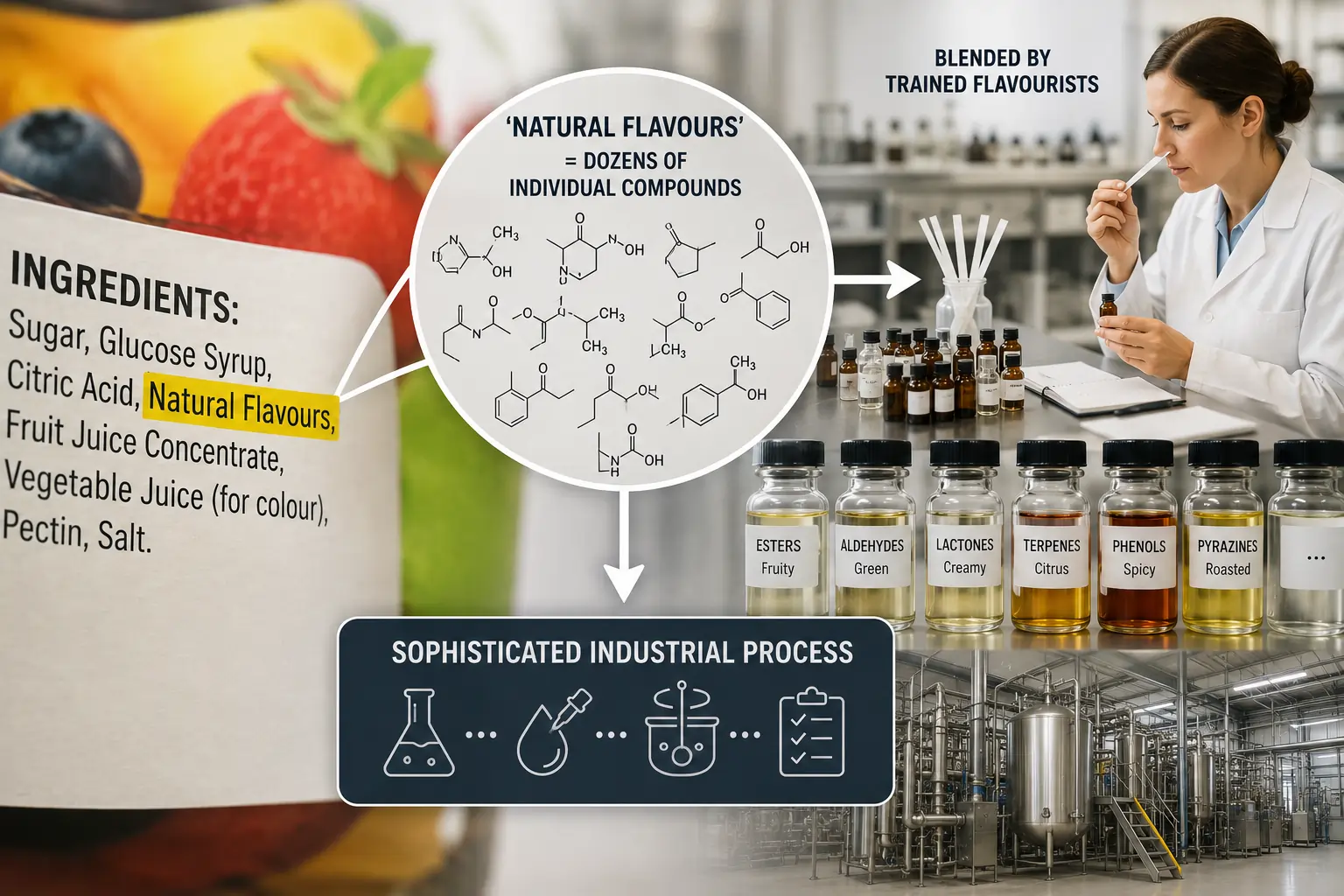
Third, and most significantly for label transparency, a single entry of 'natural flavours' on an ingredients list can represent a proprietary blend of dozens of individual chemical compounds. Manufacturers are not required to disclose the specific compounds, their concentrations, or the detailed sourcing. The entry is a category, not a specific ingredient.
What Natural Flavours Actually Are: The Chemistry
A flavour compound — natural or artificial — is a chemical that produces a sensory response when it interacts with taste or smell receptors. Most flavour perceptions we associate with food are primarily olfactory rather than gustatory: the strawberry 'taste' in a strawberry-flavoured drink is largely detected through smell, via retronasal olfaction, rather than through taste receptors on the tongue.
The flavour industry is built on identifying, isolating, concentrating, and blending the specific chemical compounds responsible for recognisable flavour profiles. A real strawberry contains hundreds of volatile chemical compounds that together produce its characteristic scent and flavour. A strawberry natural flavour might contain twenty to fifty of those compounds — the ones most responsible for the recognisable profile — extracted and blended in specific proportions.
How natural flavours are extracted and produced
| Method | How it works | Common applications | Processing level |
|---|---|---|---|
| Solvent extraction | Target compounds dissolved from source material using food-grade solvents (ethanol, hexane, propylene glycol); solvent then removed | Fruit flavours, herbal extracts, vanilla | Moderate to high; multiple purification steps |
| Steam distillation | Steam passed through plant material; volatile compounds carried in steam and condensed separately | Essential oils: peppermint, citrus, rose | Moderate; temperatures alter some compounds |
| Cold pressing / expression | Mechanical pressure applied to plant material to release essential oils; no heat or solvents | Citrus peel oils (lemon, orange, lime) | Low; closest to unprocessed plant material |
| Enzymatic processing | Enzymes used to break down precursor compounds in source material, releasing target flavour compounds | Cheese flavours, fermented notes, meat flavours | High; biological transformation of starting material |
| Fermentation | Microorganisms convert sugars or other substrates into flavour compounds | Vanillin from ferulic acid in rice bran; butter flavour (diacetyl); fruity esters | High; compound identity changes substantially from starting material |
| Roasting & thermal processing | Heat applied to source materials to generate flavour compounds through Maillard reaction or caramelisation | Coffee, chocolate, roasted nut flavours | High; complex mixture of reaction products |
| Hydrolysis | Protein or fat broken down with acid, base, or enzymes to release flavour compounds | Meat flavours, savoury yeast extracts, umami notes | High; structural transformation of source proteins or fats |
The degree of processing varies enormously across these methods. Cold-pressed lemon oil is recognisably close to the source: it is the volatile fraction of lemon peel, extracted mechanically. Fermentation-derived vanillin, by contrast, starts from ferulic acid — a compound found in rice bran or corn — and is converted to vanillin through microbial metabolism. The starting material is biological, satisfying the natural definition, but the final compound is identical to vanillin produced synthetically from guaiacol, a petroleum derivative.
This is not a criticism of fermentation-derived vanillin. It is chemically identical to vanilla bean vanillin, functions identically in food, and has the same safety profile. The point is that 'natural' as a label claim describes origin, not proximity to a recognisable natural state.
Natural vs Artificial Flavours: A Distinction That Is Smaller Than It Appears
The widespread assumption is that natural flavours are safer, healthier, or more wholesome than artificial ones. The chemistry does not support a clear general distinction on any of these grounds.
Identical molecules, different origin stories
Many of the most common flavour compounds appear in both natural and artificial flavour formulations as chemically identical molecules. Vanillin, the primary flavour compound in vanilla, is a case already mentioned: natural vanilla extract, fermentation-derived vanillin, and artificial vanillin are all chemically C₈H₈O₃. Your taste receptors cannot tell them apart because they are the same molecule.
Isoamyl acetate, responsible for banana flavour, occurs naturally in bananas and is also synthesised for artificial banana flavouring. Benzaldehyde, the primary compound in almond and cherry flavour, occurs naturally in almonds, cherries, and apricot kernels, and is also produced synthetically. The list is extensive — for most commercially used flavour compounds, the natural and artificial versions are chemically indistinguishable.
Safety is not determined by the natural/artificial distinction
Both natural and artificial flavours are assessed for safety before they can be used in food, though the regulatory pathway differs. In the United States, flavour safety is primarily overseen by the Flavor and Extract Manufacturers Association (FEMA), which operates a GRAS (Generally Recognised as Safe) expert panel. The panel reviews toxicological data and approves compounds for use at typical flavour-relevant concentrations — the very low levels at which flavours are used in food.
The natural origin of a compound does not make it intrinsically safer. Prussic acid (hydrogen cyanide) occurs naturally in apple seeds and bitter almonds. Solanine, a toxic glycoalkaloid, occurs naturally in green potatoes. Naturally occurring does not mean safe at any concentration or form. Conversely, many artificial flavour compounds have extensive safety data and are used at concentrations far below any toxicological threshold of concern.
The meaningful safety distinction in the flavour industry is between approved compounds used at appropriate concentrations and unapproved or misused ones — not between natural and artificial origin.
The Proprietary Blend Problem: What 'Natural Flavours' Does Not Tell You
The most significant practical issue with the 'natural flavours' label entry is not what it means but what it does not disclose. A single entry can conceal a complex proprietary formulation that the manufacturer has legal protection to keep confidential.
What a single label entry can contain
- Flavour compounds: The actual chemical substances responsible for the flavour — often dozens of individual compounds blended to achieve a target profile.
- Carrier substances: The flavour compounds are concentrated and must be diluted into a form suitable for food manufacturing. Common carriers include propylene glycol, triethyl citrate, ethanol, and vegetable oil. These are not flavour-active but are functionally necessary.
- Emulsifiers and solvents: Help the flavour disperse evenly through the food product.
- Preservatives: Extend the shelf life of the flavour formulation; BHA (butylated hydroxyanisole) is permitted as an antioxidant in flavour formulations even when the label only reads 'natural flavours.'
- Modifier substances: Compounds that enhance, round, or extend the primary flavour notes — some of which may have physiological effects beyond flavour.
The carrier substances, preservatives, and modifier compounds in a flavour formulation do not need to be separately declared on the food label if they function as adjuncts to the flavouring agent rather than as independent ingredients. They travel invisibly under the 'natural flavours' umbrella.
The allergen disclosure gap
The natural flavours entry also historically created a significant problem for people with food allergies. In the United States, the Food Allergen Labelling and Consumer Protection Act (FALCPA) requires that the major eight allergens (milk, eggs, fish, shellfish, tree nuts, peanuts, wheat, and soybeans) be declared on labels even when they appear in flavouring agents. This means that a natural flavour derived from milk should now be accompanied by a 'contains milk' statement or a parenthetical: 'natural flavour (milk).'
In practice, compliance is not perfect, and the disclosure requirements apply to the major declared allergens only. A person with a sesame allergy, a celery allergy, or a sulphite sensitivity — categories with regulatory protection in some countries but not uniformly globally — cannot infer safety from an unspecified natural flavours entry.
| Scenario | What the label says | What may be present | What you should do |
|---|---|---|---|
| Vanilla-flavoured product | 'Natural flavours' | Vanillin from fermentation, ethanol carrier, propylene glycol, possible trace dairy from enzymolysis | If dairy-sensitive: contact manufacturer; ask specifically about the flavour source |
| Strawberry-flavoured drink | 'Natural strawberry flavour' | Multiple extracted strawberry volatiles, possibly supplemented with non-strawberry compounds; ethanol or propylene glycol carrier | For most people: no concern. For alcohol sensitivity: check carrier solvent |
| Chicken-flavoured snack (vegetarian claim) | 'Natural chicken flavour' | Compounds derived from actual chicken via hydrolysis or thermal processing — not vegetarian or vegan | If vegetarian or vegan: this product is NOT suitable; natural chicken flavour is derived from chicken |
| Smoked or barbecue-flavoured product | 'Natural smoke flavour' | Condensed smoke volatiles from burning wood; chemically complex; often safer than direct smoking for PAH content | Generally fine; the processing actually reduces some harmful compounds vs direct smoking |
| 'Contains no artificial flavours' claim | No artificial flavours listed | May still contain highly processed natural flavour compounds including fermentation-derived or enzymolysis-derived compounds | The claim is accurate by definition; it does not mean minimal processing or whole-food ingredients |
The vegetarian and vegan disclosure problem
The allergen disclosure improvements do not address the vegetarian and vegan disclosure gap. A natural flavour derived from an animal source — from chicken, beef, dairy, or shellfish via hydrolysis or thermal processing — is legally disclosed simply as 'natural flavours' in most jurisdictions. There is no requirement to specify animal origin.
This matters practically: vegetarian and vegan consumers eating products labelled as plant-based may be consuming animal-derived flavouring compounds without any indication on the label. The most commonly relevant cases are natural chicken, beef, or pork flavours in savoury snacks; natural dairy-derived flavours (butter, cream, cheese notes) in crackers and popcorn; and natural shellfish flavours in seasonings and instant noodles.
In India specifically, the FSSAI (Food Safety and Standards Authority of India) requires the green dot (vegetarian) or brown dot (non-vegetarian) symbol on packaged foods, which provides broader coverage than allergen-only disclosure. However, the specific compound source within a declared vegetarian product is not always fully verified, and the natural flavour category remains an area of ongoing regulatory attention.
Why Natural Flavours Appear in So Many Products
Understanding why 'natural flavours' is so prevalent requires understanding what the food industry uses it for. The answer is not primarily to deceive consumers — it is because flavouring agents solve real technical problems in food manufacturing.
Flavour loss during processing
Processing destroys flavour. Heat sterilisation, pasteurisation, freeze-drying, extrusion, and extended shelf storage all degrade the volatile compounds responsible for fresh flavour. A tomato soup that starts with real tomatoes and goes through commercial sterilisation at 121 degrees Celsius for several minutes will emerge with significantly diminished tomato flavour. Adding natural tomato flavour back in restores the sensory profile that processing stripped out.
This is not fraudulent. It is a technical solution to the reality that shelf-stable food cannot retain the flavour complexity of fresh food without intervention. Whether that trade-off is worth making — accepting the flavour restoration but losing the texture, fibre, and micronutrient matrix of fresh tomatoes — is a separate question about the overall quality of the product, not specifically about the flavouring.
Flavour consistency
Natural ingredients vary in flavour composition depending on growing conditions, variety, season, and origin. Strawberries in June and strawberries in February taste different. For manufacturers producing millions of units that must taste identical year-round, this natural variation is a production challenge. Natural flavours provide flavour consistency: the same formulation produces the same sensory profile regardless of what the underlying raw ingredients taste like this season.
Flavour enhancement and cost
Beyond restoration and consistency, natural flavours are also used for enhancement — making a product taste more intensely of something than its actual ingredient composition would naturally produce. A product containing a small amount of real blueberry can be made to taste richly of blueberry by adding concentrated natural blueberry flavour.
The Flavour Industry: Who Makes Natural Flavours and How
Natural flavours are not made by food companies. They are made by a specialised industry of flavour houses — companies whose entire business is developing, producing, and supplying flavour formulations to food manufacturers. The four largest — Givaudan, International Flavors & Fragrances (IFF), Firmenich, and Symrise — collectively supply the majority of the world's flavour compounds and are largely invisible to consumers.
Flavour houses employ flavourists — highly trained professionals who blend hundreds of individual compounds to create target flavour profiles. A skilled flavourist works similarly to a perfumer: they have an extensive vocabulary of individual compounds and an understanding of how they interact, and they create formulations that achieve a target sensory experience. A natural strawberry flavour formulation might contain 40 to 60 individual compounds at very precise concentrations.
The proprietary formulations are trade secrets. A food company buying 'natural strawberry flavour' from a flavour house receives a finished product whose detailed composition is confidential. The food company knows the safety data and the allergen declarations but typically not the full compound list. This is why 'natural flavours' appears on food labels as a single entry rather than as a compound-by-compound disclosure — the food company itself often cannot provide that information.
| Aspect of natural flavour production | What it means in practice |
|---|---|
| Trade secret protection | Full compound lists are proprietary; neither the food company nor regulators publish them publicly |
| GRAS self-determination | In the US, flavour compounds can be deemed safe by manufacturers without mandatory FDA pre-market review, under the GRAS (Generally Recognised as Safe) framework |
| Carrier substance inclusion | Final flavour formulations include carriers (propylene glycol, ethanol, vegetable oil) that are not declared separately on food labels |
| Batch consistency requirements | Industrial flavour production must achieve precise sensory consistency; this requires sophisticated analytical and blending technology |
| Global regulatory variation | What qualifies as 'natural' varies by country; the EU, US, India, and Australia each have different definitions and disclosure requirements |
| Annual market volume | The global flavour industry is a roughly $30 billion annual market; natural flavours represent the largest and fastest-growing segment |

How the Definition Varies by Country
The 'natural flavours' definition is not universal. Different regulatory jurisdictions define natural differently, with meaningful practical consequences for what can appear under that label entry in products sold in each market.
| Jurisdiction | Regulatory body | Key definition features | Notable differences |
|---|---|---|---|
| United States | FDA (21 CFR 101.22) | Broad biological origin requirement; permits extensive processing; single catch-all label entry permitted | Most permissive processing allowance; reference standard for this article |
| European Union | EFSA / Regulation EC 1334/2008 | Natural flavouring substances must be produced by physical, microbiological, or enzymatic processes from plant, animal, or microbiological origin; more restrictive on chemical transformation | Requires 'natural X flavour' only if 95%+ of flavouring fraction comes from named source; otherwise must use 'natural flavour' without specific name |
| United Kingdom | FSA; retained EU framework | Broadly aligned with EU regulation; under ongoing review | Currently similar to EU; may diverge as UK develops independent food standards |
| India | FSSAI | Natural flavours permitted; vegetarian/non-vegetarian dot system provides broader source disclosure | Green/brown dot requirement gives vegetarian consumers more source transparency than EU or US labelling |
| Australia / New Zealand | FSANZ | Natural flavour defined as derived from plant or animal sources using physical, microbiological, or enzymatic processes | Generally aligned with EU approach; less permissive of extensive chemical transformation than FDA |
| Canada | Health Canada | Similar to FDA framework; flavouring agents need not be individually listed if present as flavour only | Largely consistent with US approach; subject to ongoing harmonisation discussion |
The EU distinction is practically significant: in the European Union, if a manufacturer wants to label a flavour as 'natural strawberry flavour,' at least 95% of the flavouring fraction must actually come from strawberries. If the strawberry flavour is primarily produced from non-strawberry biological sources, the label must read 'natural flavour' without the specific source name. This is a more transparent standard than the FDA approach, which permits any natural-origin flavour to be labelled 'natural strawberry flavour' as long as strawberry-derived compounds are present, even as a minor fraction.
The FSSAI dot system in India addresses a different dimension: while it does not provide compound-level disclosure, the mandatory vegetarian/non-vegetarian classification means that animal-derived natural flavours must cause the product to be labelled with the brown dot, giving vegetarian consumers a layer of protection not available in most other markets.
The Flavour Enhancer Overlap: MSG, Yeast Extracts, and 'Natural' Umami
A related category worth addressing is the overlap between natural flavours and flavour enhancers — compounds that amplify perceived taste intensity without contributing a flavour of their own. The most well-known flavour enhancer is monosodium glutamate (MSG), which activates umami taste receptors and amplifies savoury taste perception.
MSG itself is not a natural flavour — it is a separate ingredient that must be declared by name on labels. But several natural flavour ingredients function similarly. Yeast extract and hydrolysed vegetable protein are derived from biological sources through hydrolysis and contain high concentrations of glutamates — the same taste-active molecules as MSG. They can appear as 'natural flavours' or as separate named ingredients depending on their function and concentration in the product.
This matters for people who react to glutamates: while MSG itself is declared, glutamate-rich natural flavour ingredients in the yeast extract or hydrolysed protein category may not be obviously apparent to someone avoiding MSG-type compounds. The functional effect on taste receptors is the same regardless of the label entry.
| Compound | Classification | Label appearance | What it does |
|---|---|---|---|
| Monosodium glutamate (MSG) | Flavour enhancer (not natural flavour) | Must be declared as 'monosodium glutamate' or 'MSG' | Activates umami receptors; amplifies savoury taste perception |
| Yeast extract | Can appear as natural flavour or separate ingredient | 'Yeast extract' or as part of 'natural flavours' | High glutamate content; umami enhancement; richer savoury profile |
| Hydrolysed vegetable protein (HVP) | Natural flavour ingredient | Often listed separately; sometimes within 'natural flavours' | Protein broken down to amino acids including glutamates; strong umami source |
| Disodium inosinate (IMP) | Flavour enhancer | Must be declared separately; sometimes listed as E631 | Synergises with glutamates to amplify umami; often used with yeast extract |
| Disodium guanylate (GMP) | Flavour enhancer | Must be declared separately; sometimes listed as E627 | Similar synergistic umami enhancement to IMP |
| Nucleotides from yeast | Can qualify as natural flavour | May appear within 'natural flavours' entry | IMP/GMP precursors derived from yeast; same functional effect without requiring separate declaration |
How to Actually Read Labels with This in Mind
Understanding the regulatory and chemical reality of natural flavours is useful background knowledge. The practical question is what to do with it at the shelf.
Use ingredient position, not label claims
Ingredients are listed in descending order of weight. A natural flavour that appears near the bottom of a long ingredients list is present in very small quantity and is functionally a seasoning-level addition. A natural flavour that appears in the first five ingredients is a substantial component of the product and warrants more attention.
The same logic applies to the broader product assessment: a product whose first five ingredients are whole foods — oats, nuts, fruit, dairy, eggs — and which lists natural flavours toward the end is a structurally different product from one whose first five ingredients are refined flour, sugar, vegetable oil, corn syrup, and natural flavours. The presence of natural flavours is a much smaller concern in the first product than the ingredient composition of the second. The guide to building a balanced plate without a food scale covers a related principle: the whole-food composition of what you eat matters far more than individual additive entries. This same logic is the basis for the NOVA classification system, which sorts food by formulation rather than any single ingredient in isolation.
Look past the front-of-pack claim to the ingredient list
Front-of-pack claims — 'real fruit flavour,' 'made with natural ingredients,' 'no artificial flavours' — are marketing statements governed by labelling regulations but designed to create a favourable impression. They are not lies, but they are selected to emphasise and not selected to give a complete picture.
'No artificial flavours' means the flavours present are natural by regulatory definition. It says nothing about the degree of processing those natural flavours underwent, the number of compounds they contain, or the overall quality of the product. A product made almost entirely of refined carbohydrates and sugar can truthfully carry a 'no artificial flavours' claim.
'Real fruit flavour' typically means the flavour is derived from real fruit, not that the product contains real fruit in meaningful quantity. Check the ingredients list for actual fruit near the top, not just a flavour entry near the bottom.
When to contact the manufacturer
There are specific circumstances where the 'natural flavours' entry warrants direct contact with the manufacturer:
- Severe food allergies beyond the major eight declared allergens. If you have a serious allergy to sesame, celery, mustard, lupin, or other allergens with patchy regulatory coverage, contact the manufacturer directly to ask about the source of all natural flavour ingredients.
- Strict vegetarian or vegan requirements. In markets outside India where the dot system does not apply, natural flavours may contain animal-derived compounds without disclosure. Ask specifically: are any of your natural flavour ingredients derived from meat, poultry, seafood, or dairy sources?
- Strict religious dietary requirements (halal, kosher). Carrier substances, processing aids, and source materials for natural flavours may conflict with halal or kosher requirements. Look for certified products rather than relying on label inference.
- Alcohol sensitivity or avoidance. Ethanol (food-grade alcohol) is a common carrier solvent in natural flavour formulations. The quantity in a finished food product is very small, but if complete alcohol avoidance is a religious or medical requirement, the carrier substance is relevant.
The Actual Health Question: Should You Avoid Natural Flavours?
After all of this, the practical health question: is the presence of natural flavours on a label something to be concerned about?
For the general population consuming foods in normal quantities, no. The flavour compounds used in approved natural flavours are present at very low concentrations — typically in the parts-per-million range — and have been assessed for safety at those concentrations by FEMA, the FDA, EFSA, and equivalent bodies in other jurisdictions. There is no credible body of evidence that the natural flavour compounds themselves, at the levels found in food, cause harm to healthy adults.
The more meaningful health question is not about the natural flavours but about the product they are in. Natural flavours appear most frequently in heavily processed foods — flavoured snacks, instant meals, sweetened beverages, protein bars and powders, flavoured cereals, and packaged bakery products. The health concerns associated with these product categories are primarily about their overall composition: refined carbohydrates, added sugars, industrial seed oils, low fibre, and high sodium. The natural flavours in these products are the least of the nutritional concerns.
| Product context | Natural flavour concern level | What actually matters more |
|---|---|---|
| Heavily processed snack (flavoured crisps, instant noodles) | Low — the flavour is a minor concern | Overall ingredient quality: refined flour, palm oil, sodium, absence of fibre or protein |
| Sweetened flavoured beverage | Low — the flavour is not the problem | Sugar content, absence of nutrients, liquid calorie contribution |
| Protein powder or supplement | Low to moderate — worth knowing what carrier is used | Overall protein quality, third-party testing, absence of undeclared compounds |
| Plain yoghurt with natural vanilla | Very low — minor flavour addition in a whole-food product | The yoghurt itself: protein content, sugar content, live cultures |
| Sparkling or flavoured water | Very low — trace addition in water | No meaningful concern; product is water with flavour |
| Product claiming to be vegetarian but containing natural flavours | Moderate — worth verifying source | Confirm through manufacturer or FSSAI dot symbol that no animal-derived flavours are present |
| Product where you have a known allergen concern | High — verify directly | Contact manufacturer; do not rely on label inference for serious allergies |
The Broader Point: Label Literacy as a Skill
The natural flavours question is a useful entry point into a broader skill: learning to read food labels in a way that extracts genuinely useful information rather than being guided by front-of-pack marketing language.
The most useful habits for label reading are not complicated. Read the ingredients list, not just the nutrition panel. Note the order of ingredients. Identify whether the first five ingredients are recognisable whole foods or refined and processed compounds. Count the number of ingredients — not because a longer list is always worse, but because it gives you a sense of the complexity and processing level of the product. Note where the sugars appear and whether they appear multiple times under different names. For a fast, repeatable version of this habit, how to read a nutrition label in under 30 seconds condenses it into four checks you can actually run consistently in a grocery aisle.
Natural flavours, once you understand what they are, become a piece of context rather than a reason for concern or a reason for reassurance. Their presence tells you that flavour compounds have been added; it tells you they are natural-origin by the applicable regulatory definition; it tells you almost nothing else. Whether the product is a good nutritional choice is determined by everything else on the label.
The label on packaged food is a combination of regulatory compliance and marketing communication. Understanding which parts are which — what the regulations require, what the manufacturers choose to say, and what neither discloses — is the foundation of genuine food label literacy. Brazil's official dietary guidelines, notably, organise their entire framework around processing level rather than food groups — making ingredient literacy a dietary principle, not just a shopping habit. How different countries define a healthy plate covers that approach alongside five other official dietary guidelines. This same framework of choosing awareness over arithmetic applies to how we think about food more broadly: the guide on why calorie counting fails long-term makes a closely related argument about the limits of numerical food evaluation versus developing genuine nutritional literacy. And when it comes to building meals that are actually well-composed regardless of what's on the packaging, the hand-measure balanced plate system is the practical complement to label awareness. The same "read past the marketing" instinct applies to whether juice on a label is really equivalent to fruit — fruit juice vs. whole fruit is a good example of a food where the ingredient list looks reassuring but the format has quietly changed what you're actually consuming.