
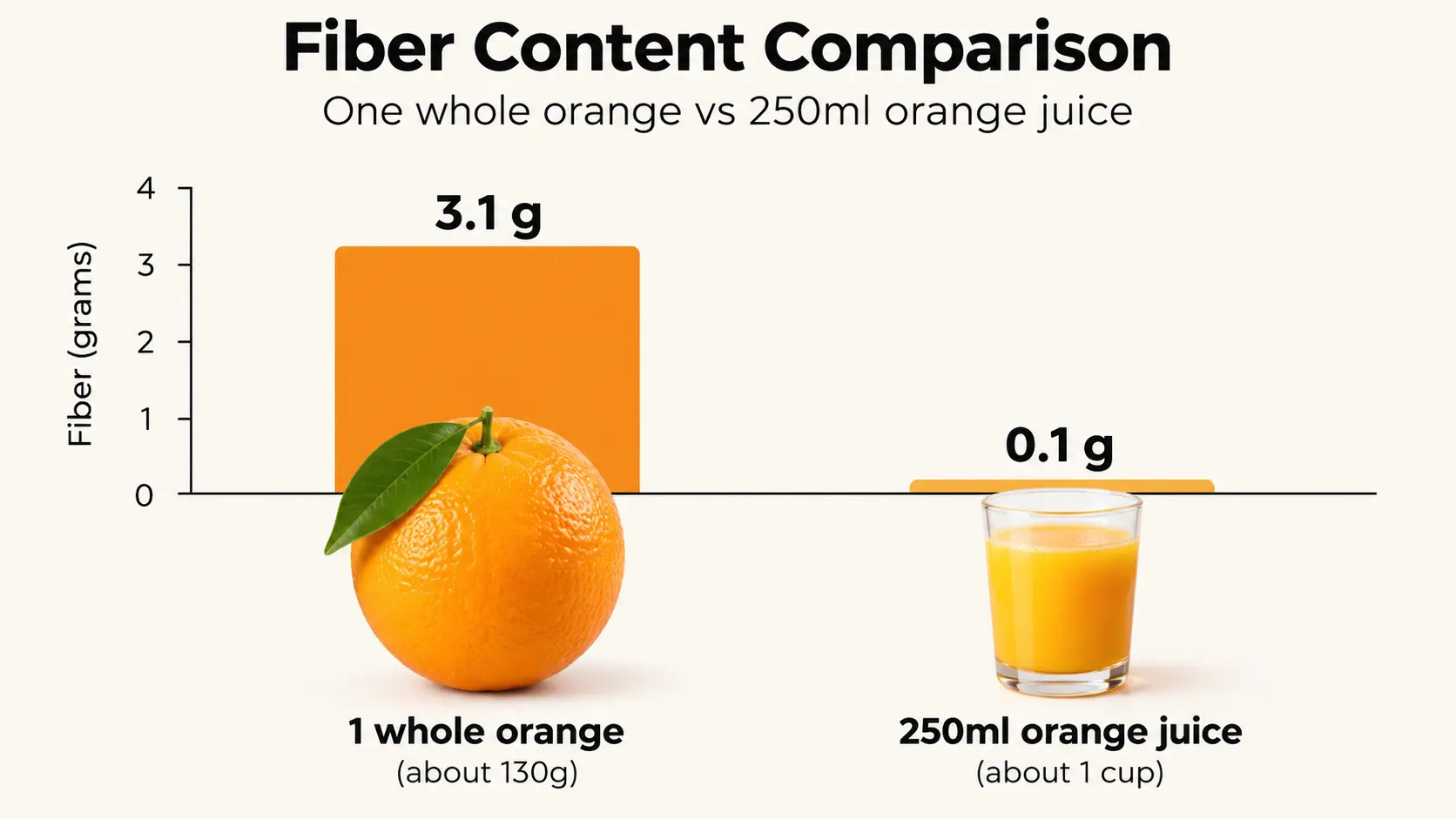
- A whole orange has roughly 3g of fiber; a glass of orange juice made from the same amount of fruit has well under 0.5g.
- Juicing typically requires 3-4 pieces of fruit per glass, meaning you consume several times the natural sugar in a fraction of the volume and time.
- The World Health Organization classifies fruit juice sugars as "free sugars" for dietary guidance, grouping them with added sugars rather than with whole fruit.[1]
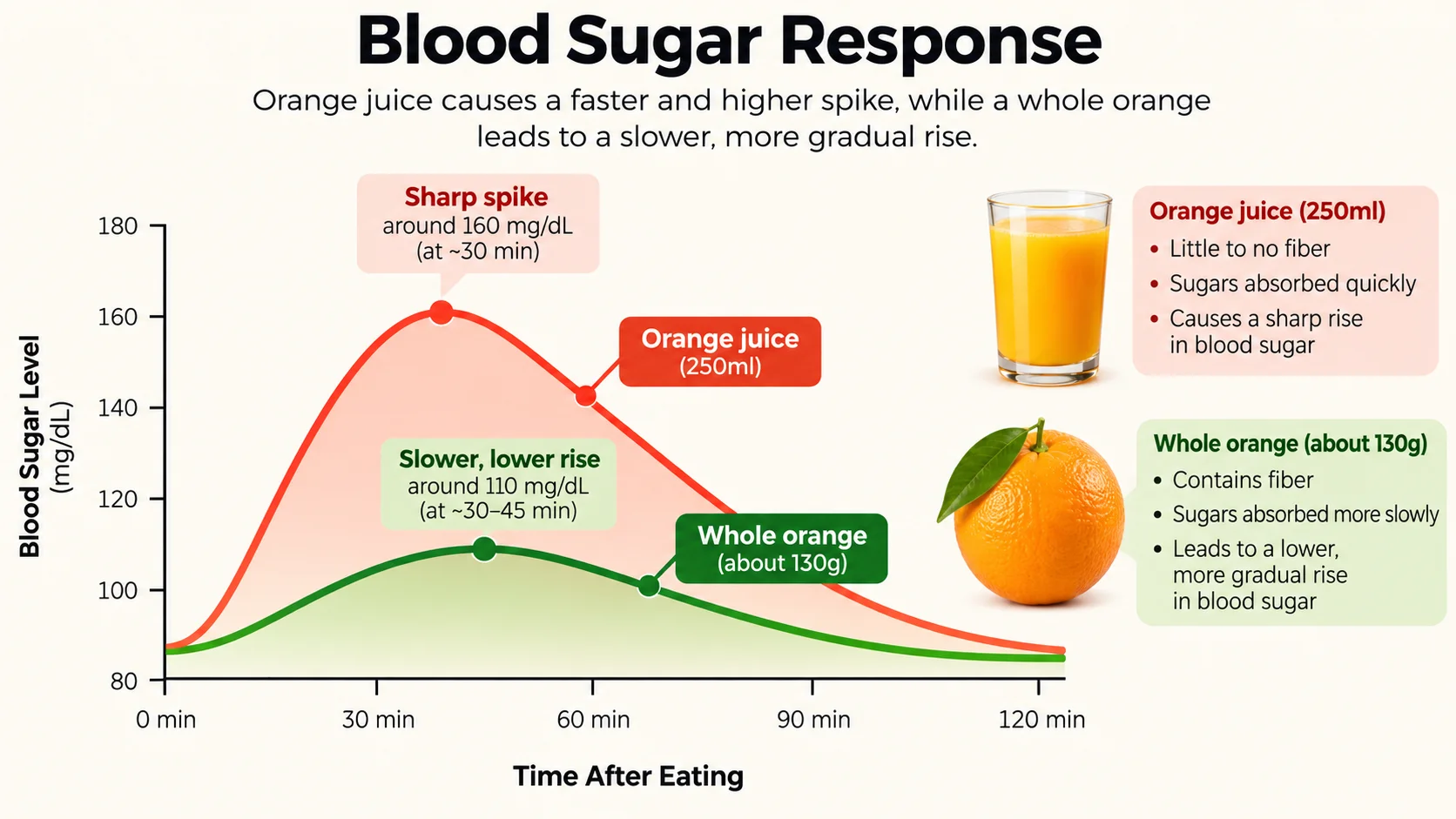
- Removing fiber changes how quickly sugar is absorbed, which affects blood sugar response and satiety — not just total sugar grams.[2]
- Smoothies retain most of the fruit's fiber because they blend the whole fruit rather than extracting juice from it.
Fruit juice and whole fruit start from the same plant, but by the time juice reaches your glass, it has been quietly transformed into a very different food. The vitamin content looks similar on a nutrition label, which is exactly why the "juice counts as fruit" assumption persists — but the fiber, the sugar concentration, and the speed at which your body absorbs that sugar are all substantially different. This isn't a case against fruit; it's a case for being honest about what juicing actually does.
Why "Is Juice Healthy?" Is the Wrong Question
Framed as a yes-or-no question, fruit juice debates go nowhere — 100% juice with no added sugar clearly isn't the same category of problem as a sugary soft drink, and treating it that way overstates the case. But "is it healthy?" also isn't the question that matters practically. The more useful question is: what does juicing change about the fruit, and does that change matter for how you actually eat and feel? The answer, backed by consistent research, is yes — mainly through one mechanism: the removal of fiber.
The Fiber Difference: What Actually Changes
Fiber lives mainly in the pulp, skin, and cell walls of fruit — exactly the parts that juicing extraction is designed to discard. Whole fruit keeps its sugar locked inside intact plant cells, which your digestive system has to physically break down before that sugar reaches your bloodstream. Juicing does that breakdown mechanically in advance, releasing the sugar and stripping out almost all of the fiber that would otherwise slow its absorption.
| Food | Fiber (approx.) | Natural sugar (approx.) | Fruit equivalent per serving |
|---|---|---|---|
| 1 medium whole orange | ~3g | ~12g | 1 orange |
| 250ml orange juice | <0.5g | ~21g | 3-4 oranges |
| 1 medium whole apple | ~4.4g | ~19g | 1 apple |
| 250ml apple juice | ~0.2g | ~26g | 2-3 apples |
| Whole-fruit smoothie (250ml, blended) | ~3-4g | ~18-22g | 1-2 whole fruits, blended |
Fiber does more than aid digestion. It physically slows gastric emptying and the rate at which glucose enters the bloodstream, it contributes to the chewing and volume that trigger satiety signals, and it feeds gut bacteria that whole fruit but not juice reliably provides.[2] Removing it doesn't just lower a number on a label — it changes how your body processes everything else in the fruit.
Sugar Content: Same Fruit, Very Different Impact
A glass of juice concentrates the sugar from multiple pieces of fruit into a form you can consume in under a minute — something whole fruit's volume and chewing time make difficult to replicate. Eating four oranges in one sitting takes real effort and time; drinking the juice from four oranges takes about ninety seconds. That difference in consumption speed, combined with the missing fiber, produces a faster and higher blood glucose spike from juice than from the equivalent whole fruit, even when the total sugar gram count is similar.[2]
The Honest Comparison
| Factor | Whole fruit | 100% fruit juice | Fruit drink / "juice-flavored" beverage |
|---|---|---|---|
| Fiber | Full amount intact | Almost entirely removed | None (rarely made from real fruit at meaningful volume) |
| Sugar absorption speed | Slower, buffered by fiber | Fast, unbuffered | Fast, and often includes added sugar on top |
| Satiety per calorie | High — chewing, volume, fiber | Low — easy to overconsume quickly | Low |
| Vitamin C / potassium (per serving) | Present | Often similar or higher (concentrated) | Usually minimal, sometimes fortified |
| Typical serving eaten in practice | 1 piece | 1-2 glasses (2-8 pieces worth) | 1-2 glasses |
| WHO "free sugar" classification | Not counted | Counted | Counted |
The honest read of this table is that 100% fruit juice sits meaningfully closer to whole fruit than a sugary soft drink does — it still carries real vitamins and no added sugar — but it is not a like-for-like substitute for whole fruit, and the gap is driven almost entirely by fiber and the ease of overconsumption, not by some hidden toxin in juice itself.
What You Gain and Lose Nutritionally
It's not all one-directional. Juicing does have a couple of narrow advantages worth naming honestly, alongside the clear downsides:
Where Smoothies Fit In
Smoothies occupy real middle ground here, and it's worth being specific about why. A smoothie blends the entire fruit — skin (where edible), pulp, and all — rather than extracting liquid and discarding the solids, so most of the fiber stays in the final drink. That single difference in method is why a homemade fruit smoothie behaves much closer to whole fruit than to juice in terms of satiety and blood sugar response, even though both are technically "drinkable fruit." The caveat is that store-bought smoothies vary enormously — some are genuinely blended whole fruit, others are juice-based with added sweeteners, so the ingredient list matters more than the word "smoothie" on the label. A smoothie made with a full piece of fruit plus yogurt or milk also adds protein and fat, which further slows digestion compared to juice on its own.
When Juice Actually Makes Sense
None of this means juice needs to disappear from your kitchen. It makes the most sense in specific, moderate contexts rather than as a daily whole-fruit replacement:
- A small glass (100-150ml) alongside a meal — the accompanying food slows absorption and the smaller volume limits total sugar intake.
- Diluted with water — halves the sugar concentration per glass while keeping the flavor, a common approach for kids' drinks.
- Post-exercise, when fast carbohydrate is actually useful — the same fast absorption that's a downside at rest can be a practical upside immediately after intense training.
- When chewing fibrous food isn't currently possible — certain medical or dental situations where juice is genuinely the more practical option.
- Occasionally, in place of a dessert or sugary drink — a reasonable swap even if it's not equivalent to eating the whole fruit.
What doesn't hold up is treating a daily large glass of juice as interchangeable with "eating fruit" for the day — the volume typically consumed as juice would be unusual, and often uncomfortable, to eat as whole fruit, which is itself a signal that something about the format has changed.
Common Mistakes
- Counting a daily glass of juice as one of your fruit servings. Most dietary guidelines that recommend whole fruit servings either exclude juice entirely or cap it at a small fraction of daily intake — it isn't a free substitute.
- Assuming "100% juice, no added sugar" means low-sugar. The sugar is entirely natural, but the concentration and absorption speed are what matter for blood sugar — not whether the sugar was "added."
- Buying "juice drinks" or "juice cocktails" thinking they're the same as 100% juice. These typically contain a small percentage of actual juice plus added sugar and water — check the label for "100% juice" specifically.
- Giving up on fruit juice entirely out of guilt, rather than right-sizing the serving. A small glass alongside food is a reasonable, moderate choice — the problem is usually volume and frequency, not the existence of juice in the diet.
Final Thoughts
Fruit juice and whole fruit aren't nutritional equivalents, and the difference comes down almost entirely to one thing: fiber. Removing it changes how fast sugar is absorbed, how filling the food is, and how easy it becomes to consume several servings' worth of fruit sugar in a single glass. That doesn't make juice dangerous — it makes it a food worth having in smaller amounts and in the right context, rather than treating it as a direct swap for the fruit it came from.
The fruit itself was never the problem. What changed is the format — and format changes what a food does in your body, even when the ingredient list looks identical.
For a broader look at how food processing more generally changes what you're actually eating, the NOVA classification guide covers the same underlying idea — that how a food is transformed matters as much as what it started as.
This article is for general educational purposes and isn't a substitute for personalized medical or nutritional advice. If you have diabetes or another condition affected by blood sugar, consult a doctor or registered dietitian about fruit and juice intake specific to your situation.
Sources
[1] World Health Organization guideline on sugars intake, classifying fruit juice sugars as free sugars. Available at: who.int
[2] Research on dietary fiber's role in glycemic response and satiety. Available at: pmc.ncbi.nlm.nih.gov