
- Ultra-processed food is defined by the NOVA classification system's Group 4 — not by packaging, shelf life, or ingredient count alone.
- A 2019 NIH-funded controlled trial found people ate about 500 extra calories a day, unprompted, on an ultra-processed diet matched for sugar, fat, and calories.[1]
- Each additional 100g/day of ultra-processed food intake is associated with a 2.6% higher risk of all-cause mortality in recent meta-analyses.[2]
- Not everything packaged is ultra-processed — canned beans and plain yogurt are NOVA Group 1-3, not Group 4.
- NOVA has been criticized for grouping nutritionally different products together under one "ultra-processed" label.
"Ultra-processed" gets used as a catch-all for "packaged" or "unhealthy," but it's actually a specific, defined category with real research behind it — and conflating it with packaging alone misses both the useful signal and the genuine nuance. The NOVA classification system, developed to study this exact category, sorts food by how it's made rather than by what nutrients it contains. Understanding the actual definition makes it a far more useful lens than the vague "processed = bad" heuristic most people default to.
The NOVA Classification, in Full
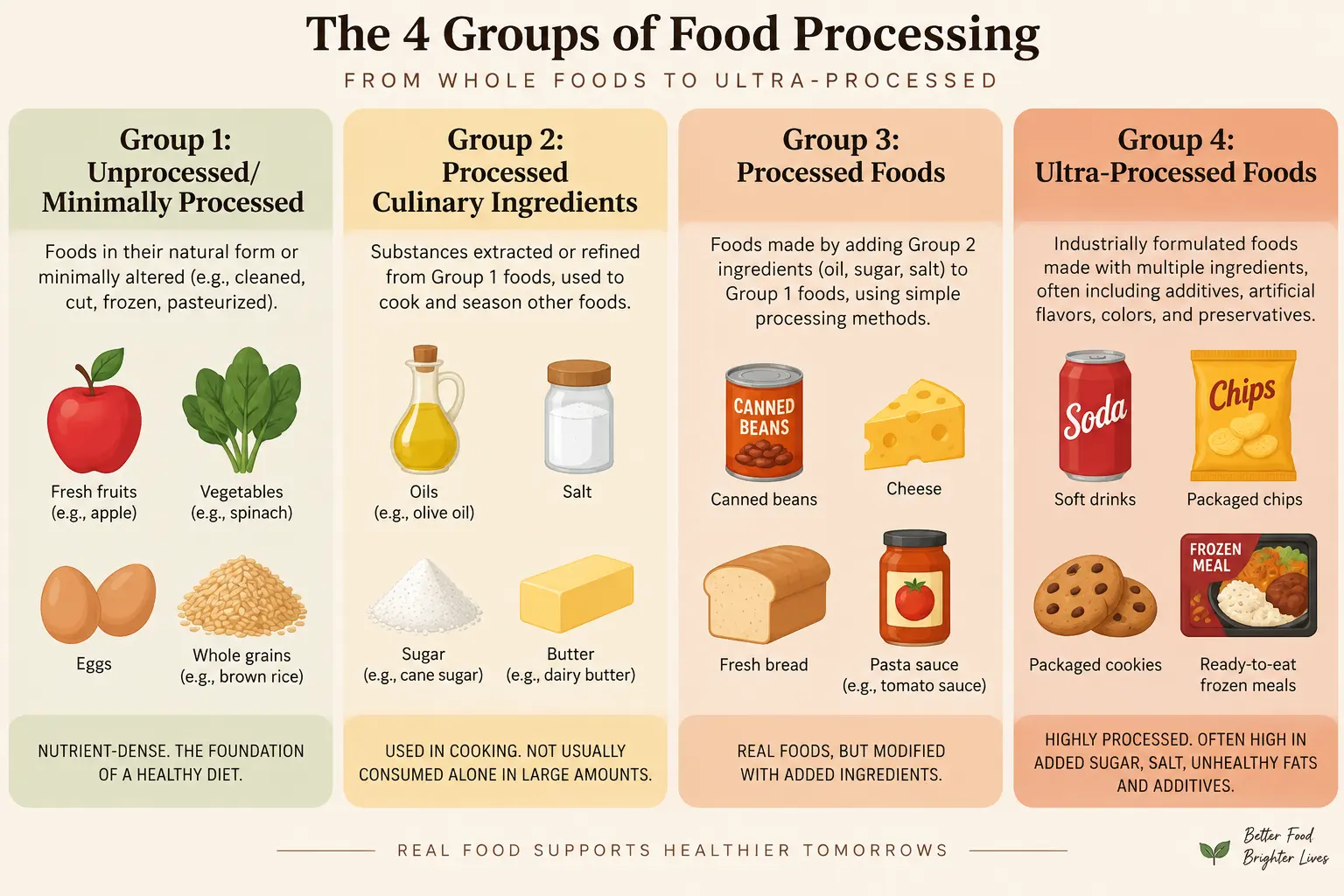
NOVA is a four-group system developed by researchers at the University of São Paulo, organized by the extent and purpose of processing rather than by nutrient content.[3] This distinction matters: a food can be low in sugar and still land in Group 4 if its formulation and manufacturing process qualify it.
| Group | Description | Examples |
|---|---|---|
| 1 — Unprocessed / minimally processed | Retain natural structure; basic prep only (cleaning, drying, freezing) | Fresh fruit, plain meat, milk, eggs |
| 2 — Processed culinary ingredients | Extracted from Group 1 foods, used to cook or season | Butter, oils, sugar, salt |
| 3 — Processed foods | Group 1 + Group 2 combined, few added ingredients | Canned vegetables, fresh bread, cheese |
| 4 — Ultra-processed foods | Industrially formulated with additives; little or no whole food remains | Packaged snack cakes, sodas, instant noodles |
The defining feature of Group 4 isn't packaging or a long ingredient list on its own — it's the presence of substances "of no or rare culinary use," things like protein isolates, hydrogenated oils, and modified starches, combined through industrial processes that don't resemble anything happening in a home kitchen.
Why "Packaged" Isn't the Same as "Ultra-Processed"
This is the single most common misunderstanding about the category, and it matters for how you actually apply the concept. Canned beans, frozen vegetables, plain yogurt, and bagged rice are all packaged — but they're NOVA Group 1 or Group 3, not Group 4, because they're recognizably derived from a single whole food with few or no added substances of no culinary use.
This distinction is exactly why label literacy matters more than a package-vs-fresh heuristic — the same instinct covered in what "natural flavours" actually means on a label, which digs into one specific ingredient category that shows up constantly in Group 4 formulations.
What the Evidence Actually Shows
The single most compelling piece of evidence isn't observational — it's a controlled trial that isolated processing itself as the variable. In 2019, NIH researcher Kevin Hall and colleagues placed 20 weight-stable adults on an ultra-processed diet and an unprocessed diet, each for two weeks, with both diets matched for calories, sugar, fat, sodium, and fiber.[1] Participants ate roughly 500 more calories per day, unprompted, on the ultra-processed diet and gained about a kilogram over two weeks; they lost weight on the unprocessed diet. Because the diets were nutritionally matched, the difference couldn't be explained by macronutrients alone — something about the processing itself increased how much people ate.
Beyond that single trial, large observational studies and meta-analyses consistently link higher ultra-processed food intake with higher rates of obesity, cardiovascular disease, and all-cause mortality. A recent umbrella review found each additional 100g/day of ultra-processed food intake associated with a 14.5% higher risk of hypertension, a 5.9% higher risk of cardiovascular events, and a 2.6% higher risk of all-cause mortality.[2]
Fruit juice is a useful smaller-scale illustration of the same underlying idea — a food's classification and how you eat it can matter as much as its raw ingredient list. Fruit juice vs. whole fruit covers how removing fiber through processing changes what would otherwise be an identical food.
The Honest Limits of the Classification
NOVA is a useful lens, not a precise nutritional score — and treating every Group 4 item as equally concerning oversimplifies the evidence.[4] Critics point out that the classification groups very different products together: a sugary soda and a fortified whole-grain bread with an emulsifier can both land in Group 4, despite meaningfully different nutritional profiles, because NOVA sorts by processing method and formulation rather than by nutrient content. A protein bar reformulated with isolates and stabilizers to hit a macro target isn't nutritionally equivalent to a candy bar, even if both technically qualify as ultra-processed.
The practical takeaway: use NOVA to identify a category worth generally limiting, not as a precise health score to apply item by item. What's inside the formulation — added sugar, sodium, fiber, protein — still matters within the category, not just whether something clears the Group 4 threshold.
How to Actually Spot It on a Label
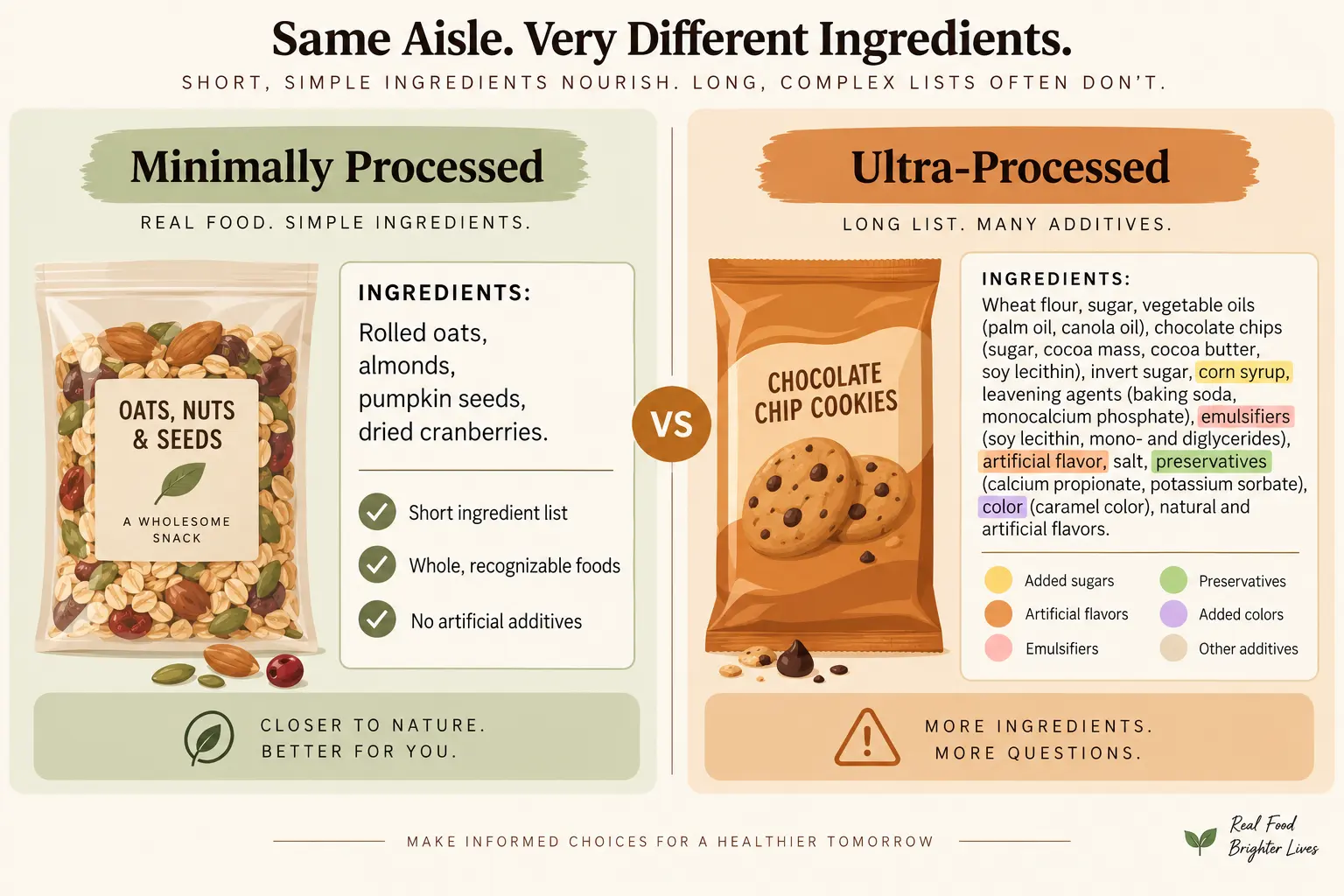
- Scan for substances you wouldn't use at home. Protein isolates, hydrogenated oils, modified starches, and maltodextrin are common markers of industrial reformulation.
- Count the additives, not just the ingredients. Emulsifiers, stabilizers, artificial or "natural" flavorings used to recreate a taste rather than season food are a strong signal.
- Ask if it resembles a recipe or a chemistry set. A genuine recipe reads like something you could recreate in a kitchen; an ultra-processed formulation typically doesn't.
- Use the "five or more unfamiliar ingredients" rule of thumb. Not a strict cutoff, but a reasonably reliable practical signal for Group 4 classification.
Pair this with a quick check of the nutrition panel itself — a 30-second method for reading any nutrition label covers the added sugar and sodium checks that round out what the ingredient list alone won't tell you.
Common Mistakes
- Assuming "packaged" means "ultra-processed." Canned and frozen whole foods are usually Group 1-3, not Group 4.
- Treating every Group 4 food as equally bad. NOVA measures processing method, not nutrient quality — context still matters within the category.
- Ignoring the ingredient list in favor of front-of-pack marketing claims. "All natural" and "no artificial flavors" don't guarantee a food isn't ultra-processed.
- Treating one observational study as proof. The controlled trial evidence is what makes the causal case strongest — look for that distinction in any claim you read.
- Trying to eliminate all ultra-processed food overnight. A gradual shift toward more Group 1-3 foods is more sustainable than an all-or-nothing approach.
Final Thoughts
Ultra-processed food is a specific, defined category — not a synonym for "packaged" or a vague feeling about how healthy something seems. The NOVA classification gives a genuinely useful way to identify it, backed by controlled trial evidence showing the processing itself, not just the nutrients, can drive overeating. It isn't a perfect nutritional score, and it shouldn't replace looking at what's actually inside a given product — but it's a far more precise lens than "processed = bad."
The honest version of this framing: the ingredient list itself is usually the fastest, most reliable signal — no app, scanner, or classification chart required, just reading what's actually in front of you.
Once ultra-processed foods are easier to spot, why sugar cravings happen and what a healthy plate looks like around the world both build naturally on the same label-literacy foundation covered here.
This article is for general information and isn't personalized nutritional advice. Consult a registered dietitian or healthcare provider for guidance specific to your health needs.
Sources
[1] Hall KD, et al. (2019). "Ultra-Processed Diets Cause Excess Calorie Intake and Weight Gain." Cell Metabolism. Available at: cell.com
[2] Ultra-processed foods and human health: umbrella review and updated meta-analyses. Available at: sciencedirect.com
[3] NOVA food classification system overview. Available at: en.wikipedia.org
[4] The NOVA classification system: a critical perspective in food science. Available at: sciencedirect.com