
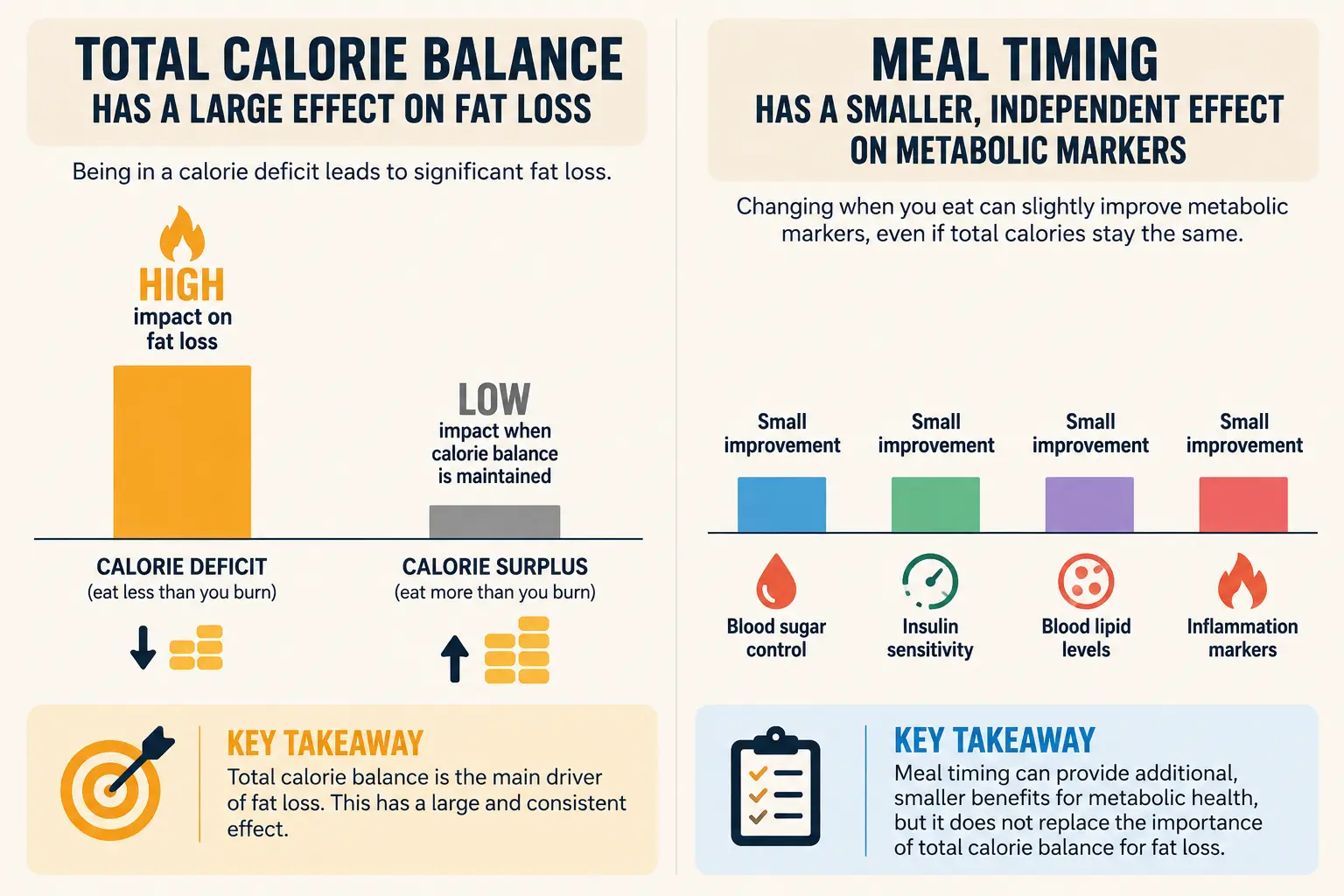
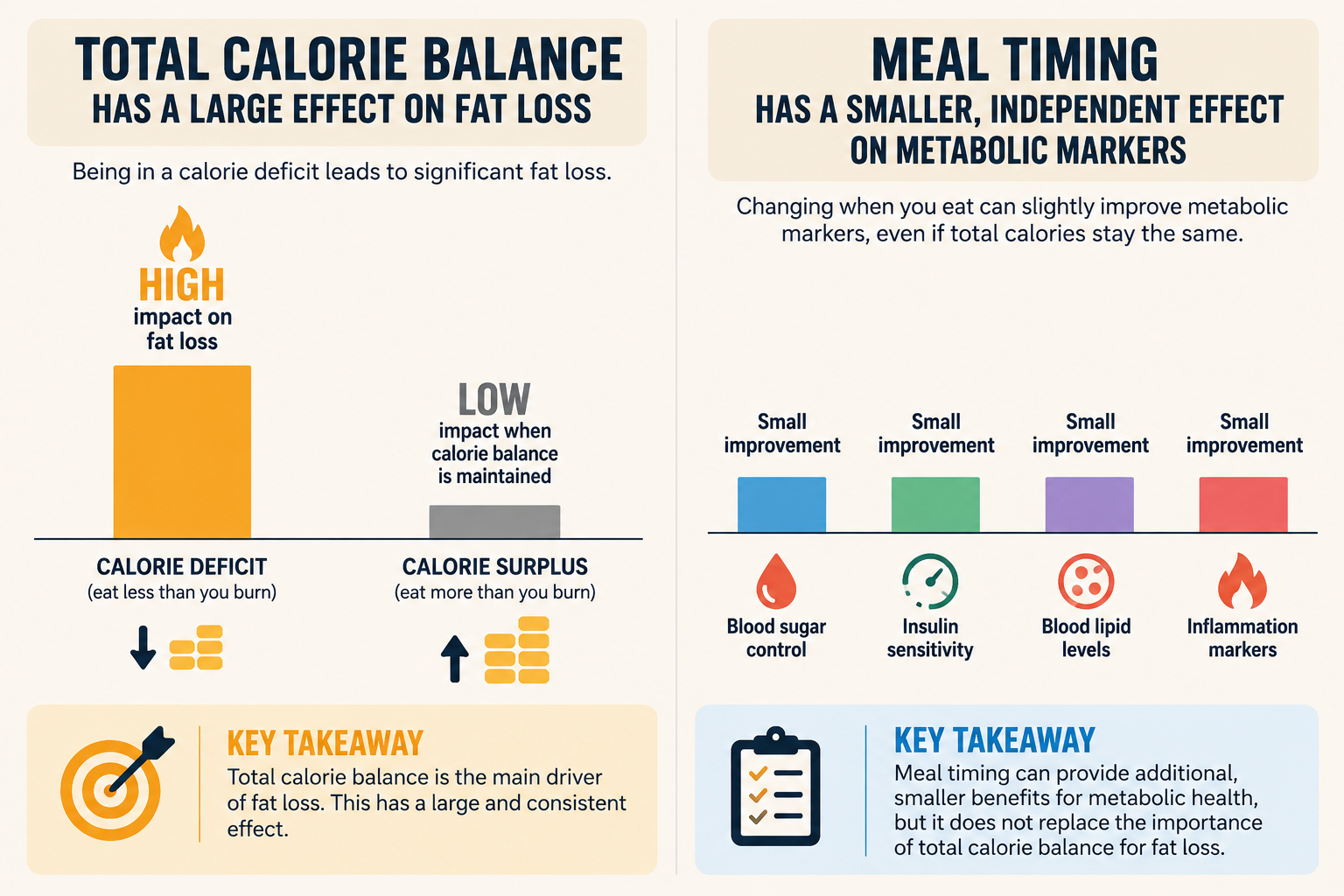
- Total calorie and protein intake remains the primary driver of fat loss — when these are matched, meal timing alone produces little to no difference in fat lost.[1]
- Insulin sensitivity and the thermic effect of food are both measurably higher earlier in the day than in the evening, giving early meals a modest metabolic edge independent of weight change.[2]
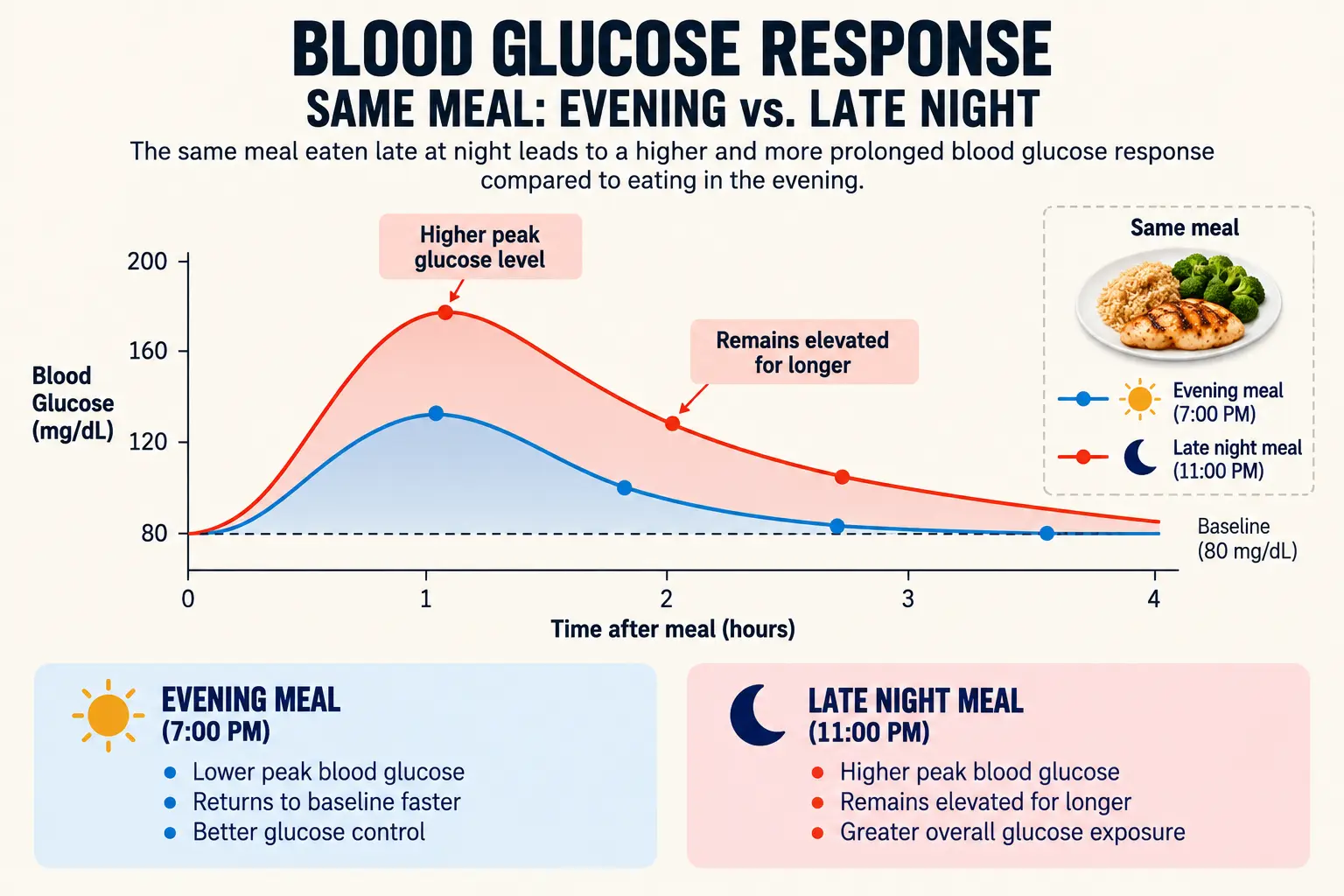
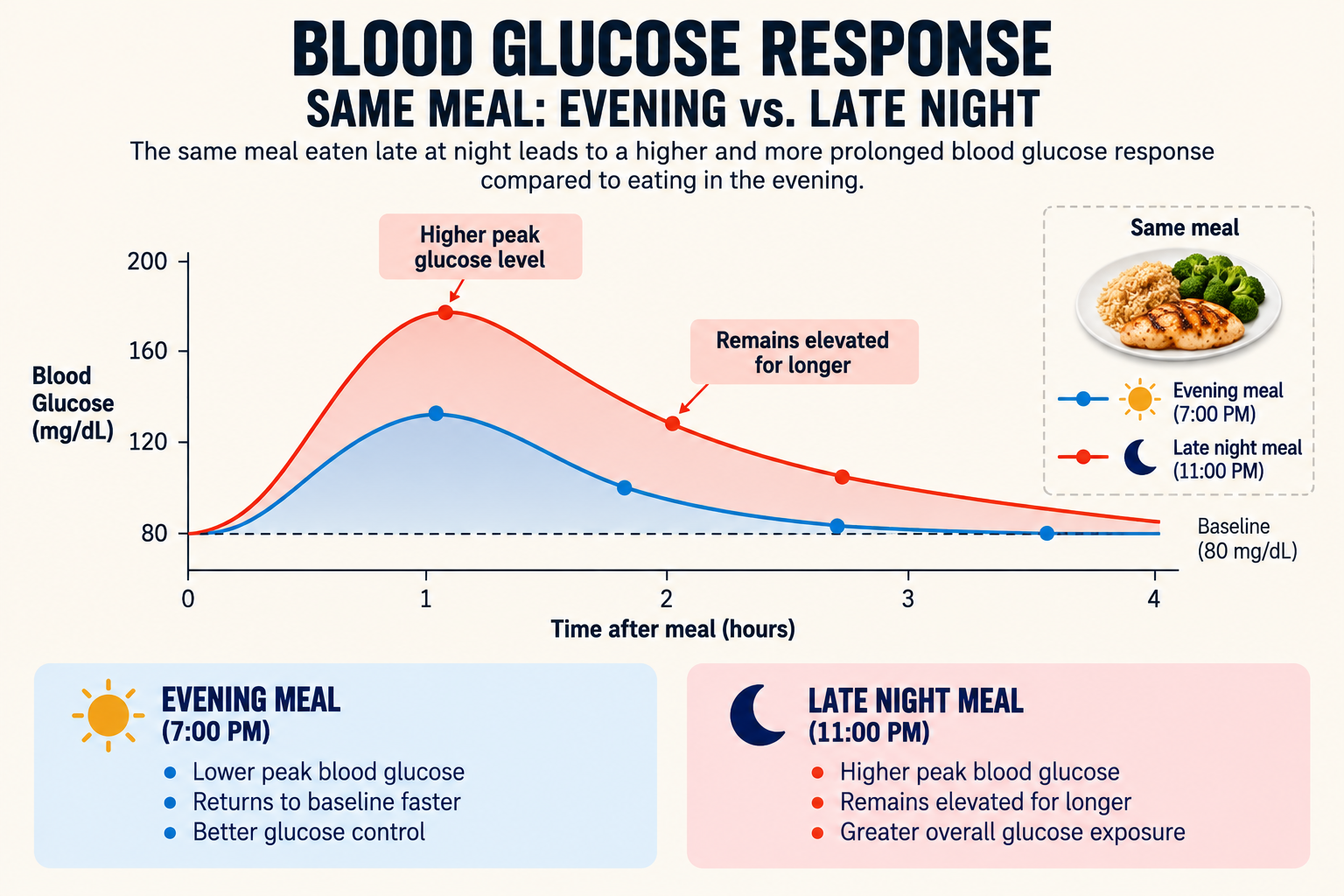
- Late-night eating is associated with poorer glucose control and worse weight outcomes in several studies, even at matched calorie intake.
- The old claim that frequent small meals "boost metabolism" isn't supported by controlled research comparing meal frequency at matched calories.
- Meal timing functions as a secondary, optimization-level lever — useful once calories and protein are already right, not a substitute for them.
"Does it matter when I eat?" is one of the most common follow-up questions to any conversation about fat loss, and the honest answer is a real but modest yes — just not in the way most timing-focused advice implies. Total calorie balance is still what determines whether you gain or lose fat. But a growing body of circadian nutrition research shows that meal timing has its own, independent effects on metabolic health — effects that are worth understanding, even though they're secondary to the fundamentals.
What "Does Meal Timing Matter" Actually Means
It helps to separate two different questions that often get merged into one. The first: does when you eat change how much fat you lose at a given calorie intake? The second: does when you eat affect metabolic health markers — insulin sensitivity, blood sugar control, inflammation — independent of weight change? The research answers these differently. The first question has a fairly consistent answer: not much, once calories and protein are matched. The second has a more interesting answer: yes, meaningfully, in ways that don't always show up on the scale.
What the Research Actually Shows
A well-known 2018 study by Sutton et al. compared an early time-restricted eating window (8am-2pm) to a standard eating pattern in men with prediabetes, with calories matched between groups.[1] The early-eating group showed improved insulin sensitivity, lower blood pressure, and reduced oxidative stress — despite no significant difference in weight loss between groups. This is a key finding: the metabolic benefit of earlier eating showed up independent of fat loss, not because of it.
Separately, controlled trials comparing meal timing for weight loss specifically — not just metabolic markers — have generally found small or no differences in fat lost when total calories and protein are held constant between an early-eating group and a late-eating group.[2] The exception tends to appear in free-living (non-controlled) settings, where late eaters often unintentionally consume more total calories, not because timing itself burns more or less fat, but because eating patterns that run later in the day tend to correlate with less structured, higher-calorie intake overall.
The Circadian Eating Effect: Why "When" Isn't Nothing
Human metabolism runs on a circadian rhythm — an internal clock that regulates hormone release, glucose handling, and energy expenditure across the 24-hour day. Insulin sensitivity, glucose tolerance, and the thermic effect of food (the energy your body spends digesting a meal) are all measurably higher in the morning than in the evening, tracking the natural cortisol curve.[2] The practical result: identical meals produce a smaller blood glucose spike and require less insulin when eaten earlier in the day compared to the same meal eaten late at night.
This is the mechanism behind why intermittent fasting research increasingly points toward eating-window position, not just duration, as a variable worth considering — a theme covered in more depth in the full evidence review on intermittent fasting, which looks specifically at how early, midday, and late eating windows compare within IF protocols.
Late-Night Eating: What Actually Happens
Late-night eating specifically — not just "eating later than average," but large meals close to bedtime — has its own body of research separate from general meal-timing studies. Several studies link consistent late-night eating with poorer glucose control the following morning, higher rates of self-reported weight gain over time, and disrupted overnight metabolic processes, even when daily total calories are accounted for.
| Eating pattern | Circadian alignment | Typical findings |
|---|---|---|
| Early-concentrated (most calories before ~2pm) | Aligned with peak insulin sensitivity | Best metabolic markers; hardest to sustain socially |
| Evenly spread through a standard day | Partial alignment | Moderate outcomes; most practical for most schedules |
| Late-concentrated (large meals close to bedtime) | Misaligned with circadian biology | Poorer glucose control; weaker fat-loss outcomes in several studies despite matched calories |
None of this means an occasional late dinner undoes progress — the research is about consistent patterns over weeks and months, not single meals. The practical takeaway is narrower than "never eat after 7pm": it's that habitually large, late meals appear to work against metabolic health and fat-loss consistency more than the same calories eaten a few hours earlier.
The Meal Frequency Myth: 3 Meals vs. 6 Small Meals
A closely related and frequently confused question is meal frequency — the old advice to eat "6 small meals a day to keep your metabolism stoked." Controlled research comparing meal frequency at matched total calories and protein has consistently found no meaningful metabolic advantage to more frequent, smaller meals over fewer, larger ones. Total daily energy expenditure doesn't meaningfully change based on how many times you eat it in.
What Actually Matters More: A Practical Hierarchy
| Priority | Lever | Approximate impact on fat loss |
|---|---|---|
| 1 | Total daily calories relative to your needs | Primary driver — determines direction of weight change |
| 2 | Adequate protein intake | Large effect on satiety, muscle retention, and adherence |
| 3 | Consistency and adherence over weeks/months | Determines whether the plan actually gets followed |
| 4 | Meal timing (earlier concentration, avoiding late large meals) | Modest, independent effect on metabolic markers and consistency |
| 5 | Meal frequency | Minimal direct effect; choose based on personal preference |
Timing is worth adjusting once calories and protein are already dialed in — not before. Someone struggling to hit a calorie target doesn't need a meal-timing protocol; they need a more sustainable approach to tracking intake first. Someone already consistent on both fronts might genuinely benefit from shifting their largest meal earlier in the day.
Who Meal Timing Matters Most For
The size of the timing effect isn't uniform across everyone, and it's worth being specific about who's likely to notice it most. People with insulin resistance or prediabetes tend to show the clearest metabolic benefit from earlier-concentrated eating, since their glucose handling is already more sensitive to timing than someone with normal insulin sensitivity — this is exactly the population the Sutton study focused on. Shift workers face the opposite problem: their circadian rhythm is already disrupted by irregular sleep and light exposure, which appears to blunt some of the timing-related metabolic benefits regardless of when meals are scheduled relative to the clock. Athletes and people training intensely have their own version of the question — meal timing around a workout (before and after training) has a more established, separate research base focused on performance and recovery rather than fat loss, and shouldn't be confused with the circadian-eating research discussed here. For most people without a specific metabolic condition or irregular schedule, the timing effect is real but modest enough that it's reasonable to treat it as a nice-to-have refinement, not a priority.
Common Mistakes
- Obsessing over meal timing while calories are still inconsistent. Timing is a secondary lever — it can't compensate for a calorie intake that swings widely day to day.
- Assuming any late meal "undoes" fat loss. The research concerns consistent patterns over weeks, not a single late dinner — one late meal doesn't erase progress.
- Believing frequent small meals speed up metabolism. Controlled research doesn't support a meaningful metabolic advantage from meal frequency at matched calories.
- Applying an early-eating window that isn't sustainable. A metabolically "optimal" schedule you abandon in two weeks produces worse results than a "good enough" one you actually keep.
Final Thoughts
Meal timing does matter — just not as much, or in the way, that most timing-focused advice suggests. Total calories and protein remain the primary levers for fat loss; timing's real, research-supported effect shows up mainly in metabolic markers like insulin sensitivity, and in the tendency for late, unstructured eating to correlate with higher total intake. Treat timing as a secondary optimization once the fundamentals are in place, and the goal isn't a rigid eating window — it's simply not routinely eating your largest meal right before bed.
When you eat can shift the margins. What and how much you eat still decides the outcome.
For a broader, honest look at building meals that work without obsessive tracking of either timing or calories, the hand-measure balanced plate system is a practical next read.
This article is for general educational purposes and isn't a substitute for personalized medical or nutritional advice. If you have diabetes or another condition affected by blood sugar or meal timing, consult a doctor or registered dietitian about an approach specific to your situation.
Sources
[1] Sutton et al., "Early Time-Restricted Feeding Improves Insulin Sensitivity, Blood Pressure, and Oxidative Stress Even without Weight Loss in Men with Prediabetes," Cell Metabolism, 2018. Available at: pubmed.ncbi.nlm.nih.gov
[2] Research on circadian regulation of glucose tolerance and thermic effect of food across the day. Available at: pmc.ncbi.nlm.nih.gov