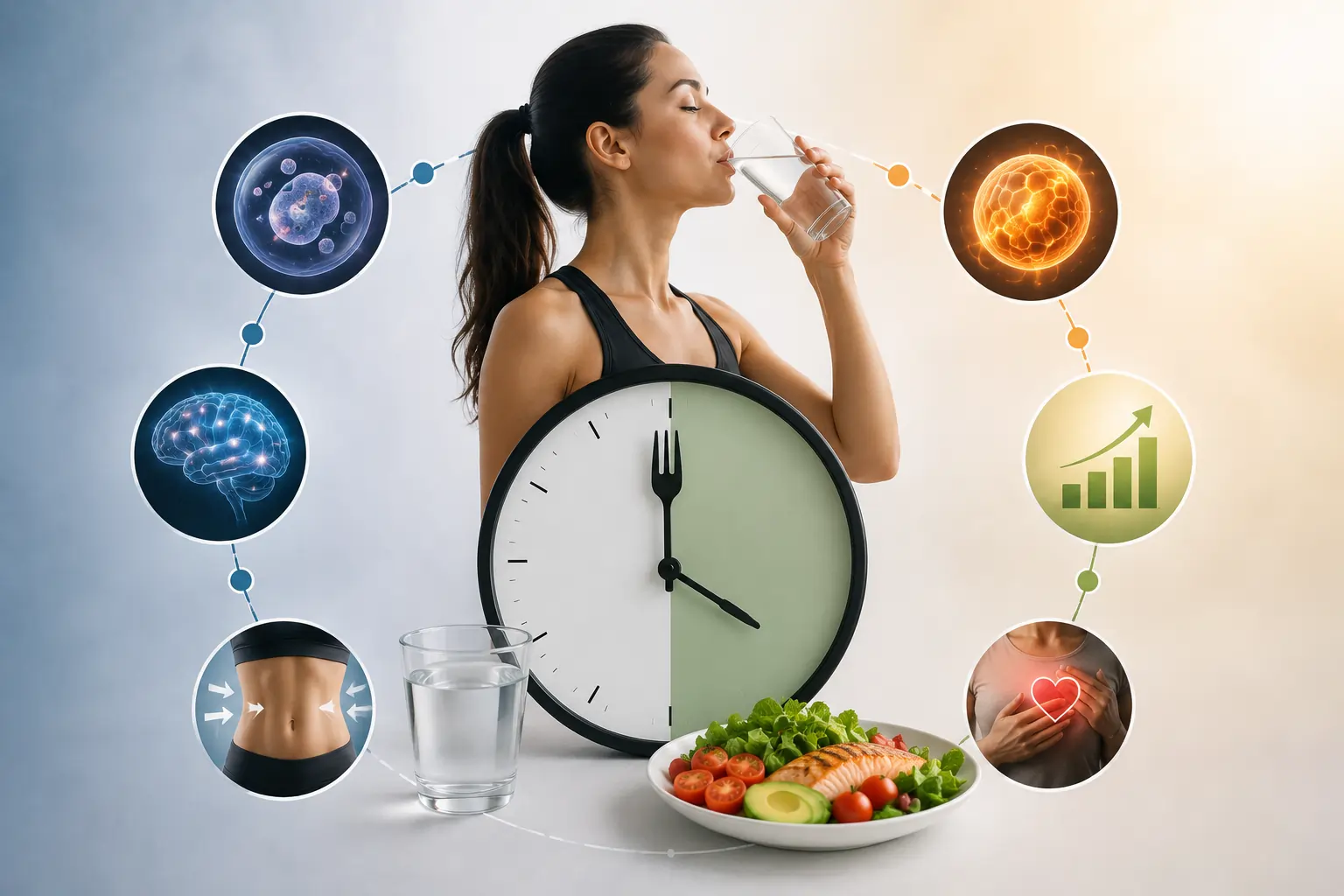
Intermittent fasting occupies an unusual position in the nutrition landscape. It is simultaneously supported by a substantial body of legitimate peer-reviewed research and surrounded by a wellness culture that has pushed those findings well beyond what they actually demonstrate. The research shows meaningful but specific effects. The popular narrative shows transformative effects on nearly everything. The gap between the two is where most of the confusion lives.
This article is not a case for intermittent fasting as a superior way to eat. Nor is it a dismissal of it as a trend without substance. It is an attempt to describe what actually happens physiologically during a fast, what the controlled research shows about its effects on body composition, metabolic health, and other outcomes, and where the current evidence is genuinely strong versus where it is preliminary, overstated, or actively contested.
The question this article answers is not "should I do intermittent fasting." It is "if I do intermittent fasting, what will my body actually be doing and what outcomes can I reasonably expect." That is a question the research can answer — with appropriate caveats about the quality of existing evidence and the meaningful individual variation in responses. Understanding where IF fits relative to your total daily energy expenditure is the foundation for using it well.
What Intermittent Fasting Actually Is
Intermittent fasting is an umbrella term for eating patterns that cycle between defined periods of eating and defined periods of fasting. It describes a temporal structure for eating — when to eat — rather than a dietary composition — what to eat. Most IF protocols do not specify macronutrient ratios, specific foods, or portion sizes during the eating window. The defining feature is the time structure.
| Protocol | Structure | Daily eating window | Evidence quality |
|---|---|---|---|
| 16:8 (time-restricted eating) | 16 hours fasting, 8 hours eating each day | 8 hours (e.g. noon to 8pm) | Strongest evidence base; most widely studied; most sustainable for most people |
| 18:6 | 18 hours fasting, 6 hours eating each day | 6 hours | Similar to 16:8 with slightly more restriction; some additional effects on insulin sensitivity |
| 14:10 | 14 hours fasting, 10 hours eating each day | 10 hours | Milder protocol; easier adherence; some metabolic benefits particularly when aligned with daylight hours |
| 5:2 (modified fasting) | 5 days normal eating, 2 non-consecutive days of 500–600 kcal restriction | Normal 5 days; very restricted 2 days | Well-studied; similar fat loss to continuous restriction in RCTs; more flexible but harder on restricted days |
| Alternate day fasting (ADF) | Alternating between normal eating days and 500 kcal restriction days | Normal every other day | Significant caloric restriction effect; harder to sustain; studied primarily in metabolically at-risk populations |
| OMAD (one meal a day) | 23 hours fasting, 1 hour eating | ~1 hour | Limited formal research; very difficult to meet protein requirements in one sitting; not generally recommended |
What Happens Physiologically During a Fast: The Timeline
The body does not switch between "fed" and "fasted" states as a binary. The transition from fed to fasted is a gradual metabolic shift across several physiological phases, each characterised by different hormonal and metabolic activity. Understanding this timeline is the foundation for understanding what IF actually does.
Hours 0–4: The fed and absorptive state
In the hours immediately following a meal, the body is in the absorptive state: nutrients from the meal are being absorbed from the gut into the bloodstream. Blood glucose rises, triggering insulin secretion from the pancreas. Insulin facilitates glucose uptake by cells, promotes glycogen synthesis in the liver and muscle, and suppresses fat breakdown (lipolysis). During this phase, the body is primarily burning the fuel just consumed. Fat oxidation is minimised. This phase typically lasts three to five hours after a standard mixed meal.
Hours 4–8: The post-absorptive state
As meal absorption completes, blood glucose begins to fall. Insulin levels decline. Glucagon — the counter-regulatory hormone that signals the liver to release glucose — rises. The liver begins releasing glucose from glycogen stores (glycogenolysis) to maintain blood glucose within the normal range. Fat oxidation begins to increase as insulin suppression of lipolysis lifts.
Most people eating three meals a day spend little time in this phase because the next meal arrives before post-absorptive metabolism has fully established. The post-absorptive state is where intermittent fasting begins to diverge from continuous feeding patterns.
Hours 8–16: The early fasting state
If eating does not resume, the body moves into the early fasting state. Liver glycogen stores become the primary source of glucose for the brain and other glucose-dependent tissues. Fat oxidation increases progressively as insulin falls further and glucagon rises. Free fatty acids are mobilised from adipose tissue and transported to the liver, where some are converted to ketone bodies.
Growth hormone begins to rise — a pattern that peaks with longer fasting and is one of the mechanisms through which fasting is claimed to support muscle preservation. Norepinephrine (noradrenaline) rises modestly, contributing to the increased alertness and mental clarity that some people report during fasting — a real physiological phenomenon, not entirely psychological. For a person on a 16:8 protocol, this is the core metabolic state the protocol is designed to reach.
Hours 16–24: The extended fasting state
With fasting extending beyond sixteen hours, liver glycogen stores are substantially depleted. Fat oxidation is now the primary energy pathway. Ketone production increases as the liver converts fatty acids to ketone bodies — an alternative fuel for the brain that becomes more significant as glucose availability falls.
Autophagy — the cellular self-cleaning process — begins to increase meaningfully in this window. Cortisol rises modestly, contributing to glucose mobilisation and alertness. This is the state reached during longer eating window restrictions, such as 18:6.
| Fasting phase | Duration | Primary fuel | Insulin | Key hormonal changes |
|---|---|---|---|---|
| Fed / absorptive | 0–4 hrs post-meal | Dietary glucose and fat | High | Insulin high; glucagon low; GLP-1 and PYY elevated |
| Post-absorptive | 4–8 hours | Glycogen; rising fat oxidation | Declining | Glucagon rising; insulin falling |
| Early fasting | 8–16 hours | Liver glycogen + fat | Low | Glucagon high; growth hormone rising; norepinephrine rising |
| Extended fasting | 16–24 hours | Primarily fat; early ketogenesis | Very low | Growth hormone elevated; ketones rising; cortisol modestly elevated |
| Prolonged fasting | 24+ hours | Fat + ketones; some protein catabolism | Minimal | Gluconeogenesis significant; deep ketosis; elevated cortisol |

What the Research Actually Shows: Sorting Signal from Noise
The IF research base has expanded considerably in the past decade. It now includes randomised controlled trials (RCTs), mechanistic studies, observational data, and multiple systematic reviews and meta-analyses. The quality of evidence varies substantially across different claimed outcomes. Below is an honest assessment, category by category.
Body weight and fat loss: moderate evidence, context-dependent
The most consistent finding in the IF literature is that time-restricted eating and other IF protocols produce weight loss in overweight and obese individuals compared to no dietary intervention. This is not controversial.
The more important and more contested question is whether IF produces greater weight loss than continuous caloric restriction at the same caloric intake. The answer from the best-quality research is: probably not meaningfully so. A 2020 RCT by Lowe and colleagues published in JAMA Internal Medicine, one of the most rigorous trials to date, found no significant difference in weight loss between 16:8 time-restricted eating and an unrestricted eating control at one year.[1] A 2022 meta-analysis pooling data from multiple RCTs found that IF protocols produced similar weight loss to continuous caloric restriction when total caloric intake was matched.
The practical summary: IF is an effective tool for reducing caloric intake for people who find it easier to restrict eating windows than to count calories or manage portion sizes throughout the day. It is not a metabolic mechanism that produces fat loss independent of calorie balance and your TDEE.
Insulin sensitivity and metabolic health: reasonably strong evidence
The evidence for metabolic benefits from IF — specifically improvements in insulin sensitivity, fasting insulin levels, and related markers — is more consistent and more likely to be independent of simple caloric restriction than the fat loss evidence.
Prolonged periods of low insulin appear to restore insulin sensitivity in cells that have become partially insulin-resistant through chronic hyperinsulinaemia from frequent eating. A 2018 study by Sutton and colleagues in Cell Metabolism found that early time-restricted eating (eating window from 8am to 2pm) produced significant improvements in insulin sensitivity, blood pressure, and oxidative stress markers in prediabetic men — without any weight loss.[2] For the other side of this same glucose and insulin story — what happens during the hours you are eating — see what happens to your blood sugar after you eat.
This finding — metabolic benefits without weight loss — is one of the more interesting and robust signals in the IF literature, suggesting that the timing of the eating window may have independent effects on metabolic health beyond the caloric restriction it creates.
Autophagy: real effect, overstated magnitude
Autophagy — the cellular process of degrading and recycling damaged cellular components — became one of the central claims of IF advocacy after Yoshinori Ohsumi won the 2016 Nobel Prize in Physiology or Medicine for his work on autophagy mechanisms. The leap from "autophagy is important for cellular health" to "IF dramatically increases autophagy and therefore prevents cancer, extends lifespan, and reverses ageing" was made with considerably more confidence than the evidence supports.
What the research actually shows: fasting does increase autophagy markers in humans. However, studies demonstrating significant autophagy induction in humans with short fasting periods (16 to 24 hours) are limited in number and methodologically varied. Much of the autophagy research showing dramatic effects was conducted in yeast, mice, and C. elegans under conditions of complete nutrient deprivation — not the partial time restriction used in IF protocols.
The honest characterisation: fasting does induce autophagy; the magnitude of induction from standard IF protocols in humans is not well-established; the downstream health effects of IF-induced autophagy in humans are not yet demonstrated in controlled trials. This does not mean autophagy is not real or not relevant — it means the popular claims have run considerably ahead of the evidence.
Cognitive function and brain health: promising but preliminary
Several mechanisms suggest that fasting could benefit brain function: increased norepinephrine during fasting improves alertness; ketone bodies provide an alternative fuel to glucose that some research suggests is neuroprotective; autophagy in neural tissue may reduce accumulation of protein aggregates associated with neurodegenerative disease.
Human evidence for cognitive benefits of IF specifically is limited. The alertness and focus that many people report during fasting windows is real and consistent with the norepinephrine mechanism, but controlled research separating the effects of IF from the effects of caloric restriction, ketosis, and improved sleep quality on cognitive outcomes in humans is sparse. Animal model research is more extensive and more positive, but animal-to-human translation in neuroscience is notoriously unreliable.
Muscle preservation: a real concern with a workable solution
One of the consistent findings in the IF literature that the advocacy community sometimes downplays is the muscle preservation question. Studies have found that IF protocols, particularly those without adequate protein distribution across the eating window, can produce muscle loss alongside fat loss. The combination of reduced eating frequency and the need to consume a full day's protein in a compressed window creates a practical challenge for protein distribution at the meal level — which is the variable that determines muscle protein synthesis stimulus frequency.
The concern is well-founded but addressable. People doing IF while resistance training and consuming adequate protein (1.6 to 2.2 grams per kilogram of bodyweight, as covered in how much protein you actually need) distributed across adequate-dose meals within the eating window show similar lean mass outcomes to those eating across a full day. The risk of muscle loss is primarily for people doing IF at low total protein intake or without any resistance training to provide the muscle-preserving training stimulus.
The Eating Window Timing Question: Does It Matter When You Eat?
One of the more interesting and less well-publicised areas of IF research concerns not just the length of the eating window but when it is positioned in the 24-hour day. This is the field of circadian nutrition or chrono-nutrition, and its findings have significant implications for how IF protocols should be designed if metabolic outcomes are the goal.
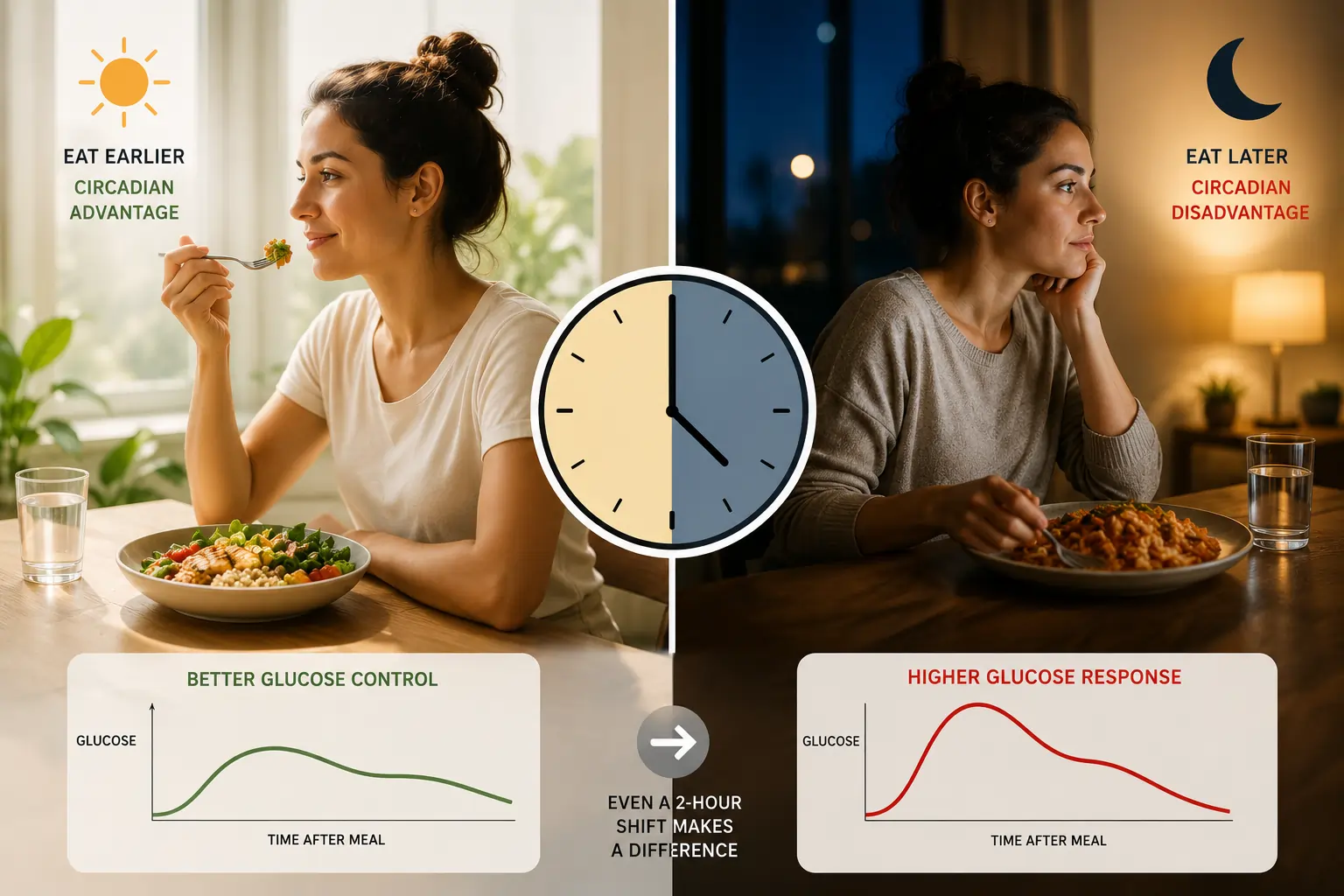
Human metabolism is regulated by circadian rhythms — the internal biological clock that coordinates physiological processes with the light-dark cycle. Insulin sensitivity, glucose tolerance, and thermogenic response to food are all higher in the morning and lower in the evening, following the natural cortisol curve. Eating the same meal earlier in the day produces a smaller glucose response, requires less insulin, and produces less fat storage than eating it later in the day.
The Sutton 2018 study mentioned above used an early eating window (8am to 2pm) specifically to align the eating window with peak insulin sensitivity. This study produced metabolic improvements even without weight loss. Later research has confirmed that early-restricted eating windows consistently produce better metabolic outcomes than late-restricted windows at the same eating window duration. This connects directly to what the research shows about chronotypes and your body's natural metabolic timing.
| Eating window timing | Circadian alignment | Research findings | Practical consideration |
|---|---|---|---|
| Early (6am–2pm or 8am–4pm) | Aligned with morning insulin sensitivity peak and cortisol high | Best metabolic outcomes; significant improvements in insulin sensitivity, blood pressure, and fasting glucose even without weight loss | Conflicts with social and work life for most people; very difficult to sustain long-term |
| Midday (10am–6pm or noon–8pm) | Partial alignment; captures some morning metabolic advantage | Moderate metabolic outcomes; better than late window; the most commonly studied standard 16:8 protocol | The most commonly practiced and most sustainable for most schedules; a reasonable compromise |
| Late (2pm–10pm or later) | Misaligned with circadian biology; peak eating during low-insulin-sensitivity evening window | Poorer metabolic outcomes than early or midday windows; may worsen insulin sensitivity over time despite caloric restriction | Most common spontaneous IF pattern (skip breakfast, eat from lunch through evening); metabolically the least favourable timing |
The practical implication: if metabolic health improvement is the primary goal of IF, shifting the eating window earlier in the day — even partially, from a 1pm–9pm window to a 10am–6pm window — is likely to produce better outcomes than focusing only on the window duration. Late-evening eating is specifically unfavourable and should be minimised regardless of the IF protocol being followed. This eating-window-position question is really a specific case of a broader one — whether meal timing matters for fat loss looks at the same research question for people who aren't necessarily fasting at all.
What Intermittent Fasting Does Not Do
The positive claims for IF in popular culture are extensive enough that it is worth being equally explicit about what the evidence does not support.
- IF does not produce fat loss independent of calorie balance. Weight loss from IF occurs because IF reduces calorie intake, not because fasting timing has metabolic magic. A person eating at their TDEE during an 8-hour window will not lose weight. Use the TDEE calculator to understand your baseline before adjusting for IF. And note that the same metabolic adaptation that undermines aggressive calorie restriction also applies within IF — a bigger deficit still doesn't mean faster results.
- IF does not prevent muscle loss on its own. Without adequate protein distribution and resistance training, IF can produce muscle loss alongside fat loss. The muscle preservation requires deliberate management within the eating window, not the fasting itself.
- IF does not cure insulin resistance. It improves insulin sensitivity markers in people with metabolic dysfunction, but it is not a medical treatment for type 2 diabetes or metabolic syndrome. Significant metabolic disease requires clinical management.
- IF does not dramatically increase autophagy in the way popular claims suggest. Autophagy does increase with fasting, but the human evidence for the magnitude and health relevance of autophagy induction from standard IF protocols is substantially weaker than popular presentations imply.
- IF does not extend human lifespan. Animal lifespan extension data does not translate directly to human longevity claims. No human clinical data demonstrates lifespan extension from IF.
- IF is not universally superior to other eating patterns. It is one tool among several. For people who find it natural and sustainable, it has real benefits. For people who find it unsustainable, who struggle to meet protein requirements in a compressed window, who have eating disorder history, or who are pregnant, it is not the right tool.
Who IF Works Well For — and Who Should Be Cautious
IF tends to work well for
- People who are not hungry in the morning and find breakfast a forced routine rather than a genuine appetite response. Skipping breakfast and eating from midday is a natural 16-hour fast that requires no deliberate effort for these people.
- People who find it easier to control eating during defined windows than to manage portion sizes throughout the day. The structural constraint reduces the decision points around food.
- People with insulin resistance, prediabetes, or metabolic syndrome who are not managing these conditions with insulin or medications that carry hypoglycaemia risk. The insulin-sensitising effects are most pronounced and most relevant in this group.
- People who eat fewer, larger meals naturally and find the compressed window format more aligned with their natural eating rhythm than multiple smaller meals.
- People who have tried continuous caloric restriction and found the ongoing daily restriction psychologically difficult; the defined fasting window provides a clearer boundary.
People who should be cautious or avoid IF
- People with a history of disordered eating or eating disorders. The restriction framework and the focus on not eating for defined periods can activate or worsen disordered eating patterns. Discuss with a qualified clinician before attempting any structured fasting protocol.
- Pregnant and breastfeeding women. Caloric restriction and nutrient timing manipulation are not appropriate during pregnancy or breastfeeding.
- People managing diabetes with insulin or sulphonylureas. Fasting changes insulin requirements and hypoglycaemia risk in complex ways. Any change to eating pattern requires medical supervision when insulin or hypoglycaemia-inducing medications are involved.
- People with a history of hypoglycaemia. Fasting extends the period of low blood glucose and can trigger hypoglycaemic episodes in susceptible individuals.
- People who find fasting increases food preoccupation or anxiety. For some people, fasting windows increase rather than decrease thinking about food. If IF is making you more anxious about food rather than less, it is not the right tool for you.
A Practical Approach to IF: What to Focus On
For people who want to try intermittent fasting as a nutritional structure, the following priorities produce better outcomes than simply picking a fasting window and hoping for the best.
- 1 Protein distribution within the eating window is the priority. The most common failure mode in IF — and the one with the worst consequences for body composition — is inadequate protein intake compressed into too few or too small meals within the eating window. In a typical 16:8 protocol with two or three meals in the eating window, meeting the protein target and distributing it at adequate doses per meal is both achievable and necessary. A rule of thumb: plan the protein content of each meal within the eating window before planning anything else. The protein per meal distribution guide covers the specific thresholds.
- 2 Shift the window earlier if metabolic outcomes matter. If the goal is metabolic health improvement rather than purely a structure for reducing calorie intake, positioning the eating window to begin earlier in the day produces better outcomes than a late window. Even shifting from a 12pm–8pm window to a 10am–6pm window captures more of the morning insulin sensitivity advantage.
- 3 Match the protocol to your schedule, not the other way around. The most effective IF protocol is the one that is actually sustainable within your specific social and work schedule. A 16:8 protocol that requires you to skip dinner with your family every night is not sustainable and therefore not effective. A 14:10 protocol that aligns naturally with when you are actually hungry is more effective than a theoretically superior 16:8 that creates daily friction.
- 4 Do not use IF as a reason to reduce protein or ignore food quality. IF is a structure for when to eat. It says nothing about what to eat during the eating window. A compressed eating window does not automatically produce better nutrition. Nutritional quality principles — protein anchors at each meal, minimally processed whole foods, adequate vegetables and fibre — apply within an IF framework exactly as they would outside one. The balanced plate guide and a Sunday meal prep system work naturally within any eating window.
What the Research Does Not Know Yet
A fair assessment of the IF evidence must acknowledge its limitations. Several significant questions remain genuinely open:
- Long-term effects beyond one to two years are not well-studied. Most IF research is shorter than twelve months. Whether the metabolic benefits persist, attenuate, or reverse over longer periods with sustained IF is not established.
- Individual variation in response is large and poorly characterised. Some people respond strongly to IF with significant metabolic improvement; others show minimal response or adverse effects. The factors that predict individual response are not yet identified well enough to personalise IF protocols reliably.
- Sex differences are under-researched. Much early IF research was conducted primarily in men. Evidence on how IF affects women differently — particularly around menstrual cycle disruption, fertility, and hormonal patterns — is emerging but not yet comprehensive.
- The gut microbiome effects are preliminary. IF appears to alter gut microbiome composition, and there is growing interest in whether these changes mediate some of the metabolic benefits. The field is early and specific mechanisms are not established.
- The optimal protocol for specific populations is unresolved. Different IF protocols have different effects, and which protocol is optimal for which population (older adults, athletes, people with specific metabolic conditions) is not yet established from controlled research.
The Evidence, Honestly
Intermittent fasting has a legitimate evidence base for several meaningful effects: reduction in calorie intake for people who find compressed eating windows easier to manage than continuous restriction; improvements in insulin sensitivity and metabolic health markers, potentially independent of weight loss when the window is well-timed; modest growth hormone elevation during fasting windows; and autophagy induction of uncertain magnitude and health relevance in humans.
It does not have a legitimate evidence base for: superior fat loss compared to equivalent caloric restriction; dramatic autophagy benefits extending to cancer prevention and lifespan extension; universal muscle preservation; or broad applicability across all populations regardless of health status, eating history, or schedule.
IF is a valid nutritional tool with meaningful and specific benefits for the right person using it in the right way. It is not a metabolic revolution, a cure for chronic disease, or a superior way of eating that everyone should adopt. It is a structure that works well for some people and not for others, that produces outcomes through mechanisms that are mostly well-understood, and that should be evaluated against the individual's specific goals, schedule, and physiology rather than as an ideology to adopt or a trend to dismiss.
If you want to place IF within a full, coherent nutrition framework — what to eat, how much, how to build meals that work for protein, satiety, and food quality — the Eat With Intent course covers all of it in sequence. Free, no sign-up, structured to be actionable regardless of whether you are doing IF or not.