
Most people who count calories are counting the wrong thing. Not wrong in the sense that their food logging is inaccurate — though it often is — but wrong in the more fundamental sense that they are measuring an input without any reliable reference for what the output is. They know, roughly, how many calories they ate today. They do not know how many calories their body actually used.
Counting calories without knowing your Total Daily Energy Expenditure is like tracking how much money you spend without knowing how much you earn. You can record every transaction precisely and still have no idea whether you are building savings or running a deficit. The record is accurate; the interpretation is impossible without the reference point. This is the core problem that explains why calorie counting so often stops working after an initially promising start.
TDEE — Total Daily Energy Expenditure — is that reference point. It is the total number of calories your body burns across a full day, accounting for everything: the energy your body uses at rest to sustain basic physiological functions, the energy cost of digesting food, and the energy expended through all forms of physical activity from a dedicated workout to simply staying upright and alert.
Understanding TDEE does not require obsessive tracking or a laboratory. It requires understanding the four components that make it up, how each one can be estimated, and crucially, why the number is not fixed — why it changes in response to changes in your body, your diet, and your activity level in ways that explain why calorie-based approaches so frequently stop working after initial progress.
What TDEE Is: The Four Components
Total Daily Energy Expenditure is the sum of four distinct components, each of which accounts for a different type of energy use. These components do not operate independently — they interact with each other in ways that matter practically — but understanding them separately is the prerequisite for understanding why TDEE varies and how to estimate it accurately.
1. Basal Metabolic Rate (BMR)
Basal Metabolic Rate is the energy your body requires to sustain basic physiological functions while completely at rest: breathing, circulating blood, maintaining body temperature, cellular repair, hormone production, organ function. It is the energy cost of being alive and doing nothing else.
BMR accounts for approximately 60 to 75 percent of total daily energy expenditure for sedentary to lightly active people. It is the largest single component and the one most influenced by body composition. Lean mass — muscle, bone, and organ tissue — is metabolically more active than fat mass, meaning it burns more calories at rest. A person with more lean mass has a higher BMR at the same bodyweight than someone with less lean mass. This is one of the primary physiological reasons why resistance training supports fat loss and weight management over the long term even when measured calorie burn during a session is modest.
BMR is estimated using predictive equations based on height, weight, age, and sex. The most widely validated equations are the Mifflin-St Jeor equation (generally considered most accurate for the general population) and the Harris-Benedict equation (older, slightly less accurate for modern populations).
| Equation | Formula (metric) | Accuracy notes |
|---|---|---|
| Mifflin-St Jeor (recommended) | Men: (10 × weight kg) + (6.25 × height cm) – (5 × age) + 5 Women: (10 × weight kg) + (6.25 × height cm) – (5 × age) – 161 |
Most accurate for general population; validated in multiple studies; recommended as the default starting point |
| Harris-Benedict (revised) | Men: (13.397 × weight kg) + (4.799 × height cm) – (5.677 × age) + 88.362 Women: (9.247 × weight kg) + (3.098 × height cm) – (4.330 × age) + 447.593 |
Slightly less accurate than Mifflin-St Jeor for modern populations; still widely used |
| Katch-McArdle | BMR = 370 + (21.6 × lean body mass kg) | Most accurate for people who know their body fat percentage; accounts for body composition rather than total weight |
2. Thermic Effect of Food (TEF)
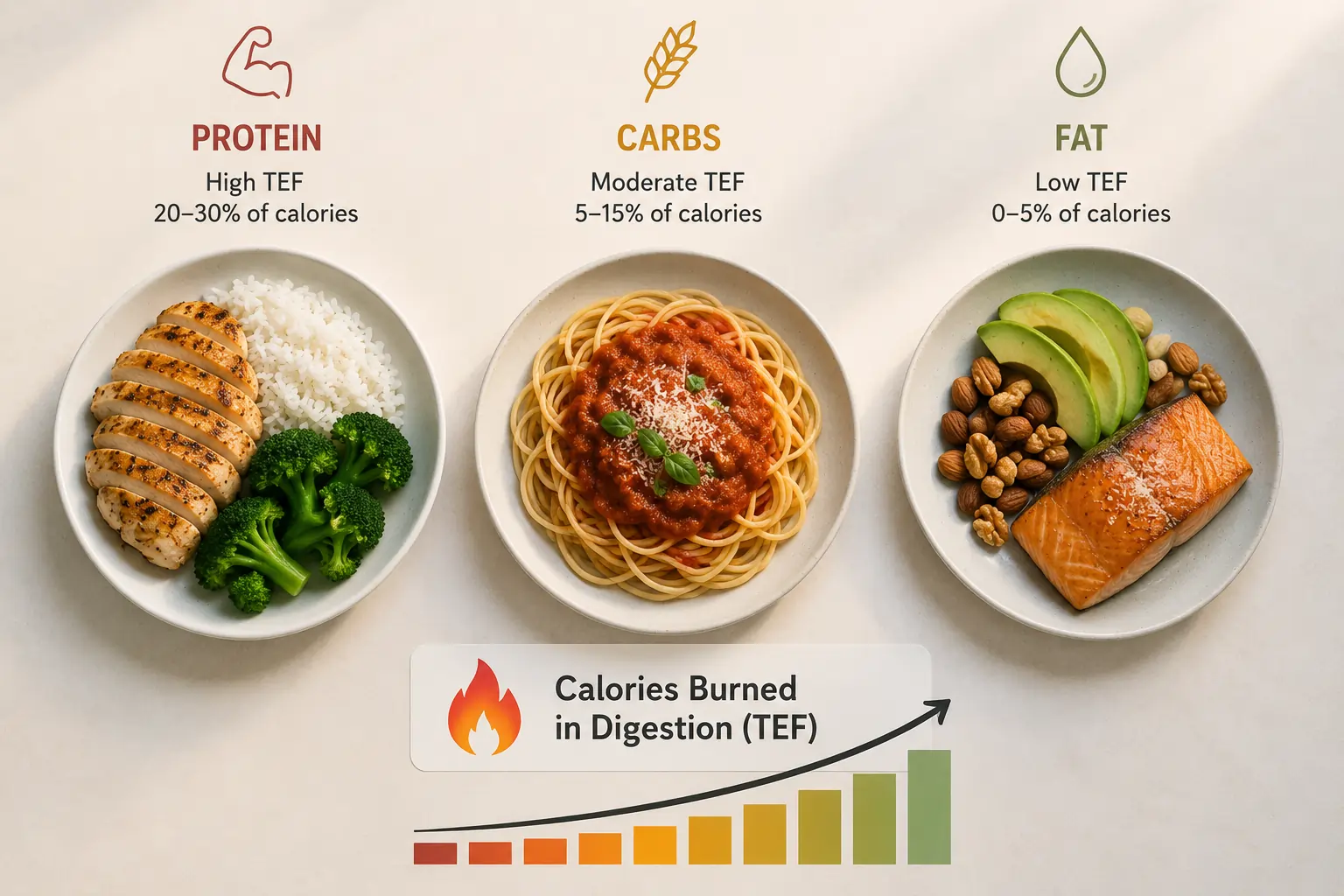
The Thermic Effect of Food is the energy your body expends processing and digesting what you eat. Digestion, absorption, and the metabolic processing of nutrients are not passive activities — they require energy, and the amount of energy required varies significantly by macronutrient.
Protein has the highest thermic effect: approximately 20 to 30 percent of the calories in protein are used in the process of digesting and metabolising it. Carbohydrates sit at approximately 5 to 10 percent. Fat has the lowest thermic effect at 0 to 3 percent. These figures mean that a 500-calorie meal of mostly protein produces a meaningfully different net caloric impact than a 500-calorie meal of mostly fat — one of the key reasons why adequate daily protein supports fat loss in multiple simultaneous ways.
TEF accounts for approximately 8 to 15 percent of total daily energy expenditure for most people eating a mixed diet. It is the smallest component of TDEE and the most consistent — it does not fluctuate as dramatically as activity-related expenditure.
| Macronutrient | Thermic effect | Practical implication |
|---|---|---|
| Protein | 20–30% of calories consumed | 100 kcal of protein has a net impact of ~70–80 kcal after thermic cost; highest satiety per calorie |
| Carbohydrate | 5–10% of calories consumed | 100 kcal of carbohydrate has a net impact of ~90–95 kcal; fibre-rich carbohydrates at the higher end of thermic cost |
| Fat | 0–3% of calories consumed | 100 kcal of fat has a net impact of ~97–100 kcal; almost no energy cost to digest |
| Alcohol | ~20% of calories consumed | Relatively high thermic effect but not a desirable macronutrient; metabolised preferentially over other fuels |
3. Non-Exercise Activity Thermogenesis (NEAT)
Non-Exercise Activity Thermogenesis is the energy expended by all physical activity that is not structured exercise: walking, standing, fidgeting, posture maintenance, carrying objects, domestic tasks, occupational activity, and every other form of incidental movement. NEAT is the component of energy expenditure with the most variability between individuals — it can differ by as much as 2,000 kilocalories per day between a naturally active and a naturally sedentary person of the same size.
NEAT also varies significantly within the same individual across different periods. A person in a desk-based office job burns far fewer calories through NEAT than the same person in a job involving standing, walking, and physical tasks. Building daily movement habits — even small ones like a consistent morning movement practice — is one of the highest-return interventions for total daily energy expenditure precisely because NEAT is so malleable and compounds across every hour of the day.
NEAT is also sensitive to calorie deficit in an important way: when calories drop significantly, NEAT tends to fall involuntarily. People fidget less, walk slightly slower, sit rather than stand, and reduce incidental movement without any conscious decision to do so. This is part of the metabolic adaptation picture described in the section below.
4. Exercise Activity Thermogenesis (EAT)
Exercise Activity Thermogenesis is the energy expended during deliberate structured exercise: gym sessions, runs, classes, sport. It is the component most people focus on when thinking about energy expenditure, but it is typically the smallest component of TDEE for most non-athletes.
For a person doing three to four moderate-intensity exercise sessions per week, EAT accounts for approximately 5 to 15 percent of total daily energy expenditure. This modest contribution explains why exercise alone, without dietary adjustment, produces relatively small weight loss outcomes — the energy expended in exercise is real but limited relative to total daily expenditure. The more significant role of exercise for body composition is indirect: its effect on lean mass (and therefore BMR), the brief EPOC effect after intense training, and its influence on appetite regulation and hormonal environment.
For a comparison of how different cardio modalities affect overall energy expenditure and body composition, running versus cycling for fat loss covers the practical differences in a format you can act on.
| TDEE component | % of TDEE (sedentary) | % of TDEE (active) | Primary drivers |
|---|---|---|---|
| BMR | 60–75% | 50–65% | Lean mass, age, sex, genetics |
| TEF | 8–15% | 8–15% | Total calorie intake, macronutrient composition, fibre content |
| NEAT | 15–30% | 20–35% | Occupation, daily movement habits, fidgeting tendency, environment |
| EAT | 3–8% | 10–20% | Exercise frequency, type, intensity, and duration |
How to Calculate Your TDEE
TDEE is estimated rather than measured for most people. Direct measurement requires metabolic testing in a clinical or laboratory setting. The practical approach is to calculate BMR using the Mifflin-St Jeor equation and then multiply by an activity factor that accounts for NEAT and EAT combined.
Step 1: Calculate BMR
Using the Mifflin-St Jeor equation. An example for a 30-year-old woman, 65 kg, 165 cm:
BMR = 650 + 1,031.25 – 150 – 161 = 1,370 kcal/day
And for a 30-year-old man, 80 kg, 178 cm:
BMR = 800 + 1,112.5 – 150 + 5 = 1,768 kcal/day
Step 2: Apply the Activity Multiplier
The activity multiplier accounts for all physical activity above complete rest, combining both NEAT and EAT into a single factor:
| Activity level | Multiplier | Description | Examples |
|---|---|---|---|
| Sedentary | BMR × 1.2 | Little or no exercise; desk job; minimal daily movement | Office worker who drives to work, takes lifts, exercises rarely |
| Lightly active | BMR × 1.375 | Light exercise 1–3 days per week; some daily walking | Office worker who walks 20–30 min daily and exercises once or twice a week |
| Moderately active | BMR × 1.55 | Moderate exercise 3–5 days per week; active job or lifestyle | Person doing 3–4 gym sessions per week with a moderately active daily routine |
| Very active | BMR × 1.725 | Hard exercise 6–7 days per week; physically active job | Person training daily or doing physically demanding work |
| Extremely active | BMR × 1.9 | Very hard daily exercise; physically demanding job; twice-daily training | Athletes in intensive training or manual labour combined with daily training |
Continuing the examples: for the 30-year-old woman at 1,370 kcal BMR who is moderately active, TDEE = 1,370 × 1.55 = 2,124 kcal/day. For the 30-year-old man at 1,768 kcal BMR who is lightly active, TDEE = 1,768 × 1.375 = 2,431 kcal/day.
These figures represent the estimated calorie intake at which these individuals maintain their current bodyweight. Eating below this number produces a calorie deficit; eating above it produces a surplus. Without this reference point, any calorie target is essentially arbitrary. Some people use a structural tool like intermittent fasting to reduce their intake below TDEE naturally — the eating window limits opportunity to eat, rather than requiring conscious calorie arithmetic.
Why TDEE Is Not a Fixed Number
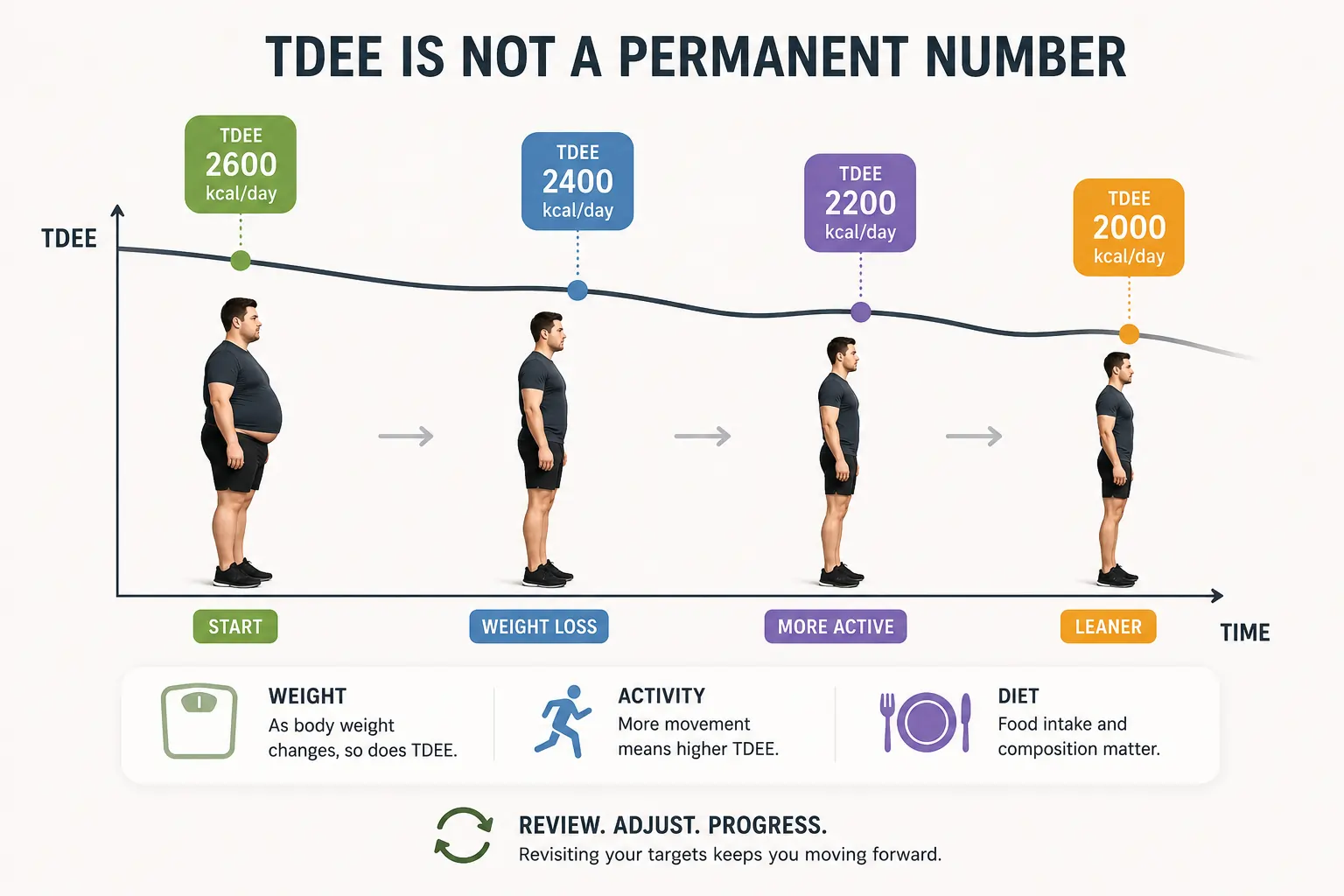
The most important thing to understand about TDEE is that it is not static. It changes in response to changes in body composition, changes in calorie intake, changes in activity level, and the normal progression of age. This dynamic nature is the primary reason why calorie-based approaches that worked initially stop working — and why "1,200 calories doesn't seem to do anything anymore" is such a common experience.
Metabolic adaptation: the body's response to a sustained deficit
When calorie intake is reduced below TDEE and the deficit is sustained for weeks or months, the body initiates a suite of adaptations that reduce energy expenditure in response to the perceived reduction in energy availability. This is metabolic adaptation, sometimes called adaptive thermogenesis, and it operates across multiple pathways simultaneously. The full mechanism — including NEAT suppression, hormonal changes, and why aggressive deficits produce worse long-term results than moderate ones — is covered in detail in why a bigger calorie deficit doesn't mean faster fat loss.
BMR falls as body mass reduces — this is expected and accounted for in the standard calculation — but it falls by more than the change in body mass would predict. Research consistently shows that prolonged caloric restriction produces a reduction in metabolic rate beyond what weight loss alone explains. NEAT falls, often dramatically: studies by Leibel and colleagues and by Kevin Hall at the NIH have found that NEAT reductions account for a significant fraction of the metabolic adaptation observed during weight loss. People on a sustained calorie deficit become less physically active in ways they are often not aware of. Thermogenic hormones — leptin, thyroid hormones, and sex hormones — all shift in the direction of energy conservation and add further to the reduction.
Why TDEE decreases as you lose weight
TDEE is calculated using current body weight. As body weight falls, BMR falls because there is less metabolic mass to maintain. A person who started at 85 kg and has lost 8 kg has a lower TDEE than when they began, even if their activity level is identical. Calorie targets appropriate for the beginning of a fat loss phase become progressively less appropriate as body weight falls.
This is why fat loss phases require periodic recalculation of TDEE and downward adjustment of calorie targets to maintain the same deficit — not because the original targets were wrong, but because the reference point has changed. Most people who experience a plateau after initial fat loss are eating at maintenance for their new weight, not at the deficit they intended.
The activity multiplier problem
NEAT is sensitive to calorie deficit in a way that makes the standard activity multiplier progressively inaccurate during a diet. When TDEE is calculated before a diet begins, the activity multiplier reflects NEAT at that calorie intake. As deficit-driven NEAT suppression occurs, the actual activity level decreases while the calculated multiplier remains the same. This creates a widening overestimate of TDEE over the duration of an extended diet.
The practical consequence: a calculated TDEE does not remain accurate through months of changing conditions. It needs to be recalculated periodically using actual weight-loss data — tracking real outcomes rather than trusting the formula to stay accurate on its own.
Using TDEE Practically: What to Do With the Number
Setting a calorie target
Once TDEE is estimated, calorie targets for different goals are straightforward to set:
| Goal | Calorie target | Expected rate of change | Notes |
|---|---|---|---|
| Fat loss (moderate) | TDEE minus 300–500 kcal/day | 0.3–0.5 kg per week | Sustainable; minimises muscle loss and metabolic adaptation; recommended for most people |
| Fat loss (aggressive) | TDEE minus 500–750 kcal/day | 0.5–0.75 kg per week | Higher muscle loss risk; greater metabolic adaptation; appropriate for short phases with diet breaks |
| Maintenance | At TDEE | Weight stable | Used during diet breaks, recomposition phases, and periods of consolidation |
| Muscle gain (lean bulk) | TDEE plus 200–300 kcal/day | 0.1–0.2 kg per week | Minimises fat accumulation alongside muscle gain; requires adequate protein and consistent training |
| Muscle gain (aggressive bulk) | TDEE plus 400–500 kcal/day | 0.25–0.5 kg per week | Faster potential but higher fat gain; more appropriate for experienced trainees |
The real-world validation method
Calculated TDEE is an estimate. The most accurate TDEE is one derived from real-world data rather than from a formula. The practical method:
- 1Track your actual calorie intake accurately for two full weeks while eating at what you believe to be your maintenance level.
- 2Weigh yourself at the same time each morning (after toilet, before eating) and average the readings across each week.
- 3If your weight was stable across the two weeks, your actual calorie intake was approximately equal to your actual TDEE.
- 4If your weight fell, your intake was below TDEE. If it rose, it was above.
- 5Use this real-world maintenance level as your actual TDEE for subsequent calorie setting, and recalculate when circumstances change significantly.
Recalculating regularly
TDEE should be recalculated when body weight changes significantly (every 4 to 5 kg during a fat loss or gain phase), when activity level changes substantially (new job, new training programme, season change), after extended diet breaks or refeeds, and whenever progress stalls unexpectedly. The formula is a starting estimate; the real-world tracking approach provides the ground truth.
The Four Most Common TDEE-Related Mistakes
Mistake 1: Using a generic 1,200 or 1,500 calorie target
Generic calorie targets — "1,200 calories for women," "1,500 for men," or whatever figure appears on an app's default setting — are not calibrated to any individual's TDEE. For a tall, active man with a TDEE of 3,200 calories, 1,500 calories is an extreme deficit that will produce rapid initial loss followed by severe metabolic adaptation. For a petite, sedentary woman with a TDEE of 1,600 calories, 1,200 calories is a moderate deficit that will work. The same number applied to two very different individuals produces two very different physiological responses.
A calorie target without a TDEE estimate is not a deficit. It is a number. Numbers without context are not nutritional guidance. This is why understanding how to build a balanced plate without a food scale matters — it gives you structure that is calibrated to portion logic rather than generic targets.
Mistake 2: Not adjusting as weight changes
The most common reason fat loss plateaus is that the calorie target was appropriate for the starting weight but has not been adjusted as weight fell. A deficit of 500 calories at 85 kg may be at maintenance when the same person is at 75 kg, because both BMR and NEAT have fallen. Regular recalculation — or real-world validation tracking — prevents the target from drifting into maintenance territory without the person realising.
Mistake 3: Overestimating exercise calorie burn
Gym equipment calorie counters, fitness trackers, and exercise app estimates consistently overestimate the calorie burn of exercise sessions, often by 20 to 50 percent. The most common consequence is "eating back" exercise calories based on an inflated estimate, effectively eating at or above maintenance while believing a deficit is being maintained. TDEE calculation with an activity multiplier already accounts for exercise; tracking exercise separately and adding those calories to a TDEE-based target double-counts exercise expenditure.
Mistake 4: Treating TDEE as a ceiling rather than a reference
TDEE is the estimated break-even point for body weight maintenance. It is a reference, not a maximum. Eating at TDEE is maintenance. Eating below it by a moderate amount produces fat loss. Eating above it produces mass gain. Treating it as a ceiling that must not be exceeded is a framing error that creates the same all-or-nothing dynamic as generic calorie counting — and leads to the same cycle of unsustainable restriction followed by abandonment. Understanding your TDEE is the foundation of why protein distribution across meals matters more than daily totals for body composition.
Worked Examples: TDEE Across Different Profiles
| Profile | BMR (Mifflin-St Jeor) | Activity level | Est. TDEE | Moderate fat loss target |
|---|---|---|---|---|
| 28F, 58 kg, 162 cm, sedentary office job, no exercise | 1,285 kcal | Sedentary (×1.2) | 1,542 kcal | 1,042–1,242 kcal |
| 28F, 58 kg, 162 cm, 3 gym sessions/week, active commute | 1,285 kcal | Moderately active (×1.55) | 1,992 kcal | 1,492–1,692 kcal |
| 35M, 80 kg, 178 cm, desk job, light exercise twice/week | 1,820 kcal | Lightly active (×1.375) | 2,503 kcal | 2,003–2,203 kcal |
| 35M, 80 kg, 178 cm, 5 training sessions/week, active job | 1,820 kcal | Very active (×1.725) | 3,140 kcal | 2,640–2,840 kcal |
| 45F, 72 kg, 160 cm, lightly active, some walking | 1,384 kcal | Lightly active (×1.375) | 1,903 kcal | 1,403–1,603 kcal |
| 45M, 90 kg, 175 cm, moderately active, 3–4 sessions/week | 1,918 kcal | Moderately active (×1.55) | 2,973 kcal | 2,473–2,673 kcal |
The worked examples illustrate the scale of variation in TDEE across different individuals. The sedentary 28-year-old woman and the very active 35-year-old man have TDEEs that differ by more than 1,500 calories per day. A single generic calorie target applied to both would be either dangerously low for one or would produce no deficit for the other. TDEE is not a detail. It is the frame without which calorie counting has no interpretable meaning.
TDEE and the Intent-Based Eating Framework
Understanding TDEE does not require counting every calorie you eat. It requires having enough information about your energy balance to make informed decisions rather than guessing. There is a middle ground between obsessive daily tracking and complete ignorance of your energy balance, and TDEE provides the framework for occupying it.
Knowing your approximate TDEE tells you what your maintenance looks like in food terms. If your TDEE is 2,200 calories, you know roughly what a maintenance day of eating looks like for your body, and you can judge whether any given period of eating is likely to produce maintenance, a deficit, or a surplus without logging every gram. The nutritional literacy that builds from a period of accurate tracking against a known TDEE is more durable and more useful than the tracking itself.
This is also why the intent-based eating approach — building meals around protein anchors, using the hand-measure system, making deliberate food choices without arithmetic surveillance — works best when it is preceded by an accurate TDEE estimate. The intent can only be well-calibrated if the person has a clear understanding of their energy balance. TDEE provides that understanding. It does not have to be maintained forever through daily tracking; once internalised, it becomes a reference that improves the quality of intuitive food decisions without requiring ongoing effort.
The Number You Need Before Any Other Number
Macros, calorie targets, deficit sizes, meal timing — all of these are secondary to TDEE. They only have meaning relative to the energy output they are being compared against. Setting a calorie target without a TDEE estimate is not a nutritional strategy. It is a guess dressed as a strategy, which is why so many people experience initial progress followed by bewildering plateaus, or count meticulously for months without the results the counting should mathematically produce.
TDEE is not a fixed answer. It changes as body weight changes, as activity level changes, as the diet itself changes the body's energy expenditure through metabolic adaptation. This is not a reason to abandon it as a reference — it is a reason to update it periodically and to understand that the absence of expected progress is usually a sign that the reference needs recalculating rather than that the approach is fundamentally wrong.
Calculate your BMR. Apply an honest activity multiplier. Validate with two weeks of real-world tracking at what you believe is maintenance. Update when significant changes occur. Use this number as the anchor for any calorie-based decision you make about your diet. Without it, you are managing your energy balance by feel in a domain where feel is consistently unreliable. With it, you have a genuine framework — imperfect, subject to revision, but grounded in the actual biology of how your body uses energy.
If you want to build this understanding into a full eating framework, the Eat With Intent course covers energy balance, protein targets, balanced eating without obsessive tracking, and practical meal planning — free, no sign-up required.
Once you have your TDEE, the natural next step is learning how to apply it across different goals — fat loss, muscle gain, maintenance, and recomposition. The companion piece how to actually use your TDEE covers deficit and surplus sizing, protein floors, diet breaks, and when to recalibrate — including a practical planner tool.