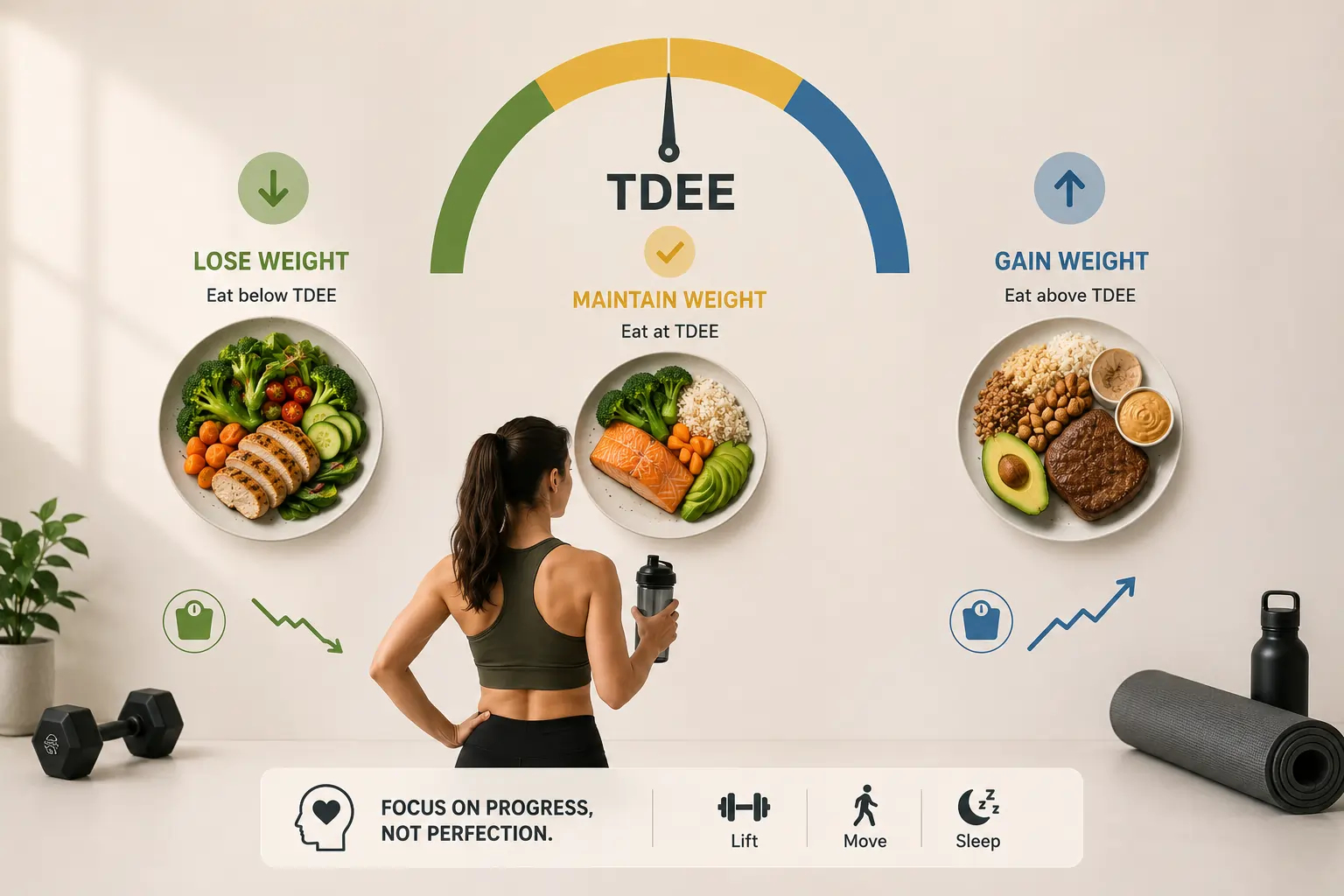
Most people who calculate their TDEE do one of two things with the number: they either start logging every calorie against it with an obsessiveness that is unsustainable, or they glance at it, feel vaguely informed, and change nothing. The number becomes either a source of anxiety or a forgotten data point. Neither outcome was the goal.
TDEE — Total Daily Energy Expenditure — is not a tracking target. It is a reference point. It tells you what your body uses each day so that you can orient your food choices around that reference without needing to measure every gram. The person who knows their TDEE is 2,300 calories and builds meals with a general sense of what 1,800 to 2,000 calories looks like in food terms is in a fundamentally different nutritional position from the person who has no reference and is simply hoping their choices are adding up to something useful.
This article is the practical layer on top of the TDEE foundation: how to translate a TDEE number into a working approach for each of the three main goals — fat loss, muscle gain, and maintenance — without turning food into an anxious daily accounting exercise. The goal is nutritional literacy that informs decisions rather than surveillance that controls them.
Before the Application: Knowing Your Number
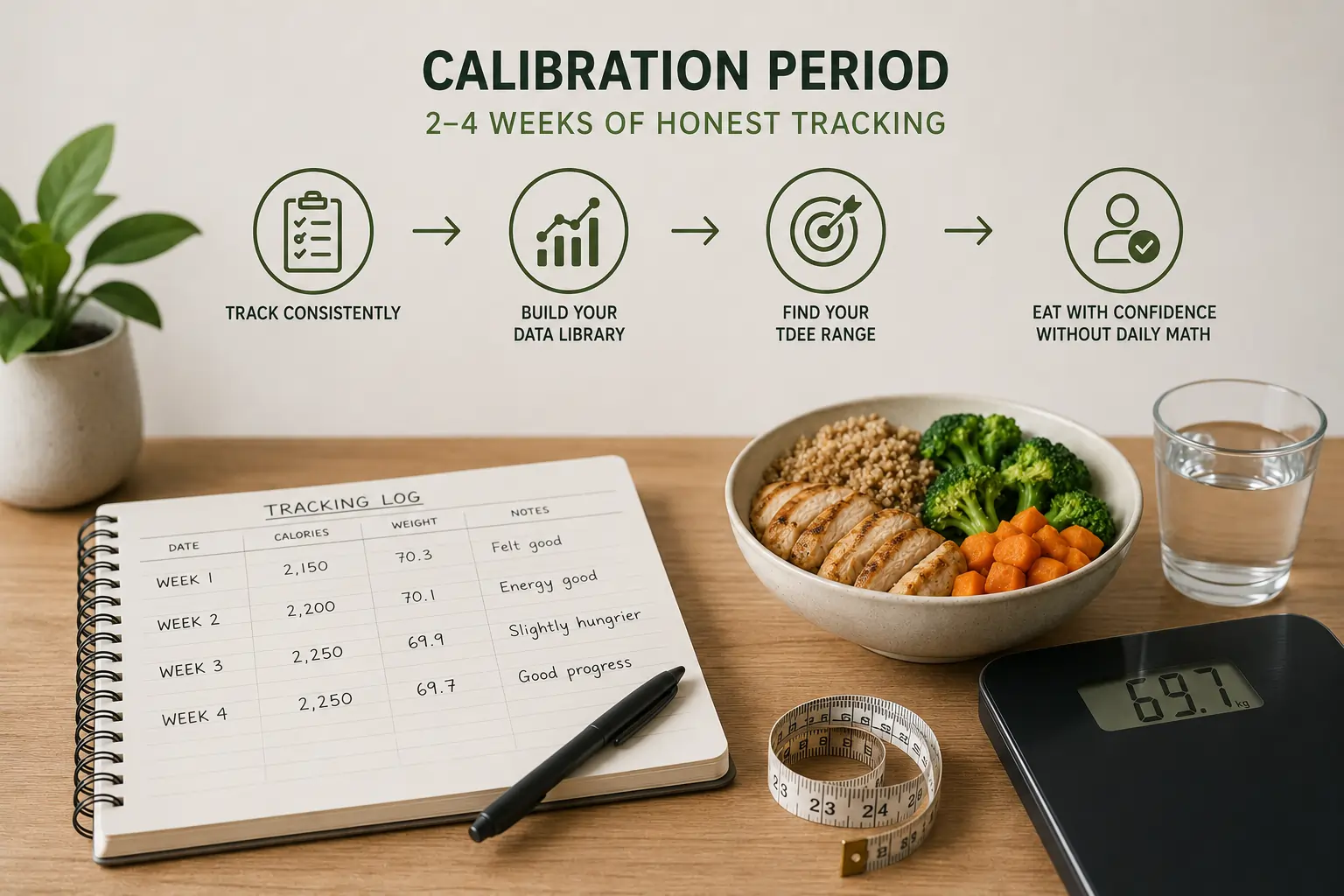
This article assumes you have estimated your TDEE using either the Mifflin-St Jeor equation with an activity multiplier, or the real-world validation method (two weeks tracking at perceived maintenance, scale stable = TDEE found). If you have not done this, the practical application below is guesswork rather than informed decision-making. The calculation is covered in full in the TDEE explainer. You can also use the TDEE calculator to get your estimate quickly.
For reference: most moderately active adults in the 25 to 45 age range have TDEEs between approximately 1,800 and 2,800 calories per day depending on size, sex, body composition, and actual activity level. The spread is large enough that using anyone else's TDEE as your reference — a friend's, a generic internet target, an app default — is not useful. You need your number.
Goal 1: Fat Loss — Using TDEE to Build a Sustainable Deficit
Fat LossFat loss requires a calorie deficit: eating less than your TDEE so that the body draws on stored energy (primarily fat) to make up the shortfall. The size of the deficit determines the rate of loss and the degree of physiological adaptation it triggers. Both matter for sustainable outcomes.
Choosing the right deficit size
The evidence on deficit sizing consistently points to a moderate deficit — 300 to 500 calories below TDEE — as the range that produces meaningful fat loss while minimising the three main costs of aggressive restriction: muscle loss, metabolic adaptation, and psychological unsustainability. The full case for why a bigger calorie deficit doesn't mean faster fat loss is worth reading before choosing an aggressive approach.
| Deficit size | Expected weekly loss | Trade-offs | Best suited for |
|---|---|---|---|
| Small (150–250 kcal/day) | 0.1–0.2 kg/week | Very slow progress; minimal metabolic adaptation; sustainable indefinitely | Last 5 kg; gradual approach; busy lifestyle with limited bandwidth for dietary change |
| Moderate (300–500 kcal/day) | 0.3–0.5 kg/week | Meaningful progress without aggressive restriction; low metabolic adaptation risk; preserves most muscle with adequate protein | Most people; most goals; the default recommendation |
| Aggressive (500–750 kcal/day) | 0.5–0.75 kg/week | Faster initial progress; higher muscle loss risk; greater metabolic adaptation; harder to sustain; requires diet breaks | Short-term phases with defined end dates; specific event preparation; not a long-term strategy |
| Extreme (750+ kcal/day) | 0.75+ kg/week | Rapid initial loss; significant muscle loss; severe metabolic adaptation; high abandonment rate | Rarely appropriate; clinical obesity with health urgency; requires professional oversight |
What a 300–500 calorie deficit looks like in food
A 400-calorie daily deficit does not require dramatic restriction. In food terms, it is approximately:
- One fewer large restaurant meal per week, distributed across daily eating
- Replacing one daily full-sugar drink (cola, sweetened chai, fruit juice) with water or plain chai
- Reducing rice or roti by one serving at two meals per day, with the same protein and vegetable quantities
- Cutting the daily takeaway lunch and replacing it with a home-packed meal of similar volume but higher protein and lower refined carbohydrate
None of these changes require calorie counting. They require knowing what the approximate caloric impact of a food choice is — the nutritional literacy that a period of TDEE-informed tracking builds — and making decisions from that knowledge rather than from daily arithmetic. For help with building balanced meals without a food scale, the balanced plate guide gives a practical, portion-based framework.
The protein floor: non-negotiable during a deficit
The single most important dietary variable during a fat loss phase is protein intake, not calorie restriction. Adequate protein during a deficit preserves lean mass, maintains metabolic rate, maximises satiety per calorie, and produces the thermogenic effect that makes a high-protein diet at the same calorie level more effective for fat loss than a lower-protein one.
The evidence-supported protein target during a fat loss phase is 1.6 to 2.2 grams per kilogram of bodyweight per day, at the higher end for people doing resistance training and the lower end for more sedentary individuals. For a full breakdown of what that looks like across Indian food sources, see how much protein you actually need per day.
The weekly average matters more than the daily number
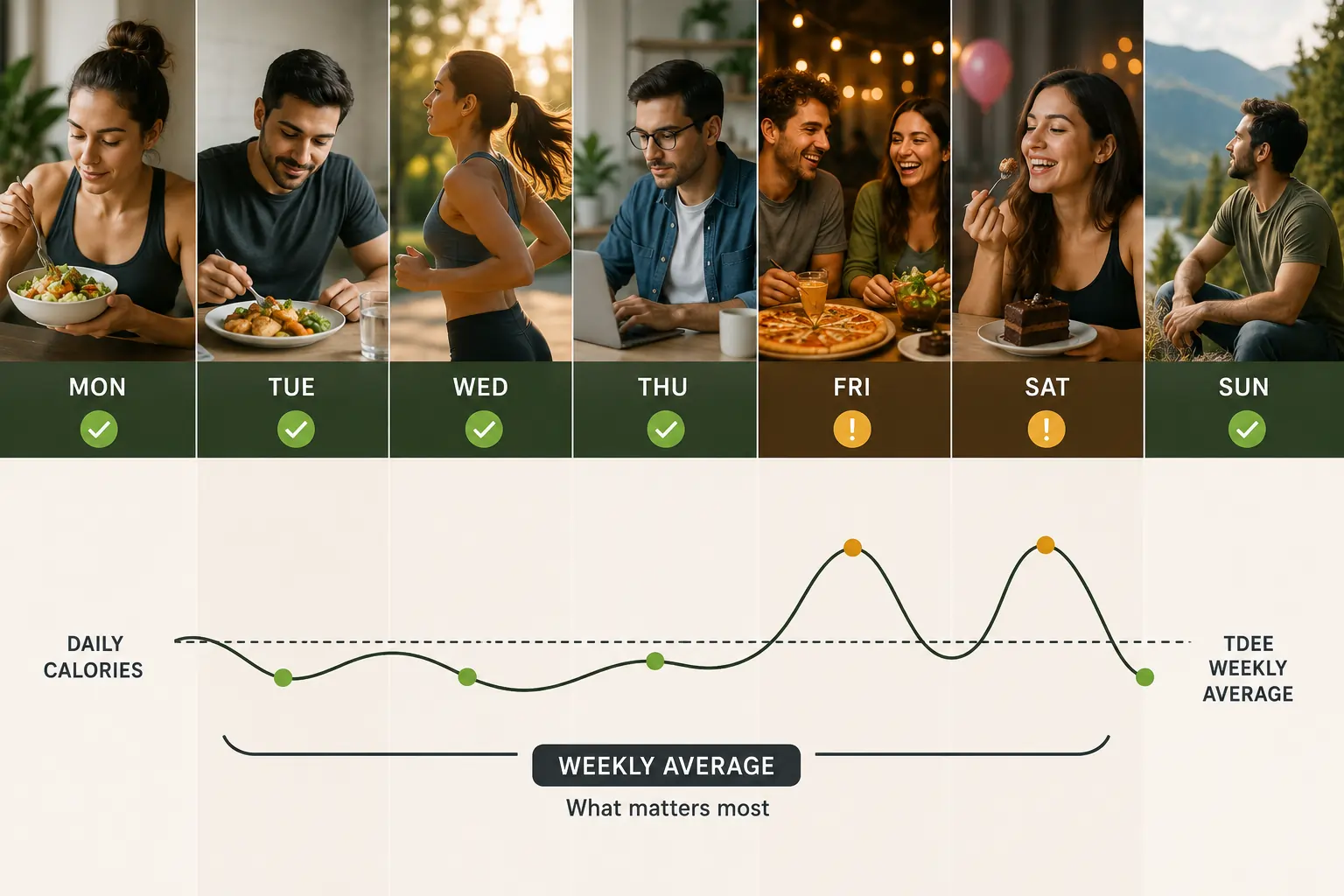
Fat loss is a process measured over weeks, not days. Eating at the target every day is not required — it is the average across the week that determines outcomes. A week where you eat at a 400-calorie deficit on five days and at maintenance on two weekend days produces an average deficit of approximately 285 calories per day, equivalent to approximately 0.25 kg of fat per week. This is meaningful progress without requiring rigid daily adherence.
This weekly framing reduces the all-or-nothing psychological dynamic that daily targets create. A meal over target on a Thursday does not negate the week. It is one data point in a seven-day average. Recovering the average over the remaining days — without swinging to compensatory restriction — is the skill that distinguishes sustainable fat loss from the cycle of restriction and rebound. This is also the core reason why rigid daily calorie counting tends to fail long-term: the system cannot tolerate normal life variation.
Diet breaks: the underused tool for long-term fat loss
A diet break is a planned period of eating at maintenance — at TDEE, not below it — for one to two weeks during an extended fat loss phase. Research, including the MATADOR (Minimising Adaptive Thermogenesis and Deactivating Obesity Rebound) study by Byrne and colleagues,[1] shows that intermittent two-week diet breaks produce similar total fat loss to continuous restriction with significantly less metabolic adaptation.
The practical benefit is that the metabolic adaptation that accumulates during an extended deficit partially reverses during a maintenance period, restoring leptin levels, thyroid function, and NEAT toward their pre-diet baseline. The subsequent deficit phase is more productive because the adapted metabolism has partially reset. Diet breaks also address the psychological cost of extended restriction and significantly reduce abandonment rates.
A simple diet break schedule: after every four to six weeks of deficit, take one to two weeks at maintenance. Expect a small scale increase from glycogen and water replenishment during the break — this is not fat gain and is expected. Return to the deficit after the break with a recalculated TDEE based on current weight.
Goal 2: Muscle Gain — Using TDEE to Build a Productive Surplus
Muscle GainMuscle gain requires energy above TDEE to support the synthesis of new tissue, fuel resistance training, and support the hormonal environment that enables hypertrophy. The surplus size determines both the rate of muscle gain and the proportion of weight gained that is fat rather than lean mass.
The lean surplus: why small is better than large
The rate at which the body can synthesise new muscle tissue is limited by genetics, training experience, hormonal environment, and protein availability — and it is slow. A well-trained natural athlete can gain approximately 0.5 to 1 kg of actual lean mass per month under ideal conditions. A beginner may gain faster in their first six to twelve months. These are the biological ceilings.
Eating in a large surplus does not increase muscle gain beyond the biological ceiling. The energy that cannot be directed toward muscle synthesis is stored as fat. A lean surplus of 200 to 300 calories above TDEE provides enough additional energy to support muscle synthesis without meaningful fat accumulation in most people.
| Surplus size | Expected weekly gain | Composition of gain | Best suited for |
|---|---|---|---|
| Lean (150–250 kcal/day) | 0.1–0.15 kg/week | Predominantly lean mass; minimal fat gain; slow but high-quality progress | Intermediate+ trainees; those wanting minimal fat gain during a build phase |
| Moderate (250–350 kcal/day) | 0.15–0.25 kg/week | Mostly lean mass with some fat gain; good compromise between rate and composition | Most people doing consistent resistance training; beginners who want to track progress more visibly |
| Aggressive (400–600 kcal/day) | 0.25–0.5 kg/week | Mixed lean and fat gain; faster scale progress but requires fat loss phase to reveal | Beginners with lower body fat; hardgainers struggling to eat enough |
Protein during a surplus
Protein requirements during a muscle gain phase are similar to those during a fat loss phase: 1.6 to 2.2 grams per kilogram of bodyweight per day. The distribution across meals matters as much as the total — with a minimum of 25 to 40 grams at each main meal to reliably trigger muscle protein synthesis. This is covered in depth in the protein per meal distribution article.
The common mistake during a muscle gain phase is treating the calorie surplus as a licence to reduce dietary care — eating any available food to hit the number without attention to protein distribution, food quality, or micronutrient adequacy. A lean surplus of 250 calories above TDEE with 2 grams per kilogram of protein distributed across four meals produces better muscle gain and better body composition outcomes than a 500-calorie surplus built from poor food quality and inadequate protein.
Training stimulus is the prerequisite
Eating in a surplus without an adequate training stimulus does not produce muscle gain. The calorie surplus provides the raw material for tissue synthesis; the training stimulus provides the signal to initiate that synthesis. A surplus without progressive resistance training produces fat gain. The surplus is not the driver of muscle gain — it is the enabler. The training is the driver. TDEE-informed eating ensures the enabler is in place; the training programme ensures the driver is operating.
Goal 3: Maintenance — The Underappreciated Goal
MaintenanceMaintenance is the most neglected application of TDEE in the popular nutrition conversation, which is dominated by discussion of fat loss and muscle gain. Maintenance — sustaining a body composition you are satisfied with over the long term, without chronic tracking or periodic dramatic intervention — is actually the end goal of every other phase.
What maintenance eating actually looks like
A person who has done one or two cycles of fat loss or muscle gain phases with proper TDEE tracking has, by the end of those phases, developed a reliable nutritional intuition about what maintenance eating looks like for their body. They know roughly what a day of eating at their TDEE feels like in food terms, how much protein they need at each meal, which foods and meals land them over versus under their energy needs, and how activity level variation across the week affects their appetite and energy balance.
This knowledge does not require ongoing daily tracking to apply. It requires occasional recalibration — a week of deliberate tracking every few months to check for drift, recalculating TDEE when weight changes significantly, and adjusting intake when activity level changes substantially. For the full system of building meals at maintenance without a food scale, the balanced plate approach is the most practical starting point. If you are also meal prepping to support consistent eating, the 2-hour Sunday reset is a reliable weekly structure.
The body composition recomposition scenario
For people at their goal weight who want to simultaneously improve body composition — reducing body fat and increasing muscle mass — eating at or near maintenance with adequate protein and consistent resistance training is the appropriate strategy. This is body recomposition: the concurrent loss of fat and gain of muscle that is most achievable in untrained and intermediate exercisers, in people returning from a training break, and in people at a higher body fat percentage.
Doing This Without Obsessing: The Practical Framework
The goal of TDEE awareness is not to replace one form of dietary obsession with another. The tracking phase that produces your TDEE estimate and builds your nutritional intuition is a tool, not a permanent mode of operating. The output of that phase should be a working knowledge that guides decisions without requiring ongoing surveillance.
Food Quality in the Context of TDEE
TDEE-informed eating does not mean food quality is irrelevant. It means that the energy balance framework and the food quality framework operate simultaneously rather than one replacing the other. High-protein, high-fibre, minimally processed foods produce greater satiety per calorie, better hunger management, more stable blood sugar, and better body composition outcomes at the same calorie level than low-quality foods at the same calorie count. The calorie number is the frame; the food quality is what makes that frame sustainable.
| Scenario | Calorie target met? | Food quality | Likely outcome |
|---|---|---|---|
| 2,000 kcal deficit day from mostly whole foods, adequate protein, high fibre | Yes | High | Good fat loss; preserved lean mass; manageable hunger; sustainable |
| 2,000 kcal deficit day from processed low-calorie foods, low protein, low fibre | Yes | Low | Fat loss possible but higher muscle loss risk; poor satiety; harder to sustain; micronutrient gaps |
| 1,800 kcal from high protein, high volume vegetables, moderate carbs (300 kcal deficit) | Yes | High | Strong fat loss; excellent satiety; very sustainable; good body composition outcome |
| 2,500 kcal at TDEE from predominantly fast food and processed snacks | Yes (maintenance) | Low | Weight stable but poor body composition; micronutrient deficiency risk; poor gut health over time |
| 2,500 kcal at TDEE from whole foods, balanced macros, adequate protein | Yes (maintenance) | High | Weight stable; good body composition; health markers maintained; sustainable long-term |
Reading the Scale Without Losing Your Mind
Scale weight is the most accessible measure of whether your TDEE-based approach is working as intended, but it is also the noisiest. Daily fluctuations of one to two kilograms are normal and are driven primarily by changes in glycogen, water, sodium, and gut content rather than by changes in fat or lean mass. A single scale reading tells you almost nothing. A trend across multiple readings tells you almost everything you need to know.
Weigh at the same time each day (immediately on waking, after toilet, before eating or drinking). Average readings across each week. Compare week-over-week averages, not day-over-day readings. The signal is in the multi-week trend; the noise is in the daily movement.
| What the scale shows | What it means | What to do |
|---|---|---|
| Daily fluctuation of 0.5–1.5 kg up or down | Normal water, glycogen, sodium variation | Nothing — this is not a signal; track the weekly average |
| Weekly average falling 0.3–0.5 kg consistently over 3–4 weeks | Working deficit of approximately 300–500 kcal/day | Continue; this is the intended outcome for fat loss |
| Weekly average stable over 3+ weeks despite intended deficit | Eating at maintenance, not deficit; TDEE may have changed; tracking may have drifted | Recalibrate; audit intake honestly; recalculate TDEE at current weight |
| Weekly average rising 0.1–0.2 kg/week consistently | Small surplus; appropriate for lean muscle gain phase | Continue if muscle gain is the goal; investigate intake if fat loss was intended |
| Weekly average rising sharply (0.5+ kg/week) during intended fat loss | Significant overestimation of deficit; eating substantially above TDEE | Accurate food audit for one week; recalculate TDEE; reduce intake or increase activity |
| Large single-day spike (1.5+ kg) after a high-carbohydrate meal or weekend | Glycogen and water replenishment; not fat gain | Nothing — allow a few days for readings to normalise; this is expected and normal |
The Social Eating Question: Managing Real Life Within a TDEE Framework
One of the most common failure points for any calorie-based approach is the social eating context: the restaurant meal where you cannot estimate the calories, the family dinner where your mother has cooked something you did not plan for, the office birthday celebration, the wedding weekend. A rigid daily calorie target creates a binary at these moments: either track it imperfectly and feel anxious about the imprecision, or abandon the tracking for the day and feel like the system has failed.
A TDEE-informed approach handles these moments more gracefully because it operates at the weekly average level rather than requiring daily precision. A restaurant dinner that lands you 500 calories over your daily target on a Tuesday is a 7 percent overage on the week's energy balance if the remaining six days are roughly on target. It is not a diet-breaking event.
- Do not try to precisely log restaurant meals. Estimate the order of magnitude (roughly light, moderate, or heavy calorie meal) and account for it in the surrounding days by eating slightly below your daily target on one or two adjacent days.
- Anchor protein before a social meal. A higher-protein lunch on a day with a planned social dinner reduces hunger going into the dinner and reduces the overage through a satiety mechanism rather than through restriction at the meal itself.
- Eat slowly and to comfortable fullness rather than to plate completion. Social meals tend to be larger than home meals. Eating to comfortable fullness rather than finishing everything produces roughly appropriate portion control without any calorie awareness at the table.
- Do not compensate with extreme restriction the following day. A slight reduction — eating at the lower end of the daily target — over two or three following days is sufficient and sustainable.
The Long Game: What TDEE-Informed Eating Looks Like After a Year
After six to twelve months of TDEE-informed eating — a calibration period, a fat loss or muscle gain phase, periodic recalibrations, and consistent protein prioritisation — most people find that the explicit framework recedes into the background. The nutritional intuition that was built during the tracked phases now operates more automatically. The protein anchor habit is established. The sense of what a maintenance day of eating looks like is accurate enough to maintain without daily measurement. The scale provides a periodic reality check rather than a daily emotional event.
| Time period | Activity | Level of tracking | Outcome |
|---|---|---|---|
| Weeks 1–2 | Establish TDEE via real-world validation: track everything accurately at perceived maintenance | High — comprehensive daily tracking | Know your actual TDEE; know what maintenance eating looks like in food terms |
| Weeks 3–12 | Apply the appropriate target (deficit, surplus, or maintenance); track protein daily, calorie total 4–5 days/week | Moderate — protein always tracked, calories monitored but not obsessively | Build nutritional intuition; establish protein anchor habit; see body composition change as intended |
| Months 3–6 | Reduce tracking to 2–3 days/week as a check; rely primarily on food quality principles and protein anchor; weekly scale average for reality check | Low-moderate — spot-checks rather than daily surveillance | Maintain progress with reduced cognitive overhead; nutritional intuition is now reliable for most situations |
| Months 6+ | Recalibrate for two weeks when circumstances change or progress stalls; otherwise rely on established nutritional intuition informed by periodic check-ins | Low — periodic recalibration only | Sustainable long-term body composition management without food anxiety or ongoing tracking burden |
The Framework, Not the Obsession
TDEE is a tool for building a relationship with food that is informed, sustainable, and effective. It is not a prescription for weighing every gram of food you eat for the rest of your life, and using it that way is a misapplication that produces the same anxiety and rigidity as the calorie counting approaches it is meant to improve upon.
The goal is a working knowledge of your own energy balance — enough to orient your food choices, detect when drift has occurred, and course-correct without drama. That level of self-knowledge is built through two or three concentrated calibration phases and maintained through periodic light-touch recalibration. The ongoing mode is informed eating, not surveillance eating.
The question TDEE answers is not "how many calories should I eat today." It is "what does my body actually need, and how does what I am eating relate to that need." That is a different question with a more durable answer. Knowing your TDEE and how to use it is the foundation that makes every other nutritional decision better-informed, more sustainable, and less dependent on willpower, restriction, or the next diet trend.
If you want to take this further as a complete eating framework — covering energy balance, protein targets, meal planning, and sustainable habits in six structured lessons — the Eat With Intent course is exactly that. Free, no sign-up required.
Note: This article is general nutritional information for healthy adults. It is not medical advice and does not replace guidance from a qualified healthcare provider, registered dietitian, or medical professional. TDEE calculations are estimates with a typical error range of ±10–15% in healthy individuals. If you have a chronic health condition affecting your metabolism, hormonal health, or a history of disordered eating, please seek appropriate professional support before adjusting your calorie intake.