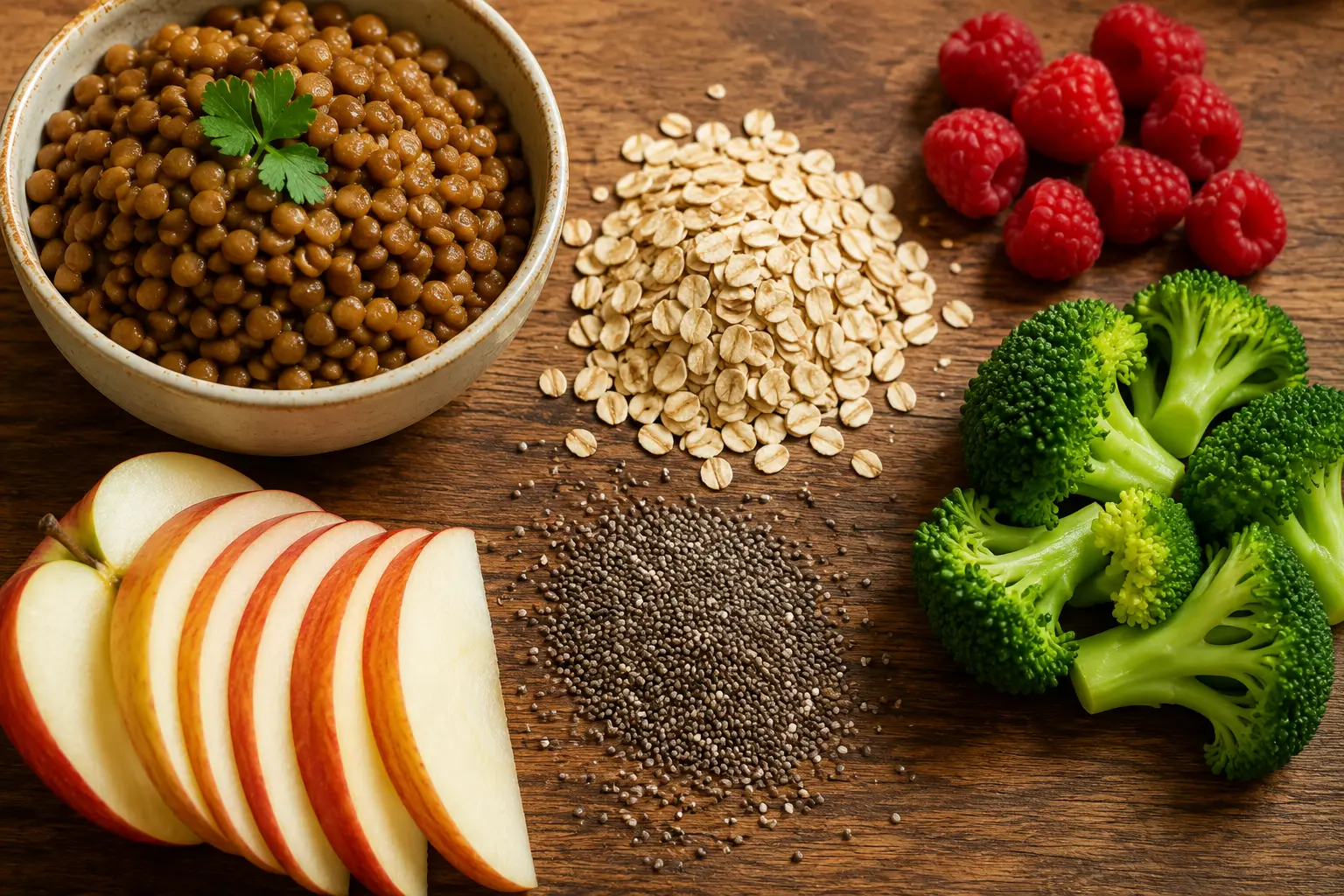
Fiber is the nutrient everyone agrees is good for you and almost nobody actually gets enough of. It doesn't have the marketing muscle of protein or the villain narrative of sugar — it just quietly sits at the bottom of most people's plates, underfilled, year after year, while its absence shows up as sluggish digestion, blood sugar swings, and a gut microbiome running on fumes.
The gap between what's recommended and what people actually eat is not small. It's one of the largest, most consistent nutrient shortfalls in modern diets — and unlike a lot of nutrition advice, closing it doesn't require supplements, tracking, or restriction. It requires knowing the actual target and which foods reliably hit it.
How Much Fiber You Actually Need Per Day
Fiber recommendations are set based on calorie intake, which is why they differ by age and sex — not because men inherently need "more" fiber, but because the standard recommendation of 14g of fiber per 1,000 calories eaten scales with typical calorie needs.
| Group | Recommended daily fiber |
|---|---|
| Women, under 50 | 25g |
| Men, under 50 | 38g |
| Women, 50+ | 21g |
| Men, 50+ | 30g |
The simplest way to personalise this: multiply your daily calorie intake by 14, then divide by 1,000. Someone eating 2,000 calories a day should aim for roughly 28g of fiber. If you already track calories through a TDEE calculator, this ratio gives you a personalised fiber target in about ten seconds.
The Fiber Gap: Why Almost Everyone Falls Short
This is not a niche problem affecting people with unusual diets. National nutrition survey data consistently finds that somewhere between 90 and 95% of adults fall short of their recommended fiber intake, with average consumption sitting around 15g a day — roughly half the target for most adults.[1] One analysis of the data found as few as 7% of adults meeting the recommendation outright.[1]
The reason is structural, not a matter of individual willpower. Fiber comes almost exclusively from plant foods in their less-processed forms — whole grains, legumes, fruits, vegetables, nuts, and seeds. Refining a grain into white flour strips away the bran and germ layers, which is where nearly all of that grain's fiber lived. Modern food systems are built heavily around refined, convenient, shelf-stable ingredients, and those ingredients are disproportionately fiber-poor by the nature of how they're processed.
Soluble vs Insoluble Fiber: What Each Actually Does
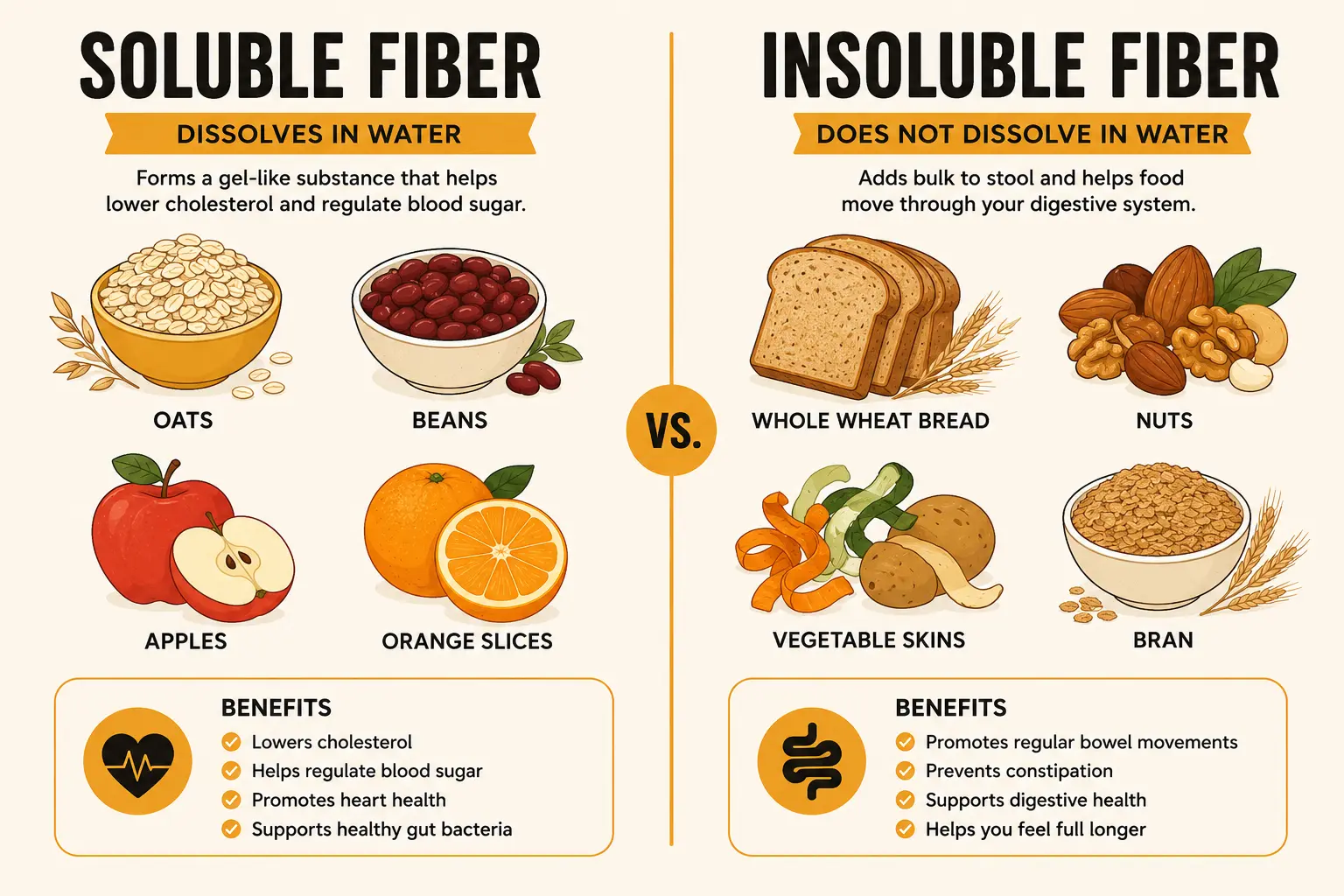
"Fiber" isn't one substance — it's an umbrella term for two functionally different types, and most whole foods contain a mix of both.
This is part of why the eating-order effect matters for blood sugar — soluble fiber's gel-forming action is one of the mechanisms slowing glucose absorption described in what happens to your blood sugar after you eat. Chasing one type of fiber in isolation is less useful than simply eating a variety of whole plant foods, which reliably delivers both.
Fiber and Gut Health: The Short-Chain Fatty Acid Connection
Fiber's role in gut health goes beyond "keeping things moving." Fiber that isn't digested in the small intestine reaches the colon, where gut bacteria ferment it and produce short-chain fatty acids (SCFAs) — compounds like butyrate that serve as the primary fuel source for the cells lining your colon, help regulate inflammation, and support the integrity of the gut barrier. A low-fiber diet effectively starves the bacteria responsible for producing these compounds, which is one proposed mechanism behind reduced microbiome diversity observed in populations eating low-fiber, highly processed diets.
This connects directly to fermentation more broadly — fermented foods around the world covers a related but distinct gut-health mechanism: introducing live cultures directly, rather than feeding the bacteria you already have. The two approaches are complementary, not competing — fiber feeds your existing gut bacteria, fermented foods can introduce new ones.
Why It Matters Beyond Digestion
Fiber's health case extends well past regularity. A major 2019 systematic review and meta-analysis commissioned by the World Health Organization, pooling data from 185 prospective studies and 58 clinical trials, found that people with the highest fiber intake had a 15 to 30% lower risk of all-cause mortality, cardiovascular disease, coronary heart disease, stroke, type 2 diabetes, and colorectal cancer compared with those consuming the least.[2] The risk reduction was greatest at intakes between 25g and 29g per day, closely matching the standard recommendation.[2]
The same body of research found that higher-fiber diets were associated with meaningfully lower body weight, lower systolic blood pressure, and lower total cholesterol in controlled trials — not just observational associations.[2] Fiber is genuinely one of the few dietary factors with this much consistent, high-quality evidence behind it.
Signs You're Not Getting Enough Fiber
- Irregular or infrequent bowel movements. The most direct and immediate sign — insoluble fiber's bulking effect is what keeps this process efficient.
- Feeling hungry again shortly after meals. Fiber slows gastric emptying and adds volume without calories, which is part of why low-fiber meals tend to leave you looking for a snack sooner.
- Blood sugar energy crashes after carb-heavy meals. Without fiber to slow absorption, refined carbohydrates spike and crash faster — see what happens to your blood sugar after you eat for the full mechanism.
- A diet where vegetables, fruit, and legumes are a minor part of most meals. The clearest structural predictor of a fiber gap — if these food groups aren't the bulk of your plate, the total is almost always short.
High-Fiber Foods: The Complete List
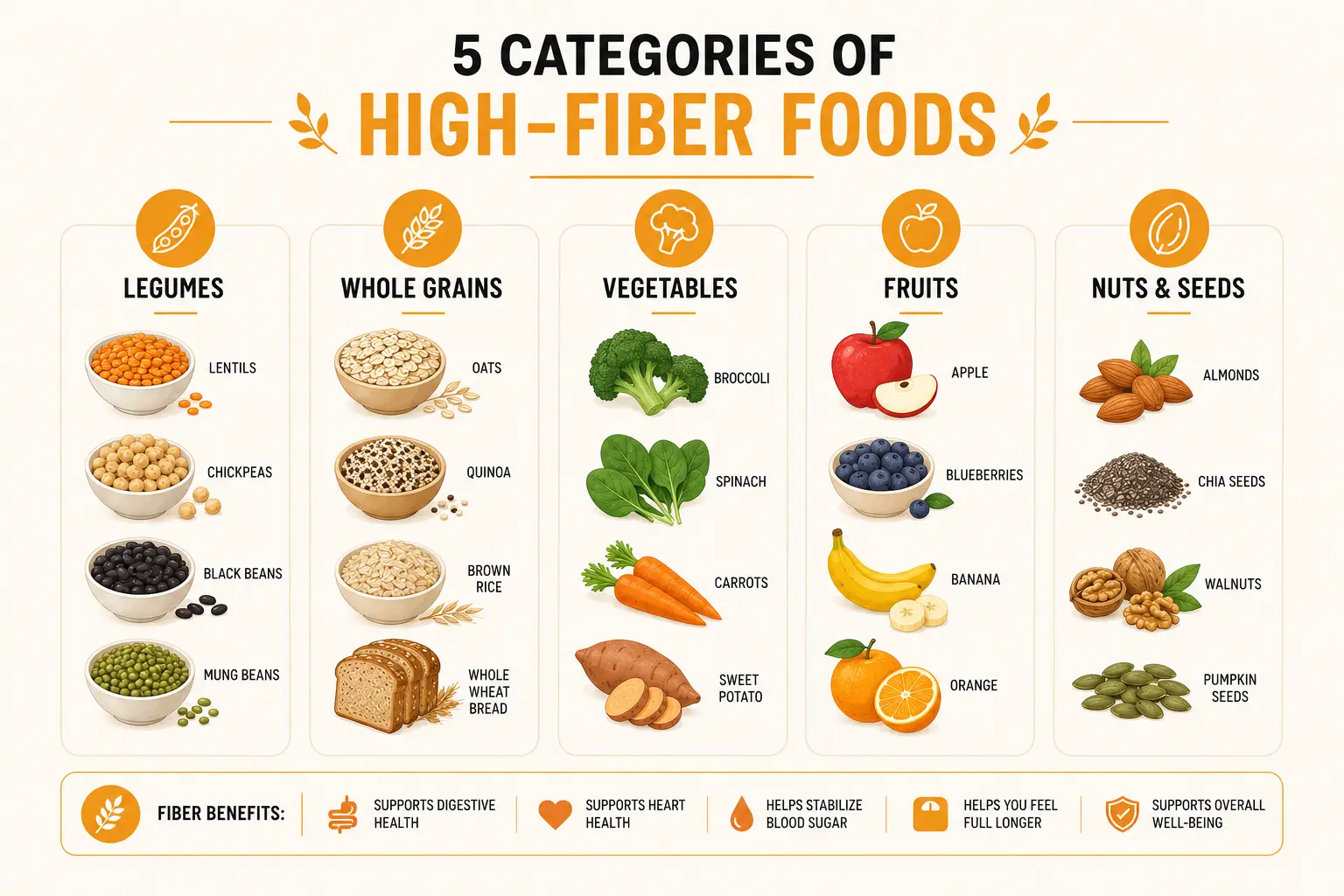
Fiber content varies widely across food groups. Here's what actually moves the needle, organised by category with typical serving amounts.
| Food (typical serving) | Fiber (approx.) |
|---|---|
| Legumes | |
| Split peas, cooked — 1 cup | 16.3g |
| Lentils, cooked — 1 cup | 15.6g |
| Black beans, cooked — 1 cup | 15g |
| Chickpeas, cooked — 1 cup | 12.5g |
| Kidney beans, cooked — 1 cup | 11.3g |
| Whole grains | |
| Barley, cooked — 1 cup | 6g |
| Whole wheat pasta, cooked — 1 cup | 6.3g |
| Quinoa, cooked — 1 cup | 5.2g |
| Oats, cooked — 1 cup | 4g |
| Brown rice, cooked — 1 cup | 3.5g |
| Vegetables | |
| Artichoke, cooked — 1 medium | 10.3g |
| Peas, cooked — 1 cup | 8.8g |
| Broccoli, cooked — 1 cup | 5.1g |
| Brussels sprouts, cooked — 1 cup | 4g |
| Sweet potato, with skin — 1 medium | 3.8g |
| Fruits | |
| Avocado — 1 whole | 10g |
| Raspberries — 1 cup | 8g |
| Pear, with skin — 1 medium | 5.5g |
| Apple, with skin — 1 medium | 4.4g |
| Banana — 1 medium | 3.1g |
| Nuts & seeds | |
| Chia seeds — 1 oz (28g) | 9.8g |
| Flaxseed, ground — 1 oz (28g) | 7.6g |
| Almonds — 1 oz (28g) | 3.5g |
| Pistachios — 1 oz (28g) | 2.9g |
Figures are approximate USDA reference values and will vary slightly by variety and preparation. A practical takeaway: a single cup of cooked lentils delivers more than half of most people's entire daily fiber target — legumes are consistently the highest-density, most efficient way to close the gap, which is worth keeping in mind if plate space and appetite are limiting factors, not just willingness to eat vegetables.
How to Actually Increase Your Fiber Intake
- Increase gradually, over 2-4 weeks. Add roughly 5g every few days rather than jumping straight to target — a sudden jump is the most common cause of bloating and discomfort, not fiber itself.
- Drink more water as you increase fiber. Soluble fiber needs water to form its gel; without enough fluid, increasing fiber can worsen constipation rather than relieve it.
- Swap refined grains for whole ones where you already eat grains. White rice to brown rice, white bread to whole grain, regular pasta to whole wheat — a like-for-like swap with no new foods required.
- Add one legume-based meal or side most days. Dal, rajma, chana, or a bean-based side dish is the single highest-leverage addition given how fiber-dense legumes are relative to effort and calories.
- Leave skins on where reasonable. Apples, pears, potatoes, and cucumbers all lose a meaningful share of their fiber when peeled.
- Snack on fruit, nuts, or seeds instead of refined snacks. A simple substitution that adds 3-10g of fiber without changing the shape of your day.
If you're building this into a broader, sustainable eating approach rather than a one-off fix, the Eat with Intent course covers how to build a balanced, fiber-inclusive plate without tracking every gram — six free lessons, no sign-up.
Common Mistakes When Increasing Fiber
- Jumping from 15g to 35g overnight. The single most common mistake — leads to bloating and cramping that gets blamed on "fiber not agreeing with me" when the real issue is the pace of increase.
- Relying entirely on fiber supplements instead of whole foods. Isolated fiber supplements (psyllium husk, methylcellulose) can help close a gap, but whole foods bring fiber packaged with vitamins, minerals, and the food matrix effects that isolated fiber doesn't replicate.
- Not increasing water intake alongside fiber. Fiber without adequate fluid can worsen rather than improve digestive comfort.
- Treating "high protein" and "high fiber" as competing goals. They're not — legumes, in particular, deliver meaningful amounts of both simultaneously, and a plate can absolutely be built around both targets at once. See how much protein you actually need per day for the parallel target.
Final Thoughts
Most people don't have a fiber problem because they're eating badly in some dramatic sense — they have a fiber problem because refined, convenient foods have quietly become the default, and fiber is the nutrient that default is worst at delivering. Closing a 10-15g daily gap doesn't require an overhaul. It requires a handful of specific, repeatable swaps: a legume-based meal a few times a week, whole grains instead of refined ones, skins left on, fruit and nuts instead of packaged snacks.
Fiber is one of the rare nutrients where the evidence, the food sources, and the practical fix are all this well-aligned. The target is clear, the foods that get you there are ordinary and inexpensive, and the payoff — digestion, blood sugar, cholesterol, long-term disease risk — is about as broad as nutrition science gets.
For the full picture of how fiber fits into an otherwise balanced plate — alongside protein, carbohydrates, and fat — without needing to weigh or track anything, how to build a balanced plate without a food scale is the natural next read.
Sources
[1] NHANES-based analyses of U.S. adult fiber intake, reporting approximately 90-95% of adults below recommended intake and average intake near 15g/day. Summary available at: healio.com
[2] Reynolds A, Mann J, Cummings J, et al. Carbohydrate quality and human health: a series of systematic reviews and meta-analyses. The Lancet, 2019 (commissioned by the World Health Organization). Available at: thelancet.com