
Most people know, in a general way, that chronic stress is bad for their health. The phrase has been repeated often enough that it no longer carries much informational weight. It has become a category — something that belongs alongside "sleep more" and "eat better" in the register of known health advice that is easy to acknowledge and easy to ignore.
What is less widely understood is what chronic stress is actually doing to the body at the physiological level. Not in a vague correlation sense — "stress increases disease risk" — but in the specific mechanistic sense: what changes in the cardiovascular system, what happens to the immune system's calibration, what structural changes occur in the brain, what the metabolic consequences are, and why these effects are produced not by a malfunctioning stress system but by a correctly functioning one that was designed for a very different threat environment.
This article is about the biology of chronic stress: the specific downstream effects of sustained HPA axis and sympathetic nervous system activation on each body system, the timelines over which those effects develop, and what it means practically. The companion cortisol guide covers what cortisol is, its daily rhythm, and how to manage it. This article covers what happens when the system runs continuously rather than episodically.
The Stress Response Was Designed for Acute Threats, Not Chronic Ones
The physiological stress response is not a design flaw. It is one of the most sophisticated survival mechanisms in mammalian biology: a rapid, coordinated mobilisation of the body's resources in response to a perceived threat, designed to maximise the probability of surviving a short-duration physical emergency. The hypothalamic-pituitary-adrenal (HPA) axis releases cortisol. The sympathetic nervous system releases adrenaline and noradrenaline. Heart rate accelerates. Blood pressure rises. Glucose floods the bloodstream. Blood flow redirects to muscles and the brain. Digestion slows. Immune function temporarily suppresses to redirect energy elsewhere.
Every one of these responses is appropriate and functional when the stressor is a short-duration physical threat. The issue is that the system was calibrated for a world where threats were predominantly acute: a predator, a physical altercation, a sudden environmental danger. The threat arrived, the response activated, the threat resolved, and the parasympathetic nervous system returned the body to baseline. The activation cycle was episodic, with genuine recovery between episodes.
Modern chronic stress does not follow this episodic pattern. A difficult job, financial pressure, relationship conflict, and chronic uncertainty do not resolve within minutes or hours. They persist for days, weeks, months, and years. The HPA axis and sympathetic nervous system do not distinguish between the threat of a predator and the threat of an approaching deadline. When that appraisal is persistent, the stress response runs continuously and the body's systems that were built to tolerate short activation periods are exposed to that activation on a chronic timescale. Over time, this is one of the main pathways behind what's often described as nervous system dysregulation — the system losing its ability to flexibly power back down between episodes.
The Cardiovascular System: The Most Extensively Documented Effects
The cardiovascular consequences of chronic stress are the most thoroughly researched and most clearly established of all stress-related health effects. The mechanistic pathway from chronic sympathetic activation and HPA dysregulation to cardiovascular disease runs through multiple routes simultaneously.
Blood pressure
Adrenaline and noradrenaline released during sympathetic nervous system activation cause direct vasoconstriction — narrowing of blood vessels — and increase heart rate and cardiac output. In acute stress, blood pressure rises temporarily and returns to baseline when the stressor resolves. In chronic stress, blood pressure is elevated for sustained periods.
Sustained elevated blood pressure — hypertension — is a major independent risk factor for heart attack and stroke. The vascular damage from chronic blood pressure elevation is cumulative: the endothelium (the inner lining of blood vessels) experiences repeated mechanical stress that triggers inflammatory responses, promotes arterial stiffening, and accelerates atherosclerotic plaque formation. A meta-analysis by Kivimäki and colleagues published in The Lancet in 2012, one of the largest studies of occupational stress and cardiovascular disease, found that work-related chronic stress was associated with a 23% increased risk of heart attack — independent of other cardiovascular risk factors including diet, smoking, and physical activity.
Inflammation and endothelial damage
Cortisol has a complex and initially counterintuitive relationship with inflammation. Acutely, cortisol is anti-inflammatory. Chronically, however, the picture reverses. Prolonged cortisol elevation eventually produces glucocorticoid resistance in immune cells: the cells become less responsive to cortisol's anti-inflammatory signalling. As a result, inflammatory cytokines rise unchecked.
This chronic low-grade inflammation is one of the primary mechanisms linking psychological stress to physical disease across multiple organ systems. Elevated C-reactive protein (CRP), interleukin-6 (IL-6), and tumour necrosis factor-alpha (TNF-α) — all markers of systemic inflammation — are consistently elevated in studies of chronically stressed individuals. Inflammation is the common pathway through which cardiovascular disease, type 2 diabetes, certain cancers, depression, and cognitive decline are all connected to chronic stress. Diet has a real, if modest, role to play here too — omega-3 fatty acids are among the few nutrients with established anti-inflammatory evidence behind them.
Heart rate variability reduction
Heart rate variability (HRV) — the beat-to-beat variation in heart rate that reflects the balance between sympathetic and parasympathetic nervous system activity — is reduced in people with chronic stress. High HRV reflects a responsive, adaptable autonomic nervous system; low HRV reflects sympathetic dominance and reduced parasympathetic (vagal) tone. Low HRV is an independent predictor of cardiovascular mortality.
Chronic stress progressively reduces vagal tone as the sympathetic nervous system maintains dominance. The heart becomes less adaptable to changing demands, less efficient in its regulation, and more vulnerable to arrhythmia. The HRV reduction from chronic stress is measurable, clinically significant, and partially — but not fully — reversible with stress reduction interventions. For what vagal tone actually is and which techniques for raising it are backed by real evidence, see what the vagus nerve actually does. Interestingly, one of the more consistent long-term interventions for cardiovascular risk specifically is heat exposure — frequent sauna use is linked to a substantially lower risk of sudden cardiac death in large cohort research.
The Immune System: Suppression, Dysregulation, and the Paradox
The immune effects of chronic stress are among the most well-studied areas in psychoneuroimmunology — the field examining how psychological states affect immune function. The findings reveal a specific and non-intuitive pattern that explains why chronically stressed people get ill more often and recover more slowly, while also being more vulnerable to certain inflammatory conditions.
Acute stress actually enhances certain aspects of immune function in the short term. The initial adrenaline surge redistributes immune cells — natural killer cells and T-cells — from circulation to tissues, preparing them to deal with potential injury or infection. This is adaptive. Sheldon Cohen's classic studies at Carnegie Mellon University demonstrated this acute immune enhancement in controlled conditions.
With sustained stress over weeks and months, the picture reverses. Natural killer cell activity — the first line of immune defence against viruses and tumour cells — is significantly reduced. T-cell proliferation decreases. Antibody response to vaccines is blunted. The production of secretory IgA — the primary immune defence at mucous membranes — falls. Cohen's research group published landmark studies in which participants were deliberately exposed to cold viruses after their stress levels were assessed. Participants with higher psychological stress scores were significantly more likely to develop an infection, with the relative risk of developing a cold more than twice as high for people in the highest stress category compared to the lowest.
Long-term chronic stress produces an additional immune complication: as cortisol receptors on immune cells downregulate in response to chronic glucocorticoid signalling, the immune system's responsiveness to cortisol's anti-inflammatory braking mechanism diminishes. The result is paradoxical — the immune system simultaneously shows signs of suppression in its adaptive function (fewer effective pathogen responses) and dysregulation toward excess inflammation in its cytokine signalling. Suppressed adaptive immunity and heightened inflammatory signalling at the same time.
This same nuance around measurable immune markers versus real-world outcomes shows up in cold exposure research too — what the research actually supports for cold showers and plunges breaks down a well-known claim (fewer sick days) that doesn't hold up under direct immune marker testing, much like the cortisol paradox above.
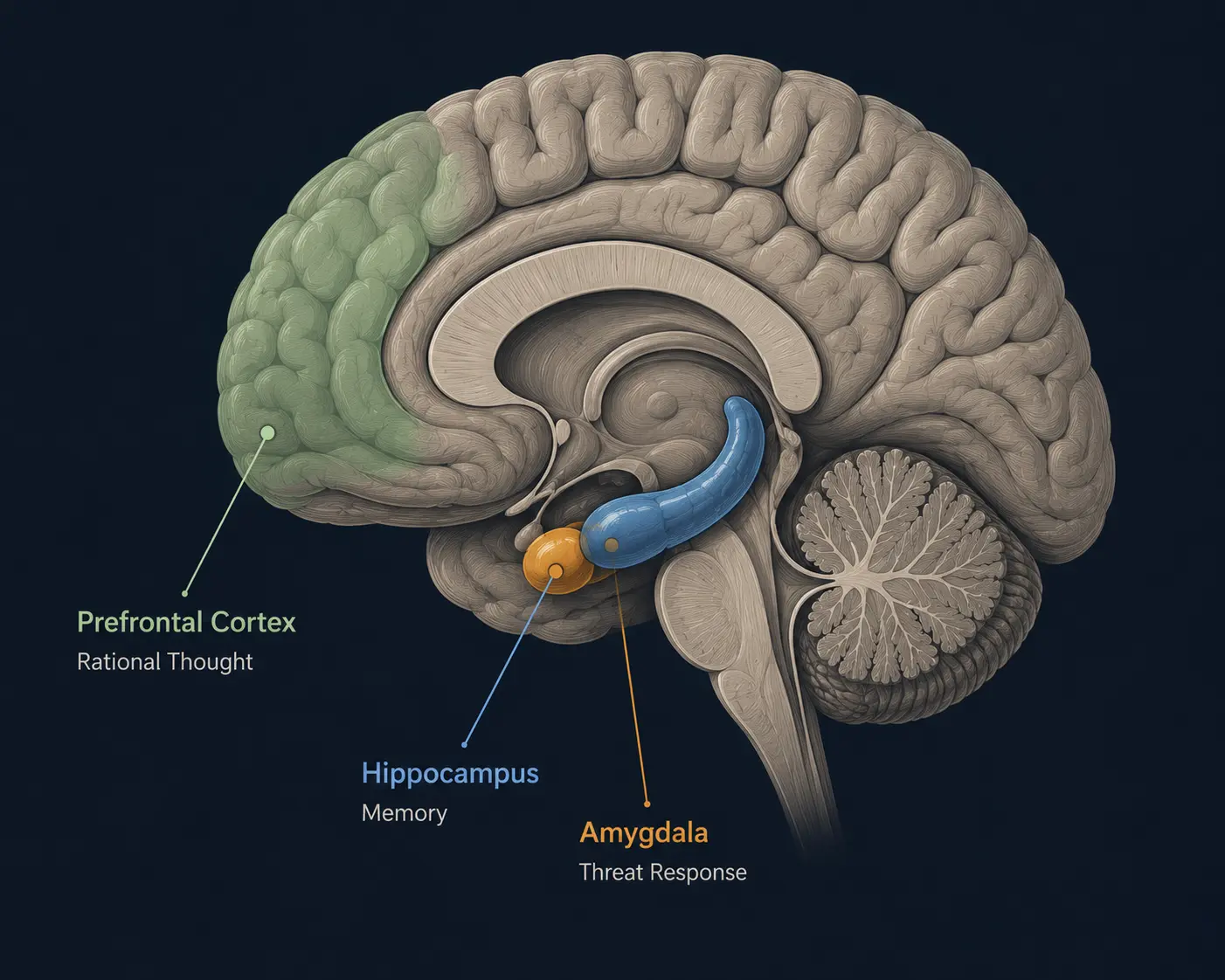
The Brain: Where the Effects Are Most Personally Felt and Structurally Significant
The brain is both the origin of the stress response and one of the primary sites of chronic stress damage. The structural and functional changes in the brain from chronic stress are among the most compelling findings in the literature because they explain the cognitive and emotional symptoms that accompany sustained stress and because some of these changes are directly measurable.
The hippocampus: memory, learning, and threat detection
The hippocampus — the brain region central to memory formation, spatial navigation, and the regulation of the HPA axis itself — has one of the highest densities of cortisol receptors in the brain and is acutely sensitive to sustained cortisol elevation. Multiple mechanisms of hippocampal damage from chronic stress have been identified: dendritic atrophy (reduced branching complexity of hippocampal neurons, meaning fewer synaptic connections); suppressed neurogenesis (chronic stress substantially inhibits the proliferation and survival of new neurons in the dentate gyrus); and volumetric reduction. A meta-analysis by Videbech and Ravnkilde examining 30 imaging studies found consistent bilateral hippocampal volume reduction in people with major depression, in the range of 8 to 19% compared to controls.
Critically, hippocampal damage from chronic stress reduces the brain's capacity to self-regulate cortisol production. The hippocampus is part of the system that tells the HPA axis to stop producing cortisol once a threat has passed. Hippocampal damage impairs that feedback signal, creating a self-reinforcing cycle: chronic stress damages the hippocampus, hippocampal damage impairs cortisol regulation, impaired regulation produces more chronic stress.
The amygdala: the threat detection circuit that grows
While the hippocampus atrophies under chronic stress, the amygdala — the brain's threat detection and emotional response centre — responds in the opposite direction. Chronic stress increases dendritic branching in the basolateral amygdala and enhances its reactivity to threatening stimuli. Research has shown that chronic stress produces structural hypertrophy of amygdala neurons specifically in the regions involved in fear learning and anxiety.
The result is a brain in which the threat detection system has become hyperresponsive — reacting more strongly to potential threats, generating more fear and anxiety responses — while the hippocampal memory system that provides contextual information to moderate those responses has been impaired. The amygdala fires more readily; the hippocampus has less capacity to provide the contextual information that says "this is not actually a threat." This is one of the neurological substrates of the anxiety, hypervigilance, and difficulty distinguishing real from perceived threats that characterise prolonged stress and PTSD.
The prefrontal cortex: the regulatory system that loses ground
The prefrontal cortex — responsible for executive function, rational evaluation, emotional regulation, impulse control, and decision-making — shows reduced activity and connectivity under chronic stress. The functional consequences are significant: diminished capacity for deliberate thought, reduced ability to override emotional responses with rational evaluation, poorer decision-making, and decreased working memory capacity.
Chronic stress therefore produces a specific and measurable reorganisation of the brain's threat-response architecture: the hippocampus (context, memory, HPA regulation) weakens; the amygdala (threat detection, fear) strengthens; the prefrontal cortex (rational override, emotional regulation) loses effectiveness. The brain becomes better at detecting and responding to threats and worse at evaluating whether something is actually a threat.
The Metabolic Consequences: Body Composition and Metabolic Health
The metabolic effects of chronic stress are among the most practically visible and the most directly connected to downstream disease risk. They operate primarily through cortisol's role in glucose regulation and fat deposition, and through the appetite-disrupting effects of chronic HPA axis activation.
Visceral fat accumulation
Visceral adipose tissue — the fat deposited around the abdominal organs rather than under the skin — has a high density of cortisol receptors and responds to chronically elevated cortisol by accumulating selectively. Unlike subcutaneous fat, visceral fat is metabolically active: it secretes pro-inflammatory cytokines, contributes to insulin resistance, and is independently associated with cardiovascular disease risk beyond what total body weight predicts.
The characteristic central fat accumulation pattern in people under chronic stress is not a metaphor. It reflects a specific hormonally-mediated process in which cortisol directs fat storage toward the visceral compartment. Research has confirmed that both cortisol levels and psychological stress scores predict waist circumference and visceral fat mass independently of diet and exercise.
Insulin resistance
Cortisol's primary metabolic role is to raise blood glucose — part of the energy mobilisation of the acute stress response. In chronic stress, this continuous glucocorticoid stimulation maintains persistently elevated blood glucose levels. Over time, repeated insulin exposure desensitises insulin receptors in muscle and fat cells, producing insulin resistance — the primary precursor to type 2 diabetes and metabolic syndrome. A 2014 meta-analysis found that people with work-related burnout had significantly elevated risk of type 2 diabetes, partially mediated by HPA axis dysregulation.
Appetite and stress eating
Chronic stress disrupts appetite regulation through multiple pathways. Cortisol elevates appetite — particularly for calorie-dense, palatable foods — through its effects on neuropeptide Y and ghrelin. The dopamine system is sensitised during chronic stress in ways that specifically increase the rewarding value of high-fat, high-sugar foods. The prefrontal cortical capacity for dietary self-regulation is simultaneously reduced.
The combination — elevated appetite for specific food types, stronger reward response to those foods, reduced capacity for deliberate restraint — explains the well-documented phenomenon of stress eating. This is not a character flaw. It is a predictable neurobiological consequence of a stress system directing the body toward energy-dense fuel sources. Sugar cravings explained goes deeper into this specific dopamine-reward pathway and what actually reduces it, beyond simply trying to resist the craving in the moment.
The Gut: The Bidirectional Highway
The gut and the brain are connected through the gut-brain axis — a bidirectional signalling system involving the vagus nerve, enteric nervous system, immune cells, and gut microbiome — and chronic stress disrupts this system in both directions. Gut motility is disrupted, gastric acid production increases, the intestinal barrier becomes more permeable (increased intestinal permeability), and the composition of the gut microbiome shifts toward patterns associated with inflammation and disease.
Multiple studies have found that chronic psychological stress alters microbial diversity and composition in ways that produce more inflammatory signalling from the gut, which then feeds back to the brain via the vagus nerve and systemic circulation, contributing to the neuroinflammation associated with depression and anxiety. The practical manifestations are the gastrointestinal symptoms — irritable bowel, bloating, alternating constipation and diarrhoea, nausea — that are consistently the most common somatic complaints in people with chronic stress.
The Reproductive and Hormonal System
The HPA axis and the hypothalamic-pituitary-gonadal (HPG) axis — the system governing sex hormone production — are in direct competition for hypothalamic and pituitary resources. Chronic HPA activation suppresses HPG function: corticotropin-releasing hormone (CRH) directly inhibits the gonadotropin-releasing hormone (GnRH) pulse that drives sex hormone production.
In men, chronic stress suppresses testosterone production through multiple routes: CRH inhibits GnRH, cortisol directly inhibits testicular testosterone synthesis, and elevated cortisol reduces the pituitary's LH output that stimulates testosterone production. The consequences include reduced libido, impaired sperm production and quality, reduced muscle protein synthesis, and impaired mood regulation.
In women, the HPG axis suppression disrupts the precise hormonal cascade required for regular ovulation. The consequences range from menstrual irregularity and cycle lengthening at lower stress intensities, to anovulatory cycles and amenorrhoea at higher intensities.
Skin, Hair, and Connective Tissue: The Visible Signs
The skin is extensively innervated by the peripheral nervous system and densely populated with immune cells, making it a direct site of stress-system activity and a visible indicator of stress-related physiological changes. Chronic stress elevates skin inflammation through both direct nerve-mediated pathways and through systemic inflammatory cytokine signalling. The inflammatory skin conditions most consistently associated with chronic stress include psoriasis, eczema, acne, and rosacea — all of which have stress-induced flares that are mechanistically mediated through inflammatory signalling.
Hair loss from telogen effluvium — stress-induced acceleration of hair follicles into the resting (telogen) phase — is a well-documented stress consequence. The hair shedding typically occurs two to four months after a significant stress event, or develops gradually in chronic stress. This is usually reversible when the stressor is removed or adequately managed. Hair thinning has a similar overlap with vitamin D deficiency, so it's worth ruling that out separately rather than assuming stress is the only cause.
Collagen synthesis — the primary structural protein of skin, tendons, ligaments, and bone — is suppressed by chronic glucocorticoid elevation. Cortisol inhibits fibroblast activity and reduces collagen production. The effects accumulate slowly but include accelerated skin ageing, impaired wound healing, reduced tendon and ligament resilience, and reduced bone mineral density. Chronic stress is an independent risk factor for osteoporosis through cortisol's direct suppression of osteoblast activity (bone formation cells) and enhancement of osteoclast activity (bone resorption cells).
Sleep: The Bidirectional Relationship That Amplifies Everything
Chronic stress and poor sleep are so consistently co-occurring that it is difficult to discuss the health effects of one without the other. The relationship is bidirectional and creates a self-reinforcing cycle that amplifies the health consequences of both.
Chronic stress elevates cortisol, particularly in the evening when it should be declining to allow melatonin to rise. Elevated evening cortisol delays sleep onset, reduces slow-wave deep sleep (during which the majority of growth hormone and immune restoration occurs), and increases the frequency of night wakings. Poor sleep, in turn, blunts the cortisol awakening response, produces a flatter diurnal cortisol curve, and reduces the brain's capacity for emotional regulation — which increases the psychological stress response to the same situations. As explored in the guide to sleep deprivation vs sleep debt, the cognitive and physiological costs of poor sleep compound rapidly across consecutive nights.
The sleep deprivation produced by chronic stress amplifies every other effect described in this article: the cardiovascular effects worsen; the immune suppression deepens; the hippocampal damage compounds; the metabolic dysregulation intensifies. Poor sleep is not a side effect of chronic stress. It is a mediator that takes the direct effects of stress and multiplies them through an independent set of physiological pathways.
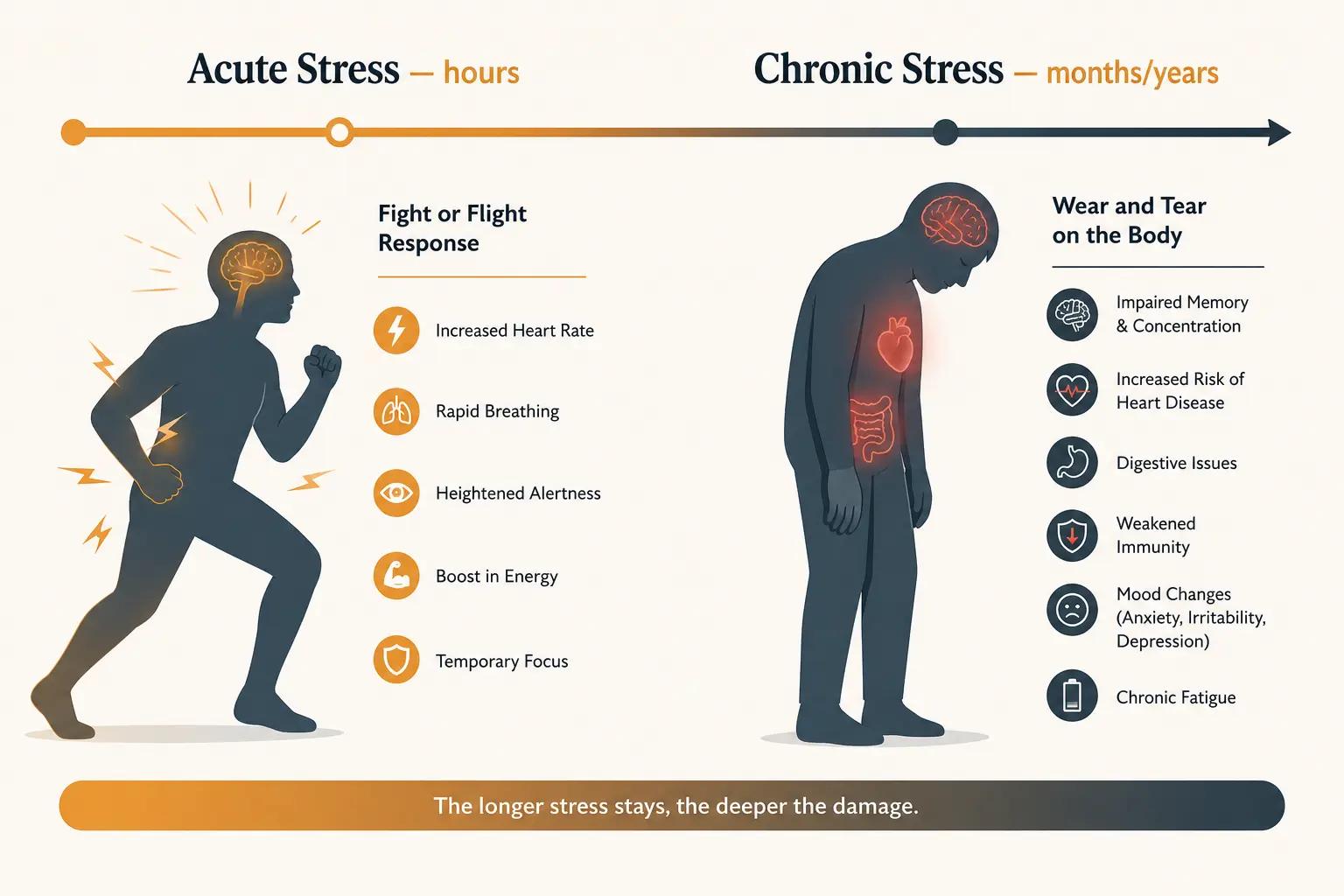
The Timeline: When Effects Emerge and How They Progress
Chronic stress effects develop progressively, with functional changes appearing before structural ones and reversible changes appearing before irreversible ones. Understanding the timeline matters both for assessing risk and for understanding the urgency of intervention.
| Duration | Primary systems affected | Typical changes | Reversibility |
|---|---|---|---|
| Weeks (2–8) | HPA axis; sleep; immune; mood | Elevated cortisol baseline; sleep onset disruption; increased infection susceptibility; mood instability; appetite changes | Fully reversible with adequate stress reduction and sleep recovery |
| Months (2–6) | Cardiovascular; metabolic; gut; skin; immune | Elevated blood pressure; early insulin resistance; gut symptoms; skin flares; reduced NK cell activity; fatigue; reduced cognitive flexibility | Largely reversible; some cardiovascular endothelial changes may persist |
| 6–12 months | Brain structure (functional); hormonal; bone; immune calibration | Measurable HRV reduction; glucocorticoid resistance beginning; HPG axis suppression (libido, menstrual changes, testosterone decline); early hippocampal functional changes | Partially reversible; hormonal changes generally reverse; early cognitive changes reversible |
| 1–3 years | Brain structure (volumetric); cardiovascular (structural); immune dysregulation | Measurable hippocampal volume reduction on imaging; atherosclerotic changes; chronic inflammatory markers elevated; immune system persistently miscalibrated; significant metabolic disruption | Partially reversible; some structural brain changes can recover with sustained stress reduction; cardiovascular structural changes partially persist |
| 3+ years | All systems | Established cardiovascular disease risk; measurable cognitive decline; sustained immune dysregulation; significant metabolic consequences; sleep architecture permanently altered; ageing biomarkers elevated | Partially reversible; structural changes less reversible at longer durations; management rather than full reversal may be the realistic goal |
The progression from functional to structural is the critical threshold in this timeline. Functional changes — elevated cortisol, disrupted sleep, immune suppression, mood effects — are essentially fully reversible with adequate stress reduction. Structural changes — hippocampal volume loss, arterial stiffening, established insulin resistance, immune recalibration — reverse more slowly and less completely.
What This Means Practically
Chronic stress produces specific, documented, progressive damage across multiple body systems through mechanisms that are now well-understood. The damage is not random or vague. It follows predictable pathways from the HPA axis through to cardiovascular, immune, neural, metabolic, hormonal, and structural consequences. Most of it is reversible in the early and middle stages. Less of it is reversible in the later stages.
When chronic stress is specifically work-related and has progressed to exhaustion, cynicism, or a drop in how effective you feel at your job, it may have crossed into what the WHO officially classifies as burnout — see burnout recovery: what actually works when you can't just quit for the specific recovery approach that condition calls for.
The practical implication is not that you need to eliminate all stress — the acute stress response is functional and appropriate. It is that sustained activation without adequate recovery is the pathological condition, and that recovery is accessible. Sleep, movement, social connection, breathing practices, and deliberate emotional regulation do not address chronic stress through positive thinking. They address it through the same physiological pathways described in this article — reducing HPA axis activation, restoring parasympathetic tone, rebuilding hippocampal function, normalising inflammatory signalling. For specific, ranked interventions you can apply within the constraints of your actual life, the practical stress management guide covers nineteen evidence-based approaches sorted by the time and effort they require.
The most important variable in the timeline above is not the type of stressor or the intensity of the HPA response. It is how long the system runs without adequate recovery. A high-stress life with consistent recovery mechanisms produces dramatically different outcomes than a high-stress life without them. The urgency of implementing recovery is proportional to how long the system has been running without it. For a comprehensive approach to building the recovery side of the equation, the Sleep Better course addresses the sleep-stress cycle directly — the single highest-leverage point for most people.