- Most health bodies recommend roughly 250-500 mg/day of combined EPA and DHA for general health.
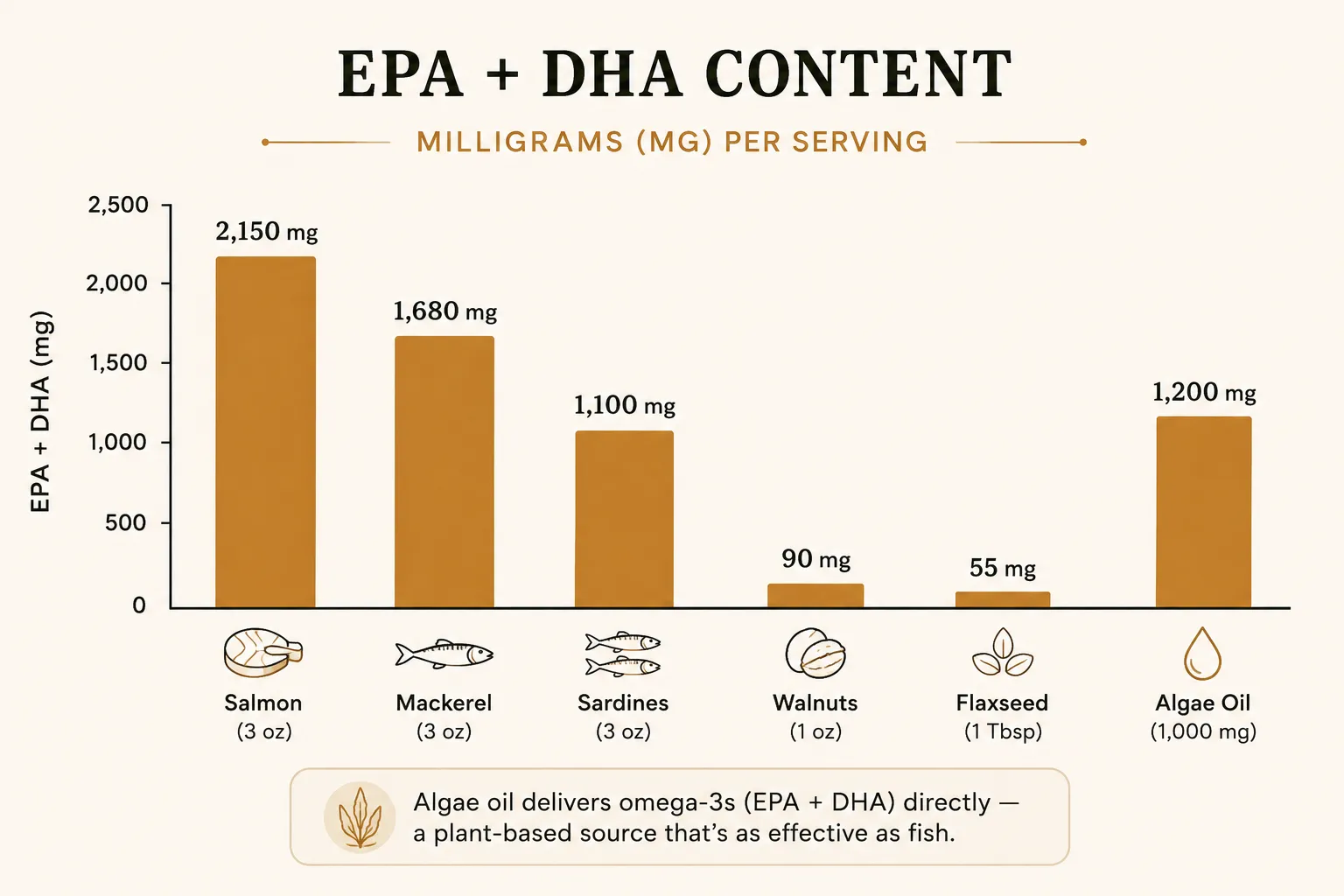
- A 6-ounce serving of cooked salmon provides around 1,800 mg of combined EPA and DHA — more than most supplement doses in one meal.
- Plant-based ALA converts to EPA at only about 5-15%, and to DHA at under 5%, in most adults.
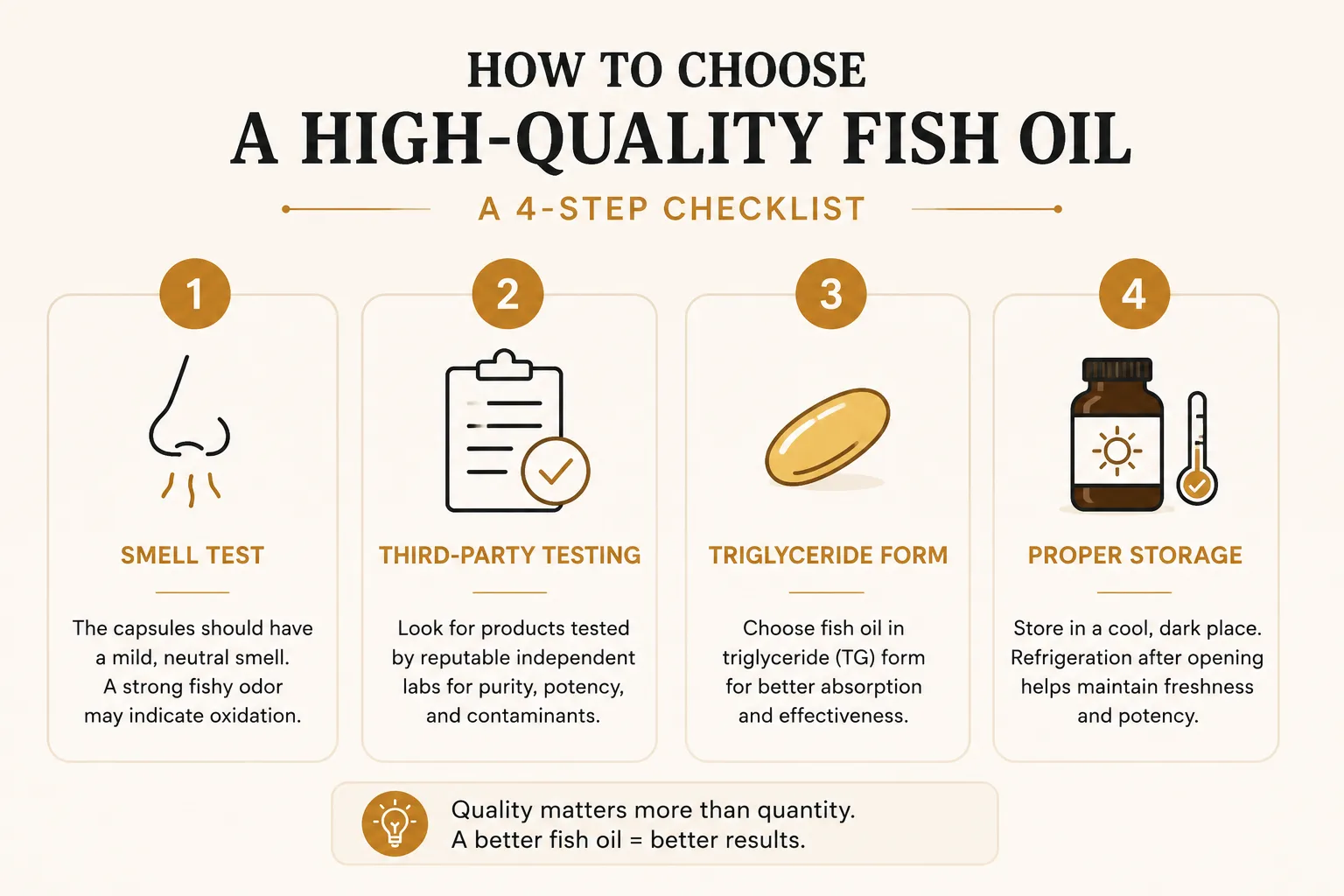
- Independent testing has found a meaningful share of omega-3 supplements either underdeliver on labeled EPA/DHA or show signs of oxidation.
- Large supplement trials have generally found less heart-health benefit from fish oil pills than observational studies find from eating oily fish directly.
Omega-3 is one of the most recommended supplements on the market, and also one of the most misunderstood — most of what the evidence actually supports points back to fish itself, not the pill aisle. EPA and DHA are genuinely useful for heart and brain health. But how much you need, whether a supplement gets you there, and how to spot a rancid one all matter more than the blanket "take fish oil" advice usually lets on.
What Omega-3s Actually Are
"Omega-3" is a family name, not one specific compound — and the differences between its members matter more than most labels suggest. EPA (eicosapentaenoic acid) and DHA (docosahexaenoic acid) are the "long-chain" marine forms found in fatty fish and algae, and they're what almost all the cardiovascular and brain research is actually about. ALA (alpha-linolenic acid) is the plant form found in flaxseed, chia, walnuts, and hemp — essential, but the body converts only a small fraction into EPA and DHA.
What the Evidence Actually Supports
How Much Do You Actually Need?
Most guidance for general health lands around 250-500 mg/day of combined EPA and DHA — meaningfully less than many supplement bottles suggest you need.[4] People with diagnosed cardiovascular disease are often advised closer to 1 g/day, typically from oily fish first, with supplements as an option under medical guidance. The FDA's upper safety threshold sits at 3 g/day combined, including up to 2 g/day from supplements — going meaningfully above that without medical supervision isn't advised.
| Context | Typical EPA+DHA target | Best source |
|---|---|---|
| General health | 250–500 mg/day | 2 servings of oily fish/week, or a modest supplement |
| Diagnosed heart disease | ~1 g/day | Oily fish first; supplement under medical guidance |
| Pregnancy/breastfeeding | 200–300 mg DHA/day minimum | Low-mercury fish or algae-based DHA |
| FDA upper safety limit | 3 g/day combined (2 g from supplements) | Do not exceed without medical supervision |
Food vs. Supplement: What the Research Actually Shows
This is the part most supplement marketing glosses over: food has the stronger evidence base, not the pill. People who eat oily fish like salmon, mackerel, or sardines at least twice a week consistently show lower cardiovascular risk in large observational studies. But several major fish oil supplement trials have found little to no equivalent heart-health benefit in people without an existing diagnosis.[5] The likely explanation: fish delivers EPA/DHA alongside other nutrients in a food matrix that doesn't fully translate into a capsule, and people who already eat fish regularly tend to have other health-supporting habits too.
Who Actually Benefits From Supplementing
- People who rarely or never eat fish. A modest EPA/DHA supplement closes a real gap if oily fish isn't realistically on your plate twice a week.
- Vegans and vegetarians. Plant ALA converts too poorly to reliably match fish-based EPA/DHA levels — see the conversion math below.
- Pregnant or breastfeeding people. DHA supports fetal and infant neurological development; low-mercury fish or algae-based DHA are the standard picks.
- People with a doctor-identified cardiovascular risk. Higher, monitored doses may be advised — this is a conversation for a healthcare provider, not a self-directed high dose.
Can Vegans and Vegetarians Get Enough?
Yes, but it takes a deliberate choice — walnuts and flaxseed alone usually aren't enough. ALA from plant sources converts to EPA at roughly 5-15% and to DHA at under 5% in most healthy adults, with women converting somewhat more efficiently than men.[6] Algae oil is the practical fix: it's the same DHA (and often EPA) that fish themselves accumulate from eating algae, sourced directly, making it the most reliable vegan route to adequate levels. If you're building out a broader supplement plan, are protein powder and creatine actually safe? covers the same evidence-first approach for the other most-asked-about supplements.
Fish Oil Quality: What to Actually Check
Not all fish oil on the shelf is equal — independent testing has found a meaningful share of products either underdeliver on labeled EPA/DHA or show early signs of oxidation.[7] Fish oil is prone to going rancid, producing compounds that can work against the anti-inflammatory benefit you're taking it for in the first place.
- Smell and taste test. Fresh fish oil should smell mild, not sharply fishy — a strong odor or sour aftertaste signals rancidity.
- Look for third-party testing. IFOS (International Fish Oil Standards) certification publishes actual test results for oxidation and contaminants like mercury and PCBs.
- Check the form. Triglyceride-form omega-3s are generally better absorbed than cheaper ethyl-ester versions.
- Store it properly. Keep it refrigerated after opening and away from light and heat — oxidation accelerates with both.
Safety and When to Be Cautious
Common Mistakes
- Assuming a supplement replicates what fish does. The stronger evidence is for food — supplement if you genuinely can't eat fish, not by default.
- Relying on flaxseed or walnuts alone for DHA. ALA conversion is too low to substitute for marine-sourced EPA/DHA.
- Buying the cheapest bottle without checking quality. Rancid or underdosed fish oil is common — a smell test and third-party testing matter.
- Taking a much higher dose "to be safe." More isn't automatically better — stay close to the evidence-backed range unless a doctor advises otherwise.
Final Thoughts
Omega-3s, specifically EPA and DHA, have real evidence behind them for heart and brain health — but that evidence points back to fish more than the supplement aisle. If oily fish twice a week is realistic for you, that's the better-supported route. If not, a modest, well-tested supplement closes the gap — treat quality and dose with the same care as any other health decision.
The honest version of this recommendation: omega-3 is one of the few supplement categories where the research genuinely favors the food over the pill — that doesn't make the pill useless, just a fallback, not an upgrade.
Curious about other supplements worth understanding before you buy? Creatine 101 and vitamin D deficiency, explained take the same evidence-first approach.
This article is for general information and isn't a substitute for personalized medical or nutritional advice. Talk to a healthcare provider before starting any new supplement, especially if you take medication or have an existing health condition.
Sources
[1] N-3 fatty acids (EPA and DHA) and cardiovascular health — mechanisms and clinical outcomes. Available at: ncbi.nlm.nih.gov
[2] Omega-3 blood levels and early-onset dementia risk, UK Biobank analysis. Available at: brain-feed.com
[3] Role of omega-3 fatty acids in cardiovascular disease — ongoing debate on dose and AFib risk. Available at: pubmed.ncbi.nlm.nih.gov
[4] Office of Dietary Supplements — Omega-3 Fatty Acids Fact Sheet. Available at: ods.od.nih.gov
[5] Omega-3 fatty acids for primary and secondary prevention of cardiovascular disease. Available at: pubmed.ncbi.nlm.nih.gov
[6] Conversion of ALA to EPA and DHA in adults. Available at: veganhealth.org
[7] IFOS fish oil quality standards and third-party testing overview. Available at: moananatura.com