
- Roughly 1 billion people worldwide have vitamin D levels below the widely accepted sufficiency threshold — deficiency affects nearly 40% of the global population.
- Most people with genuinely low vitamin D have no noticeable symptoms — it's usually caught by a blood test, not by how you feel.
- The official RDA is 600-800 IU/day, but research suggests 1,000-4,000 IU/day may be needed to reach optimal blood levels for many adults.
- Toxicity is rare and almost always caused by high-dose supplements — not sunlight or food, since the body limits its own sun-driven production.
- 5-30 minutes of midday sun on bare skin, 2-3 times a week, covers most people with lighter skin — darker skin needs meaningfully longer.
Vitamin D deficiency is one of the most common nutrient gaps in the world, and one of the easiest to miss — roughly 1 billion people worldwide have levels below what's considered sufficient, yet most feel nothing that would point them toward the cause.[1] This piece breaks down what deficiency actually looks like, who's genuinely at risk, and why the number on the label of your supplement bottle may undersell what research suggests most adults actually need.
What Deficiency Actually Feels Like
The uncomfortable truth about vitamin D deficiency is that most people who have it don't feel any different — symptoms, when they do appear, tend to be vague enough to blame on almost anything else.[2] When symptoms do show up, they typically include:
- Fatigue that doesn't improve with sleep — one of the most commonly reported early signs, distinct from ordinary tiredness.
- Bone or back pain — often felt in the lower back, hips, or shins, sometimes tender to the touch.
- Muscle weakness, aches, or cramps — vitamin D plays a direct role in muscle function, not just bone health.
- Low mood — deficiency has been associated with depressive symptoms and anxiety, though it's rarely the sole cause.
- Hair thinning or shedding — vitamin D supports hair follicle health; low levels can contribute to noticeable thinning.
- Getting sick more often — reduced immune function is a well-documented consequence of low levels.
Who's Actually at Risk — and Why
Vitamin D deficiency isn't random — a handful of factors reliably predict who's most likely to be low, and several of them are more about circumstances than anything you're doing wrong.
How Much You Actually Need
The official Recommended Dietary Allowance is 600 IU (15 mcg) per day for adults up to 70, rising to 800 IU (20 mcg) after 70 — but a meaningful body of research suggests these figures may be conservative for reaching blood levels linked to the lowest disease risk.[3]
| Source | Daily amount | Context |
|---|---|---|
| Official RDA (up to age 70) | 600 IU | Minimum intake to prevent overt deficiency in most people |
| Official RDA (70+) | 800 IU | Higher due to reduced skin synthesis efficiency with age |
| Research estimate for 97.5% of adults to reach sufficiency | ~2,900 IU | From a widely cited dose-response analysis |
| Commonly cited optimal range | 1,000-4,000 IU | Endocrine Society considers up to 4,000 IU/day safe without monitoring |
| Dose scaled by body weight (overweight/obese) | ~4,450-7,250 IU | Higher body fat requires meaningfully more to reach the same blood level |
The practical takeaway: if you have limited sun exposure, a higher body weight, or darker skin, the RDA alone is unlikely to get you to an optimal blood level — testing is the only way to know your actual number rather than guessing between the RDA and the research-based estimates.
Sun Exposure vs. Supplementation
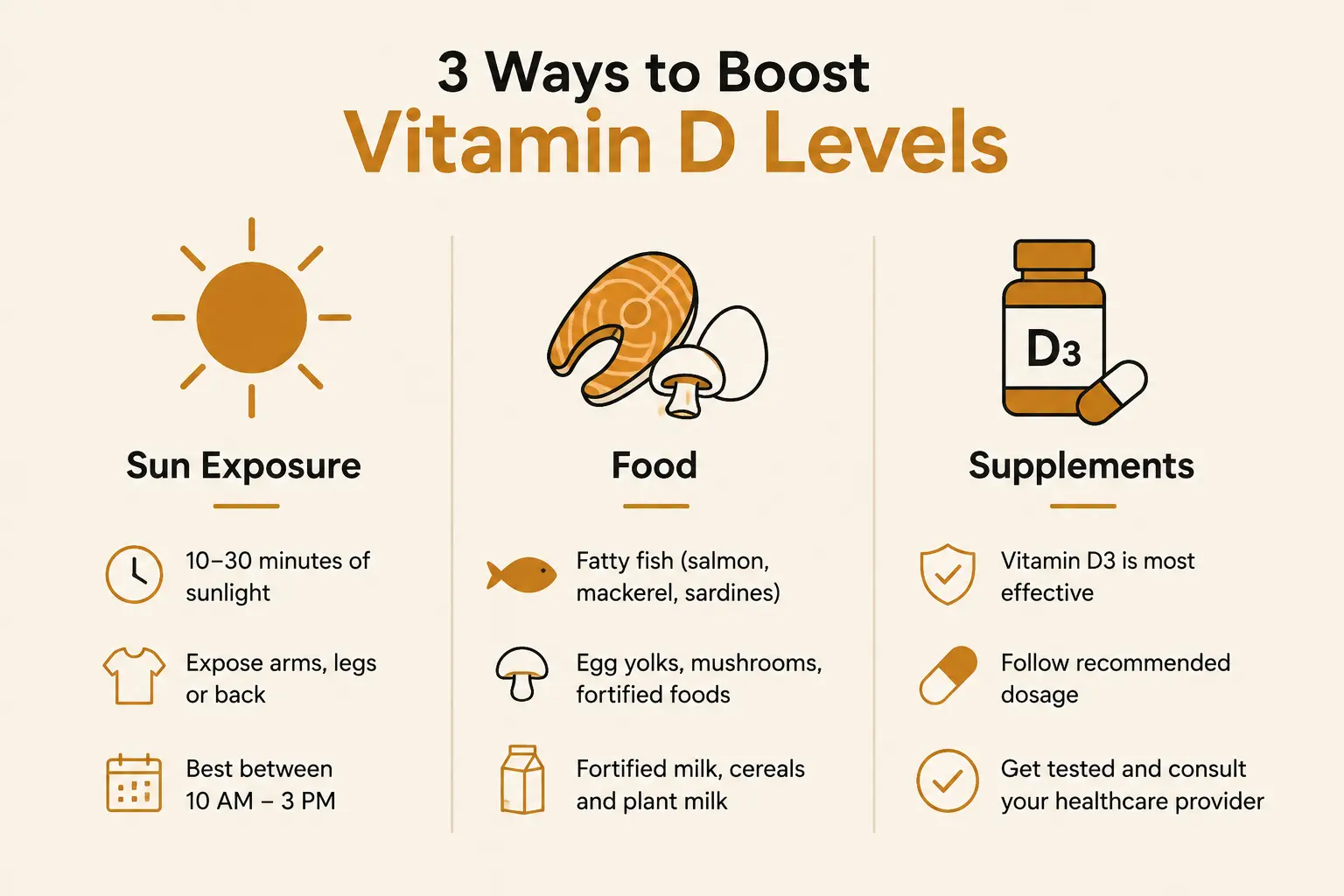
Roughly 5-30 minutes of midday sun exposure on bare arms and legs, two to three times a week, is enough for most people with lighter skin to meet their needs — but this range shifts dramatically based on skin tone, latitude, season, and sunscreen use.[4]
Vitamin D3 (cholecalciferol) is generally considered more effective at raising and maintaining blood levels than D2 (ergocalciferol), and taking it with a meal containing some fat improves absorption, since vitamin D is fat-soluble.
Reduced daylight doesn't just affect vitamin D synthesis — it affects mood regulation through a related but distinct mechanism. See seasonal affective disorder for how the same winter light drop drives a measurable, treatable mood disorder in a meaningful share of people.
Food Sources
Natural food sources of vitamin D are genuinely limited, which is part of why deficiency is so common — very few foods contain meaningful amounts without fortification.[5]
| Food | Approx. vitamin D per serving |
|---|---|
| Salmon (100g, cooked) | ~500-1,000 IU |
| Mackerel or sardines (100g) | ~200-500 IU |
| Egg yolk (1 large) | ~40 IU |
| Fortified milk or plant milk (1 cup) | ~100-140 IU |
| Fortified breakfast cereal (1 serving) | ~40-100 IU |
| UV-exposed mushrooms (100g) | ~130-450 IU (varies widely) |
For most people, food alone won't close a real deficiency — it's a helpful supplement to sun exposure and, where needed, a vitamin D3 supplement, not a replacement for either. Notably, salmon and mackerel also happen to be two of the best food sources of omega-3s, so a couple of servings a week does double duty.
Getting Tested
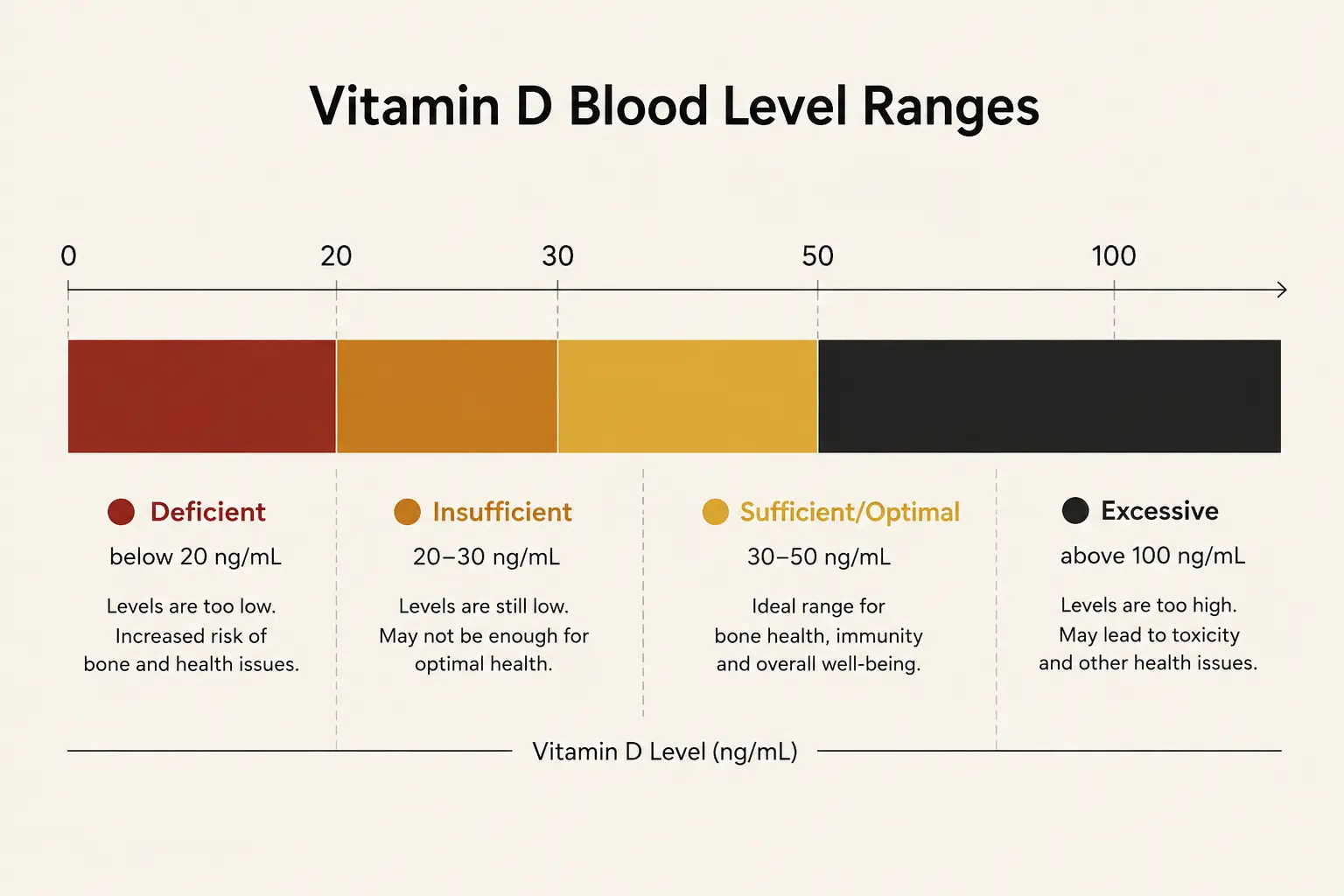
A simple blood test — the 25-hydroxyvitamin D test — is the only reliable way to know your actual level. Most labs use these general ranges:
| Classification | Blood level (ng/mL) | Blood level (nmol/L) |
|---|---|---|
| Deficient | Below 20 | Below 50 |
| Insufficient | 20-30 | 50-75 |
| Sufficient / optimal | 30-50 | 75-125 |
| Excessive | Above 100 | Above 250 |
If you have several of the risk factors above, or persistent unexplained fatigue, bone pain, or low mood, testing is worth asking a doctor about rather than starting a high-dose supplement blind. Magnesium is worth checking alongside vitamin D for the same reasons — what the evidence on magnesium for sleep and stress actually shows covers a deficiency that's similarly easy to miss on a standard blood panel.
Toxicity: Rare, But Real at High Doses
A Practical Protocol
- Get tested before supplementing heavily. A blood test tells you your actual starting point instead of guessing.
- Get sensible sun exposure where possible. Aim for 5-30 minutes of midday sun on bare skin, a few times a week, adjusted for your skin tone and climate.
- Choose D3 over D2 if supplementing, and take it with a meal that contains some fat to improve absorption.
- Start at a reasonable dose — commonly 1,000-2,000 IU/day for maintenance, higher only under medical guidance if a test shows a significant deficiency.
- Retest after about 3 months to see whether your level and dose actually match, rather than assuming the supplement is working.
Common Mistakes
- Assuming you'd feel it if you were deficient. Most people with low vitamin D have no noticeable symptoms at all.
- Relying on sun exposure alone in winter or at higher latitudes. UVB intensity drops sharply, and skin synthesis can fall close to zero for months.
- Taking a high-dose supplement without testing first or retesting later. You can't tell if the dose is right — or too much — without a number to check it against.
- Choosing D2 supplements assuming they're equivalent to D3. D3 is generally more effective at raising and sustaining blood levels.
- Taking vitamin D on an empty stomach. As a fat-soluble vitamin, absorption improves meaningfully when taken with a meal containing some fat.
Final Thoughts
Vitamin D deficiency is common enough, and quiet enough, that it's worth treating as a routine check rather than something you'd notice on your own. The official RDA is a reasonable floor, but it's not necessarily the number that gets most adults to an optimal blood level — testing removes the guesswork on both ends, from whether you're actually deficient to whether your supplement dose is doing anything at all.
The honest version of this topic: most people who are deficient feel nothing unusual. A blood test, not a symptom checklist, is what actually tells you where you stand.
If fatigue or low mood is what brought you here, it's worth reading alongside how chronic stress affects the body and insomnia vs. trouble falling asleep, since both share overlapping symptoms with low vitamin D and are worth ruling in or out separately.
This article is for general information and isn't a substitute for medical advice. Testing and supplement dosing decisions, especially above standard maintenance doses, should be made with a doctor.
Sources
[1] Global and regional prevalence of vitamin D deficiency, pooled analysis of 7.9 million participants. Available at: ncbi.nlm.nih.gov
[2] Vitamin D deficiency symptoms overview. Available at: clevelandclinic.org
[3] Optimal vitamin D supplementation doses in the general population. Available at: pmc.ncbi.nlm.nih.gov
[4] Physical determinants of vitamin D photosynthesis. Available at: ncbi.nlm.nih.gov
[5] Dietary sources of vitamin D. Available at: pmc.ncbi.nlm.nih.gov
[6] Vitamin D toxicity — a clinical perspective. Available at: ncbi.nlm.nih.gov