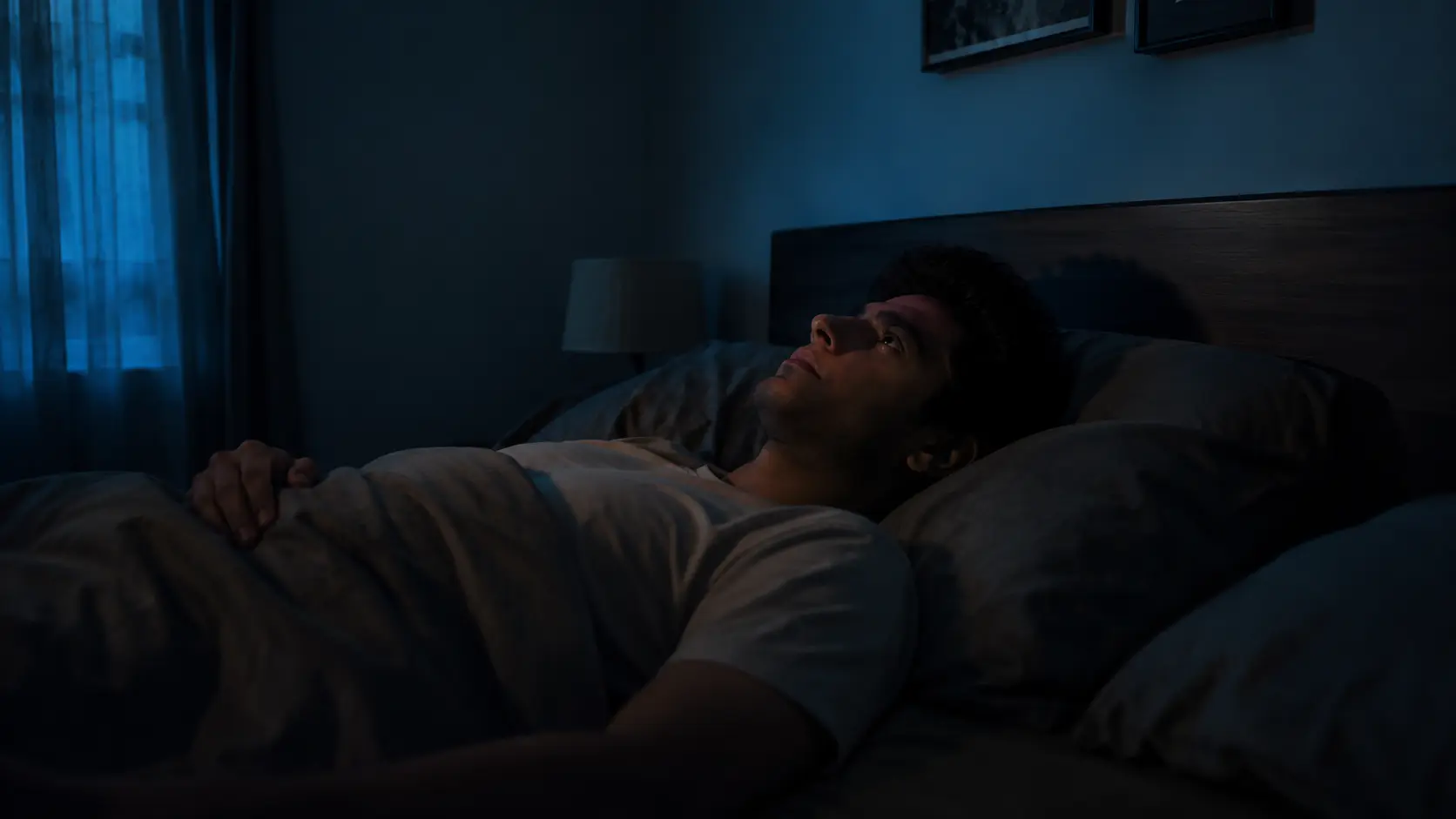
"I have insomnia" and "I had trouble falling asleep last night" get used interchangeably, but they describe genuinely different situations that call for genuinely different responses. One is a common, usually temporary experience that responds well to changing a habit or two. The other is a diagnosable condition with specific clinical criteria, and — this is the part that trips people up — it usually does not resolve with the same fixes that work for an occasional bad night.
Conflating the two is one of the more common reasons people feel like they've "tried everything" for their sleep and nothing works. If the underlying problem is chronic insomnia and the attempted fix was better sleep hygiene alone, the mismatch — not a lack of effort — is why it didn't help.
They're Not the Same Problem
An occasional night of lying awake, unable to switch off — before a big day, after too much coffee, during a stressful week — is close to universal. It is uncomfortable, but it is not, on its own, insomnia in the clinical sense, and it typically resolves once the trigger passes or a habit changes.
Insomnia disorder is a specific, defined condition. According to the DSM-5, it involves difficulty falling asleep, staying asleep, or waking too early and being unable to get back to sleep, occurring at least 3 nights a week for at least 3 months, causing real distress or daytime impairment, despite having adequate opportunity and circumstances to sleep.[1] The frequency and duration thresholds matter — a rough week is not insomnia disorder by this definition, even though it feels awful in the moment.
The Three (Really Four) Types of Insomnia
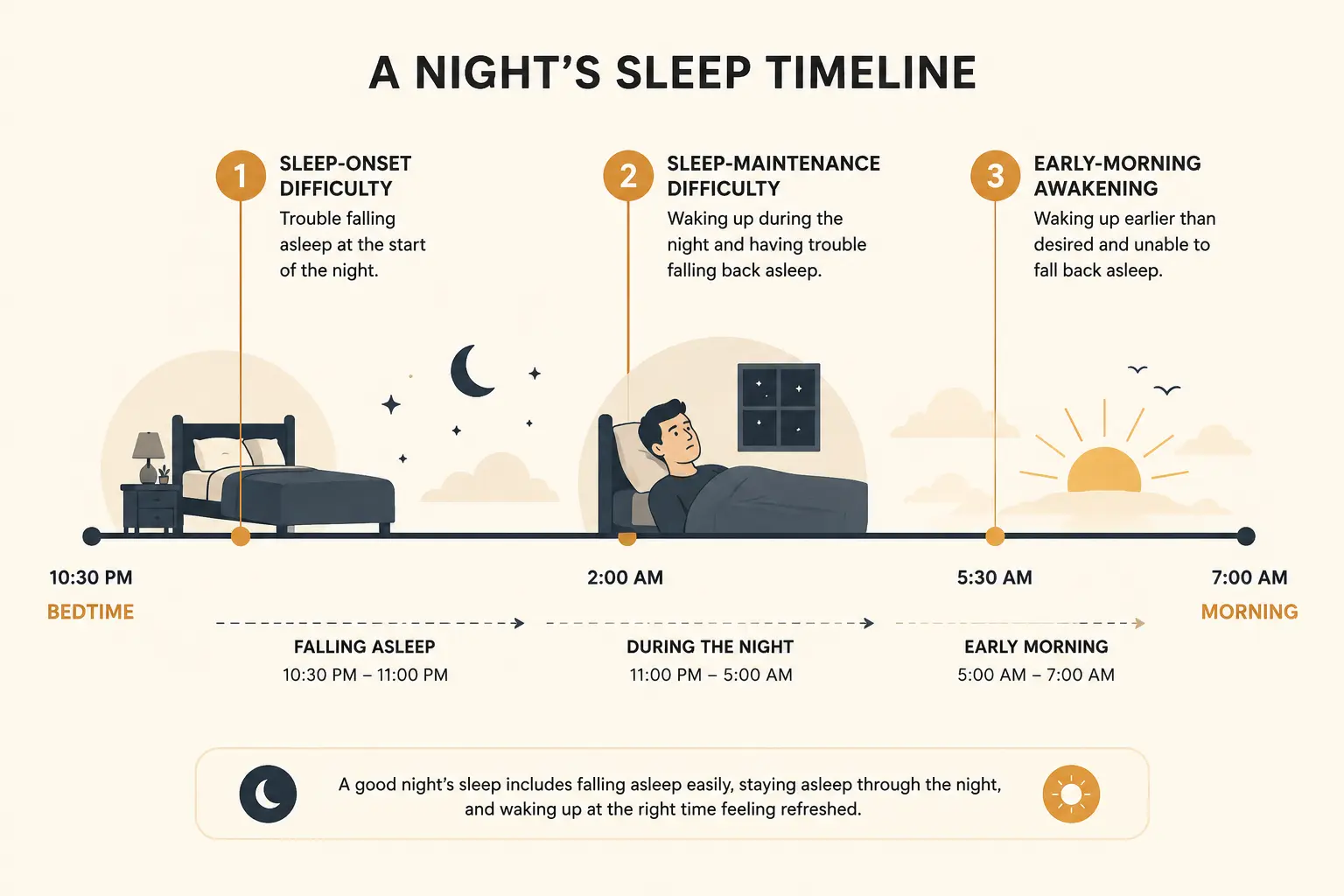
Beyond the occasional-vs-chronic distinction, insomnia itself isn't one thing. It shows up as one of three patterns, or — most commonly in clinical settings — a mix of more than one.
Mixed insomnia — a combination of two or more of these patterns — is actually the most common presentation seen clinically, affecting an estimated 40-60% of people with chronic insomnia.[2] Knowing which pattern (or combination) applies to you is the first real diagnostic step, because it points directly at the likely cause.
Why the Causes Differ by Type
This is the crux of why "the fix is different for each" isn't just a catchy framing — the research on typical causes really does diverge by which pattern you have.
This is exactly why an optimised sleep environment and a consistent wind-down routine can meaningfully help someone with sleep-onset trouble while doing very little for someone whose real issue is undiagnosed sleep apnea waking them at 3am. Same symptom category — "trouble sleeping" — genuinely different mechanism. Seasonal light changes add another layer worth ruling out — seasonal affective disorder disrupts both sleep timing and mood through the same reduced-daylight mechanism.
Why the Fix Has to Match the Cause
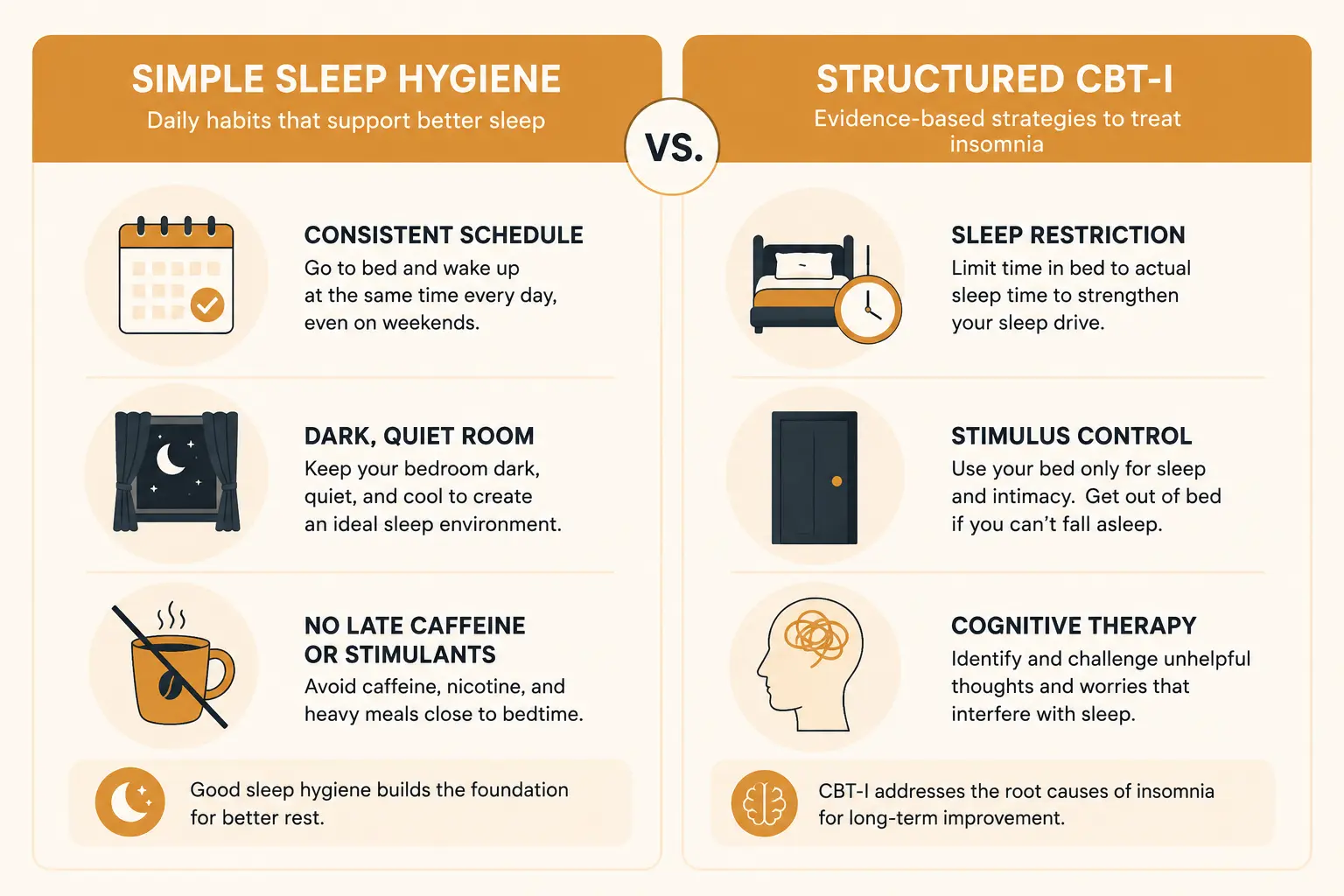
For occasional, behaviorally-driven sleep-onset trouble, the fixes most people already associate with "good sleep hygiene" are genuinely effective: a consistent schedule, cutting caffeine early enough given its long half-life, a cooler and darker room, and winding down rather than scrolling right up to lights-out. A magnesium supplement sometimes gets added to this list too — what the evidence on magnesium for sleep actually shows covers where it genuinely helps and where the claims outrun the research.
For diagnosed chronic insomnia — regardless of which type — clinical guidelines recommend cognitive behavioral therapy for insomnia (CBT-I) as the first-line treatment, and it consistently outperforms sleep medication in studies looking beyond the first few weeks.[3] CBT-I is not the same thing as sleep hygiene advice — it's a structured, multi-component approach:
- Sleep restriction. Temporarily limiting time in bed to closely match actual sleep time, which builds sleep pressure and improves sleep efficiency. Of all individual CBT-I components studied, sleep restriction has shown the largest single effect on insomnia severity.[3]
- Stimulus control. Going to bed only when sleepy, and getting out of bed if unable to sleep after roughly 20 minutes, to break the learned association between bed and wakefulness. This has been shown to improve both sleep latency (time to fall asleep) and overall sleep efficiency.[3]
- Cognitive therapy. Directly addressing the anxious, catastrophising thoughts about sleep itself ("I'll never fall asleep," "tomorrow is ruined") that often become part of what's keeping the cycle going.
Which One Applies to You — And When to See a Doctor
A simple way to sort this for yourself: has the difficulty happened at least 3 nights a week for 3 months or more, and is it noticeably affecting your daytime functioning — exhaustion, trouble concentrating, mood changes? If yes to both, this crosses into the territory clinical guidelines define as insomnia disorder, and CBT-I (via a doctor, sleep specialist, or a structured program) is the recommended next step, not another round of environment tweaks.
A few additional signals worth taking seriously: loud snoring, gasping, or choking sounds during sleep (possible signs of sleep apnea, which needs its own evaluation and is not something CBT-I alone addresses), sleep problems that started right alongside a new medication, and sleep disruption alongside a significant mood change. Any of these warrant a conversation with a doctor rather than continued self-management. If you want a lower-stakes starting point to get a general read on your own sleep patterns, the free Sleep Quality Estimator is a reasonable first check before deciding whether this looks like an occasional issue or something worth a clinical conversation.
Common Mistakes
- Treating chronic insomnia as a habits-only problem. If sleep hygiene changes haven't helped after a genuine, consistent effort and the pattern still meets the 3-nights/3-months threshold, the next step is a clinical conversation, not another environment adjustment.
- Extending time in bed to "give sleep more chances." Counterintuitively, spending more time in bed while not actually sleeping tends to weaken the bed-sleep association further — the opposite of what stimulus control aims to fix.
- Using alcohol as a sleep aid. Alcohol can shorten the time it takes to fall asleep while significantly disrupting sleep maintenance later in the night — often directly causing the 3am waking pattern people are trying to solve.
- Napping to compensate for a bad night. Can reduce the sleep pressure that would otherwise help you fall asleep more easily the following night, particularly relevant for anyone dealing with sleep-onset difficulty specifically.
- Ignoring snoring or gasping as "just how I sleep." A potential sign of sleep apnea, which requires its own diagnosis and treatment path entirely separate from CBT-I or sleep hygiene.
Final Thoughts
An occasional restless night and clinical insomnia sit on the same spectrum but are functionally different problems, with different causes and different evidence-based fixes. Sleep hygiene — a consistent schedule, a good environment, a calm wind-down — is genuinely effective for the former and a reasonable foundation for the latter, but it is not, on its own, the recommended treatment for diagnosed chronic insomnia. That distinction is what "why the fix is different for each" actually means in practice.
If you've tried the standard sleep hygiene advice consistently and it hasn't moved the needle, that's not evidence you're doing it wrong. It may be evidence you're solving the wrong problem — and that a different, more structured approach is what the pattern actually calls for.
For the mechanics of why late caffeine specifically undermines sleep-onset, caffeine and sleep half-life covers the timing details, and if the deeper issue turns out to be accumulated sleep debt rather than a single bad night, sleep deprivation vs sleep debt is the natural companion read. For a structured, multi-week approach to rebuilding sleep from the ground up, the Sleep Better course covers the same foundations — schedule, environment, wind-down — as a complete two-week reset, free.
Sources
[1] DSM-5 diagnostic criteria for insomnia disorder (≥3 nights/week, ≥3 months, with distress/impairment) and prevalence estimates (5-20% for the disorder vs. ~50% reporting occasional symptoms). Summary available at: pmc.ncbi.nlm.nih.gov
[2] Prevalence of mixed insomnia (combined onset/maintenance patterns) among people with chronic insomnia. Summary available at: getmindfulhealth.com
[3] Network meta-analysis of CBT-I components, including the effect sizes of sleep restriction and stimulus control on insomnia severity, sleep latency, and sleep efficiency. Available at: sciencedirect.com