
- Magnesium is involved in more than 300 enzymatic reactions in the body, including several tied to nervous system regulation.[1]
- Small trials, mostly in older adults, show magnesium supplementation modestly improves sleep quality and reduces time to fall asleep.[2]
- The anxiety and stress evidence is weaker and more mixed — systematic reviews describe the overall evidence base as low-quality.[3]
- The RDA is roughly 400-420 mg/day for adult men and 310-320 mg/day for adult women, ideally from food.[1]
- The tolerable upper limit for supplemental magnesium specifically is 350 mg/day — food-based magnesium carries no such risk.[1]
Magnesium glycinate has become one of the most recommended sleep supplements of the past few years, and the actual research supports a real but modest effect — not the dramatic transformation the marketing around it often implies. The honest picture: magnesium plays a genuine, well-established role in nervous system function, the sleep evidence is real but concentrated in people who are actually low in it, and the stress and anxiety evidence is thinner than most content about it lets on. None of that makes it not worth knowing about — it just means the claim needs the right amount of nuance.
What Magnesium Actually Does in the Body
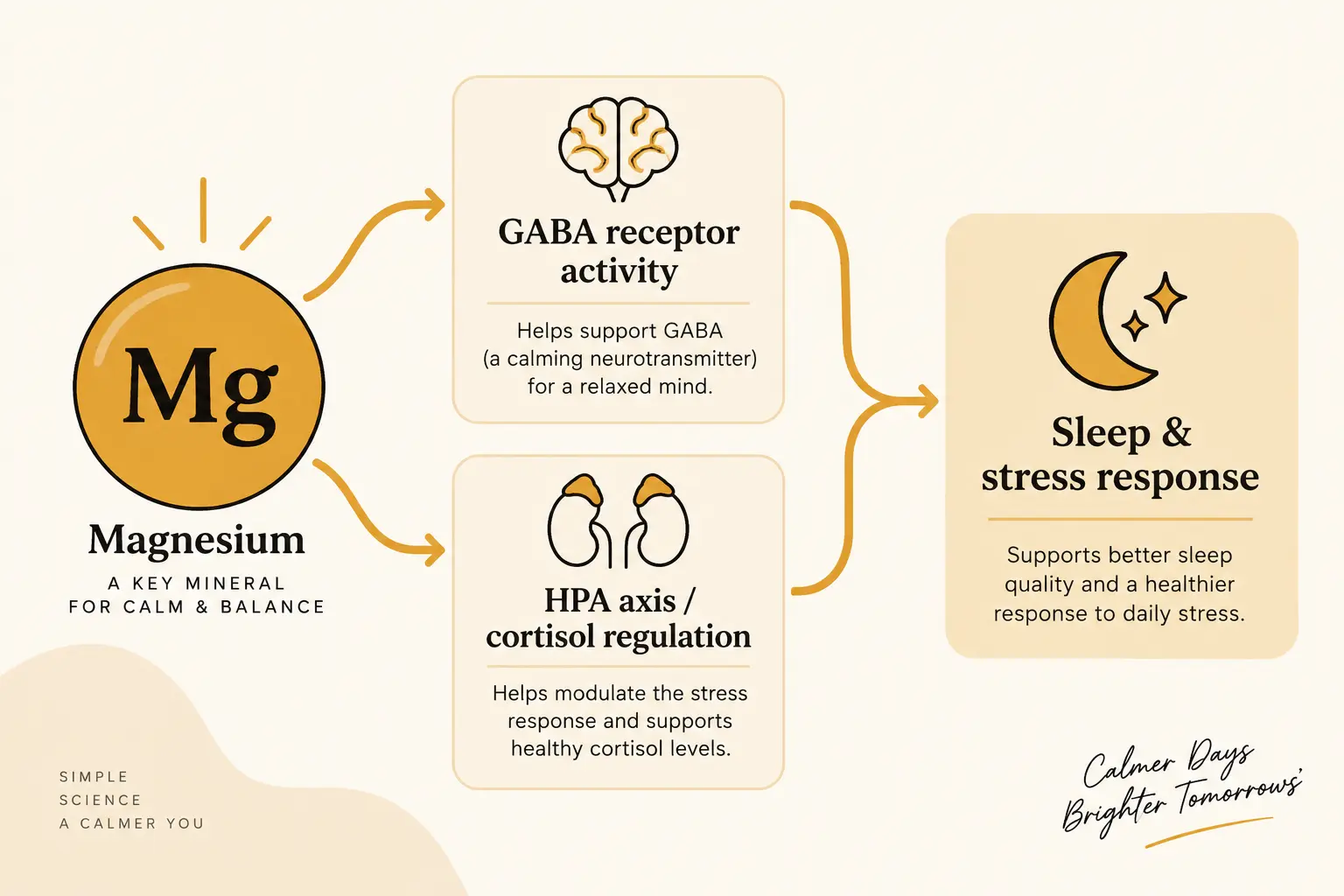
Magnesium is a cofactor in more than 300 enzymatic reactions, including several directly relevant to how the nervous system winds down.[1] It regulates the activity of GABA, the brain's primary inhibitory neurotransmitter — the one responsible for calming neural activity rather than exciting it. Magnesium also plays a role in regulating the hypothalamic-pituitary-adrenal (HPA) axis, the system that governs the body's cortisol-driven stress response. Low magnesium status has been associated, in some research, with a more reactive stress response and altered sleep architecture — which is the biological basis for why sleep and stress are the two areas magnesium supplementation gets studied for most.
The Sleep Evidence: What Studies Actually Show
A systematic review and meta-analysis of magnesium supplementation trials found modest but measurable improvements in subjective sleep quality and a reduction in the time it takes to fall asleep, primarily in trials involving older adults and people with existing insomnia.[2] The effect sizes reported are real but small — this is not the equivalent of a sleep medication, and most of the strongest results come from populations who started out low in magnesium or already struggling with sleep, not from healthy adults with no sleep complaints and adequate magnesium status.
The Stress and Anxiety Evidence: Weaker, More Mixed
The research connecting magnesium to reduced stress and anxiety is real but noticeably weaker than the sleep research. A systematic review of magnesium and anxiety-related outcomes found some trials reporting a modest benefit, but the review's own authors flagged the overall evidence quality as low — small sample sizes, inconsistent dosing, and mixed results across studies.[3] This doesn't mean magnesium does nothing for stress; it means the current evidence doesn't support strong, confident claims, and anyone marketing it as a proven anxiety treatment is overstating what the data shows.
Magnesium Glycinate vs. Other Forms
Not all magnesium supplements are the same compound — the form magnesium is bound to changes its absorption and side-effect profile significantly, which matters more for choosing a product than most labels make clear.
| Form | Absorption | Common use case | Notes |
|---|---|---|---|
| Glycinate | High | Sleep, relaxation, general use | Gentle on digestion; glycine itself has mild calming research behind it |
| Citrate | High | General deficiency correction | More likely to cause loose stools at higher doses |
| Oxide | Low | Cheap, common in multivitamins | Poorly absorbed; largely used as a laxative in higher doses |
| Threonate | Moderate | Marketed for cognition | Crosses the blood-brain barrier more readily; cognitive claims still preliminary |
| Chloride/Sulfate | Moderate | Topical (Epsom salt) or oral | Topical absorption through skin is not well supported by evidence |
Glycinate's popularity for sleep specifically comes from this combination of good absorption, low GI side effects, and the added glycine — not because glycinate itself has been tested head-to-head against other forms in large sleep trials.
Are You Actually Deficient?
True clinical magnesium deficiency is uncommon, but suboptimal intake is fairly common, and standard blood tests don't reliably catch it — roughly 99% of the body's magnesium is stored in bone and tissue rather than blood, so a normal serum reading doesn't rule out a shortfall elsewhere. Risk factors include a diet low in vegetables, legumes, nuts, and whole grains; high alcohol intake; certain medications including proton pump inhibitors and diuretics; and gastrointestinal conditions that impair absorption, like Crohn's disease or celiac disease.
How to Get Enough — Food First
| Food | Magnesium (per 100g or serving) |
|---|---|
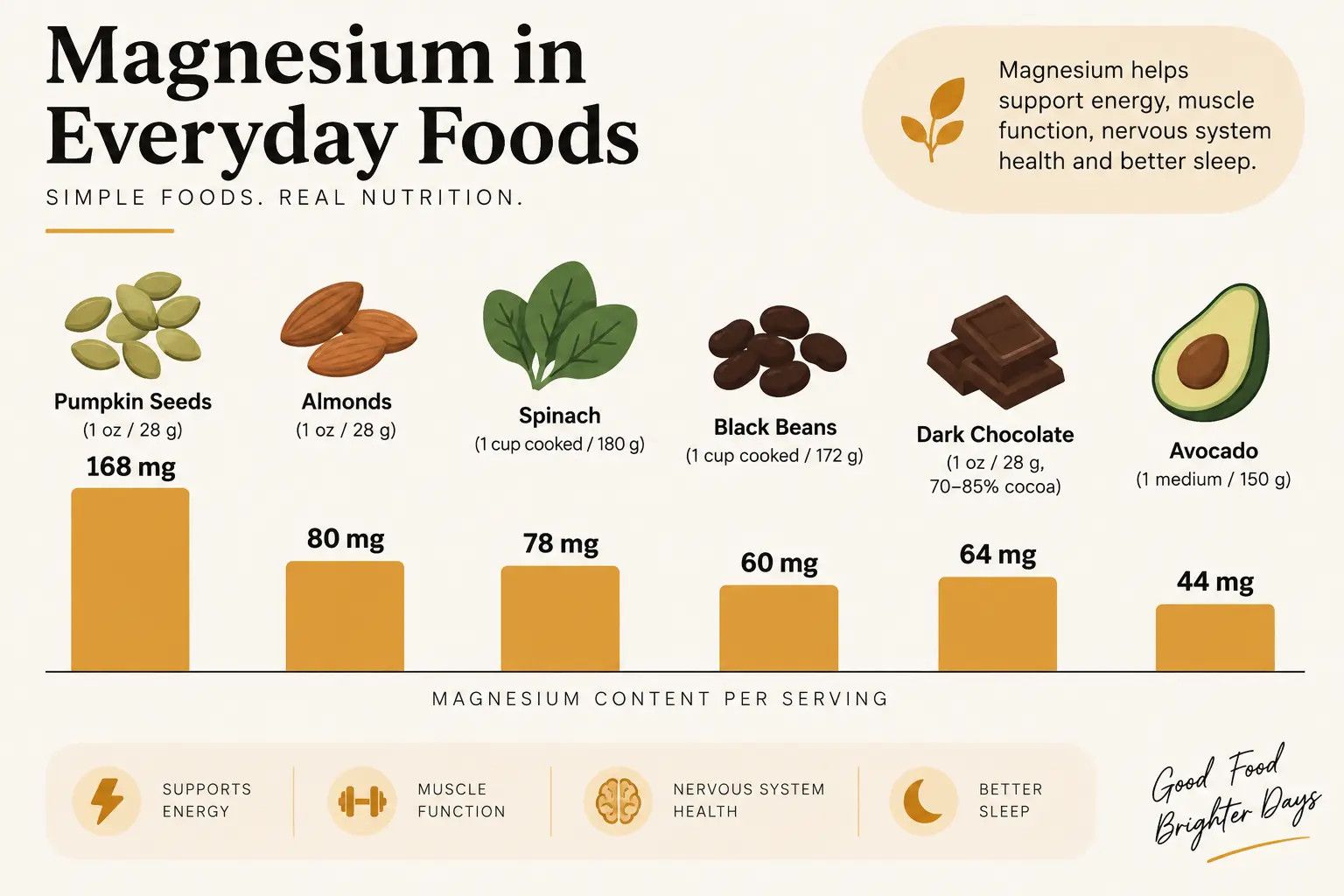
| Pumpkin seeds | ~150 mg per 28g serving |
| Almonds | ~80 mg per 28g serving |
| Spinach, cooked | ~78 mg per 1/2 cup |
| Black beans, cooked | ~60 mg per 1/2 cup |
| Dark chocolate (70%+) | ~65 mg per 28g serving |
| Avocado | ~58 mg per medium fruit |
A diet built around whole foods — vegetables, legumes, nuts, seeds, and whole grains — comfortably reaches the RDA for most people without any supplementation, which is a big part of why the general nutrition principles covered in the Eat with Intent course apply here as much as they do to any other nutrient.
If You're Considering a Supplement
For general sleep or stress support, doses in the 200-350 mg range, taken 30-60 minutes before bed, are typical in the research and in common practice. The tolerable upper limit for supplemental magnesium specifically is 350 mg/day — doses above that raise the risk of diarrhea and GI upset, though this limit doesn't apply to magnesium from food.[1]
Tracking whether a magnesium trial actually changes anything is worth doing deliberately rather than going on impression alone — the free Sleep Quality Estimator gives you a consistent baseline to compare against a few weeks in.
Common Mistakes
- Expecting a dramatic, immediate effect. The research supports a modest improvement, concentrated in people who are actually low in magnesium — not a sedative-like effect for everyone.
- Choosing oxide because it's cheapest. Poor absorption means you're often paying for a laxative effect, not the sleep or stress benefit you're after.
- Ignoring sleep hygiene and treating magnesium as the whole fix. Screen time, caffeine timing, and a poor sleep environment usually matter more.
- Exceeding the supplemental upper limit hoping for a bigger effect. More isn't better here — it mostly just causes GI upset past 350 mg/day from supplements.
- Skipping the doctor check if on other medications. Interactions with certain antibiotics and diuretics are real and worth ruling out first.
Final Thoughts
Magnesium has a genuine, well-established role in nervous system regulation, and the sleep research — while modest — is real, particularly for people who are actually running low. The stress and anxiety evidence is thinner and shouldn't be oversold. Food first is still the right general approach, and a supplement, glycinate in particular for sleep, is a reasonable thing to try if diet alone isn't closing the gap — just with realistic expectations about the size of the effect.
The honest version of this advice: magnesium is a supporting player in good sleep, not the lead. It's worth getting right, but it won't compensate for the bigger variables working against you.
For the fuller picture on sleep supplements and what the evidence actually supports beyond magnesium, how caffeine timing affects your sleep and insomnia vs. ordinary trouble falling asleep round out the picture of what's actually worth addressing first.
This article is for general information and isn't a substitute for personalized medical advice. Consult a doctor before starting any new supplement, especially if you take other medications or have kidney impairment.
Sources
[1] NIH Office of Dietary Supplements — Magnesium Fact Sheet for Health Professionals. Available at: ods.od.nih.gov
[2] Systematic review and meta-analysis of magnesium supplementation and sleep quality. Available at: pubmed.ncbi.nlm.nih.gov
[3] Systematic review of magnesium supplementation for anxiety and stress-related outcomes. Available at: pmc.ncbi.nlm.nih.gov