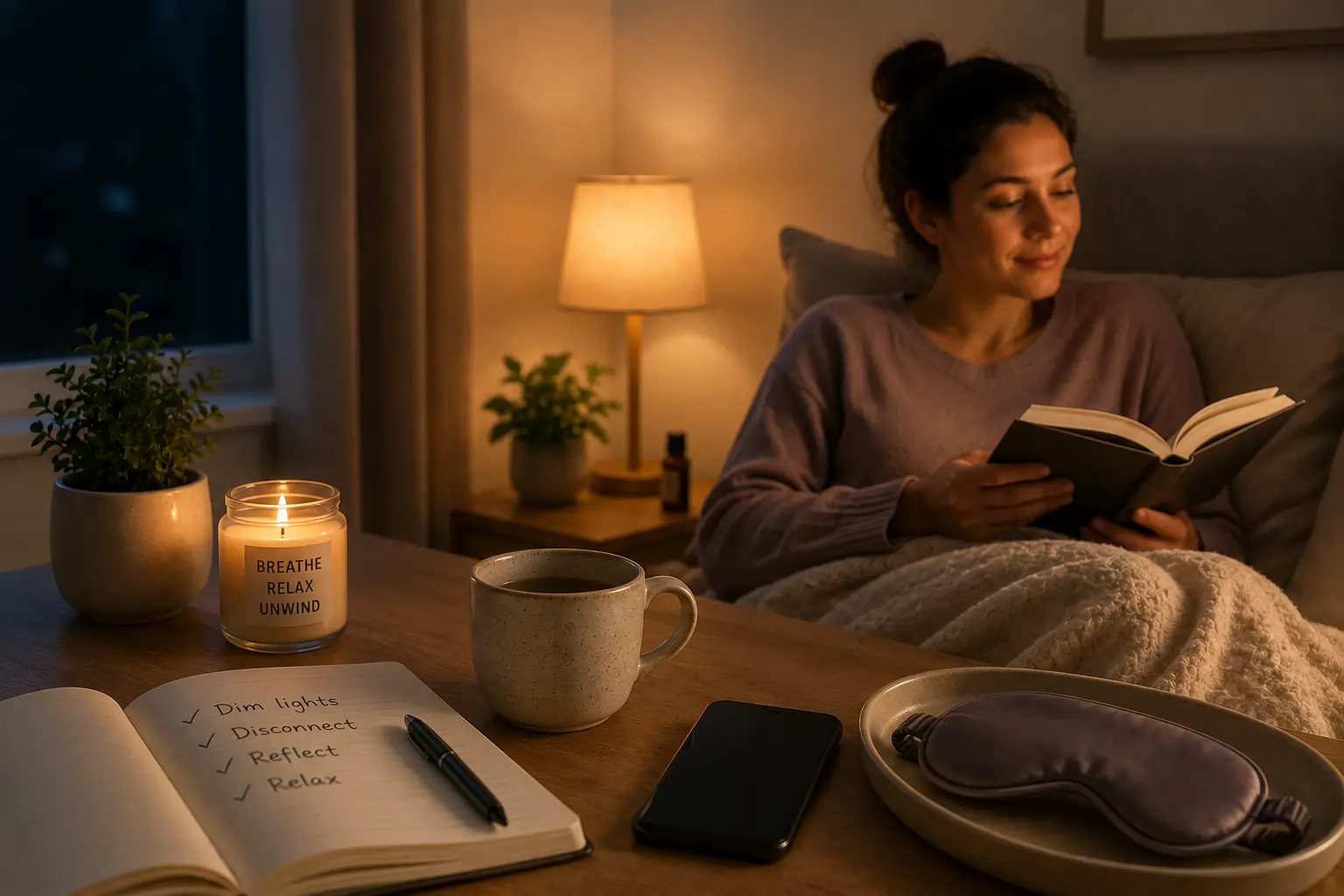
Most people treat sleep like a light switch. Functional and alert at 10:55pm, expected to be unconscious by 11:05. When that doesn't happen — when you're lying there at midnight, mind still spinning through tomorrow's emails — the conclusion is usually "I have a sleep problem."
Often, the problem isn't sleep. It's the 60 minutes before sleep, or the lack of them.
Your body doesn't switch off like a phone. Falling asleep is the endpoint of a biological transition — a gradual handoff from an alert, engaged nervous system to one that's ready to power down. That transition needs signals: dropping light levels, falling core temperature, a quieter mind, slowing heart rate. Skip the signals and go straight from bright screens and busy thoughts to "lights out," and you're asking your body to do in zero minutes what it's built to do in sixty.
This guide breaks that hour into three time-stamped phases — T-60, T-30, and T-10 — each targeting a different system that needs to wind down before sleep can arrive on schedule. There's a full timeline, ways to adapt it to shift work, parenting, or an anxious mind, and a 20-minute emergency version for the nights when a full hour just isn't realistic.
Why Most People Skip the Wind-Down (And Why That's a Mistake)
A wind-down routine sounds like a "nice to have" — something for people with more leisure time, not something that affects whether you actually fall asleep. That framing is backwards. Several physiological systems need a head start before sleep is possible, and all of them run on a timeline measured in tens of minutes, not seconds. And if the real reason you skip it is that the late evening is the only time that feels like yours, that's revenge bedtime procrastination — and it needs a different fix first.
Sunday nights are a particular test case for this. On top of the usual pre-sleep wind-down, there's often an added layer of anticipatory unease about the coming week — the Sunday scaries — that makes a deliberate transition ritual even more useful than on an average weeknight.
Here's what's actually happening in the hour before sleep, and what derails each process if you skip straight from "busy" to "bed":
| System | What needs to happen | What disrupts it |
|---|---|---|
| Core body temperature | Needs to drop by roughly 0.5–1°C to trigger sleep onset — part of why a cooling bedroom helps. | A hot room, a hot shower right before bed, or heavy exercise too close to lights-out keeps temperature elevated. |
| Cortisol | Should already be declining through the evening as part of its normal daily rhythm. (Full cortisol explainer ↗) | Stressful conversations, work emails, or doom-scrolling news right before bed spikes it back up. |
| Melatonin | Needs low light levels to begin rising 1–2 hours before your target bedtime. | Bright overhead lights and screens suppress melatonin release, delaying the whole process by 30–90 minutes. |
| Heart rate variability | Should shift toward a calmer, parasympathetic ("rest and digest") pattern. | Stimulating conversations, intense media, or anxious planning keep the body in a sympathetic, alert state. |
| Adenosine | Sleep pressure has been building all day — the body just needs the chance to act on it. | A late caffeine hit, or simply staying mentally "switched on" past the point of natural sleepiness, overrides the signal. |
That last row matters more than it looks — caffeine's effects don't end when the cup does. See how long caffeine actually stays in your system to work out whether an afternoon coffee is quietly blocking your adenosine signal by the time your wind-down routine starts.
None of these systems can be rushed. But all of them respond predictably to the right cues, given roughly an hour. That's the entire premise of a wind-down routine — not relaxation for its own sake, but giving five separate systems the lead time they need to arrive at "ready for sleep" at the same moment you turn off the light. It pairs directly with the idea of waking at the end of a sleep cycle rather than the middle of one — getting to sleep on schedule is what makes a cycle-aligned wake time possible in the first place.
The 60-Minute Wind-Down Framework
The framework below splits the hour before bed into three phases, each with a clear job. You don't need to follow it to the minute — the labels (T-60, T-30, T-10) are reference points, not deadlines.
This T-60 reset covers the highest-leverage moves, but it's a snapshot of a bigger picture. For the full research-backed targets on bedroom temperature, light, sound, and phone placement — plus the other rooms in your home that affect sleep — see the complete sleep environment audit.
| T-60 checklist | |
|---|---|
| ☐ | Lights dimmed |
| ☐ | Room cooling started |
| ☐ | Phone plugged in away from the bed |
| ☐ | Glass of water on the nightstand |
| ☐ | Tomorrow's alarm set |

The brain dump in particular has real research behind it. In a 2018 study from Baylor University, participants who spent five minutes writing a specific to-do list for the next few days fell asleep an average of nine minutes faster than those who wrote about tasks they'd already completed — measured using overnight polysomnography, the gold-standard lab method for tracking sleep onset. (Scullin et al., Baylor University, 2018) ↗ The more specific the list, the faster sleep came — which lines up with the idea that rumination, not tiredness, is often what's keeping people awake.
| Good T-30 activities | What to avoid |
|---|---|
| Reading fiction (paper or e-reader with warm/night mode) | News and social media — both reliably spike alertness and stress |
| Light stretching or yoga nidra | Phone notifications of any kind — even silent ones invite checking |
| A non-dramatic podcast or audiobook | Work chat or email "just one more check" |
| A warm shower or bath | Arguments or difficult conversations |
| Drawing, journaling, or colouring | Cliffhanger TV or anything designed to keep you watching |
| 4-7-8 breathing | |
|---|---|
| Step 1 | Inhale quietly through the nose for 4 seconds |
| Step 2 | Hold the breath for 7 seconds |
| Step 3 | Exhale slowly through the mouth for 8 seconds |
| Step 4 | Repeat for 4 full cycles |
| Alternative | Box breathing — inhale, hold, exhale, hold, each for 4 seconds, repeated |
The Complete Wind-Down Timeline
Putting it all together, here's what a full 60-minute wind-down looks like from start to lights-out:
| Time | Action | Why it works |
|---|---|---|
| T-60 | Dim all lights to warm, low lamps | Allows melatonin release to begin on schedule |
| T-58 | Lower the thermostat or open a window | Gives the room time to cool before you're in bed |
| T-55 | Plug your phone in across the room | Removes the option to check it later, when willpower is lower |
| T-50 | Quick tidy — clothes, nightstand, tomorrow's bag | Prevents low-grade "unfinished business" thoughts later |
| T-45 | Pour a glass of water, set tomorrow's alarm | Removes two small tasks that otherwise surface at T-5 |
| T-30 | Brain dump — write tomorrow's to-do list | Reduces rumination; shown to cut sleep onset time by ~9 minutes |
| T-25 | Say (or think) "I'm done for today" | Signals to your mind that no further tasks are coming |
| T-20 | Begin a light, non-stimulating activity | Keeps the mind occupied without spiking alertness |
| T-10 | Get into bed; start 4-7-8 or box breathing | Shifts the nervous system toward a parasympathetic state |
| T-7 | Optional body scan | Releases residual physical tension |
| T-3 | Final check: phone away, lights off, room cool | Removes the last common sources of late disruption |
| T-0 | Lights out | All five systems — temperature, cortisol, melatonin, HRV, adenosine — are aligned and ready |
If you're also working on when T-0 should happen, that's where the sleep cycle bedtime calculator ↗ comes in — it works backward from your wake time to a cycle-aligned bedtime, so this routine has a clear target to land on.
How to Customise This for Your Life
The 60-minute version is the full framework, but it's not the only version. A 30-minute wind-down — essentially T-30 and T-10 compressed together, skipping most of the environmental reset — captures most of the benefit if an hour genuinely isn't available. The principle that matters most is the order: environment first, mind second, body last. Compress the time, but keep the sequence.
For shift workers and irregular schedules
- Anchor the routine to "before sleep," not to a clock time. Whatever time you're heading to bed — 7am after a night shift or 11pm on a normal day — the same 60-minute sequence applies. The routine is what tells your body it's "bedtime," regardless of what the sun is doing.
- Use blackout curtains and an eye mask as part of the T-60 reset. Daytime sleep fights against natural light exposure, so the "dim the lights" step needs to be more aggressive — full blackout, not just lamps instead of overheads.
- Keep the routine identical across shift patterns. Consistency in the routine itself helps compensate for inconsistency in timing — your body learns to recognise the sequence as the cue, even when the clock varies. This connects to the same chronotype-driven flexibility covered in what your chronotype means for your schedule.
For parents with young children
- Run a shortened version after lights-out, even if it's just 10–15 minutes. The brain dump and breathing steps are the highest-value pieces if you have to cut something — they take the least time and address the two things most likely to keep a tired parent awake: a busy mind and a wired nervous system.
- Prep the environment earlier in the evening, while you still have hands free. Dim lights, set out water, and plug in your phone during your child's bedtime routine, so your own T-60 step is already done by the time you're free.
- Don't aim for perfection — aim for the sequence. Even a 5-minute version (dim lights, one-line brain dump, a few breaths) keeps the order intact, which matters more than the duration.
For anxious sleepers
- Make the brain dump longer, not shorter. If anxiety is the main barrier to sleep, give the mental handoff phase more time — 15 minutes instead of 5–10 — and be as specific as possible. Vague worries ("everything feels like too much") are harder for the brain to file away than concrete ones ("call the clinic at 9am").
- Lean on the body-first techniques. Breathing exercises and body scans work partly because they're hard to do while ruminating — they give the mind something concrete to focus on instead.
- If anxiety is a recurring barrier, it's worth looking at separately from sleep. A quick stress level check-in ↗ can help you see whether evening anxiety is part of a broader pattern worth addressing during the day, not just at bedtime. The practical stress management guide covers nineteen interventions — including the end-of-day task dump that directly targets the open-loop rumination that keeps people awake.
What to Expect in the First Two Weeks
Like any new routine, a wind-down takes a little time to become automatic — and the first attempts often feel awkward or even pointless. That's normal. Here's roughly what to expect:
If you're building this alongside other evening habits, the same stacking approach covered in the habit stack builder ↗ applies — attach the wind-down to something you already do every night (brushing your teeth, turning off the living room lights) rather than treating it as a standalone task to remember.
If you've given a consistent wind-down routine several weeks and sleep onset still hasn't improved, or the harder problem is waking during the night rather than falling asleep in the first place, insomnia vs trouble falling asleep covers when the issue has likely moved beyond what a routine change alone can fix.
Common Mistakes That Kill the Routine
- Making it too long. A 90-minute wind-down sounds thorough, but it's harder to sustain and easier to skip on busy nights. Sixty minutes — or thirty, compressed — is more realistic long-term.
- Using the brain dump as a planning session. The goal is to offload, not to solve. If writing the list turns into strategising about tomorrow's problems, it can backfire — re-engaging the exact alert, problem-solving mode you're trying to wind down from.
- Expecting perfection every night. A routine you do 70% of the time, consistently, beats a "perfect" routine you abandon after a week of disappointment. This mirrors a pattern seen across habit formation generally — see why home workout habits actually fail for the same dynamic in a different context.
- Taking a hot shower at T-10. Heat right before bed raises core temperature at exactly the moment it needs to drop. If a shower is part of your routine, move it earlier — T-30 or T-60 — so the post-shower cooling effect lines up with bedtime.
- Skipping the environment setup. It's tempting to jump straight to the "relaxing" parts — reading, breathing — and skip the lights and temperature steps. But those environmental cues are what tell your melatonin system to start the clock. Skip them, and the rest of the routine is working against a body that hasn't gotten the memo yet.
The Point Isn't the Routine. It's What It Signals.
None of the individual steps in this routine are magic. Dimming lights, writing a list, breathing slowly — none of these things cause sleep in a direct, mechanical sense. What they do is something more powerful: they teach your body to associate a specific sequence of cues with "sleep is coming."
This is classical conditioning, the same mechanism behind a thousand everyday habits. Just as a kettle's whistle becomes associated with tea time, or a gym bag by the door becomes associated with a workout, a consistent pre-sleep sequence becomes a signal your nervous system learns to respond to — lowering arousal, releasing melatonin, and shifting toward sleep readiness, often before your head even hits the pillow.
That's why consistency matters more than any individual technique, and why the first two weeks can feel like "nothing is happening." The conditioning isn't instant. But once it's established, the routine becomes one of the most reliable sleep tools available — not because any single step is powerful, but because the whole sequence becomes a cue your body trusts. One of the most effective ways to accelerate that conditioning is to reduce total screen exposure during the day — the 7-Day Digital Detox pairs well with this routine as a 7-day reset that lowers the baseline stimulation level your nervous system is carrying into the evening. The same applies on the other end of the night — a consistent morning routine bookends this one, anchoring both ends of your sleep schedule.
Quick Reference: The Minimal Wind-Down
On nights when 60 minutes isn't realistic, a compressed 20-minute version keeps the most important parts of the sequence — environment, mind, body — intact:
| Time | Action |
|---|---|
| T-20 | Dim the lights and plug your phone in away from the bed |
| T-15 | Write a quick brain dump — even 3–4 lines is enough |
| T-10 | Say "I'm done for today" and put the list away |
| T-5 | Get into bed and do one round of 4-7-8 breathing |
| T-0 | Lights out |
The wind-down is one of six lessons in the Sleep Better course — which covers the full system: sleep cycles, your environment, daily habits, and a two-week reset plan. Free, no sign-up.
A consistent wind-down routine addresses sleep onset — but if you still wake up unrefreshed despite falling asleep well, the issue may be cumulative debt rather than sleep quality. The article on sleep deprivation vs sleep debt explains the difference between one bad night and a year of short nights, including how to calculate your deficit and how long realistic recovery actually takes.
If the main obstacle to your wind-down routine is the phone — specifically social media in the hour before sleep — the account of a week without social media shows what actually happens when you remove it, why the pre-sleep shift takes until day four to appear, and which structural changes make it stick after the break ends.
Sleep quality has a direct and often underestimated effect on workout recovery: poor sleep extends the minimum rest window between training sessions, not just how you feel. The guide to rest between workouts explains the physiological mechanism — why an athlete needs 60 to 72 hours of rest on poor sleep from the same session that required only 48 hours on good sleep — and how to structure your training week to account for it.