
- The "Sunday scaries" is an informal but widely recognized term for anticipatory anxiety about the upcoming work week — not a clinical diagnosis.
- Research on anticipation consistently finds that the dread leading up to a stressor is often more intense than the stressor itself once it arrives.[1]
- The feeling typically peaks Sunday afternoon or evening and tends to ease once the work week is actually underway.
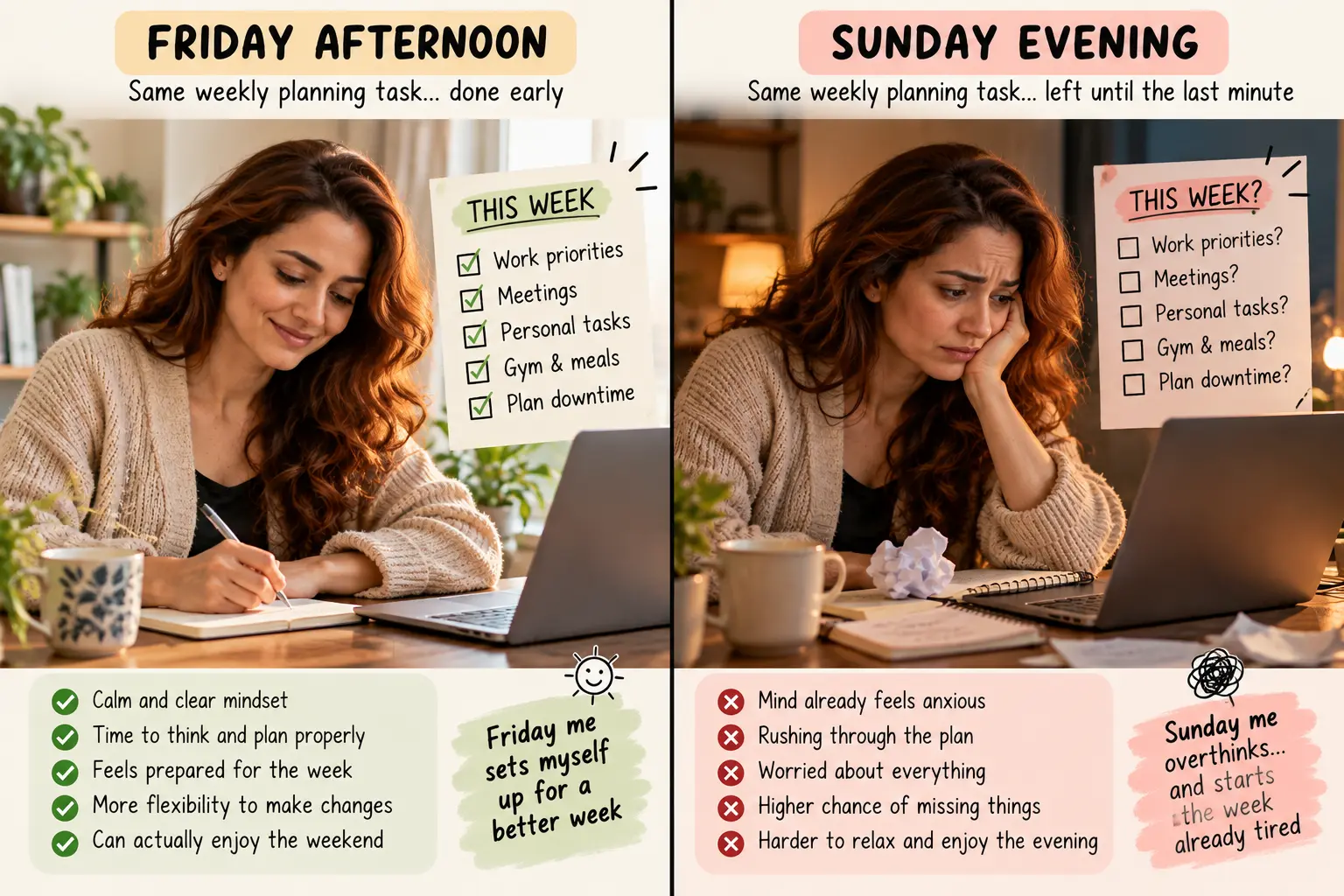
- Moving planning and task triage to Friday, rather than Sunday evening, is one of the most consistently effective practical fixes.
- Persistent, disproportionate dread that doesn't lift once the week starts may point to burnout or genuine job dissatisfaction rather than ordinary transition anxiety.
The knot in your stomach that shows up around Sunday afternoon has a name, a real psychological mechanism behind it, and — for most people — very little to do with anything that's actually happened yet. The Sunday scaries are anticipatory, which is exactly why they're so disproportionate: you're reacting to an imagined version of Monday, assembled from the worst parts of last week and whatever's sitting unresolved in your inbox, rather than to anything concrete in front of you.
What the Sunday Scaries Actually Are
The Sunday scaries describe a cluster of feelings — unease, dread, restlessness, a low-grade sense of foreboding — that build as the weekend winds down and the work week approaches. It's not a clinical term and won't appear in a diagnostic manual, but it's a real, widely recognized experience, distinct from generalized anxiety in one important way: it's situational. It's tied to a specific, recurring transition rather than being a constant, unattached state, and it typically eases once Monday actually arrives and there's something concrete to respond to.
Why It Happens — The Psychology and Physiology
Anticipatory anxiety is a well-documented pattern in which the anxiety experienced before a stressful event outpaces the anxiety experienced during it. Research on anticipation and dread has found that the period before a stressor — when the mind is free to generate open-ended, worst-case scenarios without any actual information to correct them — is often more distressing than the event itself, which at least provides structure, feedback, and something specific to respond to.[1] Sunday evening is the peak of exactly this kind of open-ended anticipation: the week hasn't started yet, so there's nothing to react to except imagination.
There's also a contrast effect at play. The unstructured freedom of a weekend — no fixed schedule, no obligations to specific people at specific times — makes the return to structure feel more jarring than it would if the two days blended more gradually into the work week. The sharper that contrast, the more pronounced the Sunday evening dip tends to feel.
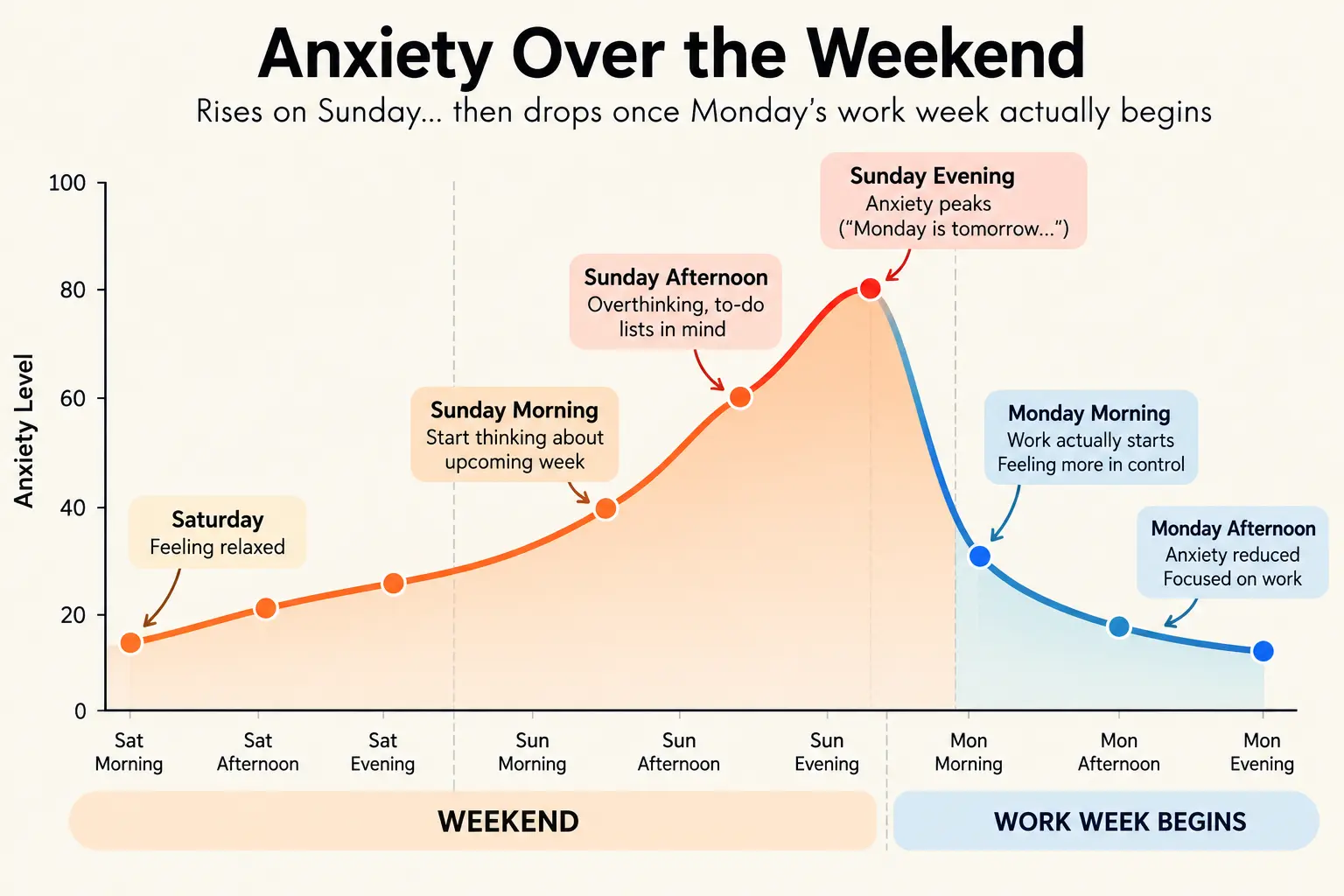
Rumination compounds the effect. Sunday evening is often the first unstructured, quiet stretch of time since the work week ended, which makes it the moment the mind finally has space to circle back to unresolved tasks, uncomfortable conversations, or a general sense of falling behind — the same rumination pattern covered in how to stop catastrophising, applied specifically to the week ahead rather than a single event.
Practical Fixes: What Actually Helps
- Move planning to Friday afternoon, not Sunday evening. A short 15-20 minute close-out — noting open tasks and a rough plan for Monday — while you're still in work mode prevents that same triage from happening during your Sunday wind-down instead.
- Build a specific Sunday evening transition ritual. A consistent, low-effort routine — laying out clothes, a short walk, prepping the next day's first meal — gives the brain a concrete signal that the transition is being handled deliberately, rather than arriving unannounced.
- Limit passive scrolling and doom-reading in the evening. Open-ended scrolling tends to feed the same undirected, worst-case-scenario thinking that drives anticipatory anxiety in the first place.
- Plan something engaging for Sunday itself, not just Monday prep. A structured, enjoyable activity on Sunday afternoon — rather than leaving the day fully unstructured — reduces the empty mental space where rumination tends to take over.
- Get some physical activity in, even briefly. Movement is one of the more reliable ways to interrupt a rumination spiral in the moment, independent of what's actually causing it.
Who Tends to Feel It Most
Not everyone experiences the Sunday scaries with the same intensity, and the differences tend to track a few predictable factors rather than being random. People whose weekends look dramatically different from their weekdays — no fixed wake time, no obligations tied to other people — tend to feel a sharper contrast effect than people whose weekends have at least some light structure carried over from the week. Jobs with a high volume of unresolved, open-ended tasks (an inbox that's never actually "done") also tend to generate more Sunday dread than roles with clearer daily boundaries, simply because there's more unfinished material available for the mind to circle back to. And people who already run a bit higher on general anxiety sensitivity tend to experience the anticipatory spike more intensely, even when the actual week ahead is unremarkable — which is one more reason a quick, honest check-in on your baseline stress level can be useful context, rather than assuming every Sunday evening dip means the same thing.
When It's More Than the Sunday Scaries
Ordinary Sunday scaries are situational — they build predictably, peak Sunday evening, and ease once Monday's structure kicks in. It's worth paying closer attention when the dread is disproportionately intense, doesn't lift once the week is actually underway, or shows up alongside broader signs like exhaustion, cynicism about work, or a persistent sense of falling behind regardless of effort. That pattern points toward something closer to burnout or genuine job dissatisfaction, where the fix isn't a better Sunday routine — it's addressing the underlying situation directly.
Common Mistakes
- Using Sunday evening to plan the entire week. This puts the most demanding cognitive task right in the middle of your wind-down window — Friday is the better slot for it.
- Leaving Sunday completely unstructured "to relax." Too much open time often creates more room for rumination, not less — some light structure tends to help more than none.
- Trying to eliminate the feeling entirely. Some anticipatory unease before a work week is normal and won't fully disappear — the goal is reducing how much of Sunday it consumes, not achieving zero anxiety.
- Assuming it's "just Sunday" when it's actually broader burnout. If the dread doesn't ease by midweek, a routine tweak won't fix what's actually a bigger, ongoing problem.
Final Thoughts
The Sunday scaries are real, common, and driven by a specific, well-understood mechanism: anticipation is often worse than the thing being anticipated. Shifting planning earlier in the weekend, building a deliberate transition ritual, and giving Sunday some light structure won't eliminate the feeling entirely, but they reliably shrink how much of your Sunday it ends up taking over.
The dread is rarely about Monday itself — it's about the open, unstructured space Sunday evening leaves for imagining it. Fill that space deliberately, and the feeling has less room to grow.
If the underlying issue is less about Sunday specifically and more about persistent overload during the week, a tiered approach to stress management is a useful next step for addressing the broader pattern.
This article is for general educational purposes and isn't a substitute for professional mental health support. If anxiety is significantly affecting your daily life, please consult a licensed therapist or doctor.
Sources
[1] Research on anticipatory anxiety and dread exceeding experienced-event distress. Available at: pmc.ncbi.nlm.nih.gov