
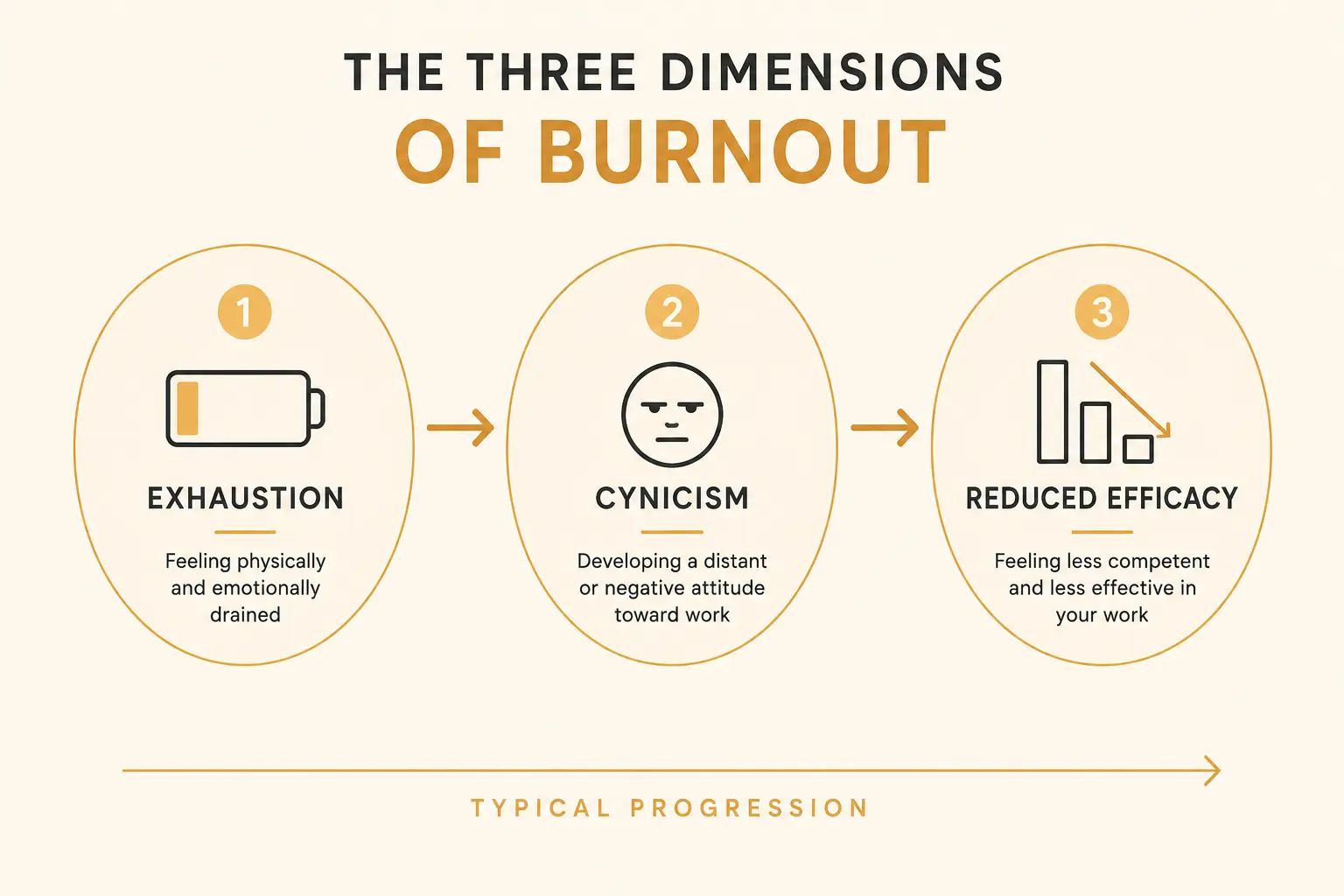
- The WHO's ICD-11 defines burnout as a syndrome from chronic, unmanaged workplace stress, with three dimensions: exhaustion, cynicism, and reduced professional efficacy.
- Recovery from mild burnout caught early often takes 3-6 weeks; moderate to severe burnout typically takes three months to a year.
- Gallup's research on nearly 7,500 employees found unfair treatment, unmanageable workload, unclear roles, poor manager support, and unreasonable time pressure are the five main causes.
- Employees who feel strongly supported by their manager are about 70% less likely to experience regular burnout.
- Burnout is situation-specific and work-related; depression is a medical condition that persists regardless of circumstances — the two are related but distinct.
Burnout recovery when you can't just quit your job comes down to changing the specific driver behind it — workload, role clarity, manager support, or time pressure — rather than simply resting harder on weekends and hoping it resolves itself. Rest alone rarely fixes burnout, because burnout is a response to conditions, and if the conditions don't change, the exhaustion returns as soon as the recovery period ends.
This matters because most burnout advice defaults to "take a break" or "practice self-care," which can help temporarily but doesn't address why the exhaustion built up in the first place. The research on burnout — its official definition, its causes, and its recovery timelines — points to a more specific and more useful answer.
What Burnout Actually Is
Burnout is officially defined by the World Health Organization as a syndrome resulting from chronic workplace stress that has not been successfully managed, with three specific dimensions — not just generic tiredness. It was added to the ICD-11 in 2019 as an "occupational phenomenon," explicitly not classified as a medical condition, and explicitly limited to the work context rather than applied to stress in other areas of life.[1]
The three dimensions, drawn from the Maslach Burnout Inventory — the research instrument the WHO definition is built on — are exhaustion, cynicism, and reduced efficacy. Severe burnout is defined as high scores on exhaustion and cynicism combined with low scores on efficacy, and research indicates it typically develops in that order: exhaustion first, then cynicism, then a decline in how effective you feel at your job.[2]
One useful early signal is whether ordinary weekly dread — the kind covered in the Sunday scaries — has stopped easing once the work week actually gets underway. Situational anticipation anxiety that resolves by Monday afternoon is normal; anticipation anxiety that persists into Tuesday or Wednesday every week is closer to a burnout marker than a Sunday-evening routine problem.
Burnout vs. Depression: How to Tell the Difference
Burnout is a response to a specific environment, usually work, while depression is a medical condition that persists regardless of circumstances — a useful practical test is whether removing the stressor eventually helps. If time away from work genuinely brings relief, that points toward burnout. If low mood, hopelessness, and loss of interest persist even away from work, that points toward depression, and burnout can also be a risk factor for depression if left unaddressed.[3]
This isn't a self-diagnosis tool — it's a starting point for deciding whether professional support is the right next step, which for persistent or severe symptoms, it usually is.
Worth ruling out separately if symptoms consistently worsen through the darker months: seasonal affective disorder shares overlapping symptoms with both burnout and depression but has its own distinct, light-driven mechanism and treatment path.
Why Burnout Happens — the Actual Drivers
Burnout is driven far more by how work is managed than by how hard someone works, according to Gallup's research on nearly 7,500 full-time employees. The study identified five main causes, and none of them are "the job is demanding."[4]
| Cause | What it looks like |
|---|---|
| Unfair treatment | Bias, favoritism, inconsistent policies, or compensation that feels arbitrary |
| Unmanageable workload | Consistently not enough time or capacity to do what's being asked |
| Lack of role clarity | Unclear expectations about what success actually looks like |
| Insufficient manager support | Little communication, feedback, or backing when things get hard |
| Unreasonable time pressure | Deadlines that don't leave room for the work to be done well |
Two figures from the same research are worth sitting with: employees who strongly agreed they felt supported by their manager were about 70% less likely to experience burnout regularly, and those who consistently had enough time to do their work were also about 70% less likely to report high burnout. Both of those are structural, not personal — which is part of why "just relax more" rarely fixes the underlying problem. That said, some people reach the overstimulation stage of burnout faster than others regardless of workload — highly sensitive people in particular tend to have a lower threshold, which is worth factoring into how much buffer you build in.
How Long Recovery Actually Takes
Recovery timelines depend heavily on how early burnout is caught: mild burnout addressed quickly often improves within 3 to 6 weeks, while moderate to severe burnout typically takes three months to a year. Chronic burnout involving depersonalization and cognitive fatigue can take six months or longer of sustained change.[5]
| Severity | Typical recovery window | What tends to help |
|---|---|---|
| Mild, caught early | 3-6 weeks | Workload and boundary changes made quickly, before cynicism sets in |
| Moderate to severe | 3 months to 1 year | Sustained changes to workload, role clarity, and support — not just a single break |
| Chronic, long-standing | 6+ months | Structural change (role, team, or job) is often necessary alongside personal recovery habits |
Recovery is also rarely linear — expect good weeks and difficult weeks even while genuinely improving, which is worth knowing in advance so a hard week doesn't feel like starting over.
What Actually Works When You Can't Just Quit
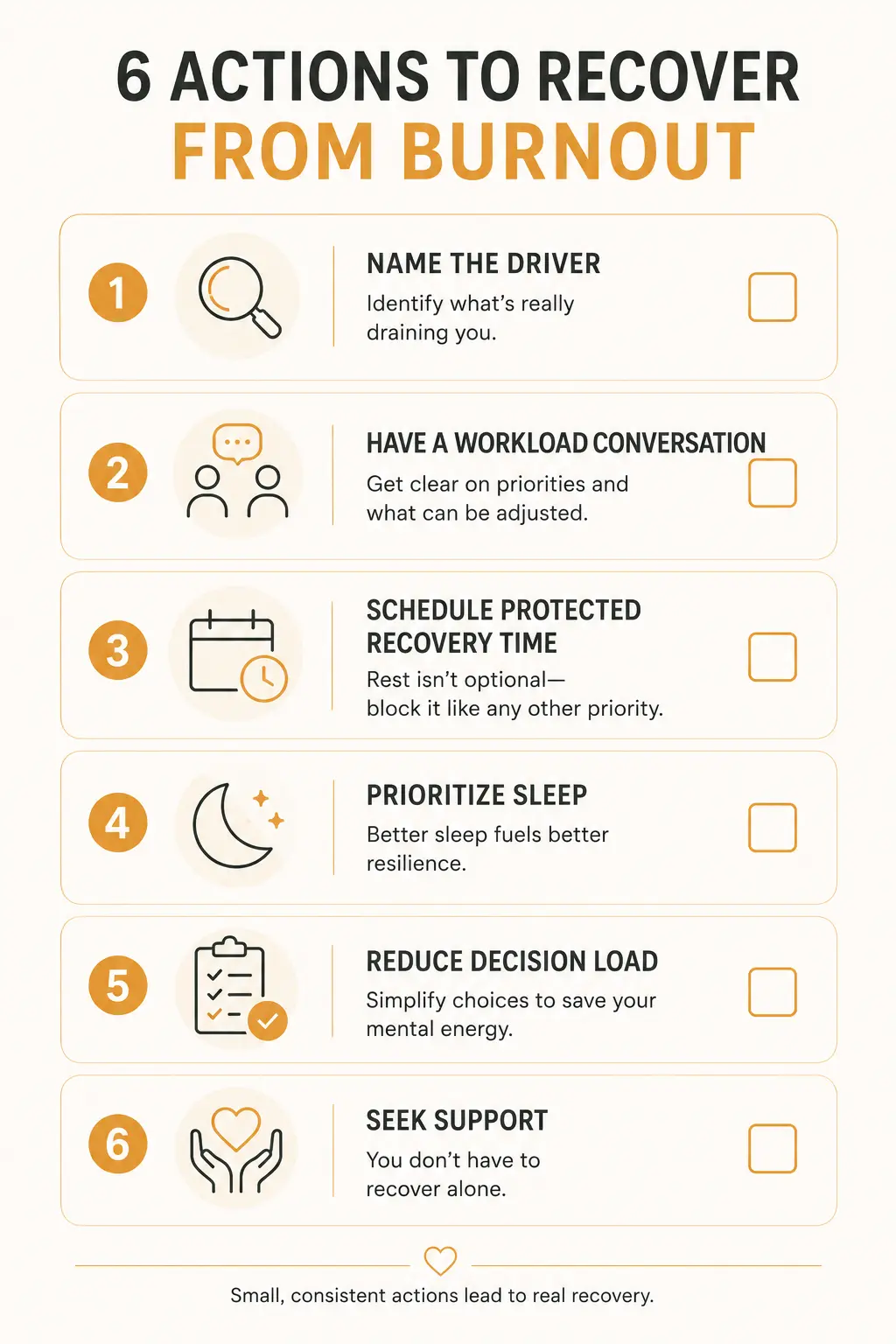
The highest-leverage actions target the specific driver identified above — workload, role clarity, manager support, or time pressure — rather than generic rest, and most of them are possible without leaving the job.
- Name the specific driver, not just "I'm burned out." Use the five Gallup causes above as a checklist. "My workload is unmanageable" and "my manager doesn't communicate expectations" require completely different fixes — treating burnout as one generic problem often means applying the wrong solution.
- Have a direct, specific conversation about workload. Vague complaints ("I'm overwhelmed") are easy to acknowledge and hard to act on. Specific asks ("I can deliver X and Y this sprint, not X, Y, and Z") are actionable and give a manager something concrete to respond to.
- Protect genuine recovery time, not just time off. A weekend spent catching up on chores and checking email intermittently isn't recovery. Recovery requires activities that are genuinely disengaged from work-related thinking — the practical guide to lowering stress without quitting your life covers specific, low-effort ways to build this in.
- Address sleep directly. Chronic stress and poor sleep reinforce each other in both directions, and sleep debt makes every other symptom of burnout worse. See sleep deprivation vs. sleep debt for how to tell how much you're actually behind and what it takes to catch up.
- Reduce decision load outside of work. Burnout often coincides with a general sense of being mentally maxed out — simplifying low-stakes daily decisions frees up capacity elsewhere. Decision fatigue, explained covers practical ways to do this.
- Get support, not just sympathy. A manager, HR, or a mental health professional can sometimes change conditions that self-directed coping cannot. If exhaustion or detachment is severe, a conversation with a doctor is a reasonable and non-drastic next step, not a last resort.
Common Mistakes
- Treating it as a willpower or productivity problem. Trying to "push through" burnout with better time management often deepens it, since the underlying driver — workload, unclear expectations, lack of support — is left unaddressed.
- Resting without recovering. Time off spent still half-engaged with work (checking email "just in case," ruminating on deadlines) doesn't provide the psychological detachment recovery actually requires.
- Waiting for cynicism to set in before acting. Because exhaustion is usually the first dimension to appear, it's also the earliest and easiest point to intervene — waiting until detachment or reduced efficacy shows up means a longer road back.
- Assuming it's depression, or assuming it definitely isn't. Neither assumption is safe to make alone. If symptoms are severe, persistent, or extend beyond work, a professional assessment is the right call rather than guessing.
- Not naming the specific driver. "I'm burned out" is a starting point, not a diagnosis — without identifying which of the five causes applies, it's hard to know what to actually change.
Final Thoughts
Burnout recovery without quitting is possible for many people, but it requires being specific about the cause rather than treating it as generalized exhaustion. The WHO's three dimensions — exhaustion, cynicism, and reduced efficacy — give a way to recognize where you actually are, and Gallup's five causes give a way to identify what's actually driving it. From there, recovery is less about resting harder and more about changing the specific condition that created the exhaustion in the first place, whether that's workload, role clarity, manager support, or time pressure.
Burnout isn't proof you can't handle your job. It's a documented response to unmanaged conditions — and conditions, unlike willpower, can actually be changed.
If workplace stress is a recurring pattern rather than a one-off season, what chronic stress is actually doing to your body over time covers the longer-term physical cost of leaving it unaddressed, and the free Stress Level Quiz gives a quick, structured read on where you currently stand.
This article is for informational purposes only and does not constitute medical or mental health advice. Burnout, chronic stress, and depression can overlap and can be difficult to distinguish without professional input. If exhaustion, hopelessness, or detachment are severe, persistent, or affecting your safety or daily functioning, please speak with a doctor or mental health professional.
Sources
[1] World Health Organization. Burn-out an "occupational phenomenon": International Classification of Diseases. Available at: who.int
[2] Maslach Burnout Inventory — three-dimension model of exhaustion, cynicism, and reduced professional efficacy. Summary available at: mindgarden.com
[3] Burnout vs. depression — distinguishing features and overlap. Available at: medicalnewstoday.com
[4] Wigert, B., & Agrawal, S. Employee Burnout, Part 1: The 5 Main Causes. Gallup. Available at: gallup.com
[5] Burnout recovery timelines by severity. Summary available at: jennifer-moss.com