- An estimated 15-20% of people have high sensory processing sensitivity (SPS), the researched trait behind the term "highly sensitive person."[1]
- About 70% of highly sensitive people are introverts — but roughly 30% are extroverts.[2]
- High sensitivity is a temperament variation, not a diagnosis or mental health condition.
- The trait is distinct from autism, which affects about 2% of people and involves a different set of diagnostic criteria entirely.
- The construct has faced legitimate scientific criticism for insufficient validation separating it from overlapping traits like anxiety.
"Highly sensitive person" gets used constantly online, often as a vague vibe rather than the specific, researched trait it actually describes. The term refers to sensory processing sensitivity (SPS) — a real personality-science construct studied since the early 1990s, present in an estimated 15-20% of people. It's not a diagnosis, and it's not the same as introversion, anxiety, or autism, though it overlaps with all three in ways that cause genuine confusion. Understanding what it actually is — and isn't — makes it a far more useful lens than the self-identification label alone.
What Sensory Processing Sensitivity Actually Is
Sensory processing sensitivity was coined and researched by psychologists Elaine and Arthur Aron beginning in the early 1990s, describing a nervous system that processes sensory, emotional, and environmental information more deeply than average.[1] It's framed as a normal variation in temperament — similar to being an introvert or extrovert — rather than a disorder. People with high SPS take in more sensory information by default, which shows up as noticing subtle details others miss, feeling more affected by loud or busy environments, and processing experiences more thoroughly before reacting.
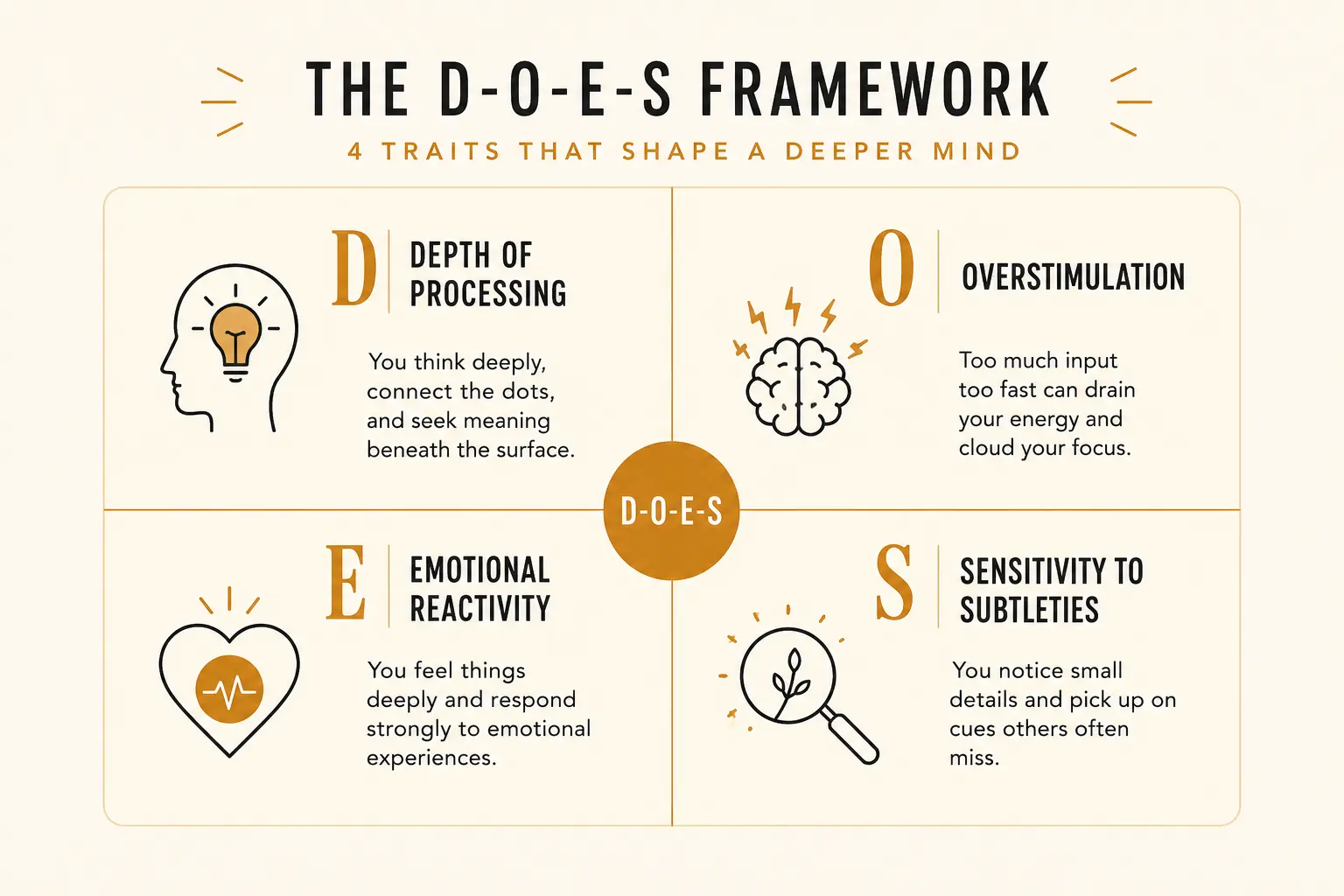
The DOES Framework
Researchers describe the trait through four core features, summarized by the acronym DOES — all four together, not just one in isolation, define the trait.
HSP vs. Introvert: Related, Not the Same
These two get conflated constantly, but they describe different things. Introversion is about where you get your energy from — solitude versus social interaction. High sensitivity is about how deeply your nervous system processes stimulation, regardless of the energy source. Research from Dr. Aron found that roughly 70% of highly sensitive people are introverts, but about 30% are extroverts who genuinely enjoy socializing while still needing more recovery time afterward than a typical extrovert would.[2] An HSP extrovert isn't a contradiction — they simply process the stimulation of social time as deeply as an HSP introvert does, and need the same kind of downtime to recover from it.
HSP vs. Autism, and HSP vs. Anxiety
High sensitivity is a personality trait variation; autism is a distinct neurodevelopmental condition.[3] Autism affects an estimated 2% of the population and involves diagnostic criteria around social communication and restricted or repetitive behavior patterns well beyond sensory processing alone. Some autistic people are also highly sensitive — which is part of why the two get confused — but one doesn't imply or explain the other, and having one doesn't mean having the other.
The relationship with anxiety is more genuinely contested. The HSP scale has faced real scientific criticism for not being rigorously validated against overlapping constructs like trait anxiety — some researchers argue the questionnaire may be capturing anxious tendencies as much as sensory processing differences.[4] This is a fair, unresolved critique worth knowing rather than ignoring: sensitivity as a temperament is a genuinely useful lens for many people, but it isn't a settled, fully validated clinical construct either.
A Quick Self-Check
These aren't a clinical diagnostic tool, but they reflect the general pattern researchers describe. If most of the following feel true, high sensitivity may be a useful lens for understanding your own experience:
- Loud noises, bright lights, or strong smells bother you more than they seem to bother most people around you.
- You notice subtle details — a shift in someone's tone, a change in a room's atmosphere — that others miss.
- You feel emotionally affected by other people's moods, art, music, or beauty more intensely than average.
- Busy or overstimulating environments leave you feeling drained faster than they seem to affect others.
- You tend to think things through deeply before acting, rather than reacting quickly.
Curious how your current stress load is affecting you day to day? The free Stress Level Quiz gives a quick read on where things stand right now, which pairs naturally with understanding a sensitivity baseline.
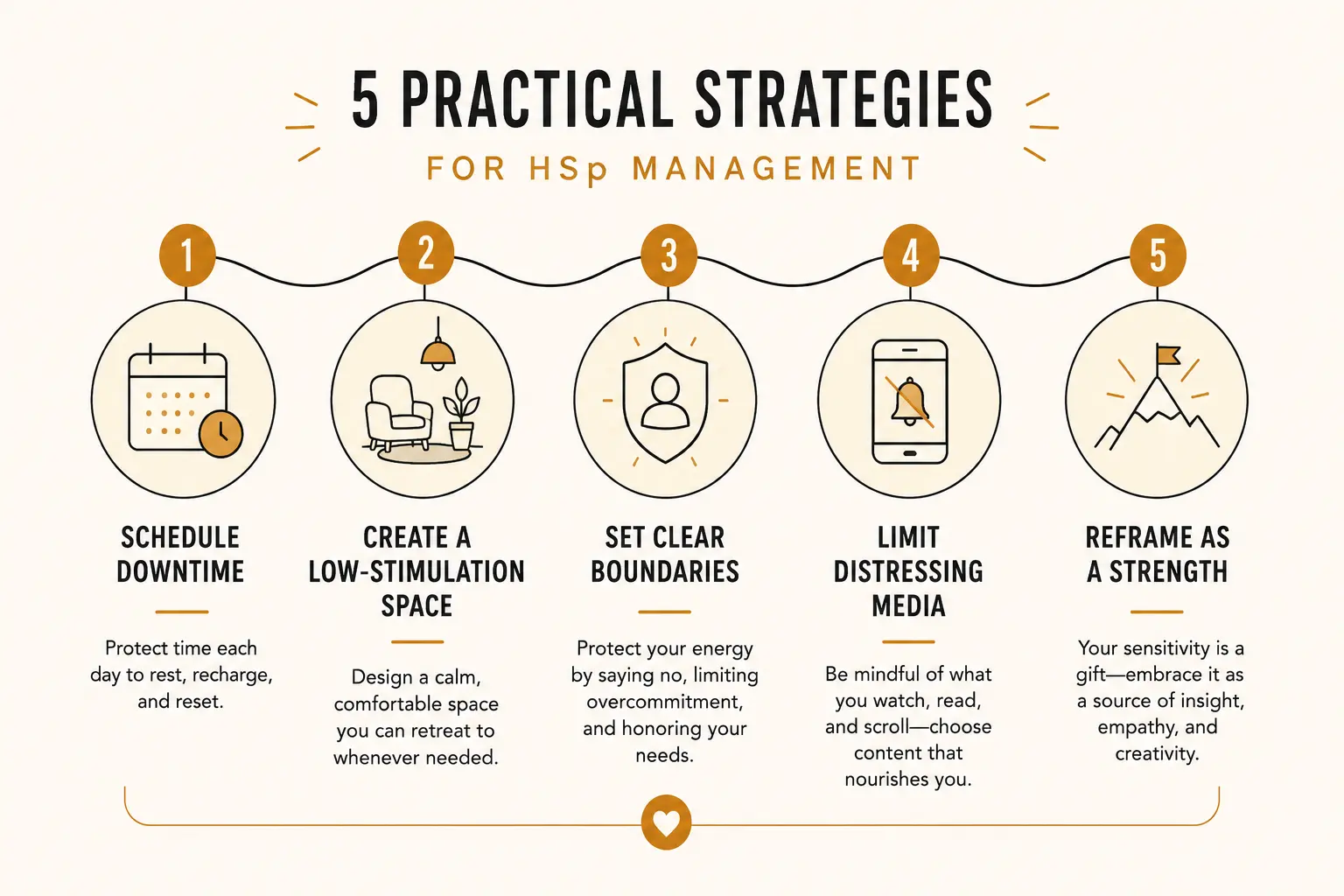
What to Actually Do With It
- Schedule downtime proactively, not reactively. Build recovery time into your calendar after socially or sensorially intense events rather than waiting until you're already overwhelmed.
- Design a low-stimulation retreat space. Somewhere with dim light and quiet you can genuinely decompress in, even for ten minutes.
- Practice saying no to draining demands. Highly sensitive people often struggle to set boundaries — treat "no" as a complete, reasonable answer.
- Limit exposure to distressing media when it isn't necessary. Deep processing means intense content lingers longer — be deliberate about what you let in.
- Reframe sensitivity as information, not a flaw. Noticing more, feeling more, and processing more deeply are also the source of genuine strengths — depth, empathy, and aesthetic appreciation among them.
Common Mistakes
- Treating "HSP" as a diagnosis to explain everything. It's a temperament framework, not a clinical label — persistent anxiety or overwhelm still deserves its own attention.
- Assuming all HSPs are introverts. Roughly 30% are extroverts with the same underlying processing depth.
- Waiting until fully overwhelmed to rest. Proactive downtime works far better than reactive recovery after burnout has already set in.
- Using sensitivity as a reason to avoid all discomfort. The trait explains a lower threshold, not a reason to never stretch outside a comfort zone.
- Ignoring the scientific debate entirely. Treating the construct as fully settled science overstates what the current research actually supports.
Final Thoughts
Being a highly sensitive person describes a real, researched pattern in how some nervous systems process the world — more deeply, more intensely, and with a lower threshold for overstimulation than average. It's not a diagnosis, not the same as introversion or autism, and not without genuine scientific debate about where its boundaries lie. What it is: a useful lens for roughly one in five to six people to understand why certain environments and experiences land differently for them — and a starting point for designing a life that works with that nervous system instead of constantly fighting it.
The honest version of this framing: sensitivity isn't something to fix. It's a trait to design around — the same way anyone builds a life around their actual temperament rather than an imagined one.
If overstimulation regularly tips into full dysregulation, what emotional regulation actually is and practical stress management techniques both build directly on the same nervous-system-aware approach covered here.
This article is for general information and isn't a substitute for professional mental health care. If sensitivity is significantly affecting your daily life, a qualified professional can help distinguish it from anxiety or other conditions that may need specific treatment.
Sources
[1] Sensory processing sensitivity: origins and core research. Available at: en.wikipedia.org
[2] Highly sensitive extroverts and the 70/30 introvert/extrovert split among HSPs. Available at: psychologytoday.com
[3] High sensitivity is not autism — key distinctions. Available at: psychologytoday.com
[4] A critical analysis of the highly sensitive person construct. Available at: psychologytoday.com