
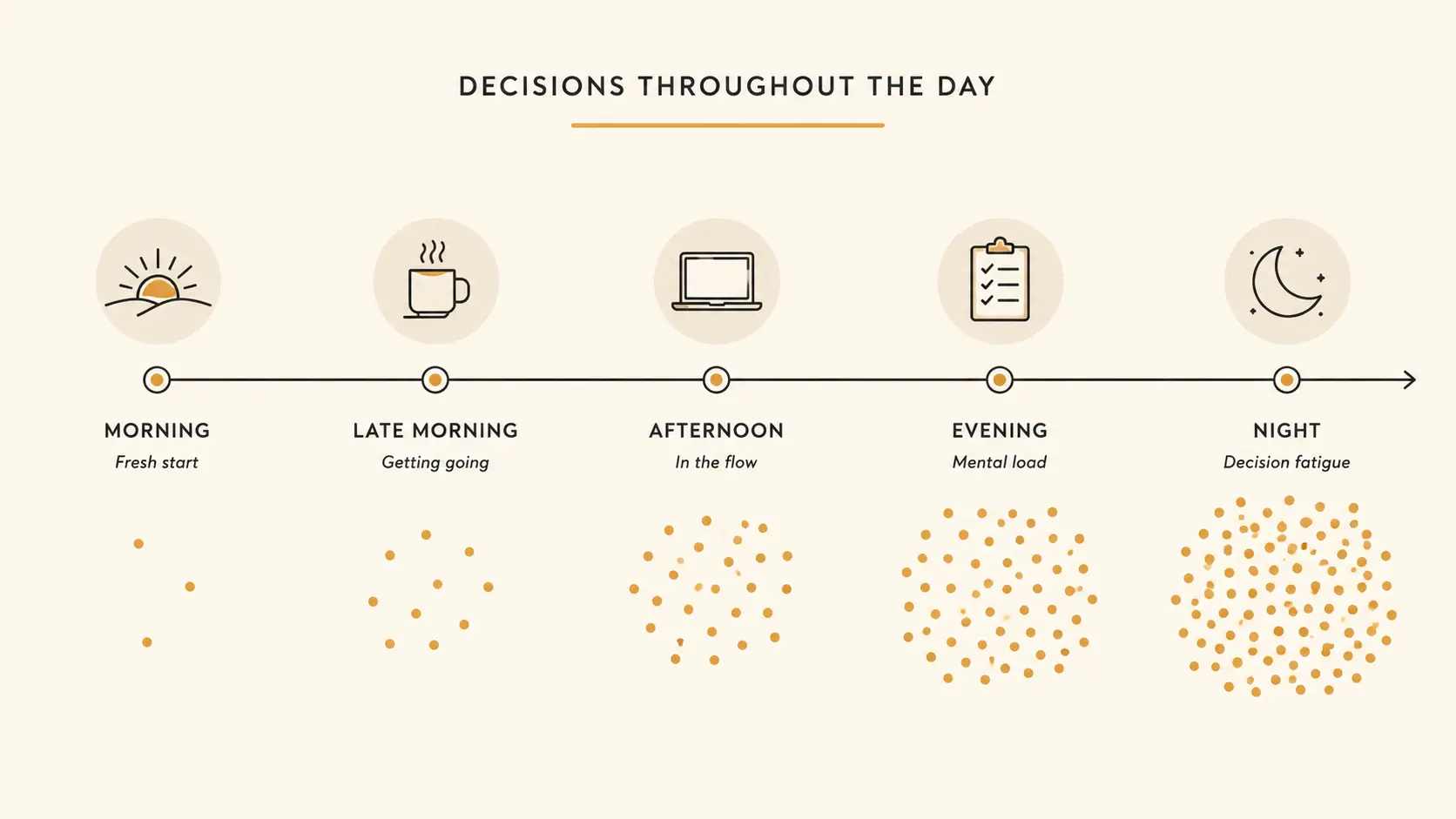
By 9pm, choosing what to watch can feel harder than the work you did that morning. Not because the decision is objectively more complex — it isn't — but because it's the hundredth or thousandth decision of the day, and something about your capacity to weigh options carefully has quietly changed since breakfast. That feeling has a name, and it's more evidence-backed than "just being tired," even though the exact mechanism behind it is more contested than most popular explanations admit.
Decision fatigue is not about physical exhaustion. It's about what happens to the quality — and the willingness — of your decision-making as the number of decisions you've already made that day climbs, and understanding the real mechanism behind it is what actually makes the practical fixes work.
What Decision Fatigue Actually Is
Decision fatigue describes a pattern: the more decisions you've made, the more likely you are to reach for the easiest option, avoid deciding altogether, or make a choice that doesn't reflect your usual judgment — regardless of how much sleep you got or how physically tired you feel. It shows up as impulsive purchases at the end of a long shopping trip, skipping the gym after a day full of small decisions at work, or agreeing to plans you didn't actually want to make because working out a polite "no" felt like too much effort.
The original explanation for this, proposed in the late 1990s, was that self-control and decision-making draw on a single, limited mental resource — willpower — that depletes with use, similar to a muscle tiring. This idea, called ego depletion, became hugely influential and shaped a generation of popular advice about willpower and productivity.
Is Decision Fatigue Actually Real? The Honest Answer
This is where the popular version of the story gets ahead of the science. Decision fatigue as a real, observable pattern of behaviour is well documented. The specific explanation for why it happens is genuinely contested, and worth understanding honestly rather than repeating the tidiest version.
The current, better-supported explanation isn't that willpower is a fuel tank that empties. It's an attention and motivation account: each decision costs mental effort, and your brain's willingness to keep investing that effort in careful deliberation decreases over a session of decisions — not because a resource ran dry, but because conserving effort and defaulting to shortcuts becomes the more attractive option as the count adds up. The observable pattern — declining decision quality, growing reliance on defaults and habits — is real and repeatedly observed. The "mental muscle running out of fuel" metaphor that made it famous is the part that hasn't held up well.
How Many Decisions Do You Actually Make in a Day?
The "35,000 decisions a day" statistic shows up everywhere in productivity content, but it doesn't trace back to a clear, well-designed study — it's a popular estimate without a solid original source, and it depends entirely on what counts as a "decision" in the first place. More carefully defined research on consciously deliberated, informed choices puts the number much lower: one study estimated around 122 informed decisions a day, with food-related choices alone accounting for roughly 227 micro-decisions when counted separately.[3]
The exact number matters less than the underlying point: even the more conservative estimates describe well over a hundred moments a day where your brain is asked to weigh options, and the overwhelming majority of them are low-stakes — what to wear, what to eat, which email to answer first, whether to say yes to a request. None of these individually matter much. The cumulative mental load of all of them competing for the same limited attention is where the real cost sits.
Signs Decision Fatigue Is Affecting You
- Reaching for the default late in the day, even when it's not what you'd normally choose. Ordering the same takeout again, wearing whatever's on top of the pile, agreeing to the first suggestion in a group chat rather than weighing in.
- Feeling disproportionately drained by small, objectively easy choices. Standing in front of the fridge for five minutes unable to decide on a snack is a classic marker — the difficulty isn't the decision itself, it's everything that came before it.
- Avoiding decisions entirely by procrastinating on them. Leaving an email unanswered, a form unfilled, or a purchase undecided not because it's genuinely hard, but because deciding at all feels like more than you have left to give right now.
- Impulsive choices that don't match your usual judgment. Late-evening online shopping, skipping a planned workout, or a snack decision that contradicts what you'd choose earlier in the day, when deliberation felt easier.
How to Actually Reduce Decision Fatigue
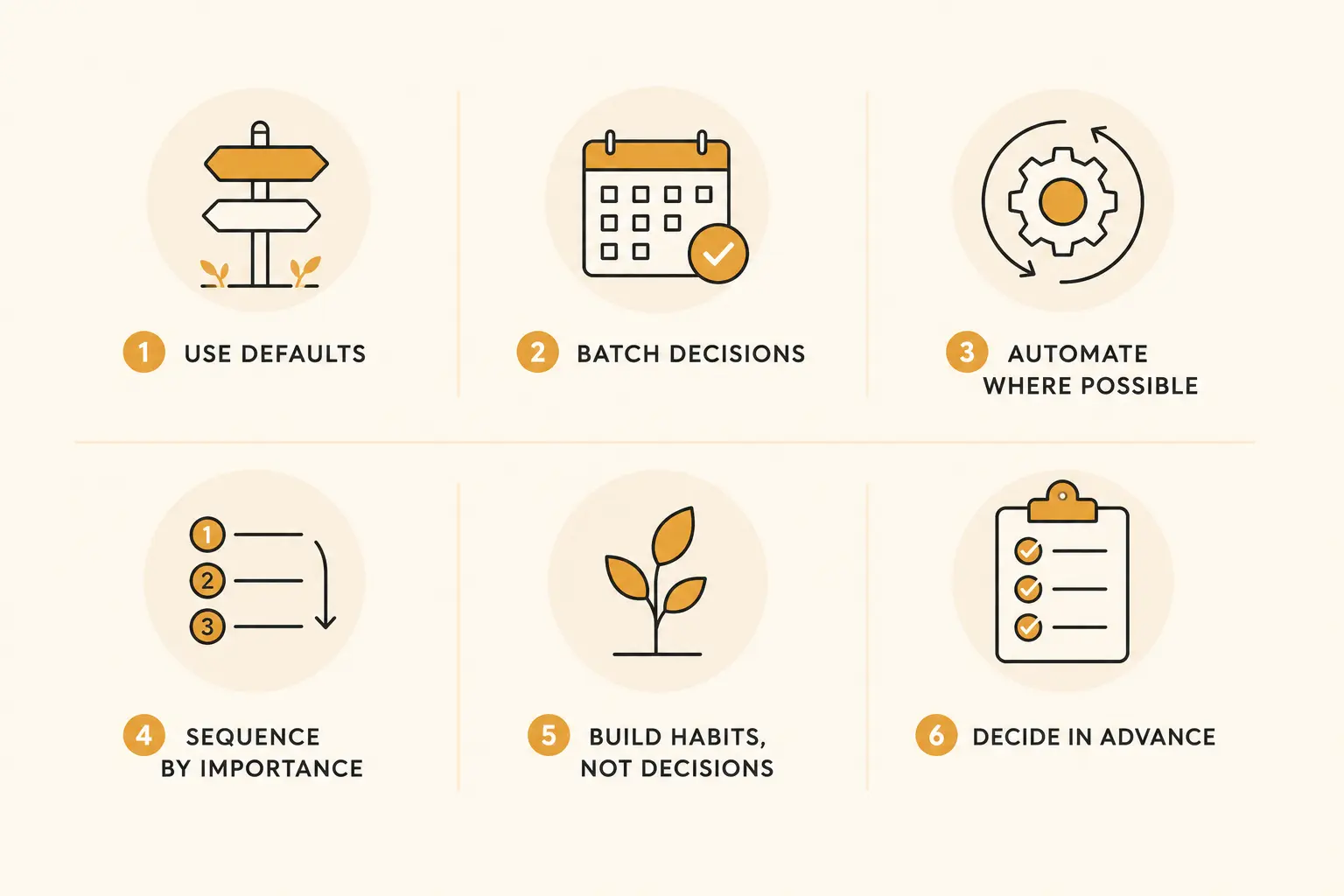
Since the more useful account of decision fatigue is about total decision volume and effort conservation rather than a resource running dry, the fixes that work best reduce the number of low-value decisions competing for your attention — not just techniques for pushing through fatigue once it's already set in.
A small rotating set of work outfits, a fixed weekly meal rotation, a standard breakfast — removes the decision entirely rather than making it faster.
Plan the week's meals in one sitting rather than deciding daily; answer all similar emails in one block instead of throughout the day. The same logic applies to sorting a photo library — batching by event rather than deciding on thousands of individual images is what makes that task survivable.
Autopay for bills, a standing grocery list, subscriptions instead of repeat purchase decisions — each one is a decision made once instead of repeatedly.
Put your highest-stakes decisions early in the day, before lower-priority choices have used up your appetite for careful deliberation.
A habit that runs on a fixed trigger (same time, same cue) removes the daily "should I do this now" decision altogether.
Decide your response to common situations in advance — a standard answer to "want to grab a drink on a weeknight" — so the same decision isn't relitigated every time.
This is the same underlying logic behind slow living and a capsule wardrobe — both work partly because they eliminate entire categories of recurring low-value decisions, not because the remaining decisions become easier to make. Habits are the most reliable version of a default: the free Habit Stack Builder helps attach new routines to existing ones so they run on autopilot instead of requiring a fresh decision every day.
Common Mistakes When Trying to Reduce Decision Fatigue
- Trying to eliminate every decision, including meaningful ones. The goal is removing low-value, recurring decisions — not flattening genuinely important choices into defaults too. A rotating meal plan is useful; defaulting on a major life decision because you're tired of deciding is not the same category of fix.
- Confusing decision fatigue with procrastination. They're related but distinct — procrastination is active avoidance of a specific decision, often from discomfort, while decision fatigue is a broader decline in deliberation quality across many decisions. Treating every stalled decision as "fatigue" can miss cases where the real issue is avoidance of one particular hard choice.
- Ignoring rest entirely because the glucose theory was debunked. The specific "willpower runs on blood sugar" explanation didn't hold up, but that doesn't mean rest, sleep, and recovery are irrelevant to decision-making generally — they still matter, just not through the mechanism originally proposed.
- Adding more decisions in the name of "optimising." Elaborate decision-making frameworks and productivity systems can themselves become a new source of decision load if they require constant tending and adjustment.
Final Thoughts
Decision fatigue is real as an observable pattern — your judgment does shift as a day of decisions accumulates — even though the tidy "willpower is a muscle that runs out of fuel" explanation behind it has not held up well under scrutiny. The more accurate picture is that your brain increasingly conserves effort and reaches for shortcuts as decision volume climbs, which means the actual fix isn't pushing through fatigue with more willpower. It's reducing how many low-value decisions you're asking yourself to make in the first place.
You don't need more discipline to fight decision fatigue. You need fewer decisions competing for the same attention — which is a design problem you can actually solve, not a willpower problem you have to white-knuckle through.
If mental clutter feels like a bigger pattern than just decisions — spilling into your physical space, your schedule, and your phone as well — digital minimalism tackles the same underlying problem from the technology side.
If reducing decision load isn't enough on its own and the underlying exhaustion is specifically tied to work, it may be worth checking whether what you're dealing with has crossed into burnout — a distinct, more specific condition with its own recovery approach.
Sources
[1] Danziger, S., Levav, J., & Avnaim-Pesso, L. Extraneous factors in judicial decisions. Proceedings of the National Academy of Sciences, 2011 (methodology subsequently disputed by other researchers). Summary available at: pnas.org
[2] Hagger, M.S. et al. A Multilab Preregistered Replication of the Ego-Depletion Effect. Perspectives on Psychological Science, 2016. Available at: replicationindex.com
[3] Research estimates on daily informed decisions (approx. 122/day) and food-related decisions (approx. 227/day). Summary available at: cnbc.com