
It's past midnight. You're tired — properly tired, the kind where your eyes sting — and you have to be up early. You know you should go to bed. Instead you open one more video, scroll one more feed, start one more episode. Not because it's especially fun, but because this is the first time all day that nobody needs anything from you.
That pattern has a name: revenge bedtime procrastination. It's one of the most relatable sleep problems going, and also one of the most misunderstood — because the usual advice ("just put your phone down") ignores why you picked it up in the first place. This guide covers what it is, why it happens, what it costs, and fixes that work on the cause, not just the symptom.
What Is Revenge Bedtime Procrastination?
The research term is simply bedtime procrastination, introduced by Utrecht University researchers in 2014 and defined as "failing to go to bed at the intended time, while no external circumstances prevent a person from doing so."[1] The "revenge" part came later. It's a translation of a Chinese expression describing people with long, stressful working hours who stay up late to take back some personal time, and it spread worldwide on social media around 2020.[4]
Three features separate it from simply having a late night:
- You intended to go to bed earlier. The delay isn't the plan — it's a gap between plan and action.
- Nothing external is stopping you. No deadline, no crying baby, no late shift. You could go to sleep.
- You know it's costing you. You expect to feel worse tomorrow, and you stay up anyway.
Why You Do It: The Psychology Behind It
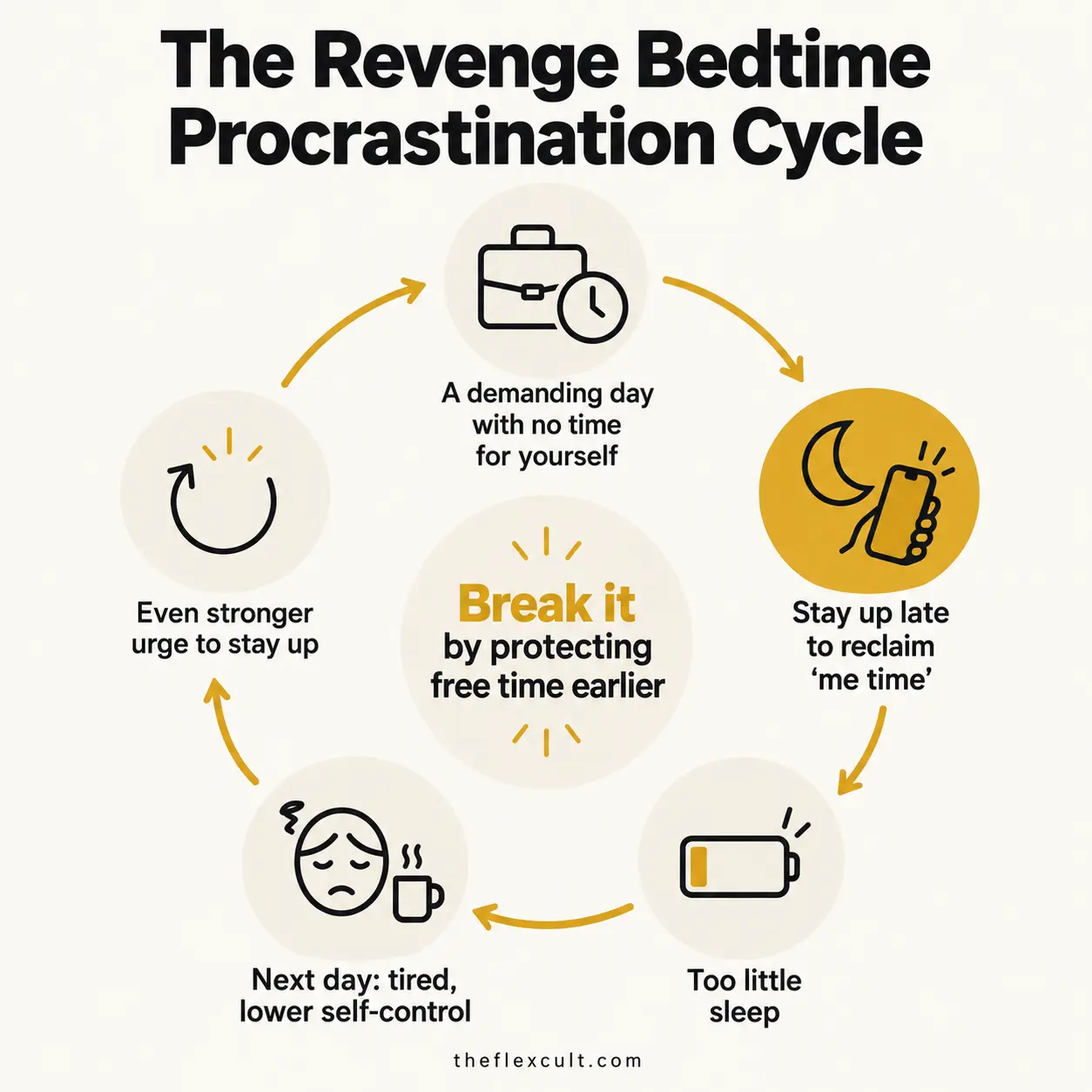
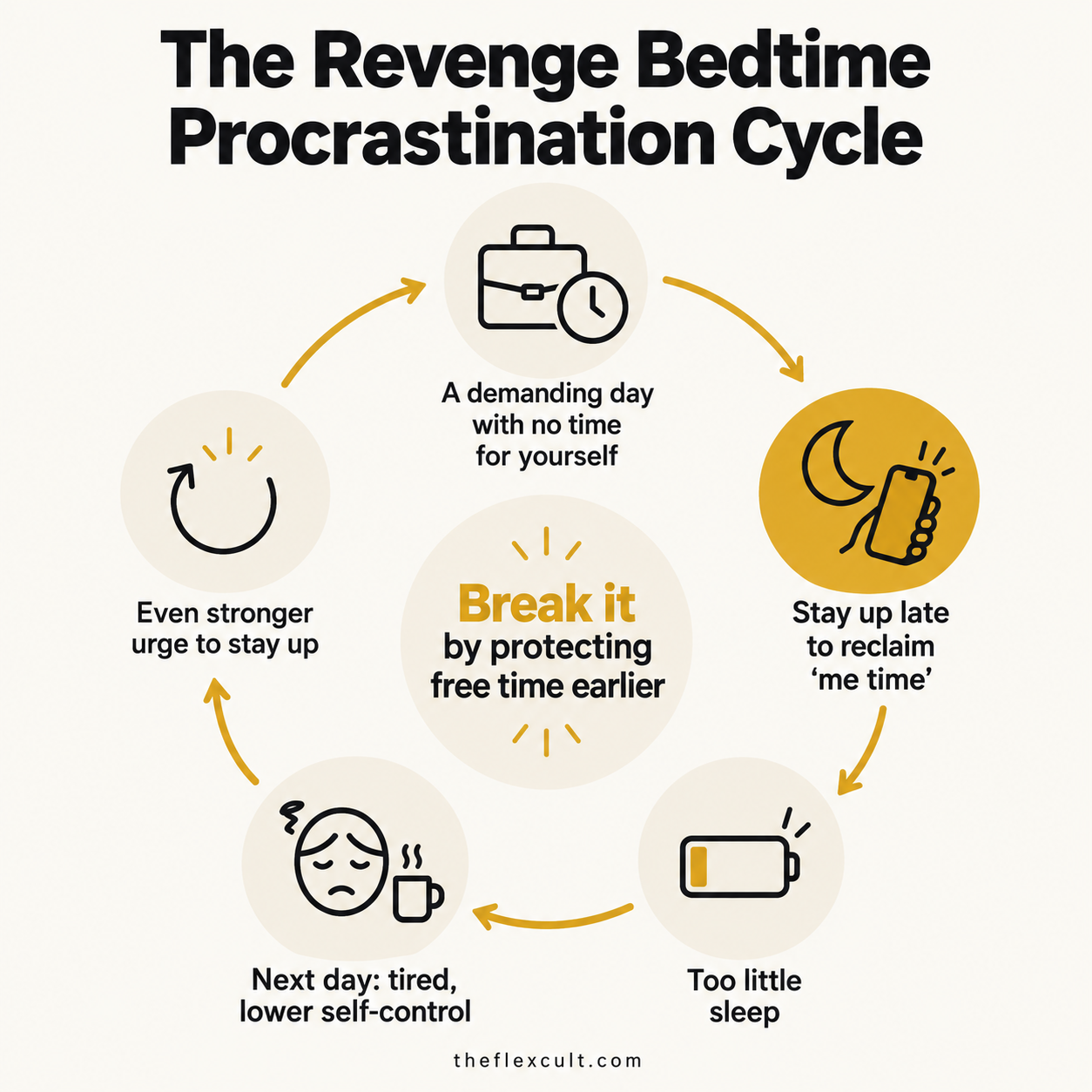
Revenge bedtime procrastination isn't laziness or a lack of discipline in the usual sense. It's what tends to happen when a demanding day meets a tired brain. Four forces usually work together:
-
A day with no time that felt like yours When work, commuting, caregiving and chores fill every waking hour, the late evening becomes the only stretch with no obligations. Giving it up for sleep feels like losing the last part of the day that belongs to you.
-
End-of-day depletion In a 2018 study of 218 adults, people who had spent more effort resisting temptations and demands during the day — especially later in the day — procrastinated more at bedtime.[2] Self-control is lowest exactly when the decision to go to bed has to be made.
-
Instant rewards vs a distant benefit The payoff of one more video is immediate. The payoff of going to bed — feeling better tomorrow — is hours away. Tired brains reliably favour the instant option, which is the same loop behind doomscrolling.
-
Endless, autoplaying content Feeds, autoplay and "next episode in 5 seconds" remove natural stopping points. Without a clear end, "five more minutes" quietly becomes an hour.
The original 2014 study also found that people with lower general self-regulation reported more bedtime procrastination.[1] That doesn't mean the fix is "more willpower." It means relying on willpower at 11:45 p.m. — when you have the least of it — is a plan built to fail. That's also why decision fatigue and bedtime procrastination often show up together.
Who It Affects Most
Anyone can do it, but it's most common when daytime feels out of your control. Research is still early, but students, women, night owls and people who procrastinate in other areas of life appear more prone to it.[4] In practice, these groups tend to recognise it instantly:
- People in long-hours or high-pressure jobs
- Parents of young children, whose only quiet time starts after bedtime
- Shift workers and people with long commutes
- Night owls whose natural rhythm already runs late — your chronotype matters here
- People recovering from, or heading toward, burnout
What It Actually Costs You
The 2014 study found that bedtime procrastination predicted insufficient sleep, even after accounting for demographics and self-regulation.[1] And sleep is where the "revenge" backfires. The American Academy of Sleep Medicine and Sleep Research Society recommend that adults sleep 7 or more hours a night on a regular basis. Regularly sleeping less is linked with weight gain, high blood pressure, heart disease, depression, weakened immunity, more errors and a higher risk of accidents.[3]
Losing an hour a night doesn't feel dramatic, but five work nights of it is a full night's sleep lost every week. That gap accumulates as sleep debt — and you adapt to feeling tired, so you stop noticing how much it's costing.
There's also a quieter cost: the time you "win back" usually isn't restful. Scrolling at 1 a.m. is rarely the relaxing, fulfilling free time you were craving. You're giving up sleep for something that doesn't really refill you.
Quick Self-Check: Is This You?
Answer honestly about a typical week:
- Do you regularly go to bed later than you planned?
- When it's time for bed, do you keep doing something else even though you're tired?
- Does the late evening feel like the only time that's truly yours?
- Do you often think "I should really go to bed" — and then don't?
- Do you wake up regretting how late you stayed up?
Three or more "yes" answers points strongly to revenge bedtime procrastination. The free Sleep Quality Estimator will show how much it's affecting your overall sleep, and the downloadable self-check below tracks the pattern over a week.
Practical Fixes That Actually Work
Because the behaviour has two parts — a reason (no time of your own) and a trigger (a tired brain plus an endless screen) — the fixes work best in pairs: give yourself the time, then make bedtime easier to act on.
1. Give the free time a home earlier in the evening
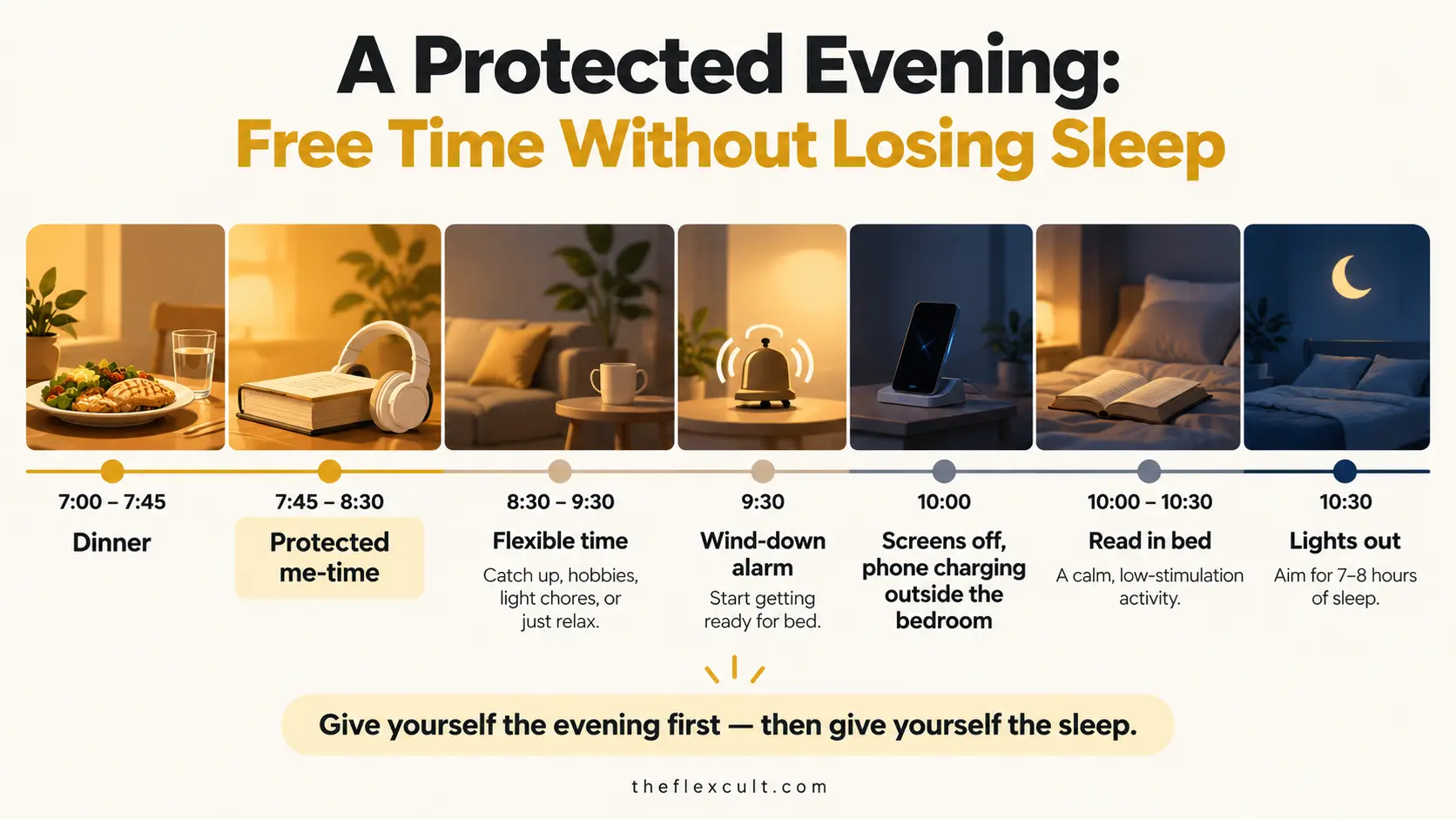
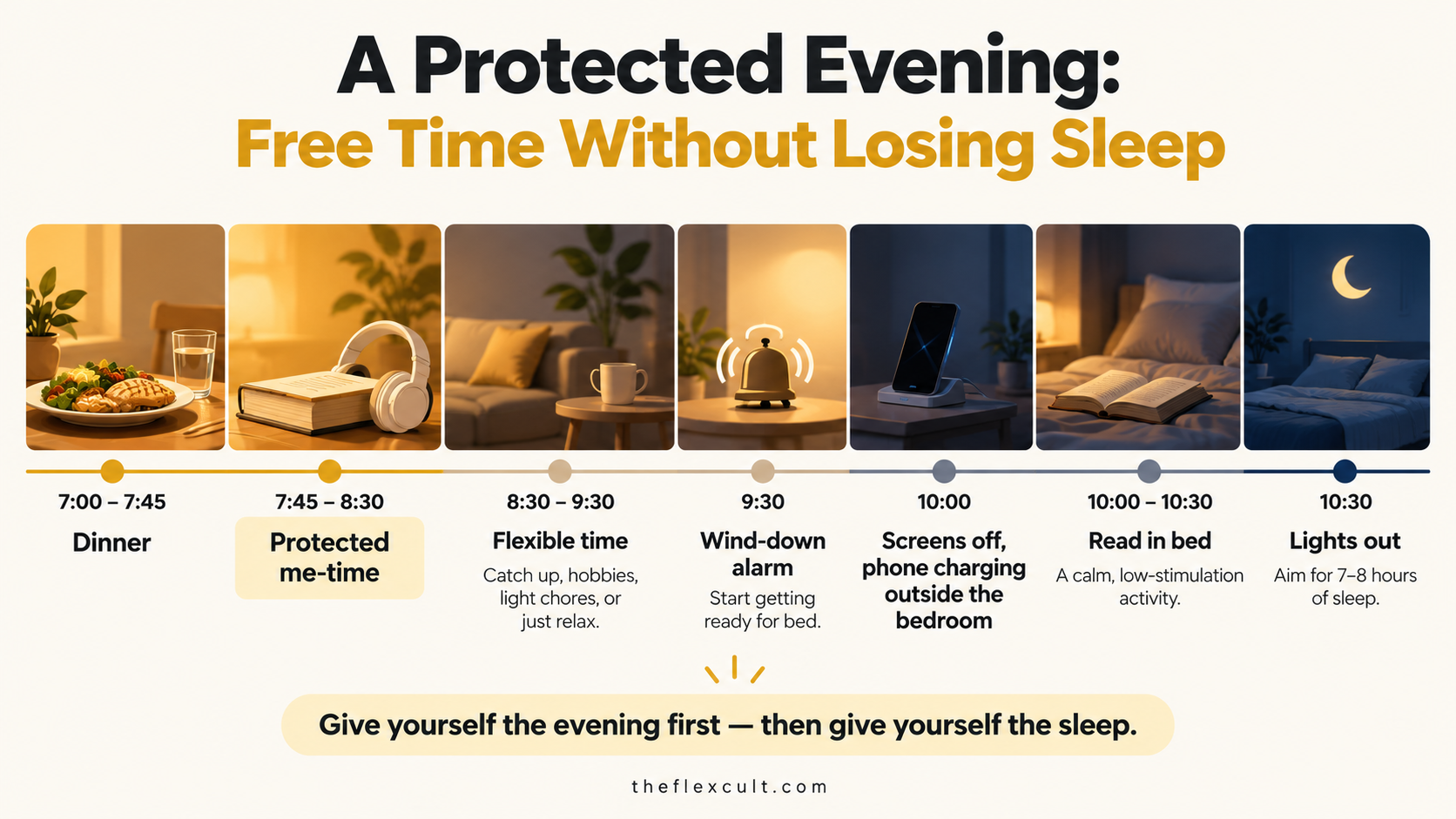
The most effective change is often the least obvious: schedule protected me-time, so it doesn't have to come out of sleep. Even 30–45 minutes, blocked off right after dinner or the kids' bedtime, takes the "revenge" pressure off later. Treat it like an appointment — no chores, no work messages.
2. Set a wind-down alarm, not just a wake-up alarm
Set an alarm for 60 minutes before your target bedtime. When it goes off, the evening shifts into wind-down mode: lights down, screens moving toward off. The 60-minute wind-down routine lays out exactly what to do in that hour.
3. Decide in advance with if-then plans
Because self-control is lowest at the end of the day, the researchers behind the 2018 depletion study suggest using pre-set if-then plans tied to cues, rather than "buckling down" in the moment.[2] Make the decision at lunch, not at midnight:
- If my wind-down alarm goes off, then I plug my phone in outside the bedroom.
- If an episode ends after 10:30 p.m., then I don't start another.
- If I catch myself scrolling in bed, then I swap to a paper book.
4. Choose me-time with a natural ending
Not all free time is equal. A chapter of a book, one episode, a bath, a phone call, journaling or a hobby all have a built-in finish line. Infinite feeds and autoplay don't. If your evening ritual is journaling instead of scrolling, it ends on its own.
5. Move the phone out of reach
Charge your phone outside the bedroom, or at least across the room. Turn off autoplay, set app limits after 10 p.m., and use your phone's bedtime or focus mode. Small amounts of friction work better than willpower. A 30-minute phone reorganisation can remove the most tempting apps from your home screen.
6. Keep your wake time fixed
A consistent wake time — including weekends — anchors your body clock, so you feel sleepy at a reasonable hour. Pick a bedtime by working backwards from it; the Sleep Cycle Calculator helps you land between cycles.
7. Shrink the daytime problem where you can
If your day leaves zero personal time, no bedtime trick fully fixes that. Look for small daytime pockets — a lunch break you actually take, a walk on the way home, a firmer end to the workday. The less starved you feel by evening, the weaker the pull to stay up.
What to Expect in the First Week
Don't try to move bedtime by two hours overnight. Pull it earlier by 15–20 minutes every few nights, and keep the protected me-time from day one so it never feels like you're giving something up. Expect one or two slips — a slip isn't failure, it's data. Note what triggered it (a stressful day, a cliffhanger, the phone in bed) and adjust the matching if-then plan.
If you want a structured version, the free 14-Day Sleep Reset challenge builds the wake time first and the wind-down second, with a daily sleep log. If your phone is the main culprit, the 7-Day Digital Detox tackles screens directly.
Final Thoughts
Revenge bedtime procrastination isn't a character flaw. It's a reasonable response to a day that took everything — just a costly one. The urge behind it, wanting time that's yours, is healthy. The problem is only where that time is coming from.
You don't need to win the battle at midnight. You need to stop scheduling it there — give yourself the evening, then give yourself the sleep.
If staying up late is one piece of a bigger sleep problem, the free Sleep Better course walks through the full picture in six short lessons — including building your wind-down routine and dealing with screens, caffeine and stress.
This article is for informational purposes only and does not constitute medical advice. If you have persistent trouble sleeping, excessive daytime sleepiness, or symptoms of a sleep disorder or low mood, speak to a doctor or qualified sleep professional.
Sources
[1] Kroese FM, De Ridder DTD, Evers C, Adriaanse MA. Bedtime procrastination: introducing a new area of procrastination. Frontiers in Psychology, 2014. Available at: pubmed.ncbi.nlm.nih.gov
[2] Kamphorst BA, Nauts S, De Ridder DTD, Anderson JH. Too depleted to turn in: the relevance of end-of-the-day resource depletion for reducing bedtime procrastination. Frontiers in Psychology, 2018. Available at: frontiersin.org
[3] Watson NF et al. Recommended amount of sleep for a healthy adult: a joint consensus statement of the American Academy of Sleep Medicine and Sleep Research Society, 2015. Available at: aasm.org
[4] Revenge Bedtime Procrastination. Sleep Foundation (medically reviewed; updated July 2025). Available at: sleepfoundation.org