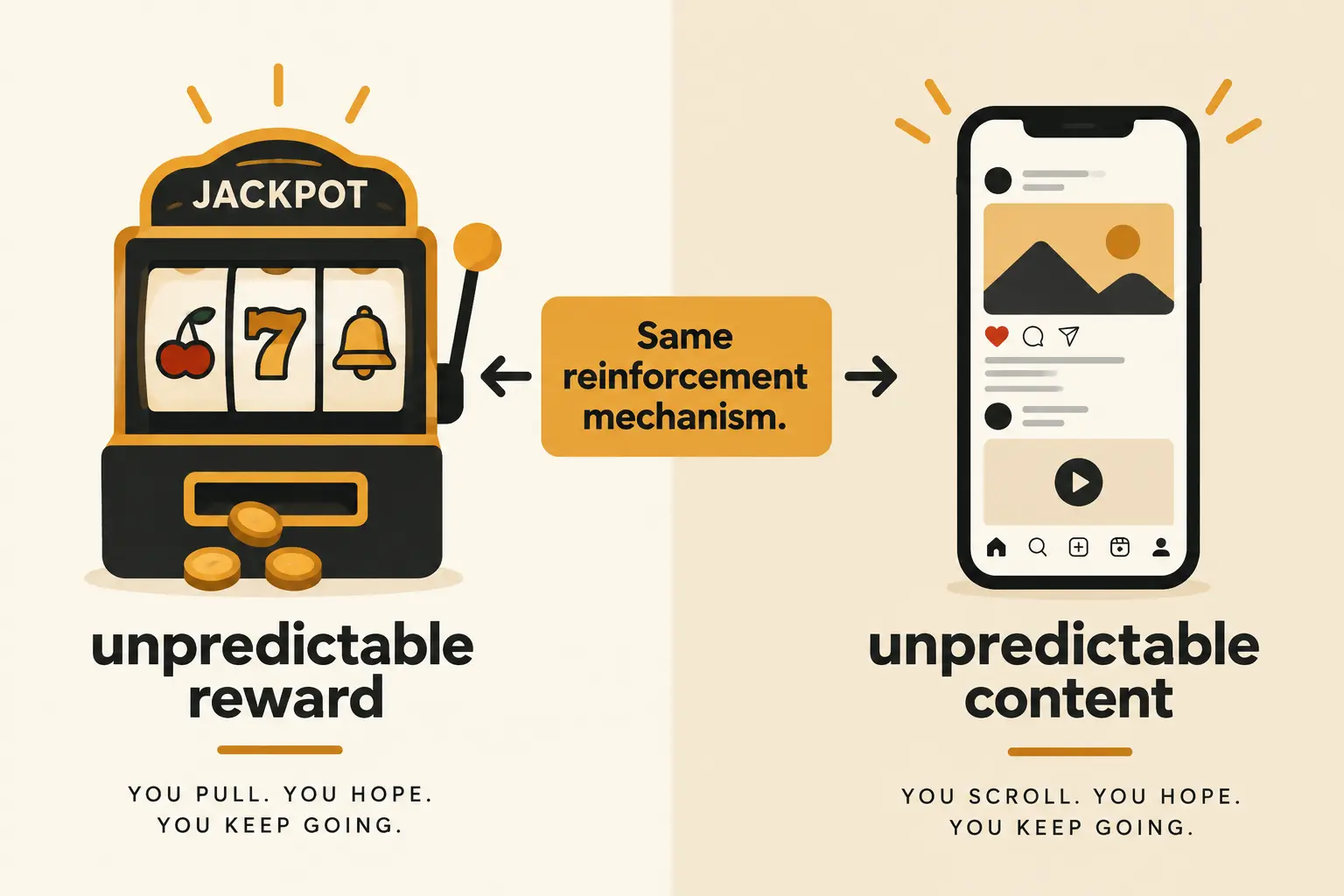
- Social feeds run on variable ratio reinforcement — the same unpredictable reward schedule that makes slot machines hard to put down.[1]
- Negativity bias means the brain is wired to pay more attention to threatening or negative information than positive or neutral content.[2]
- Research has linked heavy doomscrolling to increased anxiety, lower mood, and higher perceived stress.[3]
- Screen use before bed delays sleep onset and reduces sleep quality, independent of the emotional content being consumed.[4]
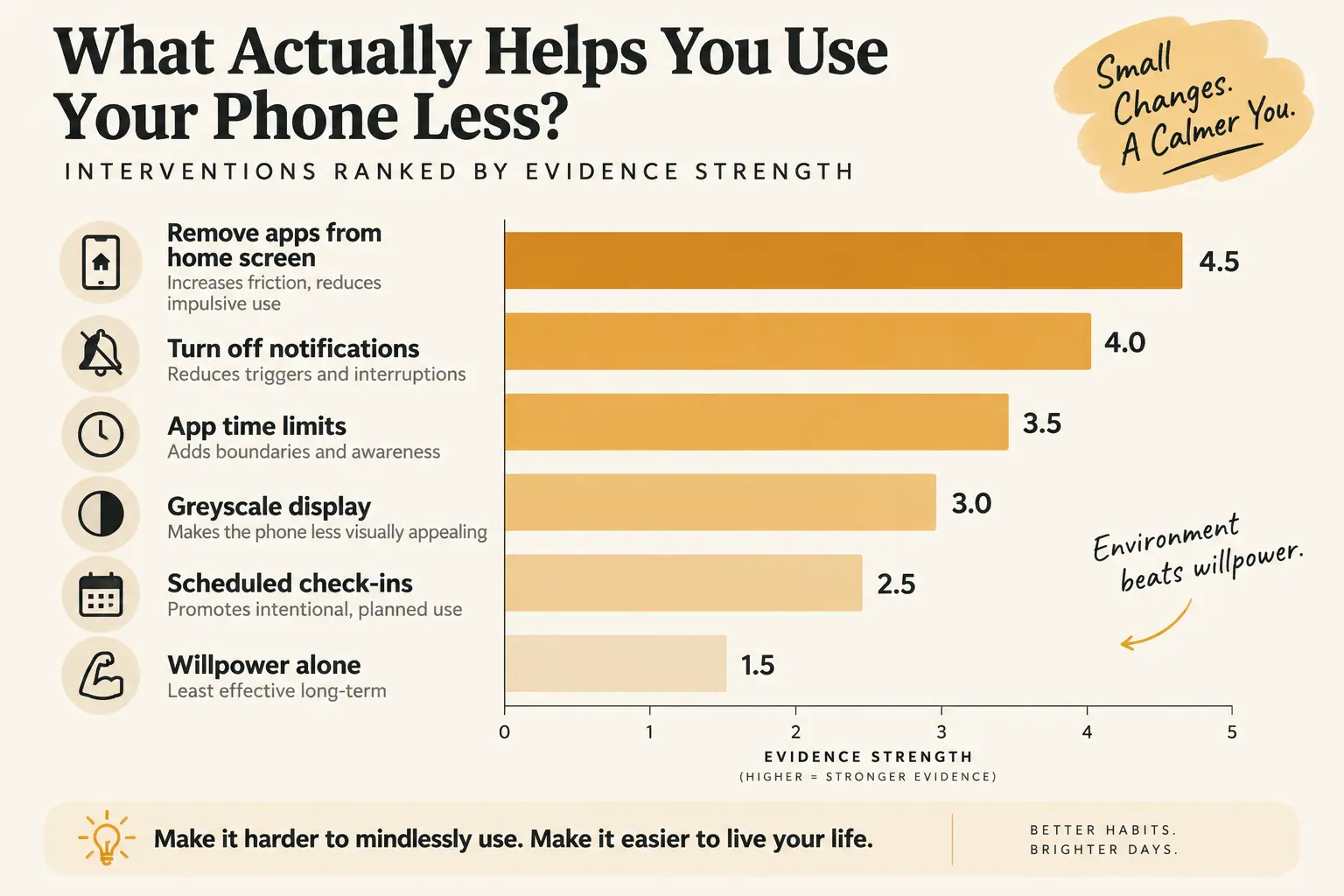
- Friction-based interventions — removing apps, disabling notifications, greyscale displays — consistently outperform willpower-based ones in behavior-change research.
Doomscrolling isn't a discipline problem, and treating it like one is a big part of why "just put the phone down" advice doesn't work. It's the product of two well-documented psychological mechanisms stacking on top of each other: a reward system that never tells you when the next interesting thing is coming, and a brain that's evolutionarily primed to pay closer attention to bad news than good. Understanding both is the difference between fighting your own wiring and working around it.
What Doomscrolling Actually Is
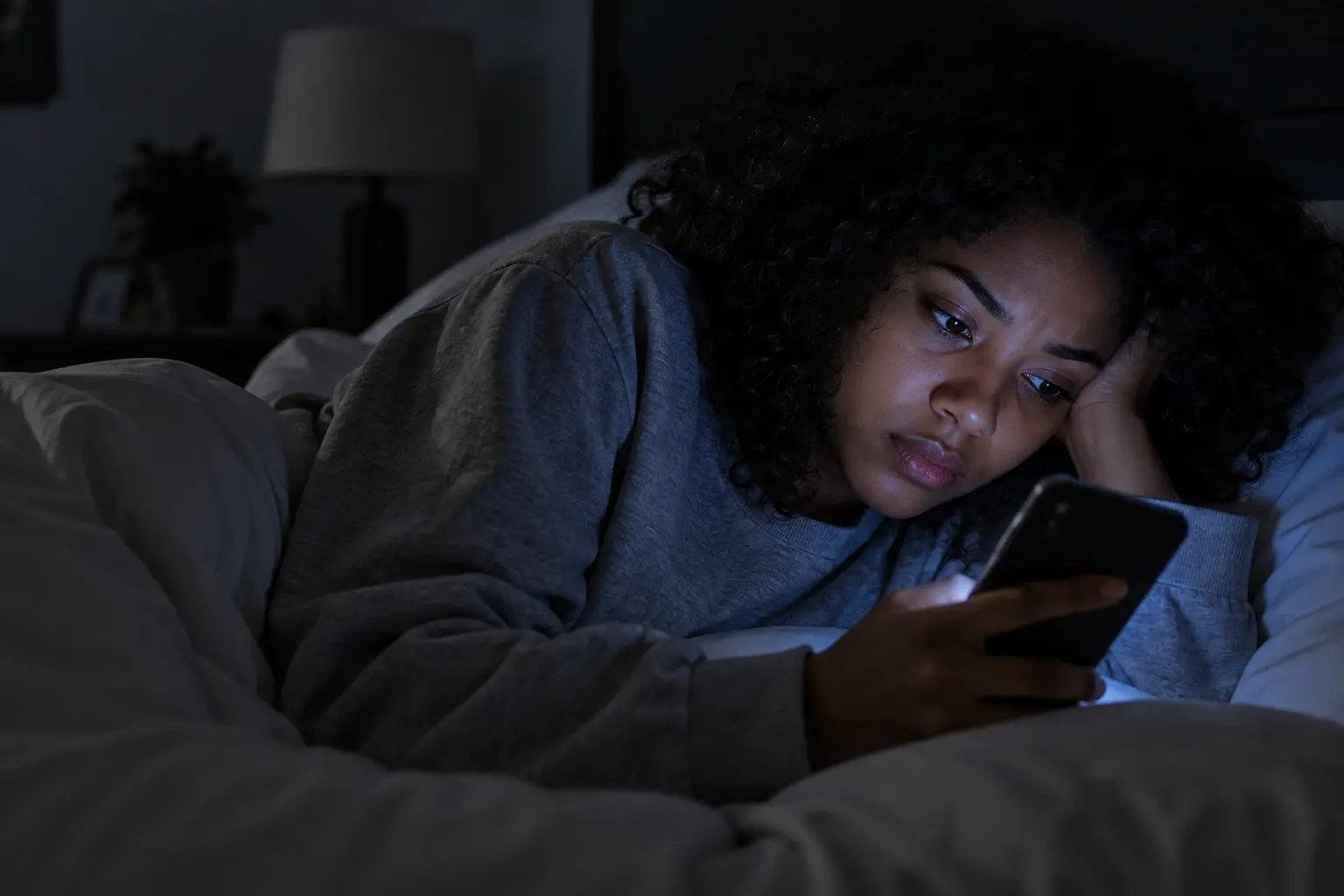
Doomscrolling is the compulsive, extended consumption of negative news or content — typically on social media — well past the point of being informed or useful. It's distinct from ordinary phone checking in three specific ways: the content skews negative or distressing, the behavior feels compulsive rather than intentional, and the session continues even as mood visibly worsens. A 10-minute scheduled news check that ends on time isn't doomscrolling. An hour spent scrolling crisis headlines at 1am, unable to stop despite feeling worse with every scroll, is.
The Dopamine Loop: Why It's Built to Be Hard to Stop
Social feeds are engineered around variable ratio reinforcement — the same reward schedule casino slot machines use, and the single most resistant-to-extinction pattern in behavioral psychology.[1] When a reward arrives on an unpredictable schedule rather than a fixed one, the anticipation of the next reward becomes more compelling than the reward itself. Every scroll might surface something funny, outrageous, validating, or alarming — and because you can't predict which, the pull to keep scrolling "just one more time" persists longer than it would with a predictable feed.
This is the same underlying mechanism covered in why you should stop checking your phone first thing in the morning — the pull isn't really about the content, it's about the unpredictability of what's next.
Why Bad News Specifically Is So Sticky
Negativity bias is the well-documented tendency for the human brain to register, remember, and dwell on negative information more readily than positive or neutral information of equal intensity.[2] This bias likely served a genuine survival function — noticing threats mattered more than noticing pleasant things — but in a feed engineered to surface the most attention-grabbing content available, it means distressing headlines and crisis content are specifically, disproportionately effective at capturing and holding your attention compared to neutral or positive posts.
The Real Cost: Mood and Sleep
Research has consistently linked heavy doomscrolling to higher anxiety, lower mood, and increased perceived stress.[3] The effect compounds when doomscrolling happens close to bedtime: screen use before sleep independently delays sleep onset and reduces sleep quality, both from blue light exposure and from the mentally activating nature of distressing content itself.[4] Falling asleep angry, anxious, or overstimulated from a scroll session makes both the sleep and the next day's mood worse — a pattern a week without social media covers in more depth for anyone who wants to measure the effect directly, rather than take it on faith. If late-night scrolling is really about clawing back time your day didn't give you, read revenge bedtime procrastination.
What Actually Helps — Ranked by Evidence
| Intervention | Evidence strength | Why it works |
|---|---|---|
| Remove apps from the home screen | Strong | Adds friction to the automatic, unconscious reach-and-tap sequence |
| Turn off notifications | Strong | Removes the external trigger that starts a scroll session in the first place |
| Set app time limits | Moderate-strong | Interrupts sessions that started intentionally but ran long |
| Greyscale display | Moderate | Reduces the visual reward signal that makes scrolling feel stimulating |
| Scheduled news check-ins | Moderate | Replaces open-ended scrolling with a bounded, intentional session |
| Willpower alone | Weak | Competes directly against an engineered reward system — a losing fight for most people, most of the time |
None of these require eliminating your phone or disconnecting from news entirely — they're about making the compulsive version of the behavior harder to fall into by default. The free Digital Declutter Checklist walks through most of these changes in one sitting, and the fuller 30-minute phone organization guide covers the notification and home-screen setup in more detail.
Replace the Habit, Don't Just Block It
Removing a habit's triggers helps, but pairing that removal with a specific replacement action improves success rates further. The urge to reach for the phone doesn't disappear just because the app is harder to open — it needs somewhere else to go. Keeping a book, a journal, or even a simple stretch routine within the same physical reach as your phone gives the reach-for-something impulse a different, less harmful target. The goal isn't eliminating the urge; it's redirecting where it lands.
Common Mistakes
- Relying on willpower alone. You're competing against a system specifically engineered to hold attention — friction-based changes work better than resisting in the moment.
- Deleting apps without a replacement plan. The urge to reach for the phone still shows up; give it somewhere else to go.
- Treating all scrolling as doomscrolling. Intentional, bounded use isn't the problem — compulsive, mood-worsening sessions are.
- Scrolling right before bed "to wind down." This is one of the most counterproductive times, given the combined sleep and mood costs.
- Ignoring a pattern that feels bigger than a habit. Persistent, hard-to-control scrolling tied to real anxiety is worth discussing with a professional, not just managing with app settings.
Final Thoughts
Doomscrolling persists because it's built on two real, well-documented mechanisms — a reward system that keeps you guessing, and a brain that's wired to pay extra attention to bad news. Neither of those is a personal failing, and neither responds well to sheer willpower. What works is adding friction to the automatic version of the habit — fewer notifications, fewer one-tap apps, a less stimulating display — while giving the underlying urge to reach for your phone somewhere else to land.
The honest version of this advice: you're not weak-willed for struggling to stop. You're responding exactly the way a reward system engineered to hold your attention is designed to make you respond.
If this is part of a bigger pattern of screen time you want to address, a week without social media and stopping the morning phone check both cover related habits worth tackling alongside this one.
This article is for general information and isn't a substitute for professional mental health support, especially if doomscrolling is tied to significant anxiety or distress.
Sources
[1] Variable ratio reinforcement and behavioral design in digital products. Available at: ncbi.nlm.nih.gov
[2] Negativity bias in social judgment and attention research. Available at: pubmed.ncbi.nlm.nih.gov
[3] Doomscrolling and mental health outcomes research. Available at: pmc.ncbi.nlm.nih.gov
[4] Screen time before bed and sleep quality research. Available at: pubmed.ncbi.nlm.nih.gov