Most sleep advice collapses into a single number: eight hours. Sleep eight hours and everything is fine. Sleep less and you're damaging your health. Sleep more and something is probably wrong.
The eight-hour rule isn't wrong. It's just incomplete in a way that gives people permission to stop thinking. Because the research on sleep isn't really about duration — it's about architecture. How your body organises sleep across a night. Which stages appear when. And critically, which stage you're in when the alarm goes off.
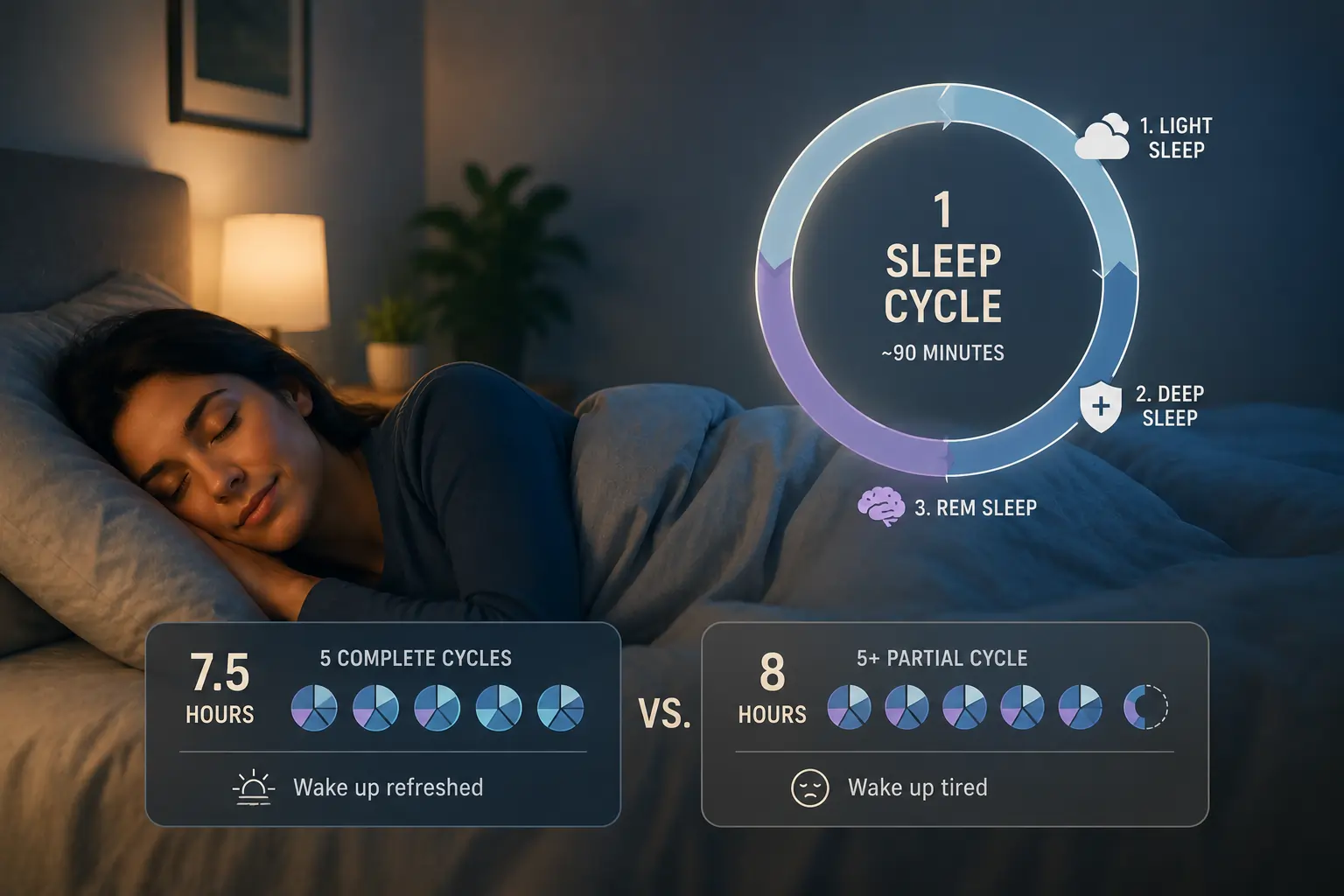
This is why seven and a half hours of sleep can feel dramatically better than eight. Not because you slept more efficiently in some vague sense, but because the timing of your wake aligns with where you are in your sleep cycle — and the timing of eight hours often doesn't.
Understanding how sleep is actually structured changes how you think about bedtimes, alarms, and what's happening inside your brain during those hours in the dark.
What a Sleep Cycle Actually Is
A sleep cycle is a single complete passage through all the stages of sleep: from light sleep, down into deep slow-wave sleep, back up through lighter stages, and into REM (Rapid Eye Movement) sleep. One complete cycle takes approximately 90 minutes in most adults, though this varies between 80 and 120 minutes depending on the individual, the stage of the night, and ordinary night-to-night variation.
Sleep isn't a flat, uniform state. It's a dynamic, architecturally organised process in which your brain moves through four distinct stages, each with different brainwave patterns, physiological signatures, and restorative functions. The stages aren't equal in importance or duration, and their distribution isn't even across the night.
In a typical eight-hour sleep period, most people complete four to five cycles. The first two cycles are dominated by deep slow-wave sleep — the physically restorative stage. The final two cycles are dominated by REM sleep — the cognitively and emotionally restorative stage. Both are essential. Missing the early cycles cuts physical recovery. Missing the later cycles cuts cognitive and emotional restoration.
If your cycle length runs a little longer or shorter than average, the timing that works best for you will shift slightly too — which is part of why your chronotype and your cycle architecture interact. Two people with the same bedtime can wake up at very different points in their respective cycles.
The Four Sleep Stages: What Each One Does
Sleep science identifies four stages: N1 (light sleep), N2 (core sleep), N3 (deep or slow-wave sleep), and REM. A fifth informal category — brief wakefulness or micro-wakes between cycles — also appears in the architecture and is completely normal.

How a Full Night of Sleep Is Structured
Understanding that sleep has stages is one thing. Understanding how those stages are distributed across a full night is what explains the 7.5-versus-8-hour phenomenon.
A typical 7.5-hour sleep period — five complete 90-minute cycles — looks like this:
| Sleep cycle | Architecture | Dominant stage | Notes |
|---|---|---|---|
| Cycle 1 (~90 min) | N1 → N2 → N3 → N3 → REM | N3 (slow-wave) | Deepest slow-wave sleep of the night |
| Cycle 2 (~90 min) | N1 → N2 → N3 → N2 → REM | N3 (slow-wave) | More REM, less deep sleep than Cycle 1 |
| Cycle 3 (~90 min) | N2 → N2 → REM → REM → REM | Balanced N2 + REM | REM dominates; minimal deep sleep |
| Cycle 4 (~90 min) | N2 → REM → REM → REM → Wake/Micro-wake | REM | Mostly REM; brief awakenings normal here |
| Cycle 5 (~90 min) | REM → REM → REM → REM → Wake/Micro-wake | REM | Almost entirely REM; memory consolidation |
Three things to notice in this architecture:
- Deep sleep (N3) is front-loaded. The majority of slow-wave sleep occurs in cycles 1 and 2 — roughly the first three hours of sleep. If you shorten the night from the front (going to bed later), you cut deep sleep disproportionately. If you shorten it from the back (waking earlier), you cut REM disproportionately.
- REM sleep is back-loaded. The majority of REM occurs in cycles 3 through 5, in the second half of the night. The final cycle can be almost entirely REM — which is why the last 90 minutes of sleep, the cycle most commonly lost to an alarm, is cognitively and emotionally the most expensive one to lose.
- Cycles are not equal. The first cycle is the most physically restorative; the last is the most cognitively restorative. A full five-cycle night isn't five identical repetitions of the same process — it's five qualitatively different stages of a structured biological programme.
Why 7.5 Hours Can Feel Better Than 8: The Cycle Completion Effect
Here's the specific mechanism behind the title claim.
If you complete exactly five 90-minute cycles (7.5 hours), you wake at the natural end of a cycle. At the end of a cycle, the brain briefly surfaces toward wakefulness anyway — this is the micro-wake that appears between cycles in the architecture table above. Waking at this point feels like waking from light sleep or REM, not from the deep N3 stage. The transition from sleep to wakefulness is physiologically smooth.
If you set an alarm for eight hours and that alarm lands 30 minutes into your sixth cycle — in N3 — you are forcibly extracted from the deepest sleep stage. The result is sleep inertia: heavy grogginess, slow cognitive processing, impaired reaction time, and the feeling that you need more sleep even though the clock says you got eight hours.
The mathematics is simple: 7.5 hours is five complete 90-minute cycles (5 × 90 = 450 minutes = 7.5 hours). Eight hours is five complete cycles plus 30 minutes — which is 30 minutes into the sixth cycle, right in the middle of N3. That 30 minutes doesn't add to your restoration. It makes waking worse.
The sleep inertia mechanism
Sleep inertia is the formal term for the impaired alertness and cognitive performance that follows abrupt waking from sleep, particularly from N3. Research associated with Harvard Medical School sleep researcher Charles Czeisler and colleagues has shown that sleep inertia can produce performance deficits comparable to total sleep deprivation in the 15 to 30 minutes immediately after waking from slow-wave sleep. (Brain network reconfiguration upon waking from slow-wave sleep) ↗
The physiological driver is adenosine — the sleep-pressure chemical that builds throughout the day and is cleared during sleep. During N3, adenosine clearance is most active. Waking abruptly from N3 means that clearing process has been interrupted; high residual adenosine produces the characteristic fog. This is also why the snooze button makes sleep inertia worse: a 9-minute snooze doesn't complete a cycle or clear residual adenosine. It simply re-initiates the descent toward N3, making the second waking even more disorienting.
Calculating Your Cycle-Aligned Wake Time
The practical application of sleep cycle science is straightforward: work backward from your required wake time to find the bedtime that aligns with cycle completion, or work forward from your bedtime to find the wake time that falls at the end of a cycle rather than in the middle of one.
The fall-asleep offset
Most people don't fall asleep the moment they get into bed. The average sleep onset latency — the time between lying down and actually falling asleep — is approximately 15 minutes. This needs to be factored into the calculation.
Four cycles (six hours) is generally adequate for a single night but not as a sustained pattern. Five cycles (7.5 hours) is the most commonly recommended target for adults. Six cycles (nine hours) is appropriate for adolescents, people recovering from illness or significant physical training load, and during periods of active sleep debt repayment.
| If you want to wake at… | Bed by… (5 cycles) | Bed by… (4 cycles) | Sleep onset assumption |
|---|---|---|---|
| 5:00 AM | 9:15 PM | 10:45 PM | ~15 min |
| 5:30 AM | 9:45 PM | 11:15 PM | ~15 min |
| 6:00 AM | 10:15 PM | 11:45 PM | ~15 min |
| 6:30 AM | 10:45 PM | 12:15 AM | ~15 min |
| 7:00 AM | 11:15 PM | 12:45 AM | ~15 min |
| 7:30 AM | 11:45 PM | 1:15 AM | ~15 min |
| 8:00 AM | 12:15 AM | 1:45 AM | ~15 min |
Knowing your target bedtime is only half the equation — the other half is actually being ready for sleep when that time arrives. That's where a structured wind-down routine comes in: a time-stamped sequence for the hour before bed that gets your body's temperature, melatonin, and nervous system aligned so sleep onset happens close to schedule, rather than 30–45 minutes after you've already turned off the light.
The important caveat: cycles aren't exactly 90 minutes
The 90-minute figure is an average derived from population studies. Individual cycles vary between 80 and 120 minutes, and cycle length within a single person varies across the night — early cycles tend to be slightly shorter, later cycles slightly longer. The 7.5-hour calculation is an approximation, not a precise prescription.
The practical implication: don't become rigidly mechanical about cycle timing. If you target 7.5 hours and still wake feeling groggy, it may mean your cycles run slightly longer than 90 minutes. Experiment — try 7 hours 45 minutes, then 8 hours exactly, and track which wake feels smoothest. The pattern across several nights will reveal your approximate cycle length.
What Interrupts Sleep Architecture (And What Doesn't)
Understanding sleep architecture also clarifies what actually damages sleep quality beyond just waking mid-cycle. The research here is often counterintuitive.
| Factor | Effect on sleep architecture | Evidence |
|---|---|---|
| Alcohol before bed | Dramatically suppresses REM in the first half of the night; rebounds with fragmented sleep in the second half. Briefly increases N3 but disrupts overall architecture. | Very strong |
| Caffeine after 2pm (average person) | Reduces N3 duration by ~20% even when not perceived as affecting sleep onset — less physically restorative sleep. | Strong |
| Blue light / screens, 1hr before bed | Delays melatonin onset by 30–90 minutes, shifting the whole architecture later and reducing total REM in a fixed-wake scenario. | Strong |
| Irregular sleep timing | Desynchronises the circadian clock; less predictable stage distribution. Chronic social jetlag reduces total N3 and REM. | Strong |
| Stress and anxiety | Suppresses N3; increases light sleep and wakefulness; fragments architecture across the night. | Strong |
| Sleeping in a warm room | Core temperature must decline to initiate and maintain deep sleep — warm rooms delay N3 and reduce total slow-wave sleep. | Moderate–strong |
| Late-night exercise (evening types) | Minimal effect if 1+ hour before bed; may delay sleep onset by 30–45 min if immediately before bed. | Moderate |
| Short nap (<30 min, before 3pm) | Doesn't meaningfully affect night-time architecture; may slightly reduce sleep debt and improve N3 quality that night. | Moderate |
| A single brief wake (toilet trip, etc.) | Normal micro-wakes between cycles are already part of architecture — a single brief wake between cycles doesn't meaningfully disrupt it. | Moderate |
The alcohol finding deserves specific attention
Alcohol is the most widely misunderstood sleep aid in existence. It reliably reduces sleep onset latency — people fall asleep faster after drinking. This gets interpreted as better sleep. It isn't.
Alcohol is a REM suppressant. Even moderate amounts consumed within four hours of sleep significantly suppress REM in the first two cycles. As the alcohol metabolises in the second half of the night, there's a rebound: lighter, more fragmented sleep, increased wakefulness, and vivid or disturbing dreams as the brain attempts to "catch up" on suppressed REM. Total REM across the night is reduced even when total sleep time is preserved.
The result: you fall asleep faster, sleep longer, and wake feeling less restored than you would have without the drink. Sleep architecture has been disrupted in the stage most critical for emotional and cognitive restoration. If you've struggled with morning workouts after an evening drink, this is very often why — see why home workout habits actually fail for more on how sleep quality, not just willpower, drives consistency.
Sleep Debt, Recovery Sleep, and Why You Can't "Catch Up" Perfectly
Sleep debt is the cumulative deficit between the sleep you needed and the sleep you got. It's real, it accumulates, and its cognitive and metabolic effects are measurable well beyond the acute period of deprivation.
The common assumption is that a long sleep on the weekend "pays back" the week's deficit. The reality is more complicated.
What recovery sleep actually does
The morning that made me rethink everything about bedtime.
For most of my twenties, I measured sleep by hours and judged mornings by how I felt. Some mornings were fine. Some were terrible. I assumed the terrible ones were because I hadn't slept enough.
One morning I woke up after 8 hours and felt genuinely awful — heavy, disoriented, unable to think properly for the first hour. That same week, I woke after 7.5 hours and felt sharp within ten minutes. I'd dismissed this as random variation in sleep quality.
When I read the research on sleep cycles and sleep inertia, the pattern became obvious. On the 8-hour morning, my alarm had almost certainly woken me mid-cycle — probably deep in N3 of a partially-completed sixth cycle. On the 7.5-hour morning, I'd woken at a natural cycle boundary, in light sleep or just after a micro-wake.
I ran a two-week experiment: targeting 7.5 hours and 9 hours on alternate nights, tracking actual sleep onset via a sleep tracker rather than just bedtime. The 7.5-hour mornings were consistently better despite technically less sleep. The 9-hour mornings were often the worst, because 9 hours placed my alarm deep into a sixth or seventh cycle.
The practical change was small: I stopped targeting a fixed number and started targeting cycle completion. If I went to bed at 11pm, I aimed for a 6:30am alarm — 7.5 hours from sleep onset, accounting for ~15 minutes to fall asleep. The quality shift wasn't dramatic, but it was consistent. The foggy mornings became rarer.
This isn't medical advice. Individual cycles vary. But the experiment was worth running, and the principle — that waking at cycle completion beats waking at a fixed duration — holds up in both the research and my experience. — Ava Mitchell
The Practical Summary: What to Actually Do
Sleep cycle science is only useful if it changes something. Here's the practical application, condensed.
For better mornings
- Target cycle completion, not duration. Calculate your bedtime based on a 7.5-hour (five-cycle) target from sleep onset — not from when you get into bed. Account for approximately 15 minutes to fall asleep, or use the bedtime calculator ↗.
- Eliminate the snooze button. It produces fragmented, low-quality sleep and worsens sleep inertia. If you can't face one alarm, set it 90 minutes later for a full additional cycle.
- Use a sleep tracker to find your natural cycle length. Oura Ring, Whoop, and Garmin all estimate sleep stages. If your wake times consistently feel groggy even at 7.5 hours, your cycles may run slightly longer — try 7 hours 45 minutes or 8 hours exactly and compare.
- Wake up at the same time every day. A consistent wake time anchors the circadian clock more powerfully than a consistent bedtime. Let bedtime vary slightly with how tired you feel; the clock-anchoring from a fixed wake time gradually improves architecture quality. If mornings are still a struggle, a step-by-step morning routine built around that fixed wake time helps it stick.
For better sleep architecture
- Stop caffeine by 2pm (average person) or 4pm (confirmed slow caffeine metaboliser). Caffeine reduces N3 by roughly 20% even when you don't perceive it affecting your ability to fall asleep — see how to calculate your personal caffeine cut-off rather than relying on a generic 2pm rule.
- Protect the last 90-minute cycle. It's almost entirely REM — cognitively and emotionally the most critical. If you must cut sleep short, cut from the beginning (go to bed slightly later) rather than waking significantly earlier. Early cycles deliver deep sleep; late cycles deliver REM. Neither substitutes for the other.
- Keep the bedroom cool — 18–19°C. Core temperature must drop for N3 initiation. Warm rooms measurably reduce slow-wave sleep — see the full sleep environment audit for temperature, light, and sound targets.
- Alcohol is not a sleep aid. Even one drink within four hours of sleep suppresses REM. If you choose to drink, earlier in the evening reduces the architectural impact.
- Dim the lights before bed. Bright overhead lights and screens delay melatonin onset, shifting your sleep architecture later relative to your wake time — meaning you end up waking earlier in your cycle than you otherwise would. Pairing this with the kind of wind-down covered in morning movement without waking up earlier sets up both ends of the day.
| Situation | What to do | Why |
|---|---|---|
| Setting bedtime | Count back 7.5 hours (5 cycles) from wake time, add 15 min for sleep onset | Targets cycle completion; avoids a mid-N3 wake |
| Waking groggy despite 8 hours | Try 7.5 or 7h45m instead | 8 hours may land the alarm mid-cycle; shorter at cycle completion feels better |
| Snooze button habit | Set a single alarm 90 min later instead | Snooze produces fragmented N1/N2; 90 min adds a complete cycle |
| Napping during the day | 20 min, before 3pm; set an alarm to avoid entering N3 | Under 20 min stays in N1/N2 — entering N3 produces post-nap grogginess |
| Alcohol in the evening | Earlier rather than later — ideally not within 4 hours of sleep | Alcohol suppresses REM as it's metabolised; earlier timing reduces the impact |
| Post-exercise sleep difficulty | Exercise 2+ hours before bed; shower after to accelerate temperature drop | Elevated core temperature from exercise delays N3 onset |
Eight Hours Is Not the Answer. Architecture Is.
The eight-hour rule persists because it's a useful heuristic for population-level health advice. Most adults sleeping eight hours in reasonably aligned conditions will get adequate sleep. But for the individual who wants to understand why some mornings feel terrible and others feel sharp, duration is the wrong unit of analysis.
Sleep is a structured biological programme. It has stages that serve different functions, distributed unevenly across the night in a pattern that's predictable but not uniform. Waking mid-cycle disrupts that programme and produces physiological grogginess that has nothing to do with how many hours the clock shows.
Seven and a half hours at cycle completion often feels better than eight hours at mid-cycle, for the same reason that arriving at a destination feels better than being stuck halfway. The journey isn't complete — and the biology knows it, even when the clock doesn't.
If you want to build the full architecture — cycle timing, wind-down, sleep environment, and daily habits — the Sleep Better course covers all of it in six short lessons. Free, no sign-up.
If your sleep quality feels good but you still never feel rested, it may not be about cycles at all — it may be about accumulated debt. The article on sleep deprivation vs sleep debt explains the difference, including how to calculate your two-week debt and what a realistic recovery timeline looks like.