
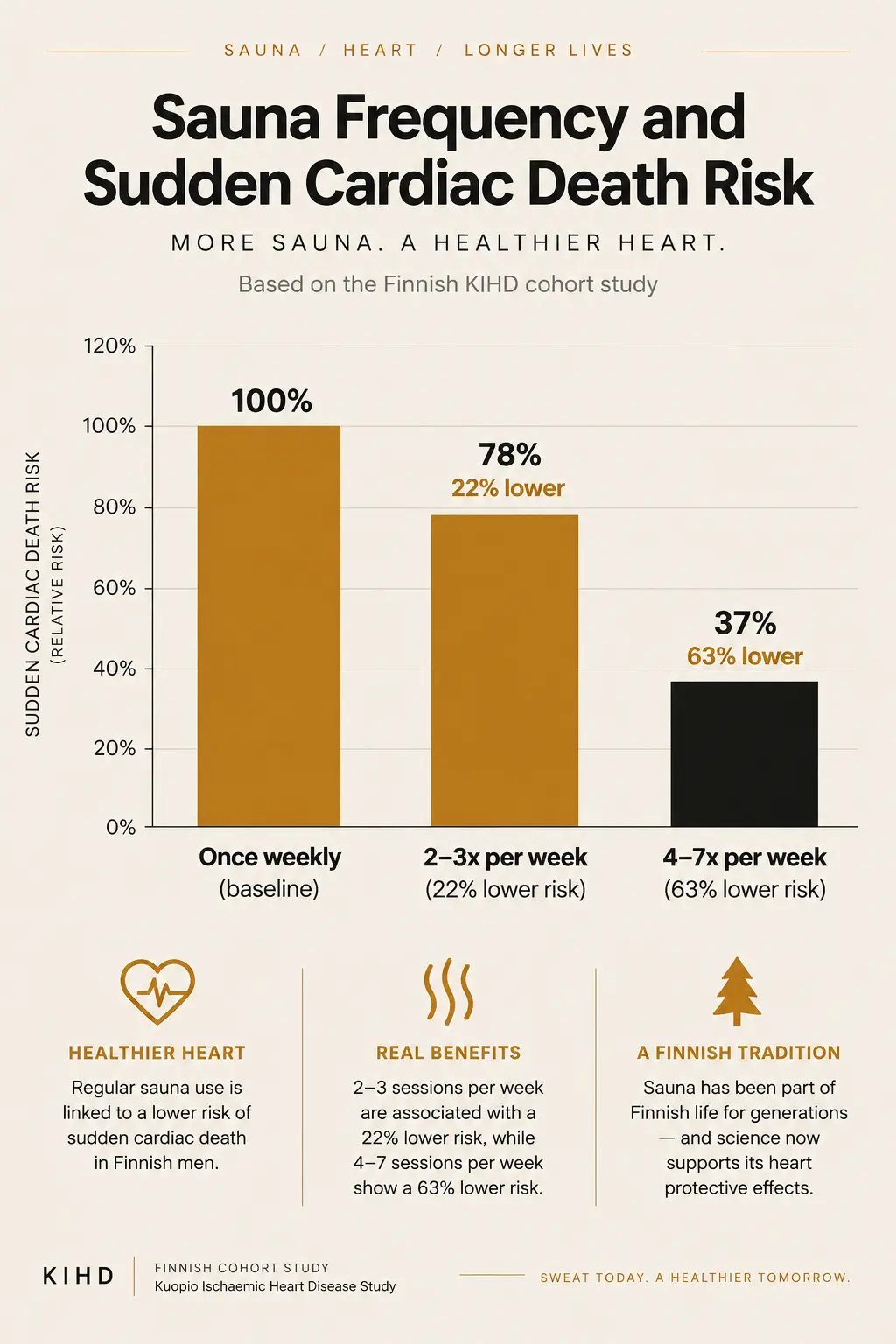
- A 20-year Finnish study of over 2,300 men found sauna use 4-7 times a week was linked to a 63% lower risk of sudden cardiac death versus once-weekly use.
- The same research cohort found frequent sauna use associated with a 66% lower dementia risk and 65% lower Alzheimer's risk.
- Sauna-induced growth hormone spikes have never been connected to actual muscle growth in any of roughly 40 reviewed studies.
- Zero studies have measured meaningful body composition or fat loss from sauna use alone.
- Combining alcohol with sauna use is linked to an increased risk of sudden death and should be avoided entirely.
Sauna use has some of the strongest cardiovascular and cognitive evidence of any popular wellness practice — a 20-year Finnish cohort study found frequent use linked to a 63% lower risk of sudden cardiac death — but the muscle-growth, fat-loss, and detox claims that dominate sauna marketing are not supported by the same body of research. This piece pairs naturally with the site's earlier look at cold showers and cold plunges, covering the other half of the heat-cold recovery trend with the same no-hype approach.
What follows is the actual split: the cardiovascular and brain-health findings that are genuinely well-supported, the muscle and recovery claims that overstate what the data shows, and the safety information — particularly around alcohol and heat stroke — that most sauna content skips entirely.
The Strongest Evidence: Cardiovascular Health
The Kuopio Ischemic Heart Disease (KIHD) study followed over 2,300 middle-aged Finnish men for more than two decades and found a clear, graded relationship between sauna frequency and cardiovascular outcomes — more frequent use was consistently linked to better outcomes, not just a one-time effect.[1]
| Sauna frequency | Sudden cardiac death risk | Fatal cardiovascular disease risk |
|---|---|---|
| Once a week (reference) | Baseline | Baseline |
| 2-3 times a week | 22% lower | Meaningful reduction |
| 4-7 times a week | 63% lower | 50% lower |
Session duration mattered too: sessions longer than 19 minutes were associated with roughly half the sudden cardiac death risk of sessions under 11 minutes.[1] Proposed mechanisms include improved blood vessel function, reduced arterial stiffness, changes in autonomic nervous system activity, and modest reductions in blood pressure — plausible, biologically grounded explanations rather than a vague "heat is good for you" claim.
Brain Health: A Large Effect, With an Important Caveat
The same Finnish research cohort found frequent sauna users had a 66% lower risk of any dementia and a 65% lower risk of Alzheimer's disease specifically, compared to once-weekly users — a genuinely large effect size for an observational study.[2]
Where the Evidence Gets Thin: Muscle Growth and "Detox"
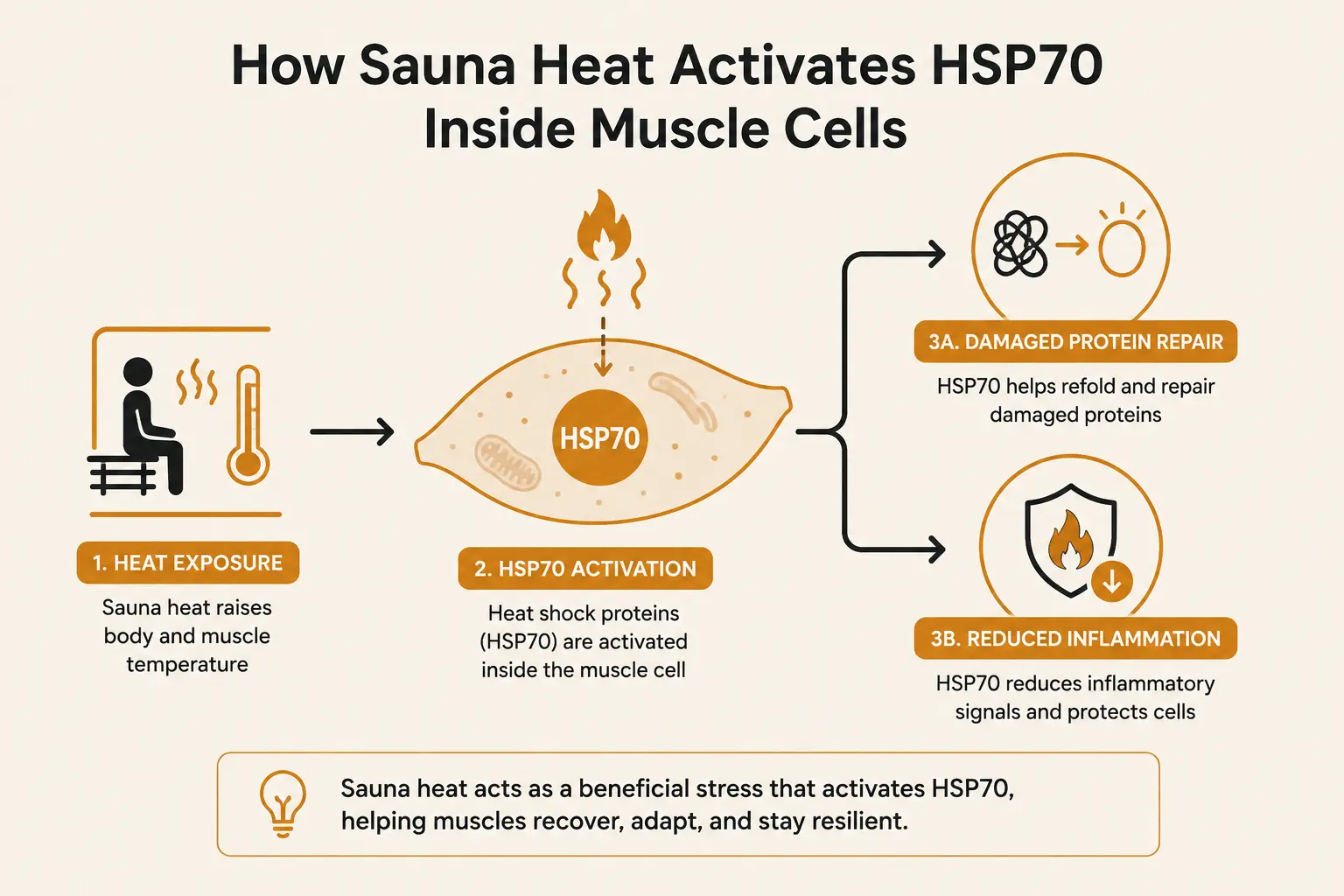
Sauna heat does trigger a real, measurable spike in growth hormone and activates heat shock proteins — but a review of roughly 40 studies found the growth hormone spike was never actually connected to muscle growth in any of them, and zero studies measured meaningful body composition or fat loss from sauna use.[3] This is a genuine gap between what's marketed and what's been tested.
On the detox claim specifically: sweating loses water and electrolytes, not a meaningful quantity of toxins — the framing of sauna as a detox tool overstates what's physiologically happening. For a comparable case where recovery marketing outran the data, DOMS explained covers a similar gap for ice baths and muscle soreness.
Traditional Sauna vs. Infrared: The Evidence Doesn't Transfer
Nearly all of the large-scale cardiovascular and dementia research — including the entire Finnish KIHD cohort — was conducted using traditional, dry-heat Finnish saunas, not infrared saunas. Infrared saunas are marketed with similar or identical health claims, but they simply haven't been studied at the same scale, so the well-established benefits above shouldn't be assumed to transfer directly to an infrared session.
The Risks Most Sauna Content Skips
The single clearest, most consistent safety finding in sauna research is that alcohol and sauna use should never be combined — the combination is linked to an increased risk of sudden death, not just discomfort. Alcohol impairs the body's ability to regulate temperature, worsens dehydration, lowers blood pressure further, and masks the early warning signs of heat stroke before they'd otherwise be noticed.
How to Use a Sauna for the Studied Benefits
- Target 2-3 sessions a week as a realistic starting point. The largest effects in the research came from 4-7 sessions weekly, but meaningful benefit showed up starting at 2-3 — a more sustainable target than jumping straight to daily use.
- Aim for sessions longer than 15-20 minutes where comfortable. The strongest cardiovascular outcomes were associated with longer sessions, though this should scale with individual heat tolerance, not be forced.
- Never combine with alcohol, before, during, or immediately after a session.
- Hydrate before and after, since sauna sweating causes genuine fluid and electrolyte loss even without the "detox" framing being accurate.
- Treat it as a long-term, consistent habit, not a single-session fix — the research measured outcomes over years of regular use, not one visit.
Common Mistakes
- Drinking alcohol before or during a sauna session. This is the single most dangerous common practice, linked to an increased risk of sudden death, not just a mild risk.
- Treating a growth hormone spike as proof of muscle growth. The spike is real; the connection to actual muscle growth has never been demonstrated in the research reviewed.
- Using an infrared sauna and assuming the traditional-sauna research applies. Almost all the strong evidence is specific to traditional, dry-heat saunas.
- Skipping hydration because "detox" framing suggests sweating is the goal. Sweating loses water and electrolytes without meaningfully removing toxins — replace what's lost regardless.
- Pushing through dizziness or nausea to finish a planned session length. These are early heat stroke warning signs, not a sign to tough it out.
Final Thoughts
Sauna use earns its place as one of the more evidence-backed wellness habits — specifically for cardiovascular and cognitive health, where the Finnish research is large, long-term, and consistent. But the version sold in fitness marketing — a tool for building muscle, burning fat, and flushing out toxins — overstates what the data actually shows. The honest takeaway: use it consistently for the heart and brain benefits that are genuinely well-supported, treat the recovery and detox claims skeptically, and never mix it with alcohol.
The research supports sauna as a long-term cardiovascular habit, not a shortcut to a different body. Those are two different claims, and only one of them holds up.
If heat and cold exposure both interest you as recovery tools, the cold showers and cold plunges piece covers the same evidence-first approach for the other side of the trend, including a similar muscle-recovery tradeoff worth knowing before combining the two.
Sources
[1] Kuopio Ischemic Heart Disease (KIHD) study, sauna frequency and cardiovascular mortality. Available at: mayoclinicproceedings.org
[2] Sauna bathing and dementia/Alzheimer's risk, Finnish cohort study, Age and Ageing. Available at: academic.oup.com
[3] Sauna, growth hormone, and muscle growth — review of research evidence vs. marketing claims. Available at: thermalfinn.com
[4] Alcohol and sauna use, risk of sudden death. Available at: peaksaunas.com
[5] Sauna health benefits, risks, and precautions overview. Available at: medicalnewstoday.com