
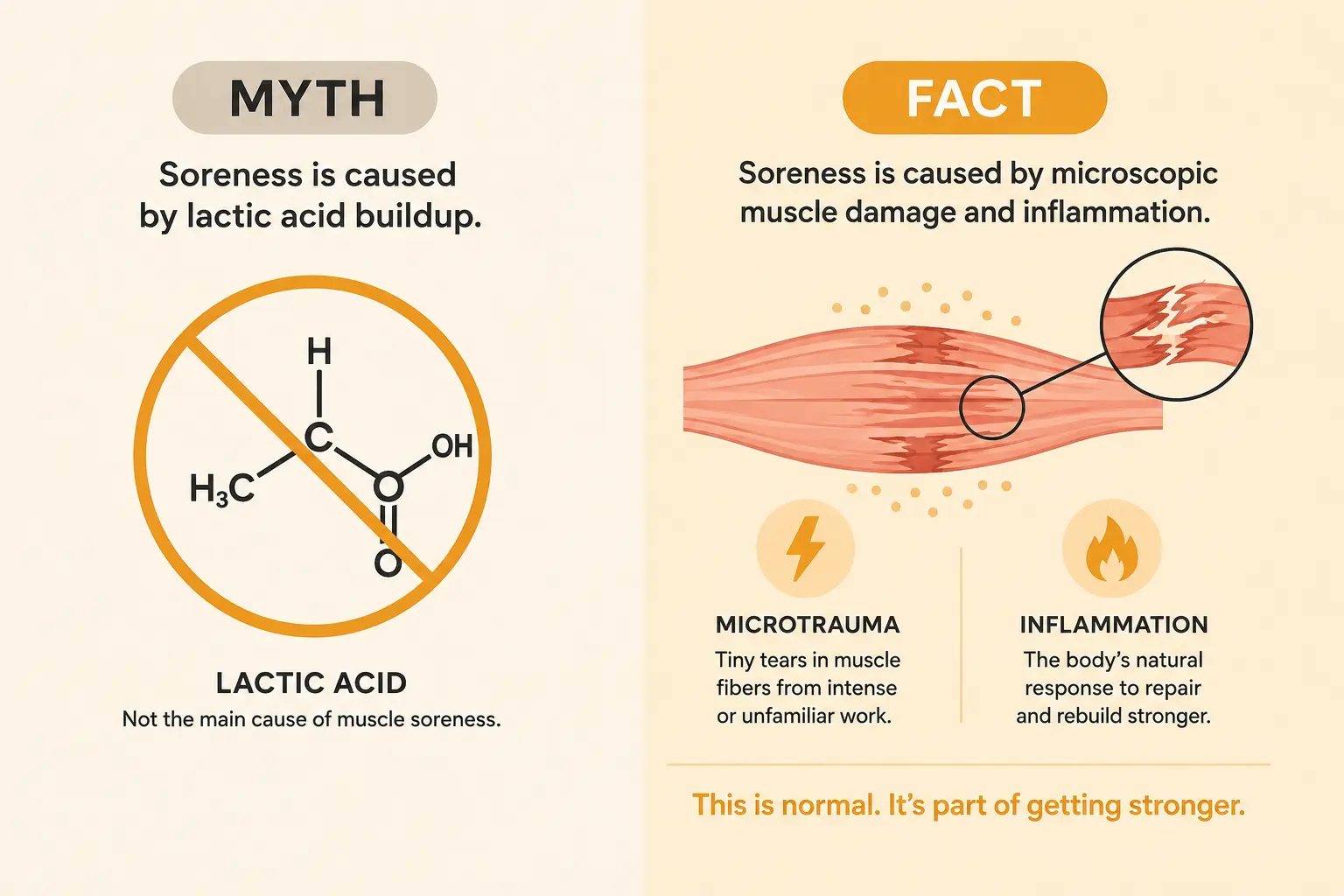
- DOMS (delayed onset muscle soreness) is caused by microscopic muscle and connective tissue damage plus inflammation — not lactic acid, which clears within an hour of exercise.
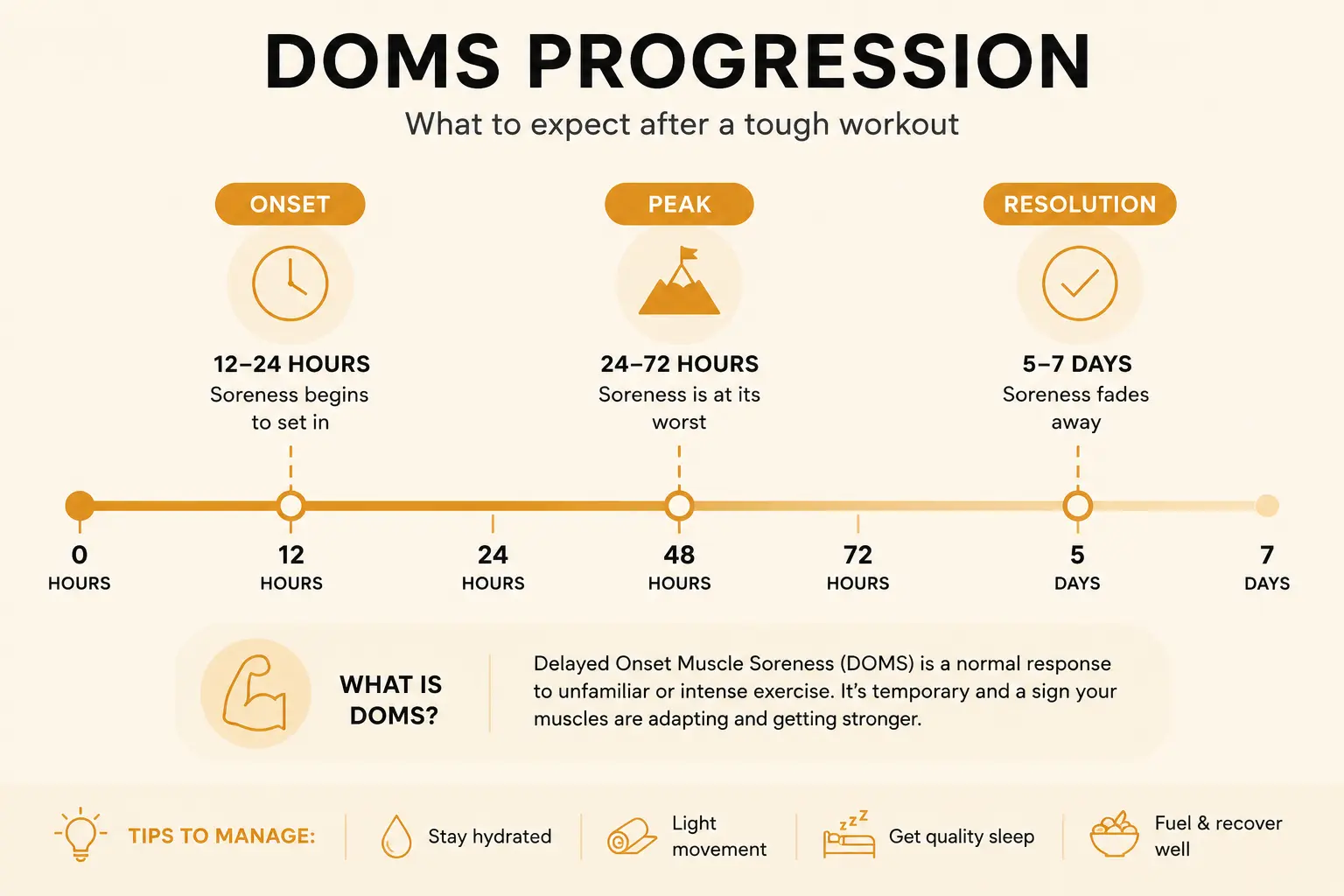
- Soreness typically starts 12-24 hours after exercise, peaks at 24-72 hours, and resolves within 5-7 days.
- DOMS presence or absence is not a reliable indicator of whether a workout was effective — soreness naturally decreases as your body adapts to a given exercise.
- Light movement and massage have the most consistent evidence for easing DOMS; regular NSAID use may blunt strength and muscle gains.
- DOMS is a dull, gradual, generalized ache; an injury causes sudden, sharp, localized pain — the timing and character are the key differences.
The muscle soreness that shows up two days after a workout — not the next morning, but a day later — is called delayed onset muscle soreness, or DOMS, and it's caused by microscopic structural damage to muscle fibers and connective tissue, followed by a local inflammatory response. It has nothing to do with lactic acid, which clears from your muscles within 30 to 60 minutes of finishing exercise — far too quickly to explain pain that peaks a full one to three days later.
Understanding what's actually happening changes how you should respond to it: DOMS isn't a badge of a good workout, it isn't dangerous on its own, and most of the things people do to "cure" it have weak or mixed evidence behind them. Here's what the research actually supports.
What's Actually Happening in Your Muscles
DOMS is caused by microscopic damage to muscle fibers — particularly at the Z-disc, a structural anchor point inside muscle cells — followed by a slower inflammatory response that produces the soreness you feel a day or two later. This is the microtrauma theory, the most widely supported explanation, though researchers note several mechanisms likely contribute, including inflammation, mitochondrial stress, and possibly nerve-ending sensitivity.[1]
Eccentric contractions — the lowering phase of a squat, the negative of a pull-up, running downhill — cause significantly more of this microtrauma than concentric (lifting) contractions. This is exactly why DOMS is worst after unfamiliar movements or exercises with a heavy eccentric component, and why a new exercise tends to leave you sorer than a familiar one at the same intensity.
The Actual Timeline
DOMS follows a predictable pattern: onset 12-24 hours after exercise, peak intensity between 24 and 72 hours, and gradual resolution within 5-7 days. This delayed, gradual pattern is itself diagnostic — it's part of what separates DOMS from an acute injury, covered below.[3]
| Time after exercise | What's happening |
|---|---|
| 0-12 hours | Little to no soreness yet; inflammatory response is building |
| 12-24 hours | Soreness typically begins |
| 24-72 hours | Peak soreness and stiffness |
| 3-7 days | Gradual resolution as tissue repairs |
Does Soreness Mean the Workout Worked?
No — DOMS indicates that muscle microtrauma occurred, not that the workout was more effective, and a session that produces no soreness can still be driving real strength and muscle gains. As your body adapts to a specific exercise or intensity — a phenomenon called the "repeated bout effect" — DOMS naturally decreases even when training continues to progress. Chasing soreness as proof of a good session is a common but evidence-unsupported habit, and one that can push people toward excessive, unproductive intensity — often by adding sets or reps well past what's needed for the goal, a mismatch how many reps and sets you actually need covers directly. The actual driver of long-term progress is progressive overload applied consistently, not how sore you feel afterward.
What Actually Helps — Ranked by Evidence
| Intervention | Evidence strength | Notes |
|---|---|---|
| Proper warm-up beforehand | Strong (preventive) | A structured warm-up before training doesn't eliminate DOMS but reduces the mechanical shock that drives its severity |
| Light movement / active recovery | Strong | An easy walk, light cardio, or gentle mobility work increases blood flow and consistently eases stiffness and perceived soreness |
| Massage / foam rolling | Moderate-strong | Reasonably good evidence for reducing soreness and improving perceived recovery |
| Sleep and protein intake | Strong (indirect) | Doesn't reduce soreness directly but supports the underlying tissue repair process |
| NSAIDs (ibuprofen etc.) | Effective for pain, caveat attached | Reduces DOMS pain, but regular use may blunt strength and hypertrophy adaptations — better for occasional use than routine |
| Ice bath / cold therapy | Mixed | Can reduce perceived soreness short-term; may also blunt adaptation if used routinely after every session |
| Sauna / heat therapy | Mixed, genuine mechanism | Heat shock protein activation genuinely supports muscle protein repair, though it hasn't been shown to speed soreness resolution specifically — see what sauna use is and isn't proven to do |
The practical takeaway: the highest-leverage, lowest-downside options are light movement and adequate sleep and protein — see how much protein you actually need and how much rest you actually need between workouts for the fuller recovery picture beyond soreness alone. On the "mixed" ice bath row specifically — cold showers and cold plunges: what the research actually supports covers exactly why that tradeoff exists and when cold exposure timing matters most. On the "gentle mobility work" mentioned in the top row — mobility vs flexibility breaks down what that actually means and how it differs from static stretching.
DOMS vs. Injury: How to Tell the Difference
DOMS builds gradually over 12-24 hours as a dull, generalized ache across a muscle group, while an injury causes sudden, sharp, often localized pain at the moment it happens — the timing and character of the pain are the clearest signals.[4]
Common Mistakes
- Chasing soreness as a measure of a good workout. This encourages unnecessary intensity and can accelerate burnout or injury risk without adding to actual progress.
- Avoiding training until all soreness is gone. Mild DOMS is training-compatible; waiting for zero soreness before training a muscle group again means consistently under-training muscles that have already recovered.
- Relying on NSAIDs after every session. Occasional use for genuinely disruptive soreness is reasonable; routine use may work against the training adaptations you're trying to build.
- Ignoring pain that doesn't match the DOMS pattern. Sharp, immediate, or localized pain deserves attention rather than being dismissed as "just soreness."
- Starting a new program too aggressively. Novel exercises and higher-than-usual eccentric loading cause the most DOMS — ramping intensity gradually, especially for beginners, reduces both soreness and injury risk. See the beginner's guide to actually using a gym for a sensible starting pace.
Final Thoughts
DOMS is a normal, expected response to unfamiliar or eccentric-heavy training — not lactic acid, not a sign your workout was extra effective, and not something that needs to be fully gone before you train again. The evidence points to light movement, sleep, and adequate protein as the highest-value, lowest-risk responses, with massage and occasional NSAID use as reasonable secondary options. What matters more than any soreness-relief tactic is recognizing when pain doesn't fit the DOMS pattern at all — sudden, sharp, and localized is a different problem that deserves different attention.
Soreness tells you microtrauma happened. It doesn't tell you your workout worked, and it definitely doesn't tell you to wait until it's gone before training again.
For the fuller picture on how much rest and recovery you actually need beyond just soreness, how much rest between workouts covers the six variables that actually determine your recovery timeline, and the free Move More course covers progressive training and recovery as a complete system.
Sources
[1] Delayed onset muscle soreness: mechanisms including microtrauma, inflammation, and mitochondrial involvement. Available at: getfitcraft.com
[2] Lactic acid myth and muscle soreness timing. Available at: bassmedicalgroup.com
[3] DOMS onset, peak, and resolution timeline. Available at: balancedfitnessgear.com
[4] DOMS vs. muscle strain / injury symptom comparison. Available at: honehealth.com