
- The FIFA 11+ structured warm-up program is linked to roughly 30-46% fewer injuries in controlled trials when done at least twice a week.
- Static stretching on cold muscles has been shown to temporarily reduce maximal strength and power output.
- Warm-up exercise raises muscle temperature by around 3°C, increasing elasticity and reducing tissue tension.
- Expert consensus: stretching alone doesn't meaningfully reduce injury risk — a full structured warm-up does.
- A general warm-up is effective in 8-10 minutes using a simple four-phase structure.
Warm-up is one of the most skipped parts of a workout — and also one of the most consistently misunderstood, even by people who do it every time. Skipping it doesn't just mean walking into your first set cold; the research suggests it measurably increases injury risk and can leave you performing worse than if you'd spent a few minutes preparing properly. The bigger issue is that a lot of "warming up" — a few slow static stretches held for 30 seconds — isn't actually what the evidence supports either.
Why Skipping It Actually Slows You Down
Warming up isn't just a ritual — it produces measurable physiological changes that directly affect performance and injury risk. Raising body temperature increases the dissociation of oxygen from hemoglobin and myoglobin, speeds up metabolic reaction rates, increases blood flow to working muscles, and reduces muscle tension.[1] Warm-up exercise has been shown to raise muscle temperature by roughly 3°C, which measurably increases elasticity in muscles, tendons, and ligaments and improves synovial fluid flow in the joints — reducing friction during movement.[2]
Skip this process and you're asking cold, stiffer tissue with less blood flow to immediately handle load it isn't physiologically primed for. The performance cost is real too — training with cold muscles means less available range of motion, less efficient force production, and a nervous system that hasn't been cued into the movement pattern yet.
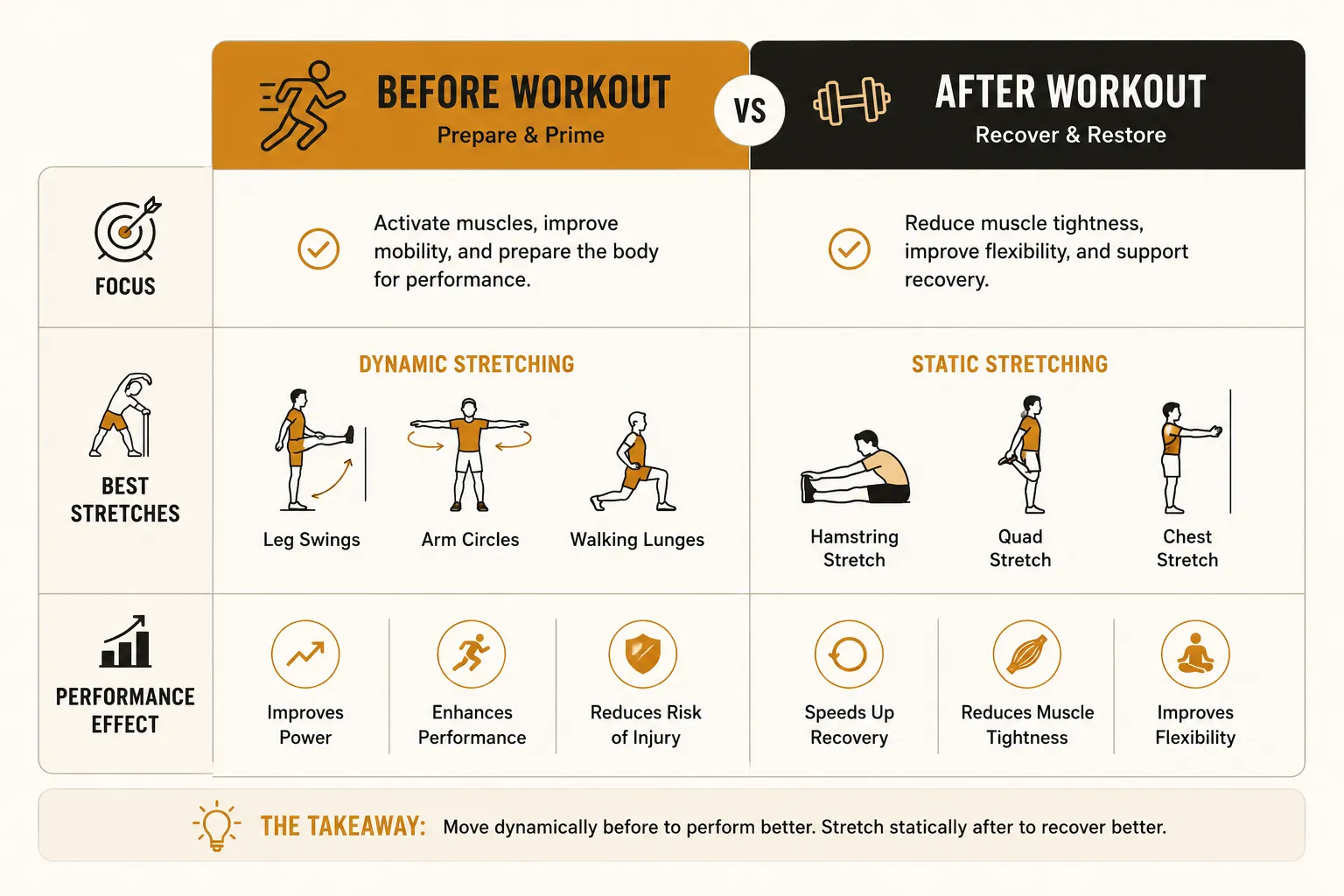
Static vs. Dynamic Stretching: The Part Most People Get Wrong
The practical takeaway: save the long static holds for after your workout, when they're both safe and genuinely useful for flexibility. Before training, dynamic movement is the better-supported choice.
The RAMP Protocol: A Structure That Actually Works
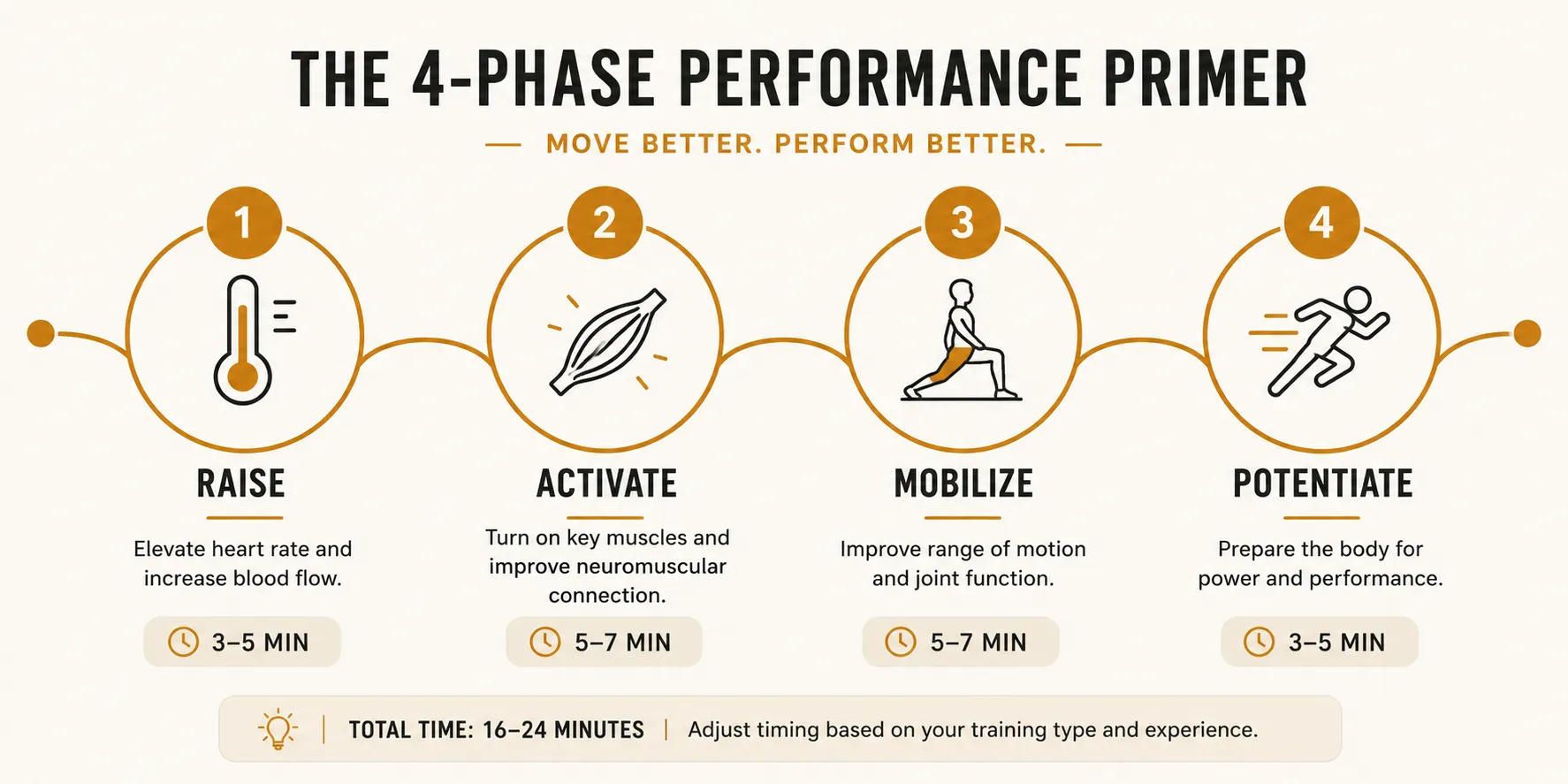
RAMP — Raise, Activate, Mobilize, Potentiate — is a structured warm-up framework developed by sports scientist Dr. Ian Jeffreys, and it's the closest thing to a research-backed template for a general warm-up.[4] Instead of a vague "stretch for five minutes," it breaks the warm-up into four purposeful phases that build on each other.
- Raise (2-3 min). Light cardio — jogging in place, jumping jacks, cycling — to raise heart rate, core temperature, and blood flow.
- Activate (1-2 min). Bodyweight moves that switch on stabilizing muscles relevant to your session — glute bridges, band walks, planks.
- Mobilize (2-3 min). Dynamic stretches and controlled range-of-motion drills for the joints you're about to use — leg swings, walking lunges, arm circles.
- Potentiate (2-3 min). Movement-specific, gradually intensifying drills — a lighter warm-up set of your first exercise — to prime the nervous system for the real thing.
The whole sequence runs 8-10 minutes and adapts to whatever you're training — the Raise and Mobilize phases stay fairly generic, while Activate and Potentiate should target the specific movement pattern of your session. Building this into a consistent pre-workout routine is exactly the kind of habit the free Habit Tracker is built for.
The Injury Prevention Evidence
The strongest evidence for warm-up reducing injury doesn't come from stretching studies — it comes from full, structured programs. The FIFA 11+ program, one of the most extensively studied warm-up protocols, combines running, strength, plyometric, and balance exercises, and is linked to roughly 30-46% fewer overall and lower-extremity injuries in controlled trials.[5] Specific findings include a 32% reduction in overall injury risk among youth female footballers, a 33% lower risk of ankle injuries, and a 63% reduction in acute lower back injury risk in meta-analyses.[6] The consistent theme across the research: compliance matters — players who performed the program at least twice a week saw the strongest protective effect.
Adapting the Warm-Up to Your Activity
| Activity | Raise phase | Activate + Potentiate focus |
|---|---|---|
| Strength training | 2-3 min light cardio | Bodyweight version of first lift, then progressively heavier warm-up sets — if you're doing this on shared gym equipment, keep your warm-up sets brief so others aren't waiting; see gym etiquette for beginners for how to handle this without cutting your own warm-up short |
| Running | 3-5 min easy jog | Leg swings, high knees, gradual build to target pace |
| Team sports | 3-5 min jogging/shuffling | Sport-specific footwork, short sprints, cutting drills |
| Yoga/mobility work | 2-3 min light movement | Slow, controlled range-of-motion through target joints |
Common Mistakes
- Doing long static holds cold. This is the single most common warm-up mistake — save static stretching for after training.
- Treating stretching as the whole warm-up. Stretching is one component; raising temperature and rehearsing movement patterns matter just as much.
- Skipping it entirely when short on time. Even 3-5 minutes of raising heart rate and a few dynamic movements beats a cold first set.
- Using a generic warm-up for every session. The Activate and Potentiate phases work best when tailored to what you're about to train.
- Rushing to failure in the first working set. The Potentiate phase should build gradually — not go straight to your heaviest weight or fastest pace.
Final Thoughts
A warm-up isn't a box to check before the "real" workout starts — it's a genuine physiological preparation step with measurable effects on both performance and injury risk. The RAMP structure gives you a repeatable template: raise your temperature, activate the muscles you'll rely on, mobilize the relevant joints with dynamic movement, and potentiate your nervous system with a lighter version of what's coming. Ten minutes, most days, is enough to make a real difference.
The honest version of this advice: warming up well doesn't make your workout longer in any way that matters — it makes the actual training more effective and considerably safer.
Once your warm-up habit is dialed in, what DOMS actually is and how much rest you actually need between workouts round out the full training-session picture — what happens before, during, and after.
This article is for general information and isn't a substitute for personalized guidance from a coach, trainer, or physical therapist, especially if you have an existing injury.
Sources
[1] Warming-up and stretching for improved physical performance and prevention of sports-related injuries. Available at: pubmed.ncbi.nlm.nih.gov
[2] Post-warm-up muscle temperature and blood flow research. Available at: ncbi.nlm.nih.gov
[3] Current concepts in muscle stretching for exercise and rehabilitation. Available at: pmc.ncbi.nlm.nih.gov
[4] The RAMP warm-up protocol and its effect on speed, agility, and endurance. Available at: journals.lww.com
[5] FIFA 11+ injury prevention program systematic review of randomized controlled trials. Available at: pmc.ncbi.nlm.nih.gov
[6] FIFA 11+ neuromuscular training program and ankle/lower back injury reduction meta-analyses. Available at: ncbi.nlm.nih.gov