
- Forward head posture was present in 85.4% of office workers in one cross-sectional study, with upper crossed syndrome found in roughly a third of office workers overall.
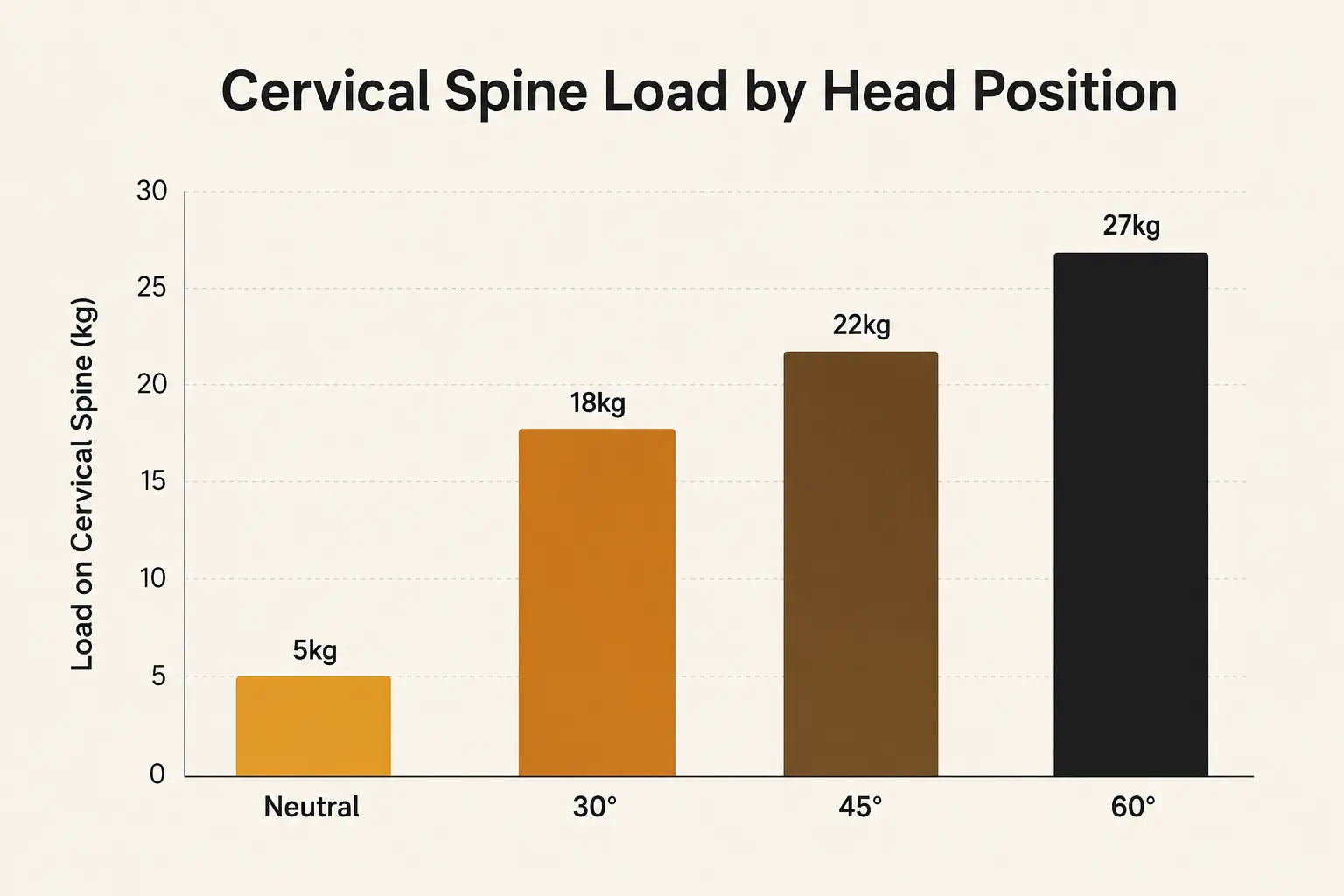
- Cervical spine load rises from ~5 kg at neutral to 18 kg at 30°, 22 kg at 45°, and 27 kg at 60° of forward head flexion.
- Chin tucks and scapular retraction both significantly reduce forward head posture and pain in randomized controlled trials, with a slight edge for each on different outcomes.
- Hourly 5-minute movement breaks offer the best balance of effectiveness and practicality for countering the harms of prolonged sitting.
- Standing desks reduce sitting time by 1-2 hours a day, but the benefit appears to come from postural variation, not standing itself.
Desk work reshapes the body in a remarkably consistent way — rounded shoulders, a forward-jutting head, and a stiff mid-back — and it happens to nearly everyone who spends years doing it. One study found forward head posture in 85.4% of office workers measured.[1] The good news: this pattern responds well to a small number of specific, well-researched exercises, not a vague instruction to "sit up straighter."
Why Desk Work Wrecks Posture
The posture problem from sitting has a name: upper crossed syndrome — a predictable pattern of tight chest and neck muscles paired with weak, lengthened upper back and deep neck muscles that develops from hours of looking at a screen with rounded shoulders.[2] It's called "crossed" because the tight and weak muscle groups form an X-pattern across the upper body.
This isn't a minor cosmetic issue. Upper crossed syndrome is a significant contributor to chronic neck and shoulder pain in computer users, and it tends to get worse gradually rather than announcing itself — most people don't notice the shift until pain or stiffness becomes hard to ignore.
The Real Cost: What Forward Head Posture Does to the Spine
Every inch the head moves forward of neutral meaningfully increases the load your neck has to support — and the relationship isn't small.[3] A frequently cited biomechanical analysis quantified this precisely:
| Head position | Approx. load on cervical spine |
|---|---|
| Neutral (0°) | ~5 kg |
| 30° forward flexion | ~18 kg |
| 45° forward flexion | ~22 kg |
| 60° forward flexion (typical phone-checking angle) | ~27 kg |
The Exercises That Actually Work
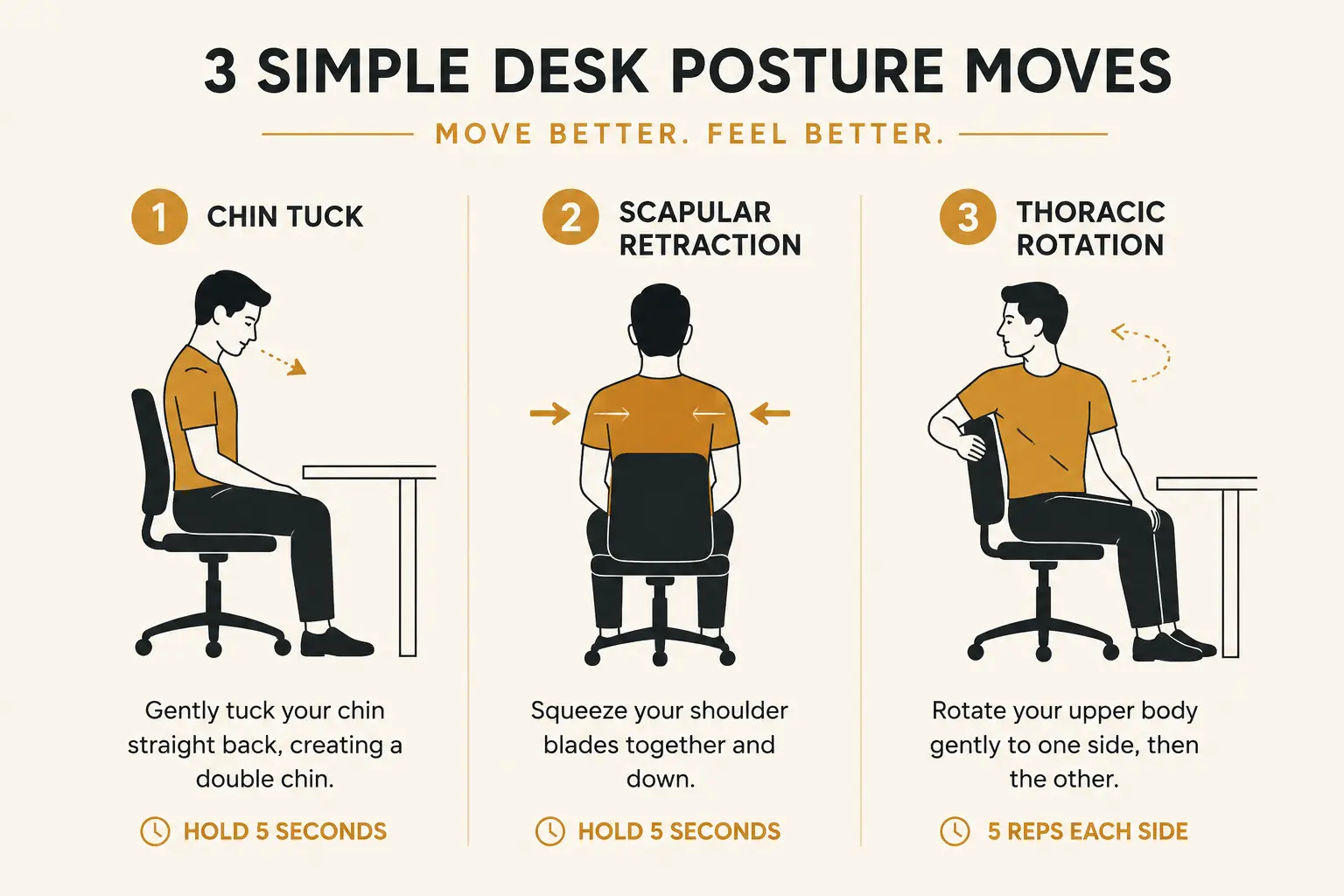
Three exercises have the strongest research support for reversing desk-related posture patterns, and a randomized controlled trial comparing two of them found both genuinely effective — just with slightly different strengths.[4]
- Chin tucks (2-3 sets of 8-10 reps, held 3-5 seconds each). Draw your head straight back, as if making a double chin, keeping your eyes level rather than tilting up or down. This activates the deep cervical flexors that switch off during hours of forward head posture. In the RCT above, chin tucks showed a slight edge for reducing neck disability specifically.
- Scapular retraction (2-3 sets of 10-12 reps, held 3-5 seconds each). Squeeze your shoulder blades together and down, as if trying to hold a pencil between them, without shrugging your shoulders up. This directly counters the rounded-shoulder pattern and showed a slight edge for pain reduction in the same trial.
- Thoracic rotation (8-10 slow reps per side). Seated or standing, rotate your upper back side to side while keeping your hips facing forward. The mid-back stiffens from prolonged sitting, and restoring its mobility makes the other two exercises more effective — a stiff thoracic spine forces the neck and shoulders to compensate.
Doing all three covers each exercise's individual strength — the RCT's authors note that the two approaches work through overlapping but distinct mechanisms, which is why combining them outperforms picking just one. If you're new to structured movement altogether, mobility vs. flexibility explains the broader distinction these exercises fall under, and how to actually warm up covers the same dynamic-movement principle applied to a full training session.
Does a Standing Desk Actually Help?
Partially — and the real mechanism is more specific than most standing-desk marketing suggests.[5]
A standing desk without posture awareness or exercise is a partial fix at best. Pairing one with the exercises above, and genuine movement breaks, is where the real benefit shows up.
Movement Breaks: How Often Actually Matters
Adults in high-income countries are sedentary for roughly 11-12 hours a day on average, a level linked to higher long-term risk of cardiovascular disease, diabetes, and some cancers independent of exercise habits elsewhere in the day.[6] Research on how to break this up most effectively points to a practical middle ground.
- Hourly 5-minute breaks offer the best balance of effectiveness and practicality for most people — sustainable across a full workday without disrupting focus.
- Shorter, more frequent breaks (every 20-30 minutes) produced slightly larger benefits for blood sugar and energy in some studies, but are harder to sustain consistently in real jobs.
- Swapping just one hour of sitting a day for light movement was linked to a meaningfully lower risk of cancer-related mortality in large cohort research — the bar for benefit is lower than most people assume.
Quick Desk Setup Checklist
- Monitor top at or slightly below eye level, roughly an arm's length away, so you're not tilting your head down or forward to read it.
- Feet flat on the floor or a footrest, hips roughly level with or slightly above knees.
- Elbows close to your body at roughly 90 degrees when typing, rather than reaching forward.
- Phone at eye level when checking it, rather than tilted down into your lap — this is where the steepest forward-flexion angles happen.
Common Mistakes
- Only stretching, never strengthening. Chin tucks and scapular retraction are strengthening exercises, not stretches — the weak, lengthened muscles need to be trained, not just loosened elsewhere.
- Doing the exercises once and expecting lasting change. Research protocols use these consistently over weeks, not as a one-time fix.
- Buying a standing desk and standing with the same slouched posture. The desk changes your position; it doesn't automatically change your posture.
- Ignoring phone posture. Checking a phone tilted down into your lap creates some of the steepest forward-flexion angles of the day — worse than most desk setups.
- Waiting for pain before doing anything. Upper crossed syndrome develops gradually; the exercises are far easier and faster as prevention than as correction.
Final Thoughts
Desk-related posture problems are common enough to be nearly universal among people who sit for a living, but they're also genuinely fixable with a small, specific set of exercises — not a vague reminder to sit up straight. Chin tucks, scapular retraction, and thoracic rotation address the actual muscle imbalance directly, and pairing them with regular movement breaks and a sensible desk setup covers the rest.
The honest version of this topic: posture isn't fixed by willpower or a single ergonomic chair. It's fixed by training the specific muscles that went weak, consistently, over weeks.
If back or neck stiffness is part of a broader pattern of desk-related tension, it's worth reading alongside how much rest you actually need between workouts and what muscle soreness actually means — both cover related recovery principles that apply here too.
Sources
[1] Prevalence of forward head posture among office workers, cross-sectional study. Available at: jhwcr.com
[2] Upper crossed syndrome in the workplace — narrative review. Available at: ncbi.nlm.nih.gov
[3] Head posture and loading of the cervical spine, biomechanical analysis. Available at: researchgate.net
[4] Chin tuck vs. scapular retraction RCT for forward head posture. Available at: jhwcr.com
[5] Effects of a workplace sit-stand desk intervention on health and productivity. Available at: ncbi.nlm.nih.gov
[6] Hourly movement breaks and effects of prolonged sitting. Available at: health.harvard.edu