
I have written a lot about home workouts on this site — a 4-week no-equipment starter programme, the 15 bodyweight exercises every beginner should master, why people quit and how to not be one of them. That content exists because a gym membership is not a requirement for fitness, and it never will be.
But here is the part that gets left out of most "you don't need a gym" content: a lot of people who avoid the gym are not actually choosing home workouts because home workouts suit them better. They are avoiding the gym because it is unfamiliar, the machines look like they need an instruction manual nobody handed them, and the idea of guessing wrong in public is uncomfortable enough that the couch wins by default.
If that is you, this guide is the fix. Not a pitch for why gyms are better than home training — they are not, categorically, one way or the other — but a straight, no-guesswork walkthrough of exactly what to do the first time you walk in: what every common machine is for, how to adjust it, the etiquette nobody explains, and a programme to follow once you are in the door.
If you have a habit-tracking system for anything else in your life, the free Habit Tracker works well for logging gym sessions too — three checkmarks a week is a realistic, trackable target for a beginner.
Why Bother With a Gym at All
Home training has a real ceiling. Bodyweight exercises are genuinely effective for the first several months of training, but progressive overload — the gradual increase in demand that drives every strength and muscle adaptation — becomes harder to deliver once basic bodyweight movements stop being challenging. A gym removes that ceiling almost entirely: adjustable resistance on every machine, a full range of free weights, and enough exercise variety that you can keep progressing for years without running out of ways to make a movement harder.
There is also a structural advantage that has nothing to do with muscle: a gym is a dedicated context for training. You get changed, you travel there, you are surrounded by other people doing the same thing — all of which make the workout the default activity for that block of time in a way that "exercise sometime in my living room" often is not.
Gym Anxiety Is Real — And Solvable
Before the machines, the etiquette, or the programme: it is worth naming the actual barrier directly, because it is rarely the exercises themselves. Consumer surveys on so-called "gymtimidation" consistently find that roughly half of gym members have felt intimidated at some point, and that first-time anxiety peaks specifically in the first one or two visits — which means the discomfort you might be anticipating is not a sign you don't belong there, it is a universal, temporary, and well-documented first-timer experience.[1]
A few reframes that hold up in practice:
- Almost nobody is watching you. Most gym-goers are deep in their own headphones, their own plan, their own effort. Attention in a gym is overwhelmingly self-directed.
- Everyone was a beginner in that room once. The person confidently loading plates onto a barbell also once stood in front of a machine reading the diagram, unsure which pin to move.
- The anxiety front-loads and fades. The first visit is the hardest. By the third or fourth, the layout is familiar, the machines are familiar, and the self-consciousness that felt so large in week one has mostly evaporated.
Before Your First Visit
A small amount of preparation removes most of the friction that causes people to bail on their first visit or leave early.
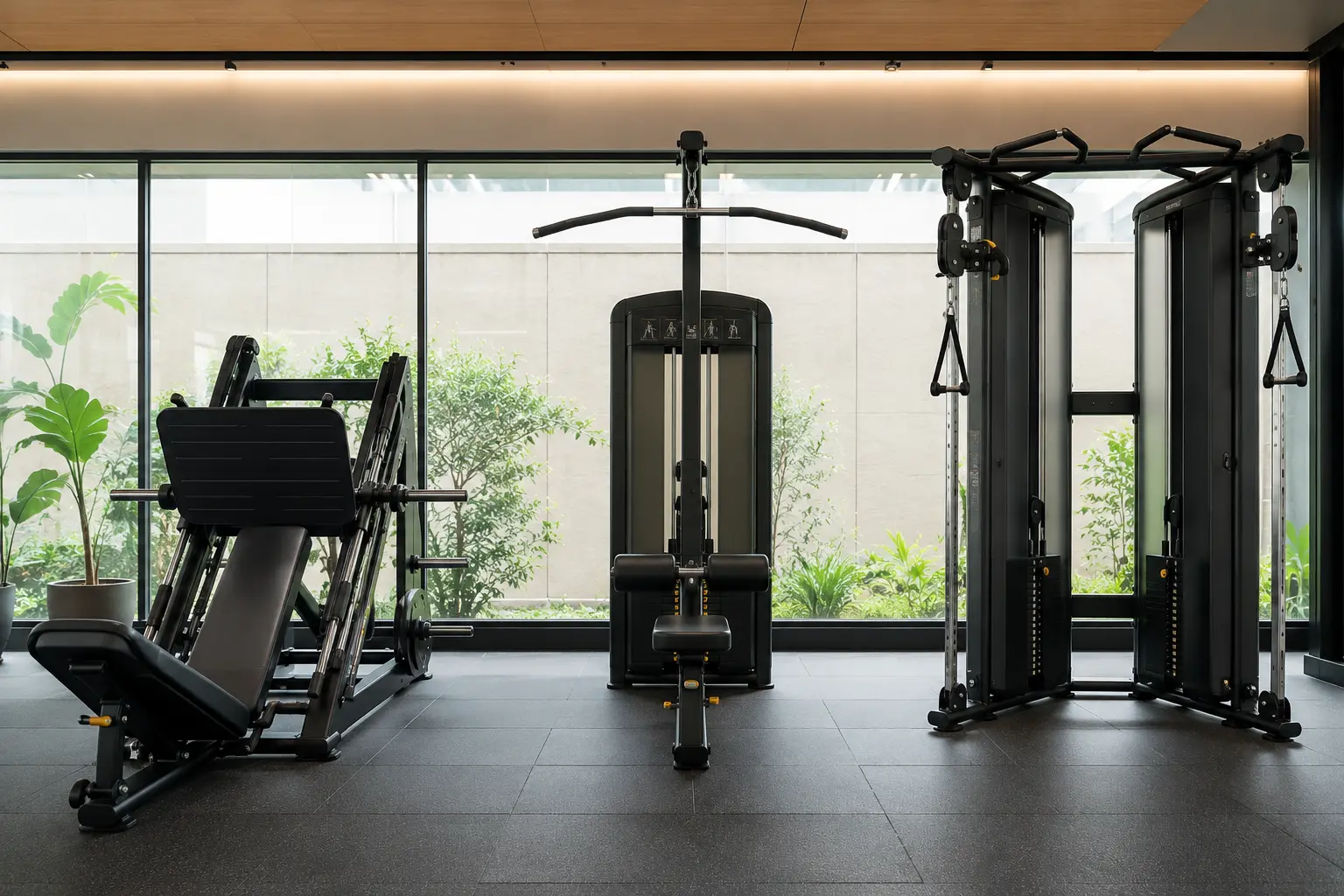
Gym Machines Explained (The Complete Beginner List)
This is the section most beginner guides skip or rush through. Here is every machine you are actually likely to use in a first month of training, what it works, how to set it up, and the one mistake that trips up almost everyone the first time.
| Machine | Works | How to Set It Up | Common Mistake |
|---|---|---|---|
| Leg press | Quads, glutes, hamstrings | Adjust the seat so your knees form roughly a 90° angle at the bottom of the movement | Locking the knees out fully at the top; letting the knees cave inward |
| Lat pulldown | Back (lats), biceps | Adjust the thigh pad so it holds your legs firmly in place when seated | Leaning back and using bodyweight momentum instead of pulling with the back |
| Seated cable row | Mid-back, lats, biceps | Feet flat on the platform, slight bend in the knees, sit tall | Rounding the lower back to add range of motion instead of squeezing the shoulder blades |
| Chest press machine | Chest, shoulders, triceps | Set seat height so the handles align with the middle of your chest | Seat set too low or high, forcing the shoulders into an awkward angle |
| Shoulder press machine | Shoulders, triceps | Set seat height so handles start at shoulder level, not above the ears | Arching the lower back off the pad to add range |
| Leg extension | Quads | Adjust seat depth and ankle pad so it sits just above the ankle | Using a weight heavy enough to make the movement jerky instead of controlled |
| Leg curl (seated or lying) | Hamstrings | Adjust ankle pad position for your leg length before starting | Letting the hips rise off the pad to compensate for a weight that's too heavy |
| Cable machine (functional trainer) | Full body — highly versatile | Set the pulley height to match the exercise (low for rows, high for pulldowns) | Standing too close to the stack, which shortens the usable range of motion |
| Smith machine | Squat, press, and lunge patterns with a fixed bar path | Position your body so the fixed vertical bar path matches your natural movement — usually slightly different from a free-weight stance | Assuming the fixed path means "safer" and using a heavier weight than free-weight form would support |
| Treadmill / bike / elliptical | Cardiovascular fitness | Start at an easy pace for 2–3 minutes before increasing intensity | Gripping the handrails hard enough to take load off your legs and skew your heart-rate reading |
If the treadmill still feels intimidating, it's worth remembering that plain walking — no incline, no speed intervals — already produces real cardiovascular benefit on its own. Walking as exercise covers what a daily 30-minute walk actually does, and it's a reasonable way to build cardio confidence before adding intensity.
Machines vs Free Weights: What Beginners Should Actually Use
This debate gets presented online as more adversarial than the evidence supports. A 2023 systematic review and meta-analysis comparing free-weight and machine-based training found that strength gains are largely specific to the tool used — machine training produced the biggest gains on machine-based strength tests, and free-weight training produced the biggest gains on free-weight tests, while gains in muscle size were comparable between the two methods.[2]
In practice, that means the "which is better" question matters less than most beginners assume. What does matter for a true beginner:
| Machines | Free weights | |
|---|---|---|
| Learning curve | Fast — the path is fixed for you | Slower — requires learning balance and stabilisation |
| Injury risk while learning | Lower — harder to use with dangerously bad form | Higher until form is grooved in |
| Builds stabiliser muscles | Minimal — the machine does the stabilising | Yes — a real long-term advantage |
| Best for a true first month | Yes — start here | Introduce gradually from month 2 onward |
The practical takeaway used throughout the programme below: lean on machines heavily in your first few weeks to learn movement patterns safely, then start layering in dumbbell work once the machine versions feel comfortable and controlled. For a deeper look at where bodyweight and free-weight progression heads once machines stop being enough of a challenge, see When Bodyweight Isn't Enough.
Your First Session, Walked Through
Here is exactly what a sensible first visit looks like, start to finish, so there is no ambiguity about what to actually do when you walk in.
The 4-Week Beginner Gym Programme
This programme leans on machines for the first two weeks to build confidence and movement familiarity, then introduces dumbbell work once the machine versions feel controlled. Three sessions a week, with at least one rest day between each.
- Treadmill or bike, easy pace — 4 min
- Arm circles and hip circles — 1 min
- Leg press — 12 reps
- Chest press machine — 12 reps
- Lat pulldown — 12 reps
- Leg curl — 12 reps
- Seated cable row — 12 reps
- Leg press — 12 reps
- Chest press machine — 12 reps
- Lat pulldown — 12 reps
- Shoulder press machine — 12 reps
- Leg extension — 12 reps
- Seated cable row — 12 reps
- Leg press — 10–12 reps
- Lat pulldown — 10–12 reps
- Leg curl — 10–12 reps
- Dumbbell flat bench press — 10 reps
- Dumbbell goblet squat — 10 reps
- Dumbbell shoulder press — 10 reps
- Plank — 30 seconds
- Leg press — 10 reps
- Dumbbell flat bench press — 10 reps
- Lat pulldown — 10 reps
- Dumbbell goblet squat — 10 reps
- Seated cable row — 10 reps
- Treadmill or bike intervals — 1 min moderate, 1 min easy, repeat 4x
Gym Etiquette Nobody Explains
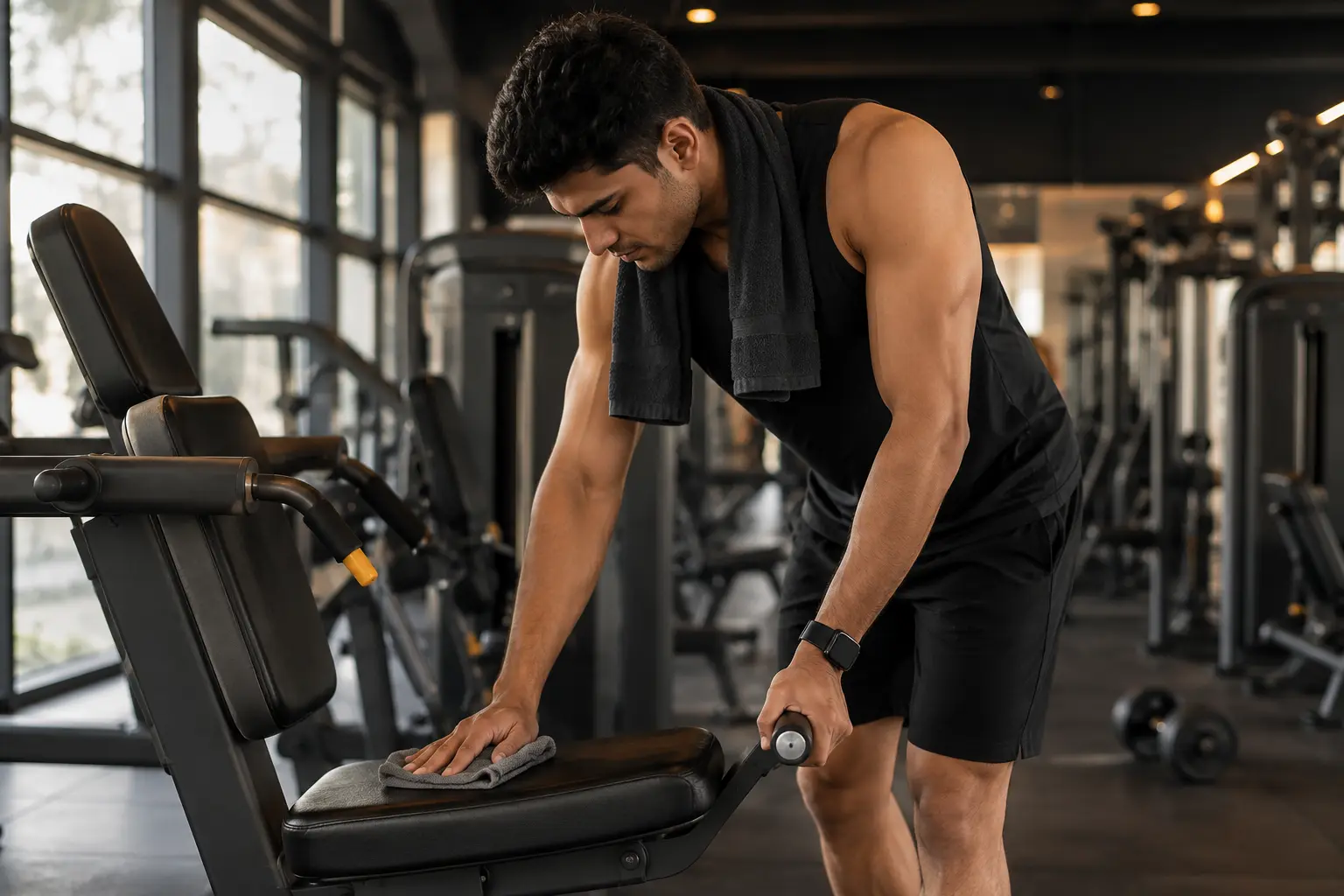
Most etiquette breaches are not malicious — they're just things nobody told a new gym-goer. Here's the unwritten rulebook (for the full, expanded version covering working in, personal space, and safety etiquette, see gym etiquette 101):
Common Beginner Mistakes (Beyond Etiquette)
- Copying a routine from social media with no progression logic. A workout you saw in a 30-second video is missing the context of the person's training age, goals, and the weeks of programming around it. Follow a structured beginner plan first — like the one in this guide — before adapting other people's routines.
- Going too heavy, too soon. The ego cost of a light first set is nothing. The time cost of a strain or minor injury from an overloaded machine in week one is weeks of setback.
- Skipping the warm-up because "it's just machines." Machines still move joints and muscles through resistance under load — cold tissue is still injury-prone regardless of the equipment.
- Avoiding free weights indefinitely out of nervousness. It's completely reasonable to start on machines. It's a missed opportunity to never progress beyond them, since free-weight work builds stabilising strength machines don't touch.
- Training without any plan and wandering machine to machine. This wastes time, produces an inconsistent stimulus, and is one of the most common reasons beginners feel like their gym time "isn't working." Once you have a routine you're sticking to, the next thing to get right is making sure that routine actually keeps demanding more from you over time — see what progressive overload actually is for why this matters more than almost anything else once the beginner phase ends.
What My First Month at a Gym Actually Looked Like
Long before The Flex Cult existed, my first gym visit involved standing in front of a lat pulldown machine for what felt like a full minute, trying to work out which pin adjusted the weight and which one adjusted the seat. Someone eventually walked past, saw me hesitating, and just said "seat's the one nearer you" without breaking stride. Nobody was watching. Nobody cared. I had built up an entire imagined audience that did not exist.
The actual hard part of that first month wasn't the machines — it was showing up a second time after the first session left me sore and slightly embarrassed about not knowing where anything was. (That soreness has a name and a mechanism, by the way — see DOMS explained if you're wondering why day two always hurts more than day one.) What got me through it was treating the first two weeks purely as an orientation phase: I wasn't there to lift heavy, I was there to learn where things were and how they worked. Lowering the bar that much made returning easy.
By week three, the gym had gone from "unfamiliar space full of equipment I didn't understand" to "the place I go on Tuesday, Thursday, Saturday." That transition happened faster than I expected, and it happened for a boring reason: repetition. The tenth time you use a leg press machine, you don't think about it at all. You just use it.
Frequently Asked Questions
One Final Thing
The gym does not require you to already know what you're doing. It requires you to show up once, read the sticker on the machine, do a light set, and leave. Then show up again a couple of days later and do the same thing, slightly more familiar than the time before.
If you're coming to this guide after months of home workouts and you're wondering whether it's worth the switch, it's worth re-reading The Complete Beginner's Guide to Working Out at Home — the honest answer is that both build real fitness, and the "right" one is whichever environment removes enough friction that you actually keep training. For many people who have stalled at the bodyweight ceiling, that turns out to be the gym.
You don't need to look like you belong in a gym to start using one. You just need to walk in the first time — the familiarity comes from the second visit, not from knowing everything before the first.
If motivation on training days is still the bottleneck once the unfamiliarity fades, Why You Keep Quitting Home Workouts covers the same consistency mechanics — scheduling, minimum viable sessions, never missing twice — and they apply just as directly to a gym habit as a home one.
Starting a gym habit at 40 or beyond comes with a few extra questions worth answering directly — see Strength Training for Women Over 40: What Actually Changes and What Doesn't for what menopause changes about training intensity and recovery, and what stays exactly the same.
[1] Multiple consumer fitness surveys on "gymtimidation" — summarised in StudyFinds, "Half of Americans battle 'gymtimidation'".
[2] Fernandez-Gonzalo R et al. "Effect of free-weight vs. machine-based strength training on maximal strength, hypertrophy and jump performance — a systematic review and meta-analysis." BMC Sports Science, Medicine and Rehabilitation, 2023. PMC