
At some point, the home workouts that used to leave you breathless start to feel manageable. The push-ups that once required serious effort have become almost routine. The squats you used to dread have become the easy part of a session you finish without being challenged.
If you are still building towards that point — or want a daily accountability layer while you work through progressions — the 21-Day Daily Movement Streak tracks one movement task per day for 21 days. The streak structure is useful while the habit is still forming.
The standard response at this point is to buy something — dumbbells, a pull-up bar, resistance bands. The fitness industry is enthusiastic about encouraging this response. But equipment is not the only answer, and for most people at the intermediate stage, it is not even the right first answer.
There are four variables in bodyweight training that most people never touch: tempo, unilateral loading, density, and leverage. Manipulating these four variables produces harder, more productive training than simply adding more reps of the same exercises — and none of them cost anything. If you've completed a structured beginner programme like the 4-Week Home Workout Plan for Beginners, this is your natural next step.
Why Bodyweight Training Plateaus (And Why It's Not What You Think)
The plateau has a specific mechanism. It is not that your body has reached its limit. It is that the specific stimulus you have been applying has become familiar, and a familiar stimulus produces minimal adaptation.
Progressive overload — the principle that adaptation requires a progressively increasing training demand — is the fundamental mechanism behind all training results. In a gym, you add weight. At home with bodyweight only, most people's only tool has been adding reps. When rep counts reach 20–30 per set, the stimulus shifts from strength and hypertrophy to muscular endurance. Not useless — but not what most people are after.
Thirty push-ups with standard form is predominantly an endurance exercise for most intermediate trainees. Ten push-ups with a four-second lowering phase, a one-second pause at the bottom, and a one-second press back up is something else entirely — a stimulus comparable to a loaded barbell exercise.
| What most people do at plateau | Why it doesn't work | What actually works |
|---|---|---|
| Add more reps until sets are 30+ | High rep counts shift to endurance; minimal strength/hypertrophy stimulus | Manipulate tempo, leverage, or unilateral loading instead |
| Add more sets indefinitely | Recovery demand increases without stimulus quality improving | Increase intensity per set before adding sets |
| Buy equipment immediately | Skips the substantial space between basic and equipment-required | Exhaust bodyweight progression first |
| Switch to a new programme entirely | Novelty provides temporary stimulus but doesn't build on what was built | Apply overload principles to exercises already mastered |
The Four Variables
Variable 1: Tempo — The Most Underused Tool
Tempo refers to the speed at which you perform each phase of a repetition: the lowering phase (eccentric), the pause at the bottom, the lifting phase (concentric), and the pause at the top. Standard bodyweight training uses none of this intentionally. Everything moves at whatever pace feels natural — which, for most people, is faster than it should be.
Why tempo manipulation works
Time under tension (TUT) — the total duration your muscles are under load in a set — is one of the primary drivers of hypertrophy. A set of 10 push-ups at natural tempo takes roughly 15–20 seconds. The same 10 reps at 4-1-1-0 tempo takes 60 seconds. That is three to four times the stimulus from the same exercise and the same number of reps.
Eccentric loading specifically — the controlled lowering phase — produces greater muscle damage and therefore greater adaptation stimulus than concentric loading. This is why eccentric-focused tempos (slow lowering, fast pressing) consistently outperform standard tempo for strength and size gains.[1]
Tempo notation
Tempo is written as four numbers: eccentric – bottom pause – concentric – top pause.
| Tempo | Emphasises | Difficulty vs standard | Best for |
|---|---|---|---|
| 1-0-1-0 | Baseline; natural rhythm | Beginner–intermediate | Learning form; warm-up sets |
| 3-0-1-0 | Eccentric emphasis | Moderate increase | First tempo progression |
| 4-1-1-0 | Deep eccentric + bottom pause | Significant increase | Hypertrophy; strength at bottom ROM |
| 4-2-1-0 | Maximum tension throughout lowering | High | Advanced hypertrophy |
| 3-1-2-1 | Full control all phases | Very high; ~2× standard time | Elite bodyweight; gym-equivalent stimulus |
| Pause rep | Bottom position strength | High — eliminates stretch reflex | Overcoming sticking points |
Tempo in practice
Push-Up: 3 sets of 15 feels manageable. Switch to 4-1-1-0 — lower for four seconds, pause one second at the bottom, press back up. Most people find 8 reps genuinely hard at this tempo. The stimulus has meaningfully increased without changing the exercise.
Squat: A slow squat with a two-second pause at the bottom eliminates the stretch reflex — the elastic energy stored when you bounce through the bottom — forcing the quads and glutes to generate force from a dead stop. This is more difficult and more productive than any higher-rep standard-tempo set.
Glute Bridge: Extending the hold at the top from two seconds to three seems trivial. Over fifteen reps, it adds 15 seconds of peak glute contraction per set. The cumulative effect across a session is significant.
Variable 2: Unilateral Loading — Doubling the Stimulus
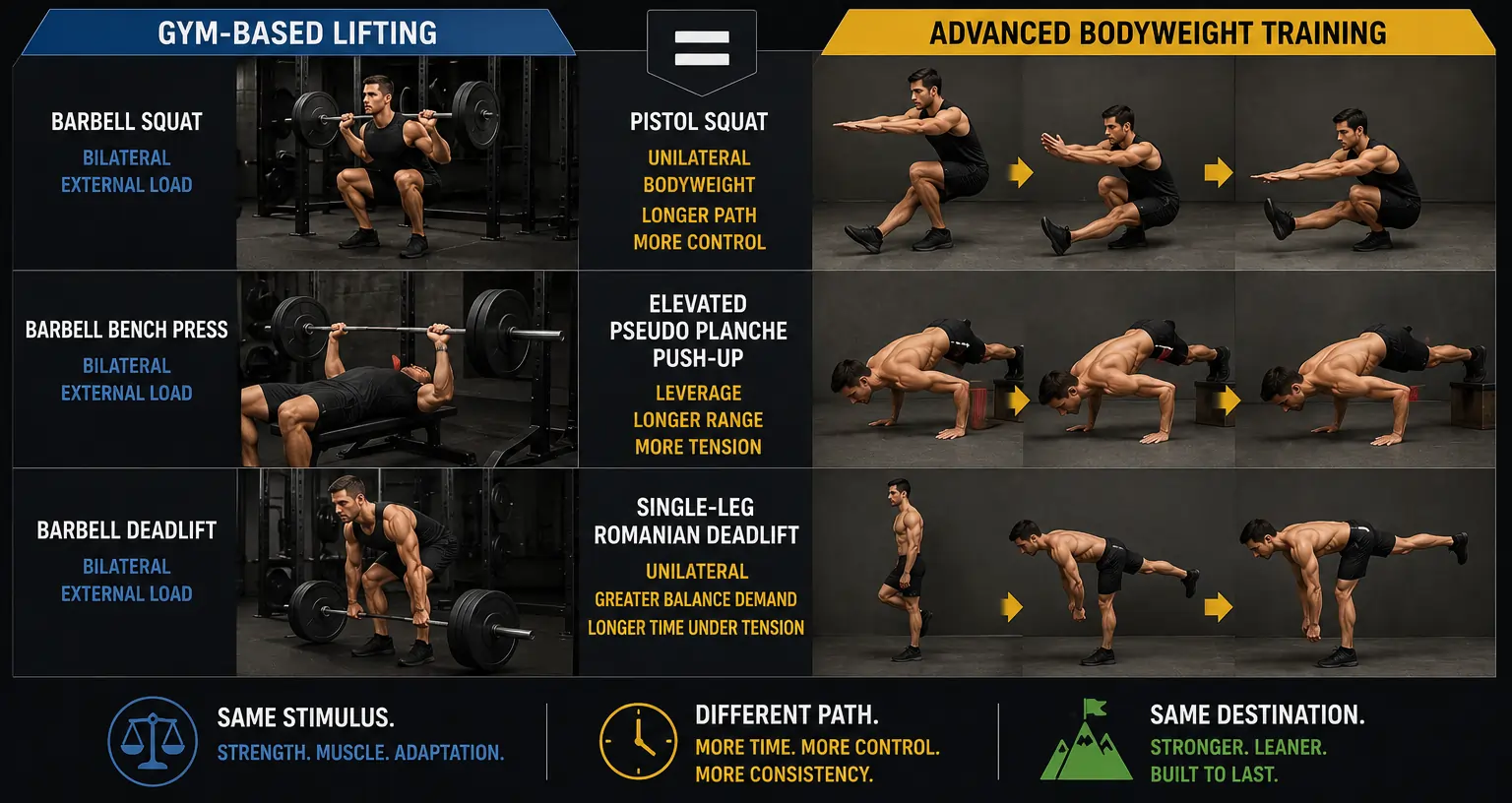
Unilateral training — exercises performed one limb at a time — is the most effective way to increase training demand without any equipment and without changing the exercise category. A two-leg squat distributes the load between both legs. A single-leg squat places the entire load on one leg. The effective difficulty roughly doubles.
Beyond pure load, unilateral training addresses a problem that bilateral training masks: side-to-side strength and stability imbalances. Almost everyone has a stronger side. Bilateral exercises allow the stronger side to compensate — unilateral work exposes and corrects that imbalance. If you've been building your base with the 15 foundational bodyweight exercises, unilateral progressions are the logical next layer.
One-Arm Push-Up Progression
Most people never attempt one-arm push-ups because the jump from two-arm to one-arm seems impossible. It is not — but it requires a progressive approach through intermediate positions.
- 1Standard push-up — master 3 × 15 with strict form
- 2Archer push-up — shift weight to one arm while the other assists with a straight arm at extension
- 3One-arm push-up with wide foot stance — reduces torso rotation demand
- 4One-arm push-up with hand elevated (on a step or couch) — reduces load on the working arm
- 5Full one-arm push-up from the floor
Key form cue: The body's tendency is to rotate toward the working arm. Resist this actively by engaging the core and the oblique on the non-working side. Controlled rotation under load is fine; passive collapse is not.
The Pistol Squat Progression
The pistol squat — a single-leg squat to full depth with the non-working leg extended forward — is the single most demanding bodyweight lower body exercise available. The strength, mobility, and balance requirements make it a legitimate multi-month goal that keeps home training productive for a long time.
- 1Bulgarian split squat — rear foot elevated; builds single-leg strength
- 2Assisted pistol squat — hold a door frame or suspension for balance; full depth single-leg squat
- 3Box pistol squat — lower to a chair or box at parallel depth; stand from the box
- 4Partial pistol squat — descend to below parallel; gradually deepen range over weeks
- 5Full pistol squat to floor
Mobility requirements: Full depth pistol squats require significant ankle dorsiflexion and hip flexor flexibility. If the heel lifts or the torso crashes forward, address ankle mobility first — daily calf raises through full range, door frame ankle stretches.
Single-Leg Romanian Deadlift
The single-leg Romanian deadlift (SL-RDL) is underused in most home training programmes. It builds unilateral hamstring and glute strength, develops hip stability, and directly improves running performance. If you completed the 4-week beginner plan, you already encountered this in Week 3 — here is how to progress it further. Along with Bulgarian split squats and step-ups, this is exactly the strength work recommended for runners building injury resilience alongside their cardio.
- 1Assisted SL-RDL with light wall touch — develops the pattern
- 2Bodyweight SL-RDL with free balance — hip hinges to 45 degrees
- 3Bodyweight SL-RDL to full range — torso approaches parallel to floor
- 4SL-RDL with load (water bottle, backpack) — bridges to loaded training
Key form cue: The hip of the standing leg should not drop or rotate outward as you hinge. That rotation is the glute medius disengaging. If you see it in a mirror, slow the movement and focus on keeping the pelvis level throughout.
Variable 3: Leverage — Changing the Physics
Leverage changes the mechanical difficulty of an exercise by altering the relationship between your body and the ground — without adding any weight. The same push-up movement performed with feet elevated on a chair shifts more bodyweight onto the pushing muscles and increases the percentage they must support. The exercise is harder without changing anything else.
| Pattern | Easier | Standard | Harder | Hardest (no equipment) |
|---|---|---|---|---|
| Horiz. push | Hands elevated | Floor push-up | Feet elevated (chair) | Feet elevated high + slow tempo |
| Vert. push | Pike push-up wide | Pike push-up standard | Feet-elevated pike | Wall handstand → Wall HSPU |
| Horiz. pull | Body at 45° | Inverted row horizontal | Feet elevated inverted row | Single-arm inverted row |
| Squat | Assisted (door frame) | Bodyweight squat | Bulgarian split squat | Pistol squat |
| Plank | Knee plank | Forearm plank | Extended arm plank | RKC plank + dead bug extension |
The handstand push-up progression: the ceiling of bodyweight pressing
The handstand push-up is performed with full bodyweight supported by the arms overhead. It is one of the most demanding pressing movements available in any training environment. Set it as a 3–6 month goal and track your position weekly.
Variable 4: Density — More Work in the Same Time
Training density is the ratio of work performed to time taken. Increasing density means performing more total work within the same or shorter session. Density training is particularly valuable for intermediate trainees because it does not require harder exercise variations — it requires doing more within a constrained timeframe, which is a different and equally valid form of progressive overload.
EMOM — Every Minute on the Minute
At the start of every minute, perform a prescribed number of reps. Rest for the remainder of the minute. Repeat for the duration of the workout.
Example 12-minute EMOM: Minute 1: 10 push-ups · Minute 2: 12 squats · Minute 3: 8 reverse lunges each leg. Repeat for 4 rounds. When each exercise takes less than 35 seconds consistently, add 2 reps per exercise.
AMRAP — As Many Rounds As Possible
Set a timer (10–20 minutes). Complete as many rounds of a circuit as possible. Record the total. Next session, beat it. The round count replaces the vague "did it feel hard enough?" question with an unambiguous number — progress is visible from session to session.
Example 15-minute AMRAP: 5 push-ups · 10 squats · 5 reverse lunges each leg · 10 glute bridges · 30-second plank. Benchmark: fit beginners complete 4–5 rounds. Intermediate: 5–7 rounds.
EDT — Escalating Density Training
Developed by strength coach Charles Staley, EDT pairs two non-competing exercises and accumulates maximum reps in a fixed time window. The paired format lets one muscle group recover while the other works, enabling high total volume with short rest.
Protocol: Pick two exercises that don't compete (e.g., push-up + glute bridge). Set a 15-minute timer. Alternate between them, performing 5 reps of each per set. Rest only as needed. Record total reps. Beat that number next session.
Combining the Four Variables: A Sample 8-Week Structure
These variables are not used simultaneously every session. They are layered across weeks, with each block emphasising a different primary variable.
"The moment my home training shifted from 'going through the motions' to genuinely challenging was when I stopped adding reps and started controlling tempo. I had been doing three sets of twenty push-ups. I switched to ten reps at 4-1-1-0 and couldn't complete the third set. Same exercise. Completely different stimulus."
The Intermediate Progression Library
For every exercise from the beginner series, here are the intermediate and advanced progressions available without any equipment.
| Exercise | Beginner | Intermediate (no equipment) | Advanced (no equipment) |
|---|---|---|---|
| Push-up | Standard, 3×12 | Slow (4-1-1-0) · Feet elevated · Wide or close grip | Archer push-up · Feet elevated high · One-arm progression |
| Vertical push | Pike push-up, 3×8 | Feet-elevated pike · Deeper ROM | Wall handstand hold → Negative → Wall HSPU |
| Row | Towel row, 3×12 | Inverted row, body near horizontal | Feet elevated inverted row · Single-arm inverted row |
| Squat | BW squat, 3×15 | Slow squat (3-2-1-0) · Jump squat · Split squat | Bulgarian split squat · Assisted pistol → Full pistol |
| Hip hinge | Hip hinge, 3×15 | SL-RDL · Slow tempo · Deficit hinge | SL-RDL with load · Nordic curl (feet anchored) |
| Glute bridge | Glute bridge, 3×15 | Single-leg bridge · 3-sec hold · Feet elevated | Feet elevated SL bridge · Hip thrust from sofa height |
| Plank | Forearm plank, 45s | Extended arm plank · Shoulder tap · RKC plank | Plank with leg raise · Archer plank · Plank to downward dog |
| Dead bug | Dead bug, 3×8 | 4-sec extensions · Full lower range | Limb pause · Hollow body hold |
| Side plank | Side plank, 30s | Hip dips · Side plank with leg raise | Side plank with rotation · Copenhagen plank |
| Burpee | Step-back burpee, 3×8 | Full burpee · Burpee to tuck jump | Burpee with clap push-up · 10-min AMRAP test |
When to Actually Buy Equipment
This guide is about extending the life of equipment-free training. But there is a real ceiling, and knowing where it is prevents you from staying in a less productive training state longer than necessary.
The signals that you have genuinely exhausted equipment-free progression:
- You can perform the hardest leverage variation of an exercise for 15+ reps with full control
- You have progressed to the unilateral version and can perform it for 10+ reps
- Tempo manipulation at its most demanding (4-2-1-1) feels manageable for full sets
- Density metrics have plateaued over 4–6 weeks without progress
Most people take 3–6 months of consistent intermediate training to reach this ceiling in push and squat patterns. Pull patterns — specifically vertical pulling — are the first to genuinely require equipment.
Buying a pull-up bar and bands is one route past the ceiling. The other is a gym, which removes it almost entirely — and if the machines and etiquette feel unfamiliar, The Beginner's Guide to Actually Using a Gym walks through exactly what to expect on your first visit.
The Honest Summary
There is more available in equipment-free bodyweight training than most intermediate trainees have explored. Tempo manipulation, unilateral loading, leverage change, and density training are not hacks or substitutes for "real" training — they are applications of the same progressive overload principles that underpin all training results. If you want the full picture of why this principle works and why plateaus happen even to people training hard, what progressive overload actually is covers the mechanisms in depth.
The ceiling of these variables, applied progressively and intelligently, sits somewhere between "I can do 20 push-ups" and "I can do wall handstand push-ups, pistol squats, and archer rows." That is a large gap, and most people exit the journey before they have covered half of it. For the next step in structuring all of this into a coherent programme, the Home Workout Routine From Scratch guide covers how to arrange these variables into a weekly training structure with the right frequency, volume, and rest.
Explore the progression space before buying anything. Not because equipment is bad — it is not — but because the progression is there, it is free, and it is more interesting than counting more reps of the same thing you've already mastered.