
Most beginner workout advice gives you either too little (just do 3 sets of push-ups!) or too much (here's a 90-day transformation programme with 25 variables to track). What actually works is something in between: a plan specific enough to follow, simple enough to actually do, and structured enough to produce progress you can measure.
This is that plan. Four weeks. Three sessions per week. Every workout written out. The only equipment you need is a chair and a bit of floor space. If you want to know more about why the foundational exercises in this plan work before you start, the 15 bodyweight exercises every beginner should master covers form, setup and progressions for each one — it's worth a read alongside this.
How the Plan Progresses Week by Week
Most beginners quit because they either plateau too fast or feel overwhelmed too soon. This plan avoids both by changing one or two variables each week — never everything at once.
| Week | Theme | What changes | Session length |
|---|---|---|---|
| Week 1 | Learn the patterns | Movement quality; low volume, generous rest | 20–25 min |
| Week 2 | Build the base | Add sets; reduce rest; increase reps | 25–30 min |
| Week 3 | Raise the intensity | Cardio finisher all sessions; exercise progressions | 30–38 min |
| Week 4 | Test yourself | Max effort sets; full progressions; measure W1 vs W4 | 35–45 min |
Three sessions per week — Monday, Wednesday, Friday works well, but any three non-consecutive days is fine. Each session targets the body differently: Session A is full body strength, Session B is lower body and core, Session C is upper body and cardio. They rotate, so no muscle group is hit twice in a row.
The Warm-Up (Do This Every Session)
Every session starts with the same 5-minute warm-up. Don't skip it. It isn't optional movement — it's the preparation that lets everything else work safely.
Once this is done, move straight into your session. The warm-up has also prepped the specific muscles most used in each workout — so you can start at working intensity without easing in further.
Week 1 — Learn the Patterns
Week 1 is intentionally easy. Not because you aren't capable of more, but because the goal this week is movement quality — not fatigue. Two circuits per session. Long rest. Focus on feeling every rep rather than pushing the numbers.
Towel Row — 10 reps
Bodyweight Squat — 12 reps
Glute Bridge (2-sec hold at top) — 12 reps
Plank — 25 seconds
Hip Hinge (wall-assisted) — 15 reps
Single-Leg Glute Bridge — 10 reps each leg
Dead Bug (slow) — 6 reps each side
Side Plank — 20 seconds each side
Inverted Row (under table) — 8 reps
Tricep Dip from Chair — 10 reps
Push-Up — 8 reps
Plank Shoulder Tap — 8 each side
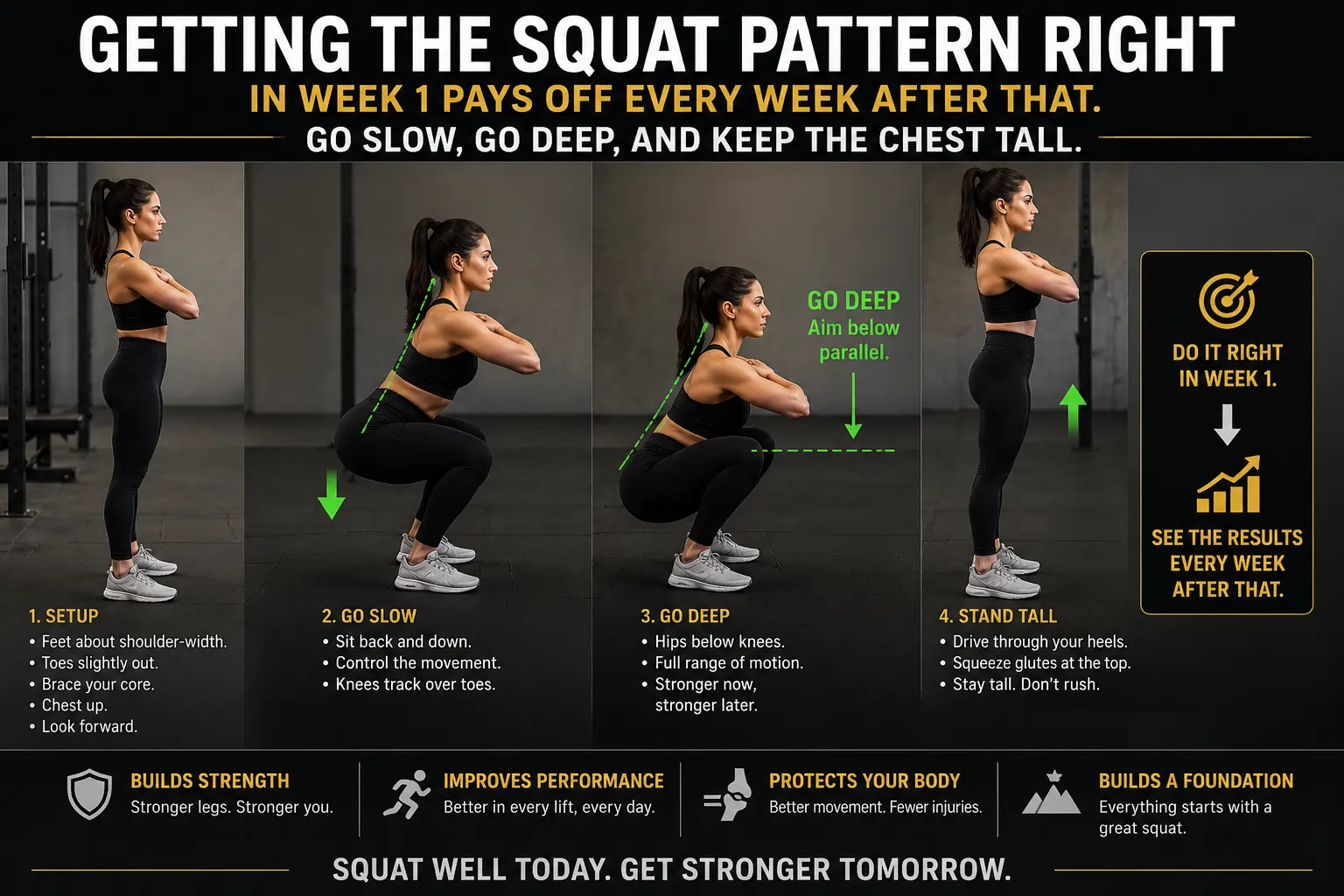
Week 2 — Build the Base
One extra circuit. Slightly less rest. More reps per exercise. Everything you learned in Week 1 gets applied under a bit more load. You will likely notice the sessions feeling harder than they look — that is the plan working.
This is also the week where the urge to quit tends to peak. The novelty has faded, you're sore, and the results aren't visible yet. This is completely normal. Push through Week 2 and the habit starts to set.
Towel Row — 12 reps
Bodyweight Squat — 15 reps
Glute Bridge (2-sec hold) — 15 reps
Plank — 35 seconds
Hip Hinge (no wall) — 15 reps
Bulgarian Split Squat — 8 reps each leg (new this week)
Dead Bug — 8 reps each side
Side Plank — 25 seconds each side
Inverted Row — 10 reps
Tricep Dip — 12 reps
Push-Up — 10 reps
Plank Shoulder Tap — 10 each side
Week 3 — Raise the Intensity
Rest drops to 60 seconds between circuits. A cardio finisher is added to every session. Several exercises get a progression — the 3-second descent push-up, the slow squat with a pause, the Bulgarian Split Squat at higher reps. If you have been following the plan, these progressions will feel hard but manageable.
Towel Row (lean further back) — 12 reps
Slow Squat (4s down, 1s pause at bottom) — 12 reps
Single-Leg Glute Bridge — 12 reps each leg
Plank — 45 seconds
Single-Leg Romanian Deadlift — 10 reps each leg (new)
Lateral Lunge — 10 reps each side (new)
Dead Bug — 10 reps each side
Side Plank with Hip Dip — 10 dips each side (new)
Inverted Row — 12 reps
Tricep Dip — 12 reps
Push-Up AMRAP (stop before form breaks) — new
Plank to Downward Dog — 10 reps (new)
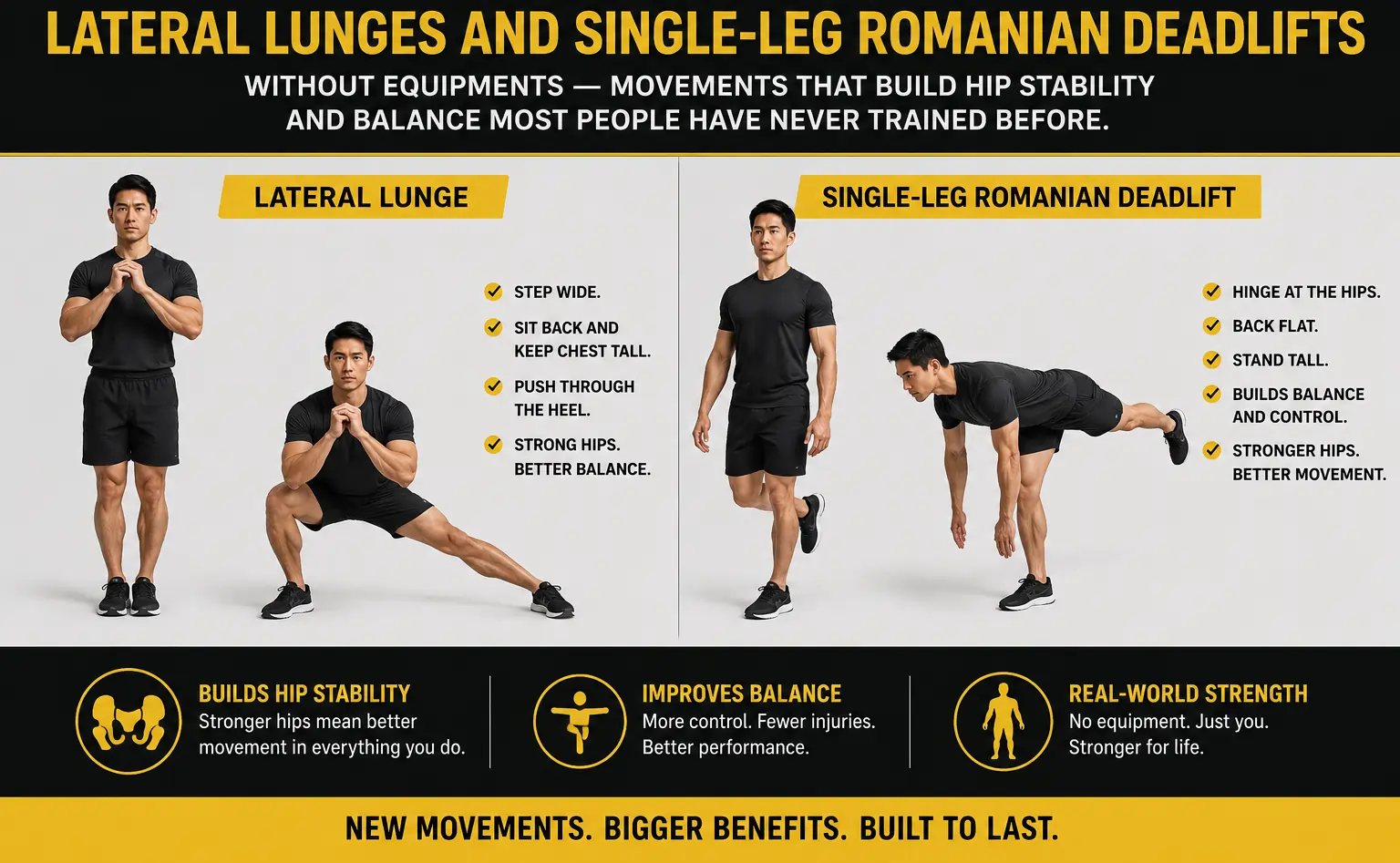
Week 4 — Test Yourself
Four circuits. Max effort sets. The hardest finishers. Week 4 is deliberately uncomfortable — it's the week you see what four weeks of consistent training has built. Embrace it.
Inverted Row — 12 reps
Bulgarian Split Squat — 10 reps each leg
Single-Leg Glute Bridge (3-sec hold) — 12 reps each
Plank — 50 seconds
Single-Leg RDL — 12 reps each
Lateral Lunge — 12 reps each
Dead Bug (4-sec extensions) — 10 reps each side
Side Plank with Leg Raise — 10 each side (new)
Inverted Row — 12 reps (set 4: AMRAP)
Tricep Dip — 15 reps
Diamond Push-Up — 8 reps (new)
Dead Bug — 10 reps each side
The Week 4 Check-In
After your final session, rest for a day and then repeat the exact same baseline tests you did before Week 1. Same conditions — same time of day if possible, same warm-up first.
| Test | Record | What to look for |
|---|---|---|
| Push-up max | Full reps until form breaks | Most people gain 3–8 reps |
| Squat max | Reps with good depth | Look for smoother, deeper movement |
| Plank hold | Seconds until hips drop | Often doubles from Week 1 |
| Burpees in 60 sec | Full burpees counted | Speed and recovery will improve |
| Energy (1–10) | Subjective — how you feel | Most people rate noticeably higher |
The numbers matter less than the direction. An improvement of even 20% across the board — after four weeks, from scratch, with no gym and no coach — is a meaningful physical adaptation.
What Progress Actually Looks Like
Beginners often expect to feel a dramatic shift. It doesn't usually work that way. Here's what you will actually notice across the four weeks:
"The hardest part is not the workouts. It is trusting the simplicity."
That quote is from my own first 4-week block. Simple doesn't mean easy. It just means you can actually do it — which is the only version of a workout plan that works.
Rest Days and Active Recovery
The days between sessions matter. What you do on them directly affects how well you adapt to training. Four rest-day principles that actually make a difference:
- Walk. 15–20 minutes of easy walking on off-days accelerates recovery by increasing blood flow without adding training stress.
- Don't do extra workouts. Adding a fourth session in Week 1 or 2 is almost always counterproductive. Trust the structure.
- Stretch the tight ones. Hips, hamstrings, and chest/shoulders are the common tension spots for beginners. 5 minutes of static stretching after a walk is enough.
- Prioritise sleep. This is where adaptation actually happens. Seven to eight hours for beginners isn't a luxury — it's a training variable.
What Comes After Week 4
Where you go depends on how the four weeks felt. Here's an honest decision table: