
You started training. The first few weeks felt like magic — every session left you noticeably stronger than the last, the weights that once felt heavy started feeling manageable, and the mirror seemed to change on a weekly basis. Then, at some point, it stopped. Same weights. Same reps. Same body. You are still showing up, still putting in the effort, and the results have simply stalled.
This is not a motivation problem, and it is very rarely a genetics problem. It is almost always a single missing ingredient: progressive overload — the one principle that separates a training programme that keeps producing results from one that quietly stopped working months ago while still feeling like effort.
What Progressive Overload Actually Is
Progressive overload means gradually increasing the demands placed on your body over time, so your muscles, connective tissue, and nervous system keep encountering a stimulus they have not already adapted to. It is not a training style, a programme, or a specific exercise. It is the underlying mechanism that makes any training style work in the first place.
Your body is fundamentally an adaptation machine. Place a stress on it that it hasn't handled before, and — given adequate recovery, sleep, and nutrition — it adapts to handle that stress more easily next time. That's the entire basis of the training response, whether the "stress" is a barbell, a bodyweight exercise, a resistance band, or a hill sprint. The problem is that adaptation is the goal, but it is also self-limiting: once your body has fully adapted to a given level of stress, that same level stops producing further adaptation. It has become the new baseline, not a challenge. This mechanism is also a big part of why, when weighing cardio against strength training for a beginner with limited time, resistance work tends to edge out cardio as the priority — it's the one that actively builds new muscle rather than just conditioning what's already there.
Why It Works: The Mechanisms Behind Adaptation
Three overlapping mechanisms are currently understood to drive the muscular adaptations — strength and size — that come from progressively overloaded resistance training:
A third mechanism, metabolic stress — the "burn" from high-rep, short-rest training — also contributes, though its role is smaller and more debated than tension and damage. All three scale with the amount of demand placed on the muscle relative to what it has already adapted to, which is exactly what progressive overload increases over time.
The muscle damage mechanism above is also what causes DOMS — the soreness that shows up a day or two after a new or heavier session. See DOMS explained for why soreness itself isn't a reliable indicator of how much progress a session actually produced.
A 2026 study published in Medicine & Science in Sports & Exercise put this to a direct test in untrained women, comparing a group that progressively increased their training load over the study period against a group that trained with a fixed, non-progressing load. Both groups built muscle — but the progressive overload group saw muscle thickness increase by 21.4%, compared to 11.3% in the non-progressing group, roughly double the hypertrophy from the same starting point and duration.[1] Training without ever increasing demand still does something. Training with progressively increasing demand does substantially more.
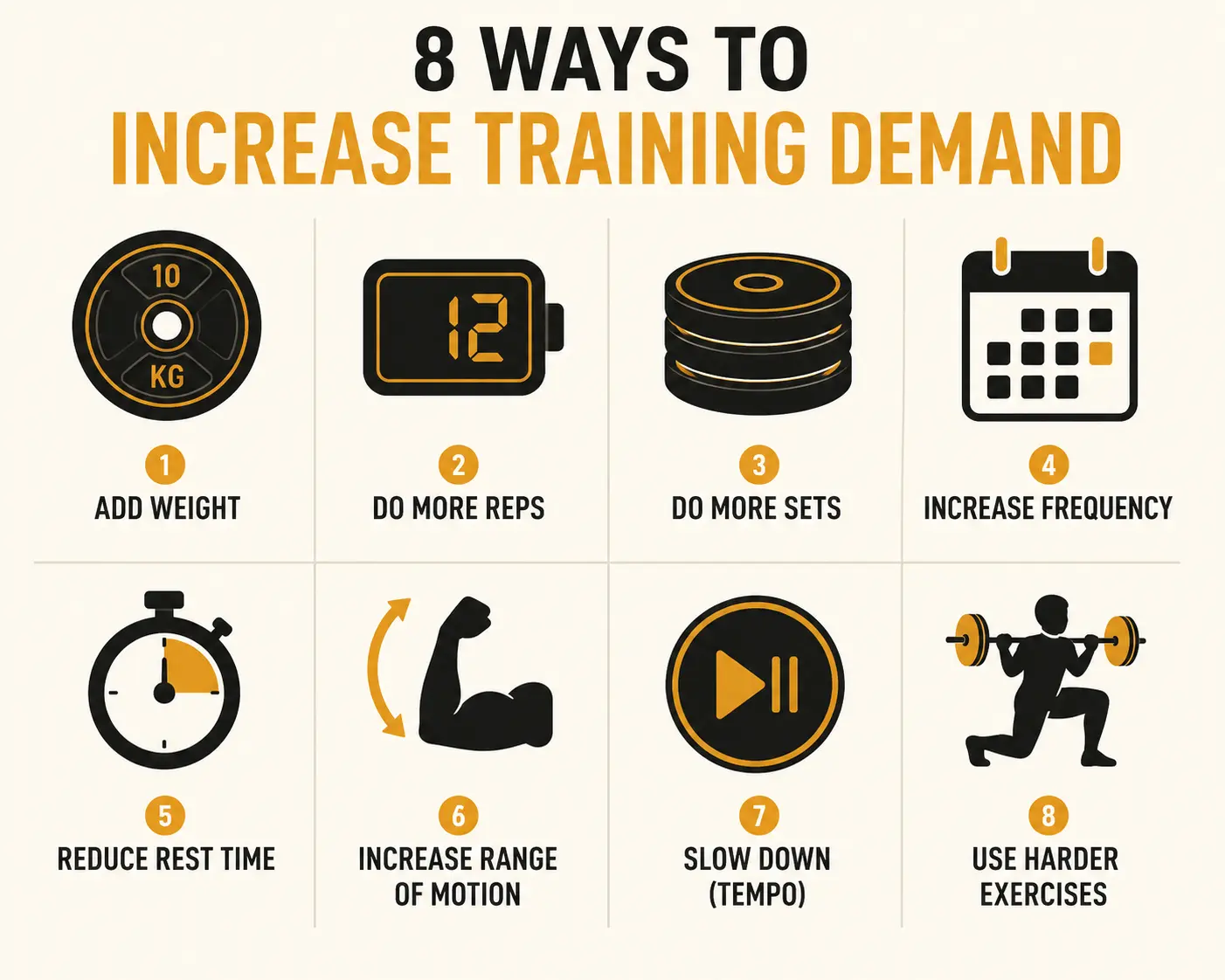
Eight Ways to Progressively Overload (It's Not Just "Add Weight")
The most common misconception about progressive overload is that it only means adding plates to a bar. That's one method — a good one, when it's available — but it's far from the only one, and relying on it exclusively is why so many people feel stuck the moment they can't add weight every week.
Add weight to the same exercise, same reps and sets.
Same weight, more repetitions per set over successive sessions.
Increase total weekly volume for a muscle group without changing load or reps.
Train the same muscle group more often per week, spreading the same or greater total volume.
Shorter rest between sets increases density and metabolic demand for the same work.
A deeper squat or fuller stretch under load increases the demand at the same external weight.
A slower eccentric (lowering) phase increases time under tension without adding load.
Move to a more mechanically demanding version — knee push-up to standard, standard to decline.
Each of these increases the total demand on the muscle relative to what it has already adapted to — which is what actually matters, not the specific lever you pull. For a deeper breakdown of applying these methods specifically without gym equipment, the home workout routine from scratch guide and bodyweight progression without equipment cover the bodyweight-specific applications of methods 2 through 8 in detail. Method 6 in particular depends on a joint's actual mobility, not just muscle length — mobility vs flexibility covers why a deeper squat under control is a mobility skill, not just a flexibility one. Methods 2 and 3 — more reps and more sets — are worth understanding on their own terms too: how many reps and sets you actually need breaks down the rep ranges and weekly volume research behind each goal.
Why Your Workouts Have Stopped Working
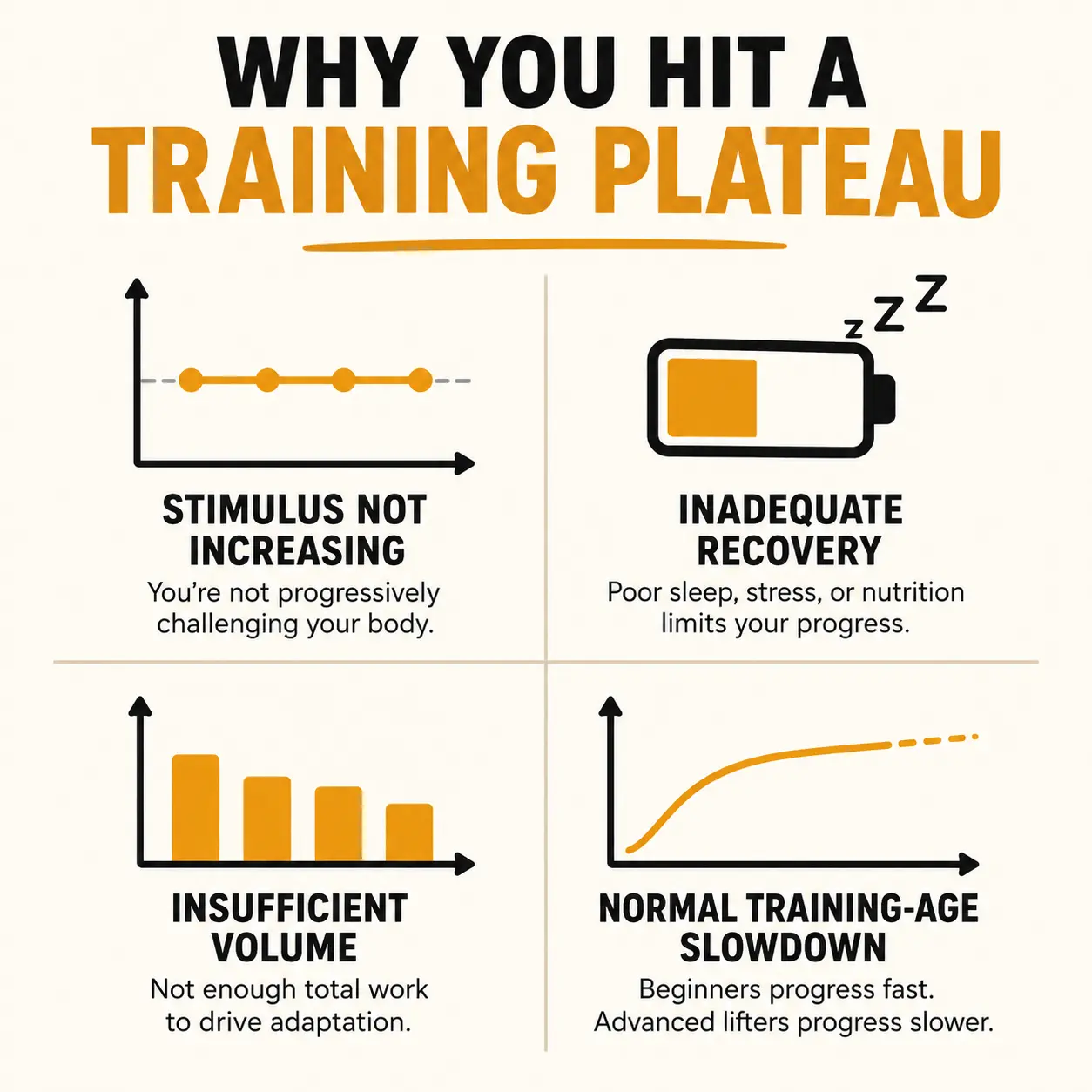
A plateau happens when the relationship between training stress, recovery, and adaptation stops producing continued improvement. In most cases, this comes down to the structure of the training itself, not a lack of effort. The most common causes, roughly in order of frequency:
- The stimulus stopped increasing. By far the most common cause — the same weights, same reps, same sets, session after session, with no deliberate plan to increase any of the eight levers above.
- Recovery isn't keeping pace. Progressive overload only works if the body has the resources — sleep, protein, calories, time — to actually adapt to the increased demand. Overload without adequate recovery accumulates fatigue instead of producing adaptation. The rest and recovery guide covers this side of the equation in depth.
- Training volume is too low to drive further adaptation. A stimulus that was sufficient for a beginner often stops being sufficient as training age increases — the same three sets that built noticeable results in month one may simply be too little signal by month eight.
- Progress is being demanded faster than biology allows. Especially past the first one to two years of consistent training, when neural adaptations have largely run their course and further gains depend on slower structural changes like muscle and tendon growth.
Normal Slowdown vs. a Genuine Plateau
Progress in strength training does not follow a straight line — it follows a curve of diminishing returns. Most of the relative gains happen in the first one to two years of consistent training, driven largely by neural adaptations (your nervous system getting better at recruiting the muscle you already have). Gains in later years come more slowly, from slower structural changes like muscle and connective tissue growth.[2] A beginner might add 2.5kg to a lift almost every week. An experienced lifter might take a month or more to add the same amount — and that slower pace is not a plateau. It's the expected shape of long-term progress.
A genuine plateau is different: performance stalling or declining for several consecutive sessions despite adequate sleep and nutrition, motivation dropping for more than a week without an external cause, or a lift that hasn't moved in over a month despite consistent training. If what you're seeing is a gradual slowdown in the rate of a still-ongoing improvement, that's normal biology. If it's a flat line with no movement at all for weeks, that's a plateau worth actively addressing.
Applying Progressive Overload by Training Age
| Training age | Realistic pace | Primary method |
|---|---|---|
| Beginner (0–6 months) | Weekly or near-weekly increases | Add load or reps almost every session — the body adapts fast at this stage, so the stimulus needs to move fast too. |
| Intermediate (6 months–3 years) | Every 1–3 weeks | Rotate between load, reps, and volume increases; a structured programme with planned progression outperforms ad hoc increases. |
| Advanced (3+ years) | Every 4–8+ weeks, sometimes longer | Small, deliberate increases in volume or intensity, often organised into training blocks with planned deloads between them. |
If you're just starting out and building your first structured routine, the beginner's guide to actually using a gym covers how to get comfortable with the equipment first — progressive overload only matters once you have a consistent baseline to progress from. Logging your numbers each session is what actually makes any of this trackable: the free Habit Tracker works well for checking off consistent training days, and the downloadable log below is built specifically for tracking load and reps week over week.
Training age isn't the only variable that changes how much stimulus a given increase actually delivers — hormonal shifts do too. Strength training for women over 40 covers why postmenopausal women often need to apply overload at a higher relative intensity than this table alone would suggest.
Common Progressive Overload Mistakes
- Trying to increase everything at once. Adding weight, reps, and sets simultaneously outpaces what most people's recovery can support. Pick one lever, progress it, then move to another.
- Chasing weekly increases indefinitely. What works for a beginner's nervous system does not work forever. Continuing to demand weekly jumps well past the first year is a common route to a stalled plateau, not faster progress.
- Ignoring recovery while increasing demand. Progressive overload without matching sleep, nutrition, and rest days accumulates fatigue rather than adaptation — see the rest between workouts guide for the recovery side of this equation.
- Sacrificing form to add load. Adding weight at the cost of range of motion or technique isn't progressive overload — it's a different, easier exercise that happens to have a heavier number attached. The demand only counts if it's applied through full, controlled range of motion.
- Not tracking numbers. Without a log of what you lifted last time, "increasing the demand" becomes a vague impression rather than a deliberate plan. This is the single easiest fix — write it down.
Final Thoughts
Progressive overload is not a technique reserved for competitive lifters — it's the reason any structured training produces results at all, and the reason unstructured training so often stalls after the first few encouraging weeks. The mechanism is simple even when the execution takes discipline: your body only keeps changing in response to demands it hasn't already adapted to.
If your workouts have stopped working, the training probably isn't the problem. The absence of a plan to keep increasing what you're asking your body to do — that's the problem, and it's a fixable one.
You don't need to overhaul your entire routine to fix a plateau. Pick one of the eight methods above, apply it deliberately for a few weeks, track the numbers, and adjust based on what the log actually shows rather than how the session felt. For building a complete, progressive training structure around this principle — including how to plan rest and avoid outpacing recovery — the Move More course covers it as a full system.
This article is for informational purposes only and does not constitute medical or clinical advice. If you have an existing injury or health condition, consult a qualified healthcare or fitness professional before significantly increasing training load.
Sources
[1] Progressive Overload Affects the Magnitude of Muscle Hypertrophy. Medicine & Science in Sports & Exercise, 2026. Available at: pubmed.ncbi.nlm.nih.gov
[2] General finding on the logarithmic, diminishing-returns pattern of strength progression relative to training age, as discussed in resistance training dose-response literature. Summary available at: strongerbyscience.com