
- Diet is the primary driver of fat loss for both cardio and strength training — exercise contributes but doesn't override a calorie surplus.[1]
- Strength training preserves lean muscle mass during a calorie deficit far more effectively than cardio alone.[2]
- Public health guidelines recommend at least 150 minutes of moderate cardio weekly, plus strength training for all major muscle groups at least twice a week.[3]
- Aerobic exercise has stronger, more extensive evidence for reducing cardiovascular disease risk specifically than strength training does.[4]
- Muscle mass naturally declines with age (sarcopenia) starting as early as the 30s — strength training is the primary tool for slowing this.[5]
"Cardio or weights?" is one of the most argued-about questions in fitness, and most of the argument is unnecessary — the honest answer is that both do different, largely non-overlapping jobs, and neither replaces the other. But that answer isn't useful if you're a beginner with limited time trying to decide where to actually start. This is the practical version: what each one does, where the evidence is strong versus overstated, and how to prioritize if you genuinely can't do both consistently yet.
Why "Which Is Better" Is the Wrong Question
Cardio and strength training aren't competing for the same outcome — they're each better suited to different, specific adaptations. Cardio trains your heart, lungs, and the efficiency of oxygen delivery to working muscles. Strength training builds and preserves muscle tissue and bone density. Asking which is "better" is a bit like asking whether a screwdriver or a hammer is better — it depends entirely on what you're trying to build.
The more useful framing, especially for a beginner with three or four hours a week, is: given limited time, which one should get priority first? That has a real, evidence-backed answer, even though it depends somewhat on your specific goal.
Part of why this debate stays so noisy online is that people on each side are usually optimizing for a different outcome without saying so. A runner training for a 10K and a beginner trying to lose 10 kilos and keep it off are asking two different questions that happen to sound identical when phrased as "cardio vs. strength." Getting specific about your actual goal — not just "get fit" — is what turns this from an unwinnable debate into a fairly simple decision.
What the Research Says About Fat Loss
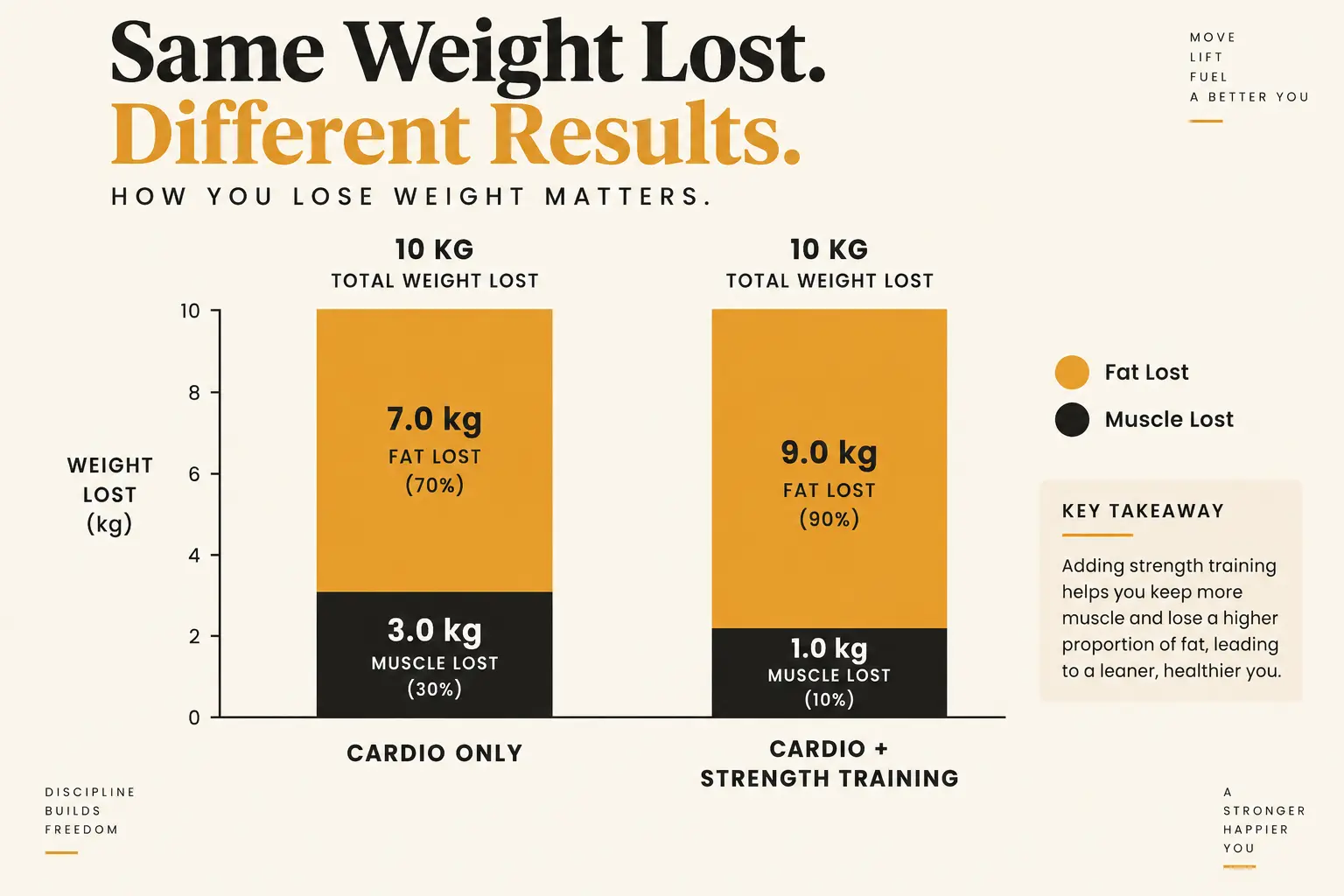
Fat loss is driven primarily by a sustained calorie deficit — through diet, activity, or both — and neither cardio nor strength training overrides that basic mechanism.[1] Where the two diverge is in what happens to your body composition while you're losing weight. Cardio burns more calories per session for a given duration, which makes it an efficient tool for increasing total energy expenditure. Strength training burns fewer calories per session but plays a specific, well-documented role: preserving lean muscle mass while you're in a deficit.[2]
This matters because weight lost without strength training tends to come from a larger proportion of muscle alongside fat, while weight lost with strength training included skews more toward fat loss with muscle preserved — meaning the same number on the scale can represent a very different, and generally less desirable, outcome without it.
What the Research Says About Muscle and Metabolism
Strength training's effect on resting metabolic rate is real but smaller than most marketing suggests. Added muscle does burn more calories at rest than fat tissue, but the difference is modest — roughly 6 calories per pound of muscle per day, not the dramatic "muscle burns fat while you sleep" framing common in supplement ads. The more significant metabolic benefit of strength training during weight loss is muscle preservation itself, not a large standalone calorie-burning effect.[2]
Where strength training has a clearer edge is in progressive overload — the mechanism that actually builds new muscle and strength over time. Cardio, even at high intensity, doesn't provide the same mechanical tension stimulus that drives hypertrophy, which is why cardio-only training plans plateau in terms of visible muscle development regardless of how much volume is added.
The Honest Comparison
| Goal | Better primary tool | Why |
|---|---|---|
| Pure fat loss | Diet first, then either | Both contribute to the deficit; strength training protects muscle while it happens |
| Building visible muscle | Strength training | Only strength training provides the progressive mechanical tension muscle growth requires |
| Cardiovascular health | Cardio | Stronger, more extensive evidence for heart disease risk reduction specifically |
| Bone density / aging | Strength training | Resistance training is the primary evidence-based tool against age-related bone and muscle loss |
| General health baseline | Both, roughly equal priority | Public health guidelines recommend both weekly, not one instead of the other |
| Endurance performance | Cardio | Sport-specific aerobic adaptation doesn't come from strength training alone |
Health Outcomes Beyond Body Composition
Cardiovascular disease risk reduction has a deeper, more extensive evidence base for aerobic exercise specifically than for strength training.[4] Regular cardio improves heart efficiency, lowers resting heart rate, reduces blood pressure, and improves cholesterol markers through mechanisms strength training doesn't replicate as fully — even though strength training does provide some modest cardiovascular benefit of its own.
On the other side, sarcopenia — the progressive, age-related loss of muscle mass and strength — begins as early as someone's 30s and accelerates with age if unaddressed.[5] Resistance training is the single most effective, well-evidenced tool against this process, and its downstream effects (fall risk, independence in older age, bone density) make it a genuinely different kind of long-term health investment than cardio provides. This is why age-specific guidance, like strength training recommendations for women over 40, tends to emphasize resistance work even for people whose primary stated goal is general health rather than muscle building.
If You Only Have 3 Hours a Week
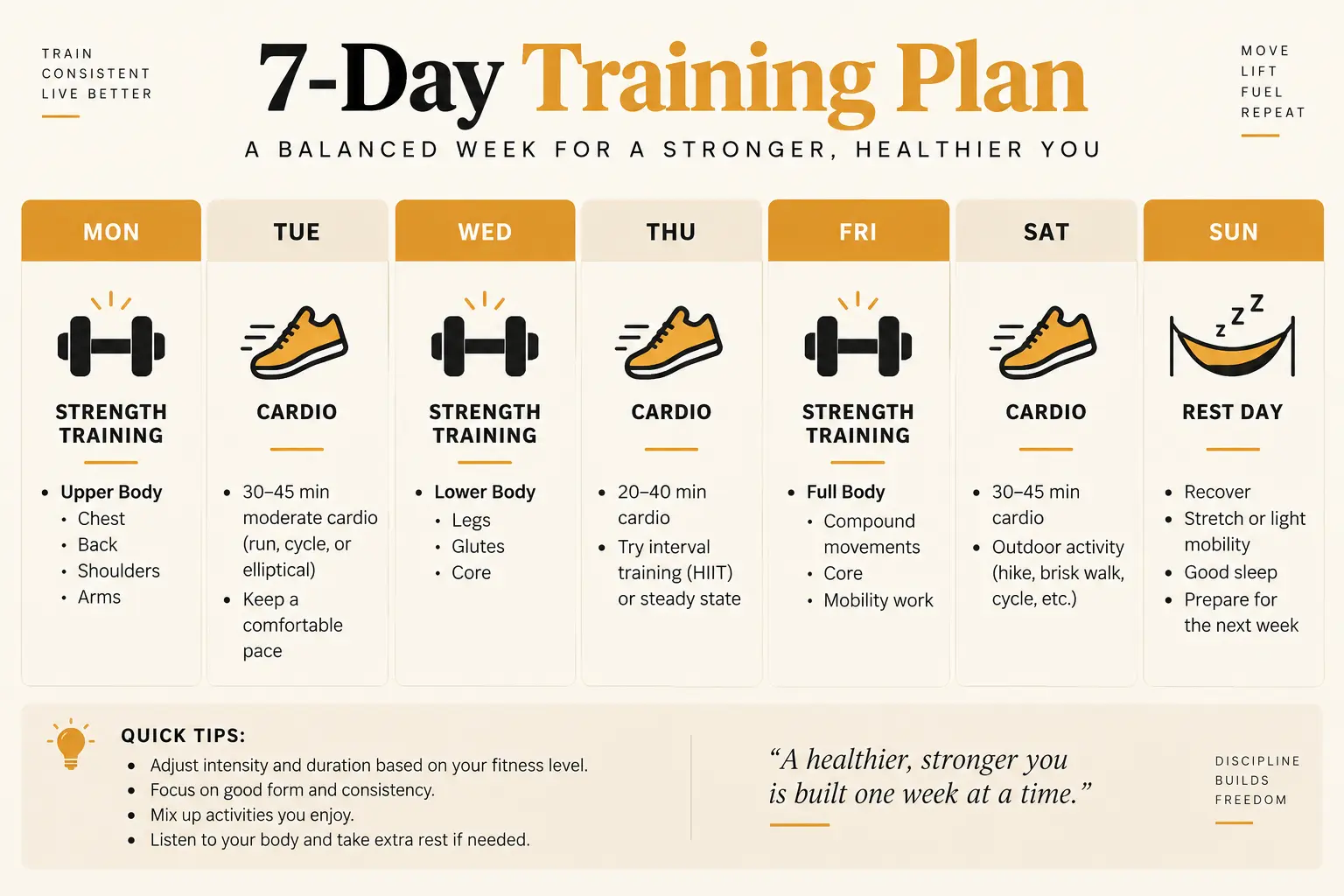
For a beginner with genuinely limited time and a general health or body composition goal, the evidence leans toward prioritizing strength training first. The reasoning: muscle is harder to build later than to maintain once you have it, strength training's benefits (bone density, metabolic health, functional strength) compound over years in a way that's difficult to catch up on, and cardio can be added incrementally — even brisk walking counts meaningfully toward the weekly aerobic guideline — without requiring dedicated gym time.
- 2-3 full-body strength sessions (45-60 min each) as the foundation — covering all major muscle groups.
- 1-2 shorter cardio sessions (20-30 min), higher intensity if time is the binding constraint.
- Daily incidental movement — walking, stairs, active commuting — to build toward the 150-minute weekly aerobic guideline without needing dedicated sessions for all of it.
This isn't a permanent hierarchy — as consistency builds and time allows, adding more dedicated cardio closes the gap on cardiovascular-specific benefits that incidental movement alone doesn't fully cover. If home workouts are the more realistic starting point than a gym, the beginner home workout routine guide covers building a strength foundation without equipment.
Common Mistakes
- Doing only cardio for fat loss and skipping strength entirely. This risks losing a larger proportion of muscle along with fat, which undermines long-term metabolic health.
- Doing only strength training and ignoring cardiovascular health. The heart-disease-risk evidence specifically favors dedicated aerobic activity — don't assume lifting alone covers it.
- Believing muscle "burns fat while you sleep" in a dramatic way. The resting metabolic effect of added muscle is real but modest — the bigger win is muscle preservation during a deficit.
- Treating this as a permanent either/or choice. The priority order here is for limited time only — both belong in a complete long-term program.
- Ignoring incidental movement as "not real cardio." Walking and daily activity genuinely count toward aerobic guidelines and are a realistic entry point for time-constrained beginners.
Final Thoughts
Cardio and strength training aren't rivals — they're tools built for different jobs, and a complete fitness plan eventually needs both. But if you're a beginner with genuinely limited time forced to choose a starting priority, the evidence points toward strength training first for most general health and body composition goals, with cardio layered in through both dedicated sessions and daily incidental movement. The goal isn't picking a permanent winner — it's building a foundation you can expand once consistency is established.
The honest version of this advice: the exercise you'll actually do consistently beats the theoretically optimal one you keep skipping. Start with strength training if time is tight, but don't let the debate become a reason to do neither.
Once your strength foundation is in place, the free Move More course walks through building out a complete, sustainable training program — strength, cardio, and everything around them — from the ground up.
This article is for general information and isn't a substitute for personalized guidance from a doctor or certified trainer, especially if you have an existing cardiovascular condition or injury.
Sources
[1] Energy balance and the role of exercise in weight management. Available at: pubmed.ncbi.nlm.nih.gov
[2] Resistance training and lean mass preservation during caloric restriction — systematic review. Available at: pubmed.ncbi.nlm.nih.gov
[3] WHO Guidelines on Physical Activity and Sedentary Behaviour. Available at: who.int
[4] Aerobic exercise and cardiovascular disease risk reduction — meta-analysis. Available at: ahajournals.org
[5] Sarcopenia: prevalence, mechanisms, and resistance training as intervention. Available at: pmc.ncbi.nlm.nih.gov