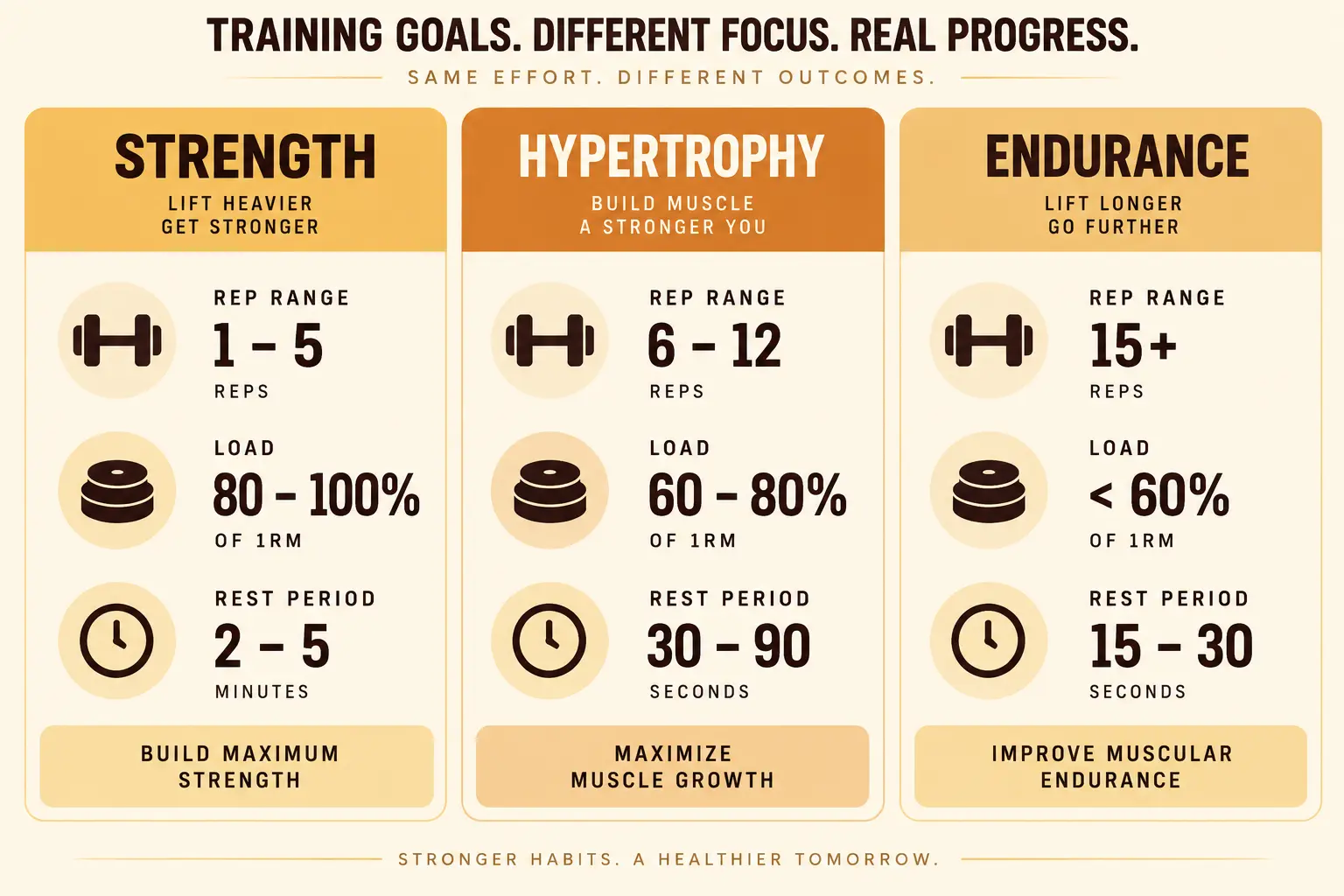
- Strength training research supports roughly 1-6 reps at 80-100% of one-rep max, with 2-5 minutes of rest.
- Meta-analyses show hypertrophy occurs across a wide range — from around 5 to 30+ reps — as long as sets are taken close to failure.[1]
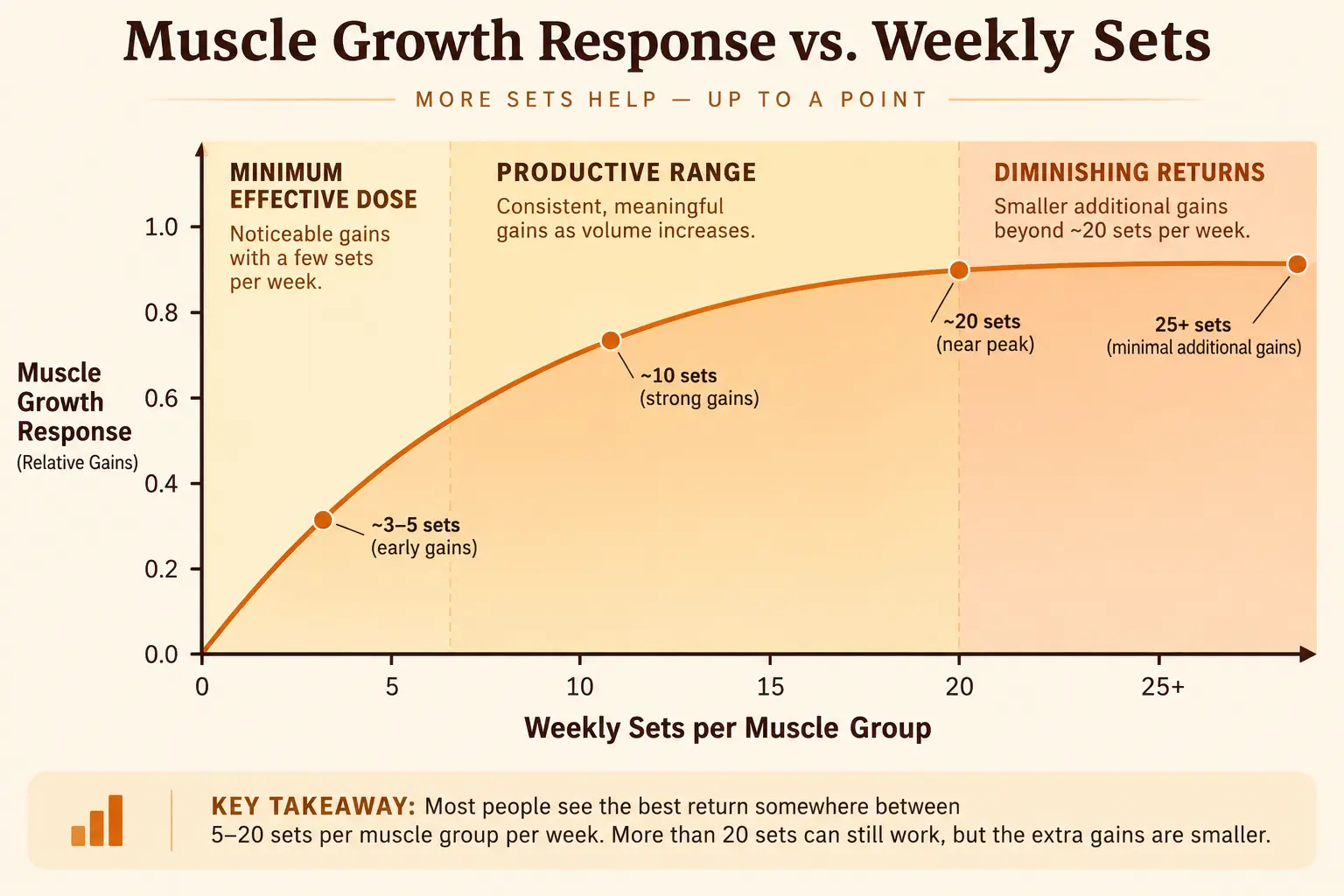
- Weekly training volume of roughly 10-20 hard sets per muscle group is linked to the best hypertrophy outcomes in research syntheses.[2]
- Muscular endurance responds best to higher reps (15-25+) at lighter loads with shorter rest periods.
- Total effort — how close a set gets to failure — predicts muscle growth better than the exact rep number chosen.[3]
"How many reps and sets should I do?" is one of the most Googled questions in fitness, and it doesn't have one answer — because it's really three different questions wearing one costume. Strength, muscle size, and muscular endurance are distinct physiological adaptations, each responding best to a different combination of load, reps, sets, and rest. Picking a rep range that doesn't match your actual goal is a common reason people train consistently for months and feel like nothing is changing.
Why "It Depends On Your Goal" Is Actually the Real Answer
Reps and sets describe training intensity and volume — and different intensities stress the body differently. Heavy loads for very few reps mostly challenge your nervous system's ability to recruit muscle fibres efficiently, which is why powerlifters train close to their one-rep max. Moderate loads taken close to fatigue create the mechanical tension and metabolic stress that drive muscle growth. Lighter loads for many reps train the muscle's ability to keep working under sustained effort — endurance.
None of these ranges are "better" in the abstract. A rep range is a tool matched to a specific outcome, the same way progressive overload is the mechanism that keeps any of them working over time. It's the same reasoning behind the broader cardio vs strength training question — the "right" choice depends entirely on what you're actually training for.
The Three Rep Ranges, Explained
These ranges come from decades of strength and conditioning research, including position stands from the National Strength and Conditioning Association and the American College of Sports Medicine.[4] They're a useful starting framework — but the more interesting research is what happens at the edges.
The Hypertrophy Range Is Wider Than Most People Think
For years, "6-12 reps for muscle growth" was treated as gospel. More recent meta-analyses have complicated that picture. A well-cited systematic review found that low-load training (around 30+ reps to failure) produced muscle growth comparable to high-load training (6-12 reps to failure), as long as sets were taken close to muscular failure.[1] The mechanism appears to be that mechanical tension and metabolic stress — not the specific rep count — actually drive the muscle-building signal.
This doesn't mean rep range is irrelevant. Very low reps (1-5) at near-maximal loads accumulate less total time under tension per set. Very high reps (30+) take longer and fatigue accumulates faster. The 6-12 range remains a good default — it's just not the *only* range that works, which matters if joint stress or equipment pushes you outside it.
Sets: How Much Weekly Volume You Actually Need
Reps get most of the attention, but total weekly sets per muscle group is arguably more important for hypertrophy. A frequently cited meta-analysis found a clear dose-response relationship: fewer than roughly 5 sets per muscle group per week produced the smallest gains, while 10+ sets per week produced meaningfully more growth.[2] The productive range generally sits at 10-20 hard sets per muscle group per week, with most lifters seeing strong results around 12-16 sets — returns flatten out or reverse past roughly 20 sets due to accumulated fatigue.
| Goal | Reps per set | Sets per exercise | Rest between sets | Load (% of 1RM) |
|---|---|---|---|---|
| Strength | 1-6 | 3-5 | 2-5 min | 80-100% |
| Hypertrophy | 6-12 (5-30 workable) | 3-4 | 60-90 sec | 65-85% |
| Endurance | 15-25+ | 2-3 | 30-60 sec | Under 65% |
| General fitness (mixed) | 8-15 | 2-4 | 45-90 sec | 60-80% |
This weekly-set total is spread across all the exercises that train a given muscle group, not per single exercise — three sets of squats and three sets of leg press in the same week both count toward your quad volume.
Beginners vs. Experienced Lifters
Rep-range precision matters less than most beginners assume. In the first several months of consistent training, almost any structured rep range in the 6-15 zone produces solid results, because the nervous system and muscles are adapting to a completely new stimulus — often called "newbie gains." As easy progress slows, the exact numbers — reps, sets, load, and how deliberately you apply progressive overload — start to matter more.
- Months 1-3 (beginner). Focus on technique and consistency. 8-12 reps, 2-3 sets, moderate weight is a safe default.
- Months 3-12 (novice-intermediate). Start matching rep ranges to specific goals. Introduce heavier strength work if that's a priority.
- 1+ years (intermediate-advanced). Weekly volume and progressive overload become the main levers, since easy adaptation has run out.
Where Rest Between Sets Fits In
Rest period isn't an afterthought — it's part of the same system as reps, sets, and load. Longer rest (2-5 minutes) lets the phosphocreatine energy system and nervous system recover enough to lift near-maximal weight again, which is why strength training uses long rests. Shorter rest (60-90 seconds) for hypertrophy work trades slightly less recovery for more training density per session. For the full picture on rest days too, how much rest you actually need between workouts covers both. If you're training on a busy gym floor, longer rest periods also mean sharing equipment more often — gym etiquette for beginners covers exactly how "working in" between sets is supposed to work.
Common Mistakes
- Using the same rep range for every goal. 10-12 reps for everything is a reasonable default, but it isn't optimal for pure strength or pure endurance goals.
- Chasing rep numbers instead of effort. A set of 10 stopping 5 reps short of failure trains very differently than one taken close to failure — proximity to failure matters as much as the number.
- Ignoring total weekly volume. Three sets of one exercise, three times a week, isn't automatically enough — track total weekly sets, not just a single session.
- Cutting rest periods to save time. Shorter rest reduces the weight you lift on later sets, undermining strength and hypertrophy goals.
- Never changing anything. The same reps, sets, and weight for months is the fastest way to stall — pair your rep range with progressive overload.
Final Thoughts
Reps and sets aren't a universal formula — they're dials you adjust based on what you're training for. Low reps and heavy loads build strength. Moderate loads taken close to failure, across a wider rep range than most assume, build muscle. Higher reps and lighter loads build endurance. Total weekly volume and how close you push each set to failure matter as much as the numbers on the page. Pick the range that matches your goal, apply it consistently, and let progressive overload do the rest.
The honest version of this advice: the "perfect" rep range only helps if you actually show up and do the sets — consistency beats optimization every time someone skips a session chasing the ideal number.
If you're building this into a repeatable weekly routine, the free Habit Tracker can help you stay consistent with your training days, and the free Move More course walks through building a complete, sustainable training program from the ground up — reps, sets, and everything around them. Once you're training consistently, a simple workout log is what actually confirms your reps and sets are producing progress over time, rather than just staying busy.
This article is for general information and isn't a substitute for personalized programming from a certified coach or trainer, especially if you have an existing injury or medical condition.
Sources
[1] Effects of low- vs. high-load resistance training on muscle strength and hypertrophy: a systematic review and meta-analysis. Available at: pubmed.ncbi.nlm.nih.gov
[2] Dose-response relationship between weekly resistance training volume and increases in muscle mass: a systematic review and meta-analysis. Available at: pubmed.ncbi.nlm.nih.gov
[3] Effect of resistance training to muscular failure vs. non-failure on strength, hypertrophy and muscle architecture. Available at: pubmed.ncbi.nlm.nih.gov
[4] National Strength and Conditioning Association position stand on resistance training for health and performance. Available at: journals.lww.com