
- Most workout logs are abandoned within the first few weeks — the common failure point is a system too detailed to maintain once motivation naturally dips.
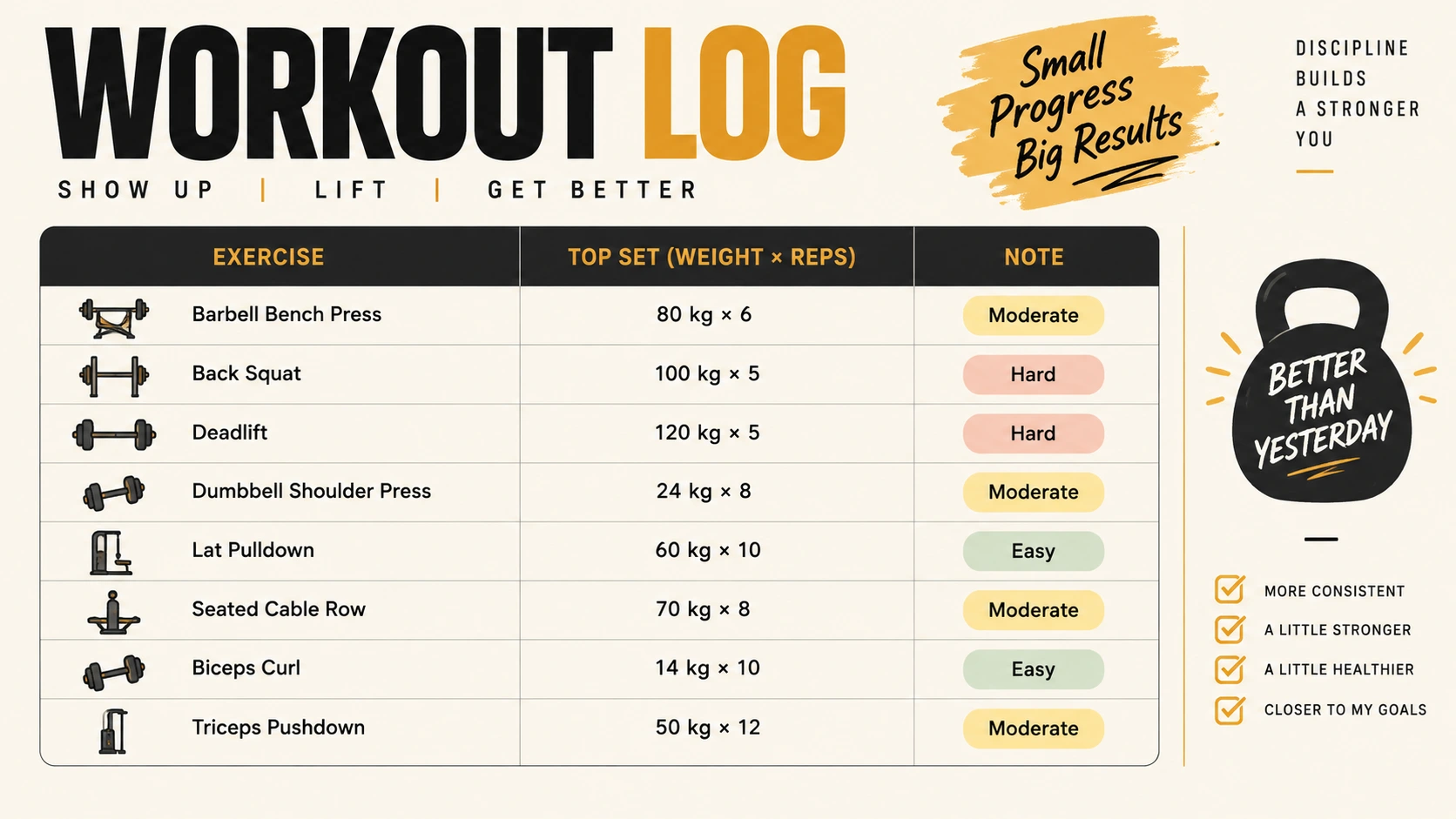
- Three fields — exercise, top set weight/reps, and one subjective note — cover most of what a training log actually needs to be useful.
- Self-monitoring is one of the most consistently supported behavior-change tools in exercise adherence research.[1]
- Without a written record, most people meaningfully misremember the weight or reps used in a previous session.
- The right format — paper, app, or spreadsheet — is whichever one survives contact with a tired, unmotivated version of you.
Almost everyone who starts lifting seriously eventually hears "track your workouts" — and almost everyone who tries it quits within a few weeks. The advice isn't wrong. The problem is nearly always the system: most people start with a level of detail — every set, every rest period, every subjective note — that takes real time and effort to maintain, and that effort disappears the moment motivation dips, which happens to everyone eventually. This is the version that's actually designed to survive.
Why Most People Give Up on Workout Tracking
The typical failure pattern looks the same regardless of format: week one is meticulous, week two starts skipping details, week three the log is abandoned entirely. This isn't a discipline problem — it's a design problem. A log that takes three to five minutes per session to fill in properly requires exactly the kind of sustained motivation and energy that a hard training session tends to deplete, not build. Asking for detailed effort at the exact moment you have the least of it is a predictable way to lose the habit.
There's also a common misconception that tracking needs to capture everything to be useful — every warm-up set, every rest period, every accessory exercise in full detail. In practice, a small fraction of what a typical fitness app or spreadsheet template asks for actually drives useful decisions later. The rest is friction that doesn't pay for itself.
It's worth being honest about what's actually happening in that third week when a log gets abandoned. It's rarely a single decision to quit — it's a string of small moments where logging a set felt like one more task on top of an already demanding session, and skipping it "just this once" felt harmless. The problem is that "just this once" compounds quickly, because a half-filled log feels less useful to look back on, which removes the main reason to keep filling it in. The fix isn't more willpower in that moment — it's removing enough friction upfront that there's rarely a moment where skipping feels like the easier option.
One practical note if you're logging on your phone between sets at a gym: keep the entry quick and put the phone away once it's done. Lingering on a machine scrolling while others wait is one of the more common etiquette frustrations covered in gym etiquette for beginners — a three-field log takes seconds to fill in for exactly this reason.
What Tracking Actually Needs to Capture
The minimum viable log needs exactly three things: the exercise, the weight and reps of your top working set, and one quick subjective note. That's it. This is enough to reliably answer the two questions tracking actually exists to answer: am I getting stronger over time, and is a specific lift stuck or regressing?
Everything beyond these three — total volume, rest periods, RPE scores for every set — has real value for advanced programming, but it's also exactly the kind of detail that turns a two-week habit into a permanent one, or a permanent one into an abandoned one, depending on which direction the added effort pushes you.
Paper vs. App vs. Spreadsheet: Picking the Right Format
| Format | Best for | Watch out for |
|---|---|---|
| Paper notebook | Training at one fixed location; people who find apps distracting mid-workout | Easy to lose or leave at home; harder to review trends over months |
| Phone app | Training in multiple locations; wanting automatic charts and trend views | Notification distractions; app abandonment if the interface has too many fields |
| Simple spreadsheet | People who already think in tables; wanting full control over the format | Requires opening a separate app or tab mid-workout, adding friction |
None of these formats is objectively superior — the research on habit formation consistently points to consistency mattering more than the specific tool.[2] The right test is simple: which format will you actually still be using in week six, not which one looks the most complete on day one.
The 3-Field Method: A Log You'll Actually Keep Up
- Write the exercise name before you start the set, not after. This removes the "I'll log it later" step that's the most common point where tracking quietly stops.
- Log only your top working set, immediately after finishing it. Not every set — just the hardest one. Twenty seconds, then move on.
- Add the one-word subjective note last. Easy, moderate, or hard — whichever best describes how the top set actually felt.
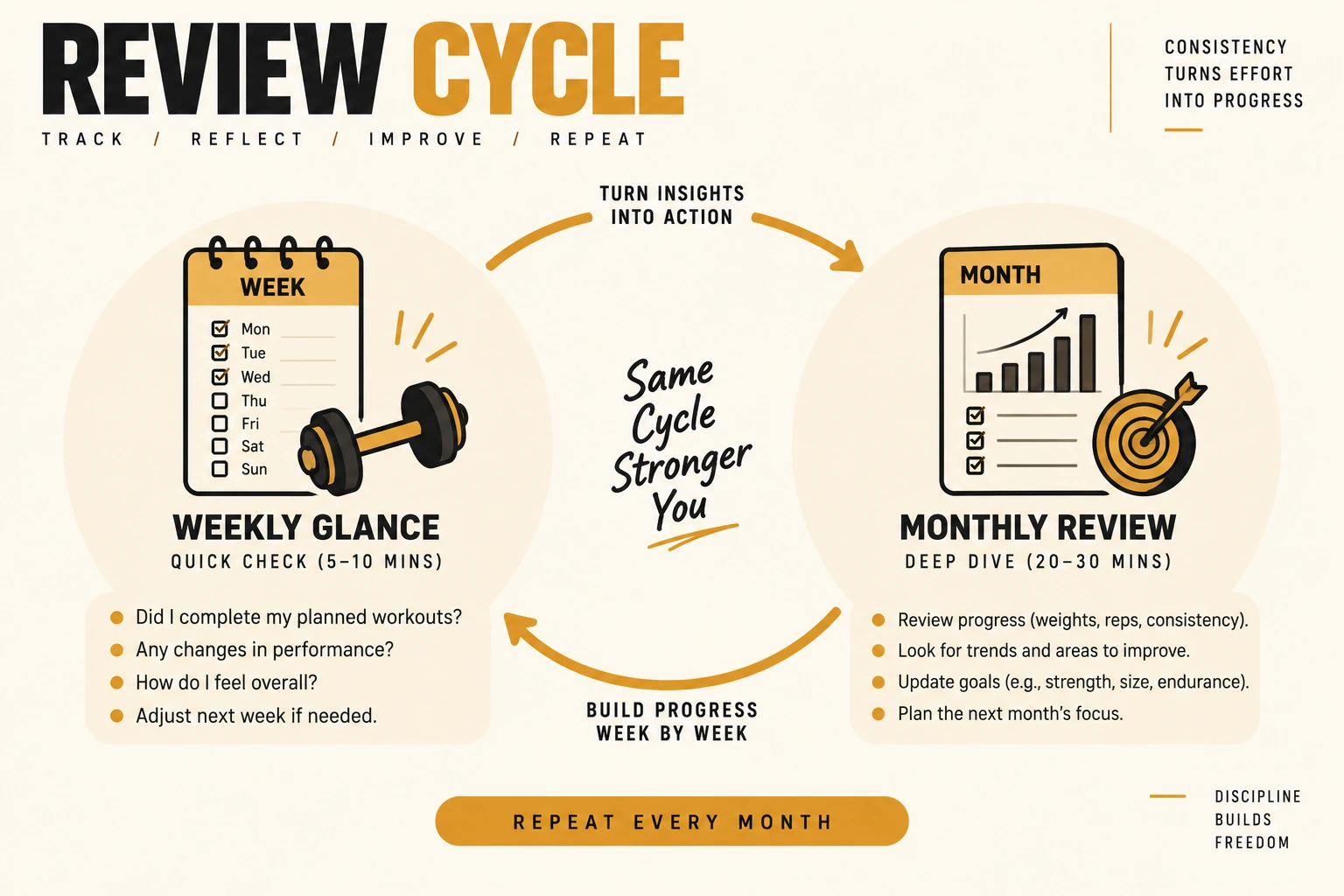
- Do a five-minute review once a week, not after every session. Scan the week's entries for anything that's stalled or gotten easier — that's the signal worth acting on.
What to Do With the Data
A consistent log's real value shows up over months, not days. The most direct use is spotting whether you're applying progressive overload consistently — a top set that hasn't changed in weight or reps across four or five sessions is a clear, objective signal to change something, rather than a vague feeling that "progress feels slow."
The subjective note earns its place here too: a lift that's been logged as "hard" for three sessions in a row despite the same weight is a different situation than one that's been "easy" at the same weight — the first suggests recovery or programming needs attention, the second suggests it's time to add weight. Numbers alone miss this distinction; numbers plus one word usually catch it.
A worked example
Take a squat logged at 60kg × 8 reps, marked "moderate," across four consecutive sessions. On its own, that looks like a plateau. But if the subjective note shifts from "moderate" to "easy" over those same four sessions while the weight stays identical, that's not actually a stall — it's a clear, specific signal that 60kg has stopped being a real training stimulus and it's time to add weight. Without the one-word note, this would just look like unchanged numbers; with it, the log tells you exactly what to do next. This is the entire value of the method: not more data, but data specific enough to produce a decision.
Common Mistakes
- Starting with a system too detailed to maintain. Every warm-up set and rest period logged in full is exactly the kind of friction that ends a tracking habit within a month.
- Waiting until after the workout to log everything from memory. Numbers get misremembered fast — log the top set immediately, not an hour later.
- Reviewing the log after every single session. Day-to-day comparisons are noisy; weekly and monthly reviews reveal the trend that actually matters.
- Switching formats repeatedly looking for the "perfect" app. A mediocre format used consistently beats a perfect one abandoned after two weeks.
- Treating a stalled log as a discipline failure rather than a design problem. If a log keeps getting abandoned, the fix is usually to remove fields, not to try harder with the same system.
Final Thoughts
Workout tracking doesn't fail because people lack discipline — it fails because most systems ask for more detail than anyone can sustain once the initial motivation wears off. Three fields, twenty seconds per exercise, and a weekly glance is enough to catch progress and plateaus reliably, without turning the log itself into one more thing you eventually quit.
The best tracking system isn't the most complete one — it's the one still open on week twelve.
If consistency more broadly — not just the log itself — is the harder part, why people actually quit working out covers the seven most common patterns behind it, with a fix for each.
This article offers general fitness guidance and isn't a substitute for advice from a certified trainer or medical professional, especially if you're managing an injury or health condition.
Sources
[1] Self-monitoring as a behavior change technique in physical activity interventions — systematic review. Available at: pmc.ncbi.nlm.nih.gov
[2] Habit formation research on behavior consistency and automaticity. Available at: onlinelibrary.wiley.com